A hungry person hears a minor disagreement as an accusation. After a meal, the same words lose some of their hostility. A bodily need had become a story about another person’s failure.
The human instrument is the living organization through which consciousness receives and answers the world. Bodily state, attention, memory, emotion, and interpretation shape what a person can recognize and do. Speech, movement, craft, and choice give that reception consequences. Those consequences change both the surrounding world and the person who encounters it again.
“Your body is the temple of the Holy Ghost which is in you” — 1 Corinthians 6:19, KJV
A temple gives presence a place and conduct a form. Its orientation, images, and repeated observances organize a relation between visible and invisible orders. The body carries that relation into every act.
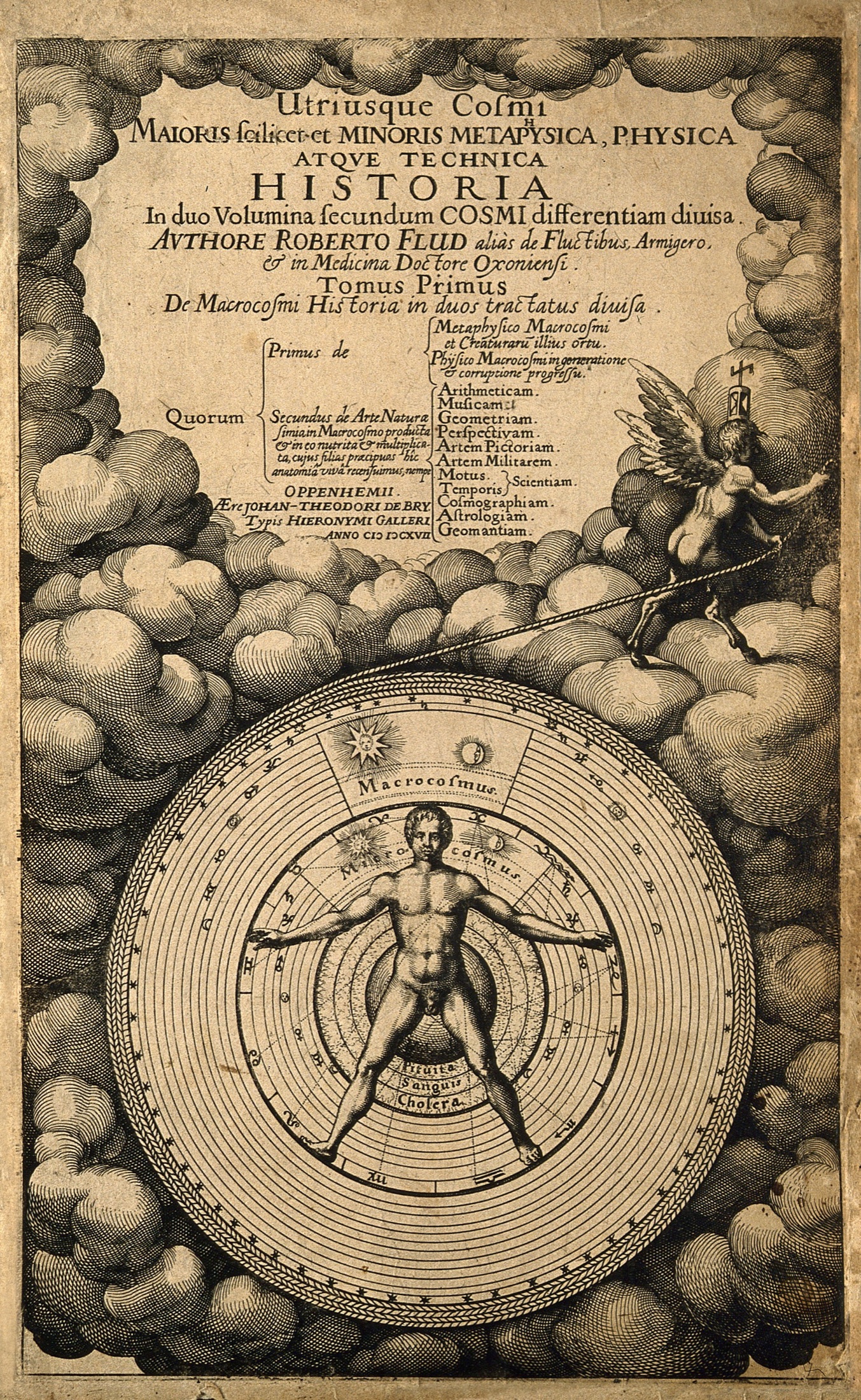
Theodor de Bry after Robert Fludd, The Microcosm (Man) and the Macrocosm (the World), 1617. The human being stands within the greater order as a point of exchange between worlds.
Fludd’s microcosm places celestial and terrestrial life within the human figure. The greater order enters a particular body, whose conduct returns something to that order. Correspondence identifies this shared operation across the two scales. Participation depends on what the person’s instrument can sustain.
Descent Gives Consciousness Power
Embodiment gives possibility conditions in which it can become an acquired power. A hand learns a movement through practice and correction. An intention becomes a deed, while a promise must survive the mood in which it was made. Material resistance makes these differences consequential.
Arthur M. Young’s reflexive arc gives descent and return an evolutionary form. Constraint becomes the setting in which powers develop and reflective choice becomes possible. Rudolf Steiner approaches embodiment through spiritual anatomy; Itzhak Bentov approaches it through the organism’s rhythms and relation to consciousness. The enduring operation is incarnation, experience, and return with acquired capacity.
Earlier forms of organization remain active within the human being. Mineral relations support bone and electrolyte balance. Growth and metabolism maintain the living body. Appetite, attachment, movement, and social learning continue within reflective life. Conscious attention inherits these powers and learns to coordinate them.
MacLean’s triune-brain image arranged instinct, emotion, and reason into an appealing ladder. Cesario, Johnson, and Eisthen describe brain evolution through integrated changes across related systems. Three successive brains stacked within a skull misrepresent that anatomy. The kingdom correspondence concerns interdependent powers within a person; comparative neuroanatomy traces the evolution of physical structures.
Spirit enters material conditions, and embodied experience returns to Spirit as developed capacity. The returning person has learned a distinction, kept a promise, or acquired a skill that changes the next encounter. Descent gives freedom something to answer for.
The Body Is a Nested Commonwealth
A person can decide to speak while a dry mouth, racing pulse, or remembered humiliation makes speech difficult. Intention arrives within an organization already at work. Neural activity, metabolism, immunity, gut signaling, posture, and relationship help determine the action available.
Maturana and Varela called life’s self-producing organization autopoiesis. A living system continually renews the components and boundary through which it persists. Matter and energy pass through while organized activity maintains a recognizable being. The body’s unity is ongoing work.
Friston’s free-energy account joins perception, learning, and action through the regulation of expected sensory states. An organism revises its prediction or acts to change what it encounters. Reconsidering a threatening sound changes the interpretation; reaching for water changes the sensory conditions. The same perception–action relation gives bodily regulation a formal language.
Organs and tissues contribute without waiting for the conscious narrator to approve each adjustment. Their needs also reach experience through interpretation. Fatigue becomes “I cannot do this”; fear becomes “this will certainly happen.” A bodily demand and the story built around it can be distinguished, allowing each to receive an appropriate response.
The Distributed Receiver follows this wider organization of cognition. The Subtle Body carries its etheric, vital, and imaginal relations: the spiritual dimensions through which embodied life participates beyond ordinary sensation. Physical processes and subtle participation meet in one living person.
The Living Boundary
A cell maintains differences across its membrane. Ion channels regulate the passage of charged particles; gap junctions allow neighboring cells to exchange ions and small molecules. Networks of membrane voltages participate in the organization of tissue. Electrical state can help determine what cells build together.
Pai and colleagues manipulated ion channels in Xenopus embryos, changing membrane voltage and inducing eye tissue outside its usual region. A physiological change redirected anatomical development. Levin, Pezzulo, and Finkelstein place these results within endogenous bioelectric networks: electrical relations the body itself produces. Pai et al., 2012.
Anastassiou and colleagues studied another electrical relation in rat cortical slices: extracellular fields altered neuronal membrane potential through ephaptic coupling. This is local influence through an electric field, alongside synaptic and chemical signaling. Bioelectric Fields supplies these physical carriers; Information, Energy, and Field distinguishes their roles from the meanings interpreted through them.
maintained boundary → potential difference → regulated exchange
         ↑                                        ↓
         └──── repair and changed organization ← action
Polarity has a measurable expression in voltage difference. Rhythm appears where coordinated activity repeats. Cause and Effect returns action through a changed bodily condition. Correspondence follows the operation across cell, tissue, and person while retaining the carrier proper to each scale.
A living boundary preserves continuity and allows participation. Boundary Sovereignty extends this relation to judgment and consent: the ability to receive and answer depends on keeping a center capable of refusal.
The Instrument Sees Itself
Anger can organize a conversation before anyone notices it. It selects hostile details, recruits old injuries, tightens the body, and prepares a reply. Reflection begins when the person notices this arrangement while it is happening.
Hofstadter’s strange loop follows self-reference across levels. Activity produces an image of the self, and that image returns to affect the activity. A vow redirects habit; imagined failure inhibits movement; recognizing a pattern changes the next response. The self-image has consequences because a living person acts through it.
William James locates attention within this selective process: “My experience is what I agree to attend to.” Repeated attention makes some distinctions familiar and leaves others unattended. Training can enlarge what is noticed. Repetition can also make an error easier to retrieve. Discernment brings both the image and the conditions under which it acquired authority into judgment.
Alchemy names the transformation solve et coagula. An established reaction loosens; its components become distinguishable; a new relation takes form in conduct. Someone recognizes fear within an accusation, separates the useful warning from the imagined certainty, and speaks with greater precision. The change becomes durable when another difficult encounter calls it into use.
The Inner Parliament
A person promises to rise early and later silences the alarm. Gurdjieff, as recorded by Ouspensky, uses this everyday reversal to expose competing identifications. One part makes a commitment that another must fulfill. “Every thought, every mood, every desire, every sensation, says ‘I.’” The changing speaker claims the authority of the whole person.
The Parliament of Consciousness gathers these competing motives. Comfort, ambition, belonging, fear, and conscience can each organize a decision. Minsky’s Society of Mind supplies a cognitive account of many processes contributing to apparently unified action. The initiatic question concerns how a person can recognize these contributions and sustain a chosen direction among them.
Witnessing creates an interval before a person identifies with an impulse. What does it need? Which memory does it recruit? Where would following it lead? Bodily needs deserve recognition, while their first interpretation remains open to examination. Inner plurality describes this ordinary conflict without making every thought an external agent.
The alchemical vessel holds enough continuity for this work to proceed. Containment includes rest, support, and the capacity to release pressure. Endurance becomes useful when it serves integration. A growing ability to remain present, reconsider, and repair is a better measure of formation than the intensity of an ordeal.
The Gatekeeper Pays
Maxwell’s demon sorts particles by their motion. Its apparent free gain changes when memory and operation enter the thermodynamic account. Landauer links logically irreversible erasure to heat dissipation under the relevant conditions. This cost concerns resetting information; attention and judgment operate through their own biological processes.
Embodied agency requires a living sequence: distinguish, remember, select, act, and update. The organism needs resources to maintain the structures performing that sequence. A tired person can still make a sound judgment, but fatigue changes the conditions under which it must be made.
Captured conditions exploit those limits. Repeated interruption can prevent sustained comparison; manufactured urgency can force a decision before memory and conscience have their say. Recovery restores room for judgment. Sleep, nourishment, supportive relationships, and time away from incessant demands belong to the practical maintenance of the instrument.
Capacity and virtue have different jobs. Capacity makes action possible; virtue governs its use. A disciplined manipulator can possess endurance and precise attention. Freedom requires those powers to answer to truth, reciprocity, and the lives affected by them. Care remains due to the person whose capacities are limited or exhausted.
The Coupled Gyre follows the return as retained capacity: experience becomes discrimination, discrimination informs choice, and repeated choice forms character. The Persistent Pattern follows what endures through bodily change, lineage, death, and renewed embodiment.
Seed, Signal, and Incarnation
The instrument receives through sensation, dream, intuition, and spiritual contact. Nous names the apprehension of intelligible form; psyche gives experience its images, desires, memories, and interpretations. Soul carries personal continuity through transformation. Spirit joins that life to its transpersonal source and direction. These relations become effective through an embodied person.
A radio selects an electromagnetic signal and uses local energy to produce sound. Tuning and interference determine what becomes audible. The image explains how a receiver’s condition affects reception.
Spiritual reception reaches a living interpreter through faculties wider than radio detection. A dream carries imagery, emotional weight, and a place in the person’s history. Each feature contributes to its meaning.
A craftsperson recognizes a form that an apprentice cannot yet see in the material. Study has supplied distinctions, practice has joined perception to movement, and correction has made the response more reliable. Spiritual preparation likewise develops the capacity to recognize and sustain contact. Coherence means these faculties can work together without requiring every experience to fit the first explanation.
The Seed and the Vessel joins formative possibility to the conditions that give it a body. How Consciousness Becomes a World follows its passage through interpretation into action. Whole–part correspondence belongs to the Hermetic microcosm; physical holography gives boundary–bulk relations a distinct mathematical treatment.
form · sensation · dream · contact
                 ↓
recognition → interpretation → embodied action
                 ↑                    ↓
       retained capacity ← consequence and return
Spirit and matter circulate reciprocally. Spiritual form enters experience and becomes conduct, artifact, and relation. The result returns through material memory and spiritual or morphic inheritance, giving another turn its starting conditions. The transceiver receives and answers; the world it helps form enters its next education.
Guests at the Threshold
The wider field is inhabited. Other people, collective formations, discarnate beings, and other classes of mind enter relations with embodied consciousness. Memory, expectation, and inner conflict also generate vivid experiences. Identifying a particular encounter requires attention to its source and consequences; vividness alone cannot settle that identification.
An encounter requires examination beyond its first explanation. What content arrived? What seemed autonomous, and how was that assessed? What direction did the relationship take over time? What independently checkable residue remained? Surprise warrants investigation without granting its source authority.
The effects on agency matter. Guidance can deepen patience, precision, courage, and responsibility. A relation demanding isolation, unquestioning obedience, or escalating urgency narrows the space in which judgment operates. The capacity to pause, decline, seek another perspective, and return to ordinary obligations belongs to spiritual discernment.
The Living Field describes the ecology; The Phenomenon follows anomalous encounters; Discernment in Spiritual Contact develops the practical work of hospitality, refusal, and closure. The prepared instrument grows in sensitivity and sovereignty together.
Consequence Makes Agency Real
A brief daily record makes the instrument’s changing conditions visible. Keep the record for one week. Note sleep, bodily tension, media exposure, recurring emotion, and one interval between an impulse and an action.
Record unusual experiences if they occur. Separate the observation from its first interpretation. Include ordinary days.
Compare conditions across the week. Which situations allowed a second interpretation? When did a bodily need become a judgment about another person? What made a promise easier to keep? The record is a way to notice patterns, with enough room for an initial explanation to change.
Retained capacity becomes visible through clearer attention, more reliable choice, and a greater ability to repair mistakes. Bodily resilience supports this work, while courage and virtue give it direction. A spiritual opening matures through integration, relationship, and the consequences of conduct.
The opening disagreement can now be met differently. Hunger receives food, the grievance receives examination, and the other person receives an answer less governed by an unnamed need. The instrument has gained a distinction it can carry into another encounter.
The Rendered World follows how this selective participation becomes the world a person experiences. The body gives that world a point of view and gives each answer a consequence.
References
James, William. The Principles of Psychology. Henry Holt, 1890.
Friston, Karl. “The Free-Energy Principle: A Unified Brain Theory?” Nature Reviews Neuroscience 11 (2010): 127–138.
Minsky, Marvin. The Society of Mind. Simon & Schuster, 1986.
Bentov, Itzhak. Stalking the Wild Pendulum. Dutton, 1977.
Hofstadter, Douglas R. I Am a Strange Loop. Basic Books, 2007.
Landauer, Rolf. “Irreversibility and Heat Generation in the Computing Process.” IBM Journal of Research and Development 5, no. 3 (1961): 183–191.
Levin, Michael, Giovanni Pezzulo, and Joshua M. Finkelstein. “Endogenous Bioelectric Signaling Networks: Exploiting Voltage Gradients for Control of Growth and Form.” Annual Review of Biomedical Engineering 19 (2017): 353–387.
Maturana, Humberto R., and Francisco J. Varela. Autopoiesis and Cognition: The Realization of the Living. D. Reidel, 1980.
Anastassiou, Costas A., Rodrigo Perin, Henry Markram, and Christof Koch. “Ephaptic Coupling of Cortical Neurons.” Nature Neuroscience 14 (2011): 217–223.
MacLean, Paul D. The Triune Brain in Evolution. Plenum Press, 1990.
Ouspensky, P. D. In Search of the Miraculous. Harcourt, 1949.
Steiner, Rudolf. An Outline of Esoteric Science. 1910.
Young, Arthur M. The Reflexive Universe: Evolution of Consciousness. Robert Briggs Associates, 1976.
De Bry, Theodor, after Robert Fludd. The Microcosm (Man) and the Macrocosm (the World). 1617. Wellcome Collection, Public Domain Mark. Object record.
James, William. “Attention.” The Principles of Psychology, Volume I, Chapter XI. Chapter text.
Ouspensky, P. D. In Search of the Miraculous, Chapter III. Text of the many-I and promise discussion.
Cesario, Joseph, David J. Johnson, and Heather L. Eisthen. “Your Brain Is Not an Onion With a Tiny Reptile Inside.” Current Directions in Psychological Science 29, no. 3 (2020). Article record.
Pai, Vaibhav P., Sherry Aw, Tal Shomrat, and Michael Levin. “Transmembrane Voltage Potential Controls Embryonic Eye Patterning in Xenopus laevis.” Development 139, no. 2 (2012): 313–323. Primary paper.
Primary research records: Friston, 2010; Levin, Pezzulo, and Finkelstein, 2017; Anastassiou et al., 2011; Landauer, 1961.
The Holy Bible, King James Version. 1 Corinthians 6:19.