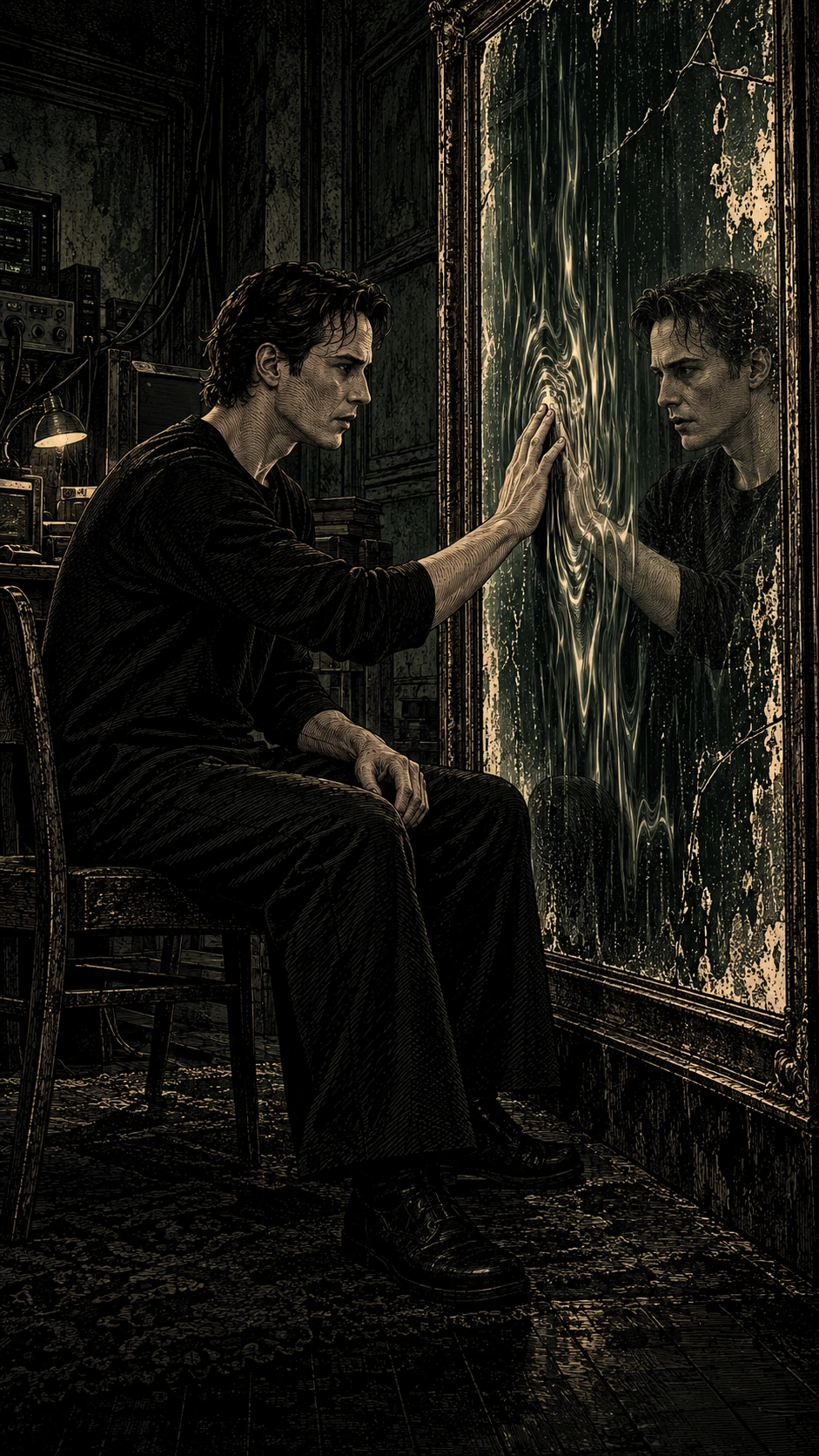
The illustrated reader uses JavaScript. The complete readings remain available below.
Hierarchy
Ten levels trace manifestation downward from the unconditioned source to the body at work. Plotinus describes the One, divine intellect, and soul. Hermetic writings explain the ordering word and the cosmos as one living body. Teilhard describes Earth’s thinking layer; Steiner distinguishes the person’s members. Each plate explains the particular work that becomes possible at its level.
The ground beneath the ladder
Plotinus compares the first principle to a spring that supplies every river without running dry. Life remains whole at a tree’s root while sustaining its branches. He calls this source the One, above being and thought. A person returns toward it through the attention its own life sustains.
In On Nature, Contemplation and the One, Plotinus asks us to imagine a spring with no source outside itself. It supplies every river without being used up. The rivers take different courses, but their water remains one at its source.
He then describes the life of a great tree. That life sustains every branch while remaining whole at the root. The branches multiply without dividing the principle that gives them life. Both images show a source that remains itself while giving rise to many things.
Everything we name has a particular nature: a mind, a god, a body, or a number. That nature distinguishes each thing and limits what it is. A source limited in the same way would itself require another source. Plotinus therefore places the One above being and thought. Our names describe its effects on us without enclosing its nature.
the One is all things and no one of them — Plotinus · Enneads
Porphyry places On the Origin and Order of the Beings Following the First second in the fifth Ennead. Plotinus taught in Rome during the 250s and began writing at about fifty. Students brought questions to his meetings, and discussion preceded the treatises. His poor sight prevented him from reading his manuscripts over for revision.
After Plotinus’s death, Porphyry arranged the writings in six sets of nine; an ennead is a group of nine. Porphyry also reports four occasions of Plotinus’s union with the first principle during their years together. He records his own single union at sixty-eight. The writings preserve teaching directed toward this actual spiritual attainment.
The source sustains the person seeking it, including the faculty used to search. There is therefore no outside from which to escape its presence. Return requires a direction within the life already received.
The levels proceeding from the source also supply the way back toward it. In Hermetic teaching, the ordering word gives the next account of source becoming form. Contemplation turns attention toward what gives that attention its life. A person can begin on an ordinary afternoon without equipment.
The One and procession
The word that gives the current a shape
Hermes sees light, then darkness becoming a restless, moist nature. A holy word descends from the light. Fire rises, and air follows; earth and water separate later. Poimandres identifies Logos with the divine word inseparable from Mind. The word that orders nature also sees and hears within a person.
Hermes first sees everything become light. Darkness then settles over part of the vision and becomes a restless, moist nature. It coils, gives off smoke like fire, and releases a cry without words. Earth and water remain mingled within it, without discernible boundaries.
This vision opens the Corpus Hermeticum, a collection of seventeen Greek treatises written in Roman Egypt and copied across later centuries. A vast being appears while Hermes’s bodily senses remain suspended. He names himself Poimandres, the Mind of the Sovereignty, and promises to teach. Hermes asks to understand existing things and know God.
A holy word descends from the light onto the moist nature. Pure fire leaps upward, and air rises after it. Earth and water remain mixed below, stirred by the word pervading them. Their separation occurs later, when the formative Mind sets its governors in motion and Nature brings forth living creatures. The ordering unfolds through a sequence.
The Light-Word (Logos) that appeared from Mind is Son of God. — Corpus Hermeticum I.6, Poimandres
The Greek term logos joins spoken word with reason and ratio, the proportion by which a thing takes shape. A building’s proportions give a familiar example of this ordering relation. In the vision, speech and ordering act together: the holy word reaches the unformed nature and begins distinguishing its elements.
Poimandres identifies the light as divine Mind and the word proceeding from it as God’s Son. Mind and Word remain undivided; their union sustains life. The word gives nature articulation through the divine intelligence from which it proceeds.
A person born into this order inherits settled relations. The sky admits measurement, seasons return, and the body has boundaries that distinguish it from surrounding air. Those distinctions make an inhabited world possible.
The same word also lives within the person. Poimandres identifies what sees and hears in Hermes as the Lord’s Word. The person therefore participates in what gives the world its order. Divine speech addresses a being able to hear and answer. The first response gives that participation an act.
CH I · Mind and Logos
The intelligence that sees the form
Porphyry argued that the Forms known by divine intellect stood outside it. Plotinus asked Amelius to answer, and their exchange ended in Porphyry’s public retraction. Nous, or divine intellect, knows through identity with its Forms. Spiritual participation receives their timeless wholeness before thought divides an experience into parts.
Porphyry recounts his own disagreement after joining Plotinus’s circle in Rome. He wrote that the things divine intellect knows stand outside it as objects waiting to be seen. Plotinus asked Amelius to answer the objection. Porphyry replied to Amelius, who wrote a second answer.
Porphyry then grasped the doctrine he had opposed. He wrote a recantation and read it aloud before the circle. The dispute concerned whether divine knowledge receives an external image or knows reality through its own being.
Plotinus places nous, divine intellect, above soul. This intellect is also life, and its Forms are the intelligible realities it knows. He devoted a treatise to explaining why those Forms remain within intellect.
Poimandres gives a related Hermetic account through a vision. He identifies the boundless light Hermes sees as divine Mind. A second Mind proceeds from it as a craftsman who forms seven governors around the perceptible cosmos. The Hermetic scene gives formative intelligence divine agency; Plotinus explains the identity of intelligence and its known Forms.
Mind, which is life and light — Corpus Hermeticum · Poimandres
An ordinary thought of a horse differs from the horse standing in a field. The thought receives an image that can be mistaken or fade. In the divine intellect, knowing and what is known belong to one act. Knowledge therefore has no external gap across which its object becomes uncertain.
Plotinus describes the Forms as present together while each retains its own identity. Complete presence preserves distinction within unity. Divine knowing holds each reality through the life of intellect itself.
Beyond time, the forms retain their complete being. What earthly life later brings to birth, wears down, and forgets has its intelligible being there. This priority concerns the order of being, rather than an earlier moment in history.
Iain McGilchrist describes a related distinction in human attention. A person receives a whole before dividing it into parts; analysis loses something when that whole was never received. Spiritual participation in divine intellect brings the whole of a thing into awareness before its pieces are handled. The return carries an intact relation that later analysis can preserve or lose.
Nous and the intelligible Forms
The Master and His Emissary · attention and abstraction
The pattern that returns
In Plato’s Timaeus, the divine craftsman shapes the visible world after an eternal living model containing all intelligible creatures. Plotinus asks how individual beings also have intelligible principles. Enduring forms sustain recurring embodiments and enter shared memory through language, song, and buildings. A remembered pattern helps a person recognize an actual descent.
Timaeus begins by distinguishing an eternal model from something already made. A craftsman who follows the unchanging model makes a beautiful work. Copying a created thing yields an inferior result. The visible world is the fairest of created things, so its divine maker follows the eternal.
That model is a living creature containing all intelligible living creatures. These are the beings known by intellect, before their visible embodiment. The world contains people and animals as its model contains their intelligible originals. Its varied life gives that encompassing pattern a visible body.
In Ennead V.7, Plotinus asks whether individual people also have intelligible archetypes. Socrates supplies the test. If his soul is eternal, his authentic being also exists in the divine intellect. Plotinus then argues that distinct individuals require distinct formative principles; a single human pattern cannot explain all their differences.
The argument preserves individuality within intelligible order, beyond a general pattern for the human kind. Archetype comes from archetypon, an original stamp. The term identifies the pattern from which particular impressions take their shape.
the intelligible world — Plotinus · Enneads
The stamp image explains how one form supplies many instances without being used up. A physical die wears, but the intelligible pattern remains complete through its embodiments. The hundredth rose receives the form as fully as the first.
The cave in a descent story and a cave someone enters enact one form. Their shared operation is passage into a depth concealed by ordinary life. One manifestation need not copy the other. Recurrence across cultures without contact follows from this common intelligible source. Where transmission also occurs, shared form retains its ordering role.
These patterns enter shared human memory through language, song, and buildings. A person who already carries the cave’s pattern recognizes the character of an actual descent. Inherited form gives experience a direction before the person fully understands what lies below.
Plato ends Timaeus by returning to the living model. The visible world is a living creature and an image of the intelligible one. He calls it the greatest, best, fairest, and most perfect of created things. The pattern endures while its life becomes visible in a world of particular beings.
Intelligible Forms
The world that thinks through us
Between 1938 and 1940, Teilhard developed The Phenomenon of Man in Peking as war interrupted his fieldwork. He described human thought as a planetary layer carried by language, memory and technical connections. Within that layer, enduring forms acquire historical bodies that people can preserve, alter or erase.
Teilhard developed The Phenomenon of Man in Peking between 1938 and 1940. War interrupted the excavations at Zhoukoudian that had occupied him during the previous decade. The Jesuit authorities refused permission to publish the book. It appeared after his death in 1955. He had described a planet acquiring the means to think about its own development.
His examples were ordinary connections between people. Roads and railways carried travelers, while the press, telephone wires and radio carried their words. Dense populations heard the same news on the same morning. These connections gave shared thought an organization beyond any individual person. Over the planet’s living layer, another layer was taking shape.
The name noosphere grew from Paris discussions during the early 1920s involving Teilhard, the philosopher Édouard Le Roy and the geologist Vladimir Vernadsky. Vernadsky brought the concept into his study of the earth’s chemistry. Their different investigations met at the point where human thought began changing the planet that had produced it.
evolution become conscious of itself — Pierre Teilhard de Chardin, The Phenomenon of Man
Evolution becomes able to examine itself through the people it has formed. The Greek word nous means mind; the noosphere is a mind-layer surrounding the living world. A child enters a language they did not invent. Counting uses signs settled by earlier scribes; reasoning uses instruments made by people who are already dead.
The inheritance continues through speech, paper and wire. A written account remains available while its author sleeps or after that author dies. No single skull contains the entire system. Each person receives its accumulated distinctions and adds acts that other people will inherit.
At this level, enduring forms enter dated human arrangements. Here the recurring shapes acquire particular bodies: a rose in a poem, or a mountain climbed by a named person in a named century. Intelligible forms, the enduring patterns that give things their shape, have timeless priority; their historical descriptions still have authors and dates. Here the embodiment itself becomes part of a history.
People can edit what they inherit, repeat it until others remember it, or let it disappear. A child then grows within the world those choices have maintained. Custody of shared memory determines which forms remain available for recognition and action.
The rise of the noosphere
Attention, culture and the divided world
The medium between worlds
Hermes tells Asclepius how Egyptian priests invited souls into statues through materials carrying natural powers. The ensouled cosmos connects those materials with divine presence. Ritual prepares the connection deliberately. A person also receives influence through that connection before forming an opinion, so discernment begins with identifying what has arrived.
The Egyptian priests could not make souls, Hermes tells Asclepius, so they learned to call souls into statues. They prepared the images with herbs, stones and scents possessing powers of their own. The inhabited statue foretold events, sent sickness or cured it, and brought sorrow or gladness according to the recipient’s deserts. Hermes explains the process in a temple dialogue about earthly divinity. Material preparation provides a dwelling for spiritual agency.
The Asclepius survives complete in Latin. Augustine quoted passages from it in The City of God to condemn its account of human beings making gods. His attack preserved the teaching while rejecting the beings it invited. The eleventh treatise of the Corpus Hermeticum supplies the wider cosmological relation.
Mind teaches Hermes about Aeon, the enduring order within which the cosmos exists. God inhabits Mind, Mind inhabits Soul, and Soul inhabits matter. These relations hold the world together from within. The divine life also encompasses the whole body of the cosmos.
But all this Body, in which are all the bodies, is full of Soul; and Soul is full of Mind, and Mind of God. It fills it from within, and from without encircles it, making the All to live. — Corpus Hermeticum XI.4, Mind unto Hermes
The cosmos is one living body whose parts respond to one another. The Greeks called this fellow-feeling sympatheia, or sympathy. Within an animal, an injury to a foot affects the creature’s liver and other organs. Their responses belong to one life rather than a collection of isolated parts.
A plant, a planet and a human disposition also participate in the cosmos’s connected life. The priest chooses a herb because its power belongs to a relation extending beyond the plant. Its material presence brings the near end of that relation to the statue. The invited being inhabits a body prepared to receive it.
Influence also reaches a person who has performed no ritual. It arrives as mood, pressure or the felt pull of a room before the person forms an opinion. Someone who takes every arriving influence as their own can defend it without knowing what they have received. Reception becomes mistaken for authorship.
A person who recognizes a receiver between the surrounding current and conscious thought can ask where a mood began before acting. That inquiry makes the received influence available to judgment. The priest works the same relation in the other direction. Hands arrange material conditions so that a particular spiritual presence can enter.
CH XI · Mind and the cosmos
Relational attention and context
The transmission body
Steiner distinguishes the physical processes of seeing from the inward experience of blue. His account joins a material body, formative life, sensation and a human I. The subtle body mediates what reaches conscious experience. Preparation through bodily habits refines that reception before the person must judge it in thought.
Steiner begins with a meadow in flower and distinguishes what the flowers reveal from the joy a person experiences. The plant grows through laws that will also govern next summer’s flowers. Light of a particular wavelength enters the eye and initiates processes through the nerves and brain. Those processes describe what happens physically during seeing.
Later, he asks what holds the experience of blue. A light wave is movement, while blue is an inward sensation. Plant growth supplies living form without itself becoming an act of seeing. Neither description identifies the bearer of the person’s experience.
Steiner published Theosophy in Berlin in 1904. He distinguishes the physical body from the life-body that gives living things their formative organization. The physical body contains substances also found in minerals. Plants possess this living organization too. Animals also possess an inward life of sensation. Human beings carry an I through which body and soul become instruments of self-conscious agency.
The sentient body mediates between bodily processes and the sentient soul that experiences them. Steiner’s fourfold account groups that body and soul together as the astral body. The name astral preserves the older association with stars. These members interpenetrate; they do not occupy separate compartments within the flesh.
the astral body is the bearer of the soul — Rudolf Steiner · Theosophy
The subtle bearer mediates between surrounding influence and a person’s conscious response. Pressure reaches inward experience as feeling before thought gives it a name. Warmth in a room, dread on a staircase and attraction across a hall enter through this passage. The person receives something before deciding what it means.
The inner life develops desire and dream around such reception. Steiner also describes the soul preserving impressions in memory and passing their content to spirit. Memory retains what sensation first encounters. These distinct activities connect bodily reception with the experience a person can reflect upon.
Selection begins below deliberate thought. An instrument that admits every influence without discrimination leaves the person overwhelmed by what arrives. Preparatory disciplines address this reception through breath, food, sleep and company. Those habits change the conditions under which influence becomes inward experience.
This refinement brings less disorder into conscious judgment. Thought still has work to do, including distinguishing a received feeling from an instruction to obey. Preparation gives that work a steadier bearer. The person can receive the surrounding world while retaining authority over their response.
Body, soul and spirit
The mirror that shows one life
A reader can become absorbed in a page without noticing the act of reading. Plotinus distinguishes the activity from the inward image that makes it visible. Thought continues when illness or agitation disturbs that image. Refining the personal mind gives spiritual activity a steadier surface through which to enter conscious judgment.
We can read without noticing that we are reading, Plotinus says. The reader most absorbed in the page can be least aware of themselves. Reading continues throughout that absorption. Attention to an activity differs from the activity itself.
Plotinus compares the inward image-making faculty to a mirror. A smooth surface at rest reflects what stands before it. Illness or agitation disturbs that surface, and the image disappears. The thinking that supplied the image continues. Losing its reflection does not extinguish the activity.
The comparison enters his treatise on well-being. Happiness remains possible without continual attention to being happy. Someone performing a brave act attends to what needs doing rather than watching their own courage. Their courage remains active.
The image-making faculty makes rational and intellectual activity available to reflective awareness. Plotinus places that faculty below the thought it reflects. Its disturbed condition explains why an activity can continue without appearing before the person’s attention. Intellectual life exceeds the image through which we notice it.
when the mirror is in place the image appears but, though the mirror be absent or out of gear, all that would have acted and produced an image still exists — Plotinus, Enneads I.4.10
Psyche is the Greek word for soul. Here the term distinguishes the personal one: the mind within which a person experiences their life. It receives intelligible forms, the patterns that give things their shape. It also receives sensations admitted through the body.
The personal mind joins these arrivals into a continuous picture fitted to one life. A person can hold its images before attention and examine their relations. The picture gives received experience an inward form available for reflection.
Attraction and recoil begin selecting what enters before deliberate judgment. Reflection makes that selection available for examination, argument and correction. Sitting still and watching the mind brings its movements into view. The person can then distinguish an arriving impression from the response they have formed around it.
The wider current supplies more than one life’s picture can contain. Training the inward mirror steadies its reception. A quieter surface reflects spiritual activity more clearly and gives the person greater freedom to judge what they receive.
Soul life and the human constitution
Attention and the construction of a world
The continuity that carries the work
Plotinus died on Zethos’s estate in Campania as his doctor arrived from Puteoli. Porphyry records his final effort to return the divine within himself to the divine whole. His teaching gives that return a continuing bearer: soul survives bodily death, while something of it remains in the Intellectual Realm throughout life.
Porphyry was in Sicily when Plotinus died and learned the circumstances afterward from Eustochius, his doctor. Illness had made Plotinus’s voice hoarse and his sight dim. Ulcers appeared on his hands and feet. His friends withdrew from the close contact he continued to seek.
Plotinus left Rome for Zethos’s estate in Campania, near Minturnae. Zethos had already died, but his estate helped provide for the philosopher. Eustochius was staying at Puteoli and arrived late. He alone attended Plotinus at the end.
Porphyry reports that Plotinus was striving to return the divine within himself to the divine in the whole. This final effort followed the teaching he had developed during his life. Soul joins bodily existence to the Intellectual Realm, where intelligible forms remain available in divine thought.
Plotinus states that human soul never descends entirely into bodily life. Something of it continues in the Intellectual Realm even while the person attends to sensation. Trouble within the embodied life can obscure awareness of that higher activity. The activity continues while attention remains occupied below.
even our human Soul has not sunk entire; something of it is continuously in the Intellectual Realm — Plotinus, Enneads IV.8.8
The personal mind forms its pictures through a particular body, city and company of friends. Those conditions change, and access to their memories changes with them. Soul provides a continuity through sleep, lost memories and the body’s death. Its existence exceeds the sequence of images a person can presently recall.
A choice therefore matters beyond the day when someone makes it. Repeated conduct develops the person who must carry its consequences. Forgetting an event leaves that development in place. Spiritual work concerns what the person becomes through experience, including what they retain when a lifetime ends.
Experience received through sensation and reflection enters this continuing life. The person takes up what supports development and releases what keeps desire disordered. Sorting reduces the wants they retain and directs them toward the good. In this sequence, spirit is the member of the person that remains oriented toward that enduring good.
The order developed through earthly choices remains when the present life’s familiar scenes recede. At Plotinus’s death, Eustochius saw a snake pass beneath the bed and leave through a hole in the wall. Porphyry preserves that movement beside the philosopher’s final return toward the divine whole.
Soul between Intellect and the sensible world
The instrument under resistance
Plotinus refused to sit for a portrait, calling it another likeness of the bodily likeness nature had given him. Amelius brought Carterius to his open meetings to study his face. The resulting portrait preserves a teacher whose body carried philosophical work and the daily care of children entrusted to him.
Plotinus refused to sit for a painter or sculptor. He asked Amelius why anyone should preserve another likeness of the likeness nature had already wrapped around him. Porphyry begins his biography with this refusal. Plotinus also withheld his ancestry, parents and birthplace, showing his reluctance to identify himself with bodily origins.
Amelius brought his friend Carterius to the philosophical meetings, which anyone could attend. The painter studied Plotinus’s features there and later drew them from memory. Amelius helped refine the resemblance. They obtained the portrait without Plotinus’s knowledge.
Porphyry records twenty-six years in Rome. During that Roman life, Plotinus taught through a body whose voice and hands made his philosophy available to other people. The lectures and writings that became the Enneads depended on those instruments.
Steiner describes the physical body through the substances it shares with the mineral world. Its weight can be measured, its tissues cut, and its needs met through food. Labor exhausts it. The same material bearer that limits a person also lets their intention act upon the world.
the body is the instrument of the soul — Plotinus · Enneads
An untuned lyre produces false notes even in a skilled player’s hands. Fatigue can also impair patience in someone who intends to act kindly. The instrument’s condition shapes how an intention reaches another person.
Resistance gives embodied work its particular demands: weight must be carried, hunger answered and time spent. Practice reveals whether an intention survives those demands. Someone who works through difficult hours learns what they can sustain. Inner examination alone cannot supply the experience of completing the task.
The continuity carried by soul enters hours of labor and work that takes years. Such work can fail, and its consequences become further material for development. Food and sleep support the body’s recovery, while habit and practice train it. Spiritual intention acquires a more reliable instrument through that repeated care.
Porphyry records another consequence of Plotinus’s embodied life. Parents entrusted their children and property to him before dying, so his household filled with boys and girls. He attended to their education and checked the financial accounts himself. The philosopher who refused a painted likeness protected the children’s inheritance through the daily use of his own hands and attention.
The threefold human constitution
The body as instrument of soul
Tarot
Twenty-two Tarot cards, the Major Arcana, follow Pamela Colman Smith’s 1909 pictures and Arthur Edward Waite’s explanations published in 1910. Spirit enters bodily life, receives instruction, and encounters government before passing beyond reason’s limits. Captivity and broken doctrine give way to spiritual renewal, resurrection, and the World’s dance within a wreath. The passage returns embodied life to conscious participation in God.
The Fool
A young traveler pauses at a cliff with a white rose, an embroidered wallet, and a dog beside him. Waite identifies him as spirit seeking experience. The sun knows his origin and eventual return. The card holds that complete journey behind a single step whose consequences the traveler must learn through life.
Zero stands above the figure, and his name appears below. Smith draws a young man among snowy peaks, wearing a black tunic patterned with red wheels and green leaves. His forward foot approaches the lip of the rock while his face turns toward the sky. A wand crosses his right shoulder, carrying a small embroidered wallet. His other hand holds a rose, drawn white. A white dog leaps beside him.
In the 1911 Pictorial Key to the Tarot, Waite explains the deck drawn by Pamela Colman Smith. He contrasts his Fool with older designs, where a backward glance leaves the traveler unaware of the precipice. A dog, or an animal described as a tiger, drives that figure toward destruction. Other commentators fill the wallet with its bearer’s follies and vices. Waite rejects that explanation as arbitrary. His own traveler faces the height with intelligence and without terror.
He is the spirit in search of experience. — A. E. Waite · The Pictorial Key to the Tarot
Waite calls this traveler a prince from another world, passing through this one. Spirit enters experience before acquiring a particular earthly history. A body and place give that history its setting, while successive days let events change the traveler. Waite names the rose without fixing its meaning in this passage. The traveler carries something whose value the journey will disclose.
The sun behind him knows where he came from, where he is going, and how he will return along another path. That return lies many days ahead. The picture gives the sun a view of the complete journey while holding the traveler at its beginning. Entering life places spirit within events that must be experienced in sequence. The whole route remains beyond the walker’s present view. He must learn from inside the life his next step opens.
Part II · 0 · The Fool
Letter XXI · opening discussion of The Fool
The Magician
The Magician raises a wand toward heaven and points his other hand toward earth. Four suit emblems lie on his table, surrounded by roses and lilies. Waite reads his gesture as the descent of divine grace. The adept must cultivate the capacity to receive that power and give it an earthly expression.
The Magician’s right hand raises a wand toward heaven while his left points toward earth. Waite identifies this gesture with high grades of the Instituted Mysteries, the ceremonial traditions through which initiates receive spiritual teachings. His own background included the Golden Dawn. Here, the two arms show grace, virtue, and light descending from above into the world below. The adept receives divine power and communicates its gifts through his embodied action.
Waite describes a youthful magician with Apollo’s face and a confident smile. Above his head, a horizontal figure eight bears the sign of life and the Holy Spirit. A serpent circles his waist and swallows its own tail. Waite gives this circle the meaning of enduring spiritual attainment. The table holds a cup, coin, sword, and wand, the emblems of the four suits. Roses and lilies grow beneath it, cultivated from wild flowers.
the possession and communication of the Powers and Gifts of the Spirit. — A. E. Waite · The Pictorial Key to the Tarot
These emblems represent the elements of natural life, which the trained adept can arrange and use. Waite calls them counters before him. The objects supply instruments for the work; their presence alone does not explain the divine power passing through the man. The flowers show cultivated aspiration, just as the adept’s preparation makes him able to receive and direct that power.
Waite names the card’s teaching as the divine motive within a person, reflecting God. Human will gains freedom through union with what is above. A spiritual call thus acquires a body capable of carrying it into earthly activity. The table gives that activity particular instruments. The raised wand and downward hand show where their use receives its direction.
Part II · I · The Magician
Letter I · opening discussion of The Magician
The High Priestess
The High Priestess holds a scroll marked TORA, partly hidden beneath her mantle. A veil hangs behind her between dark and light pillars. Waite distinguishes the written law from its divine meaning. As Shekinah, the indwelling glory, she gives that meaning to the just reader. Visible words announce a teaching that requires spiritual reception.
The High Priestess holds a scroll marked TORA, partly covered by her mantle. A lunar crescent rests at her feet. Her horned crown surrounds a globe, and Waite describes the large cross on her breast as solar. She sits between a white pillar marked J and a black pillar marked B. Behind her, a temple veil bears palms and pomegranates.
The letters recall Jachin and Boaz, the pillars at Solomon’s temple porch in the Book of Kings. The veil places her before a concealed sanctuary. Her seat marks the threshold between approaching the sacred place and entering its mystery. Waite interprets TORA as the Greater Law and the second sense of the Word. A reader can recognize the writing before receiving the inward meaning it carries.
some things are implied and some spoken. — A. E. Waite · The Pictorial Key to the Tarot
The covered scroll makes that distinction visible. Part of the teaching is spoken, while another part remains implied. Waite calls the Priestess the Secret Church, a house shared by God and humanity. Drawing on Kabbalah, he also names her Shekinah, the indwelling divine glory. When the just person reads the Law, she gives its divine meaning.
Understanding therefore requires more than access to the written words. The reader must receive what the divine presence communicates through them. Someone before the Priestess first learns that this second meaning exists without yet possessing it. The Magician’s gesture shows power descending into action; the seated Priestess guards the conditions under which revelation becomes understanding. Her stillness requires patience from the person seeking entry. The visible scroll gives that person a teaching to approach while its mantle preserves what remains to be received.
Part II · II · The High Priestess
Letter II · opening discussion of The High Priestess
The Empress
The Empress sits outdoors among ripening grain, trees, and falling water. Twelve stars crown her, and a nearby shield bears Venus’s sign. Waite identifies her with the earthly paradise and the entrance into life. Through her gate, spirit acquires a body and enters the time required for growth, experience, and further initiation.
Grain ripens before the Empress, with a waterfall beyond it. Waite describes her rich clothing and royal bearing as those of a daughter of heaven and earth. Twelve stars gather in her crown. A nearby shield carries the sign of Venus. The scepter in her hand ends in the globe of this world. Smith seats her on cushions outdoors, with trees behind her.
the door or gate by which an entrance is obtained into this life — A. E. Waite · The Pictorial Key to the Tarot
Waite calls her the lower Garden of Eden, the earthly paradise, and the visible dwelling of humanity. He distinguishes her from the Queen of Heaven. Her title refugium peccatorum means refuge of sinners; she is the fruitful mother of thousands. The High Priestess guards a veiled sanctuary, while the Empress presides over life growing in the open. Her teaching becomes visible through the world that receives its inhabitants.
This gate admits spirit into a life governed by growth, ripening, and harvest. Embodiment places experience within time. Waite assigns entrance into earthly life to the Empress. The High Priestess knows the way beyond that life and communicates its secret to the elect. The two cards distinguish entry into manifestation from knowledge of the passage beyond it. Grain gives this earthly condition a visible sequence: sowing precedes growth, and growth precedes harvest.
Later initiation requires someone who can undergo its changes. Purification needs a body to wash. Instruction needs hands that can carry a lamp and years in which learning becomes an ability. The Empress gives spirit the bodily life within which this work proceeds. That entrance begins the journey without completing the knowledge it will require. Around her seat, the grain continues to ripen.
Part II · III · The Empress
Letter III · opening discussion of The Empress
The Emperor
The Emperor sits armored beneath a red robe, holding a globe and an ankh-shaped scepter. Rams’ heads project from his stone throne; bare mountains rise behind him. Waite grants him earthly power and the rulership of thought. Authority shapes the life entrusted to it, yet possession of office does not supply wisdom from a higher world.
Smith places armor beneath the Emperor’s red robe. The crowned monarch sits on a stone throne whose arms bear rams’ heads. His right hand holds the crux ansata, the looped Egyptian cross of life, as a scepter. A globe rests in his left hand. Bare mountains rise behind him, with a narrow river below. His seat stands on dry ground.
Waite reads the Emperor beside the Empress. She gives life its generative power; he brings decisions into effect within that life. Waite describes him as worldly power carrying its highest natural attributes. The Empress responds to his masculine power, which seeks to uncover the mystery figured by Isis’s veil. That mystery remains untouched. Readers associate the throne’s rams with Aries and Mars, but Waite leaves their astrological meaning unstated in this passage.
the higher kingship, occupying the intellectual throne. — A. E. Waite · The Pictorial Key to the Tarot
An office gives its holder’s decisions force while placing obligations upon personal desire. The opening of Meditations on the Tarot’s fourth letter develops this restraint: its ruler renounces private freedom to guard his charge. That author describes another card design; Smith’s seated, armored monarch remains the figure before us.
Waite also gives the Emperor a higher kingship through the lordship of thought. He distinguishes this intellectual authority from conscious wisdom received from a higher world. The Emperor and Empress possess extraordinary experience without yet possessing that wisdom. Governing the globe and carrying the sign of life therefore remain distinct from knowing life’s divine source.
The Empress gives a candidate life; the Emperor introduces law governing its exercise. Initiation brings the candidate into obligations as well as powers. Passage into the country of the dead also requires an encounter with its rulers. Learning to recognize authority prepares the traveler for that encounter without making every ruler wise. Smith gives this lesson a visible figure: an armored man seated in stone, holding a world in his hand.
Part II · IV · The Emperor
Letter IV · opening discussion of The Emperor
The Hierophant
The Hierophant raises a blessing over two kneeling ministers. His triple crown, crossed keys, and triple-cross staff identify an office through which divine grace enters institutional life. The power exceeds its bearer. Waite names the danger: the pontiff can mistake the grace he transmits for something contained within his own authority.
Two priestly ministers kneel before the Hierophant in albs, the white garments worn beneath their vestments. Smith shows their backs, with yellow collars and robes patterned with roses and lilies. Crossed keys lie at the seated figure’s feet. His left hand holds a staff ending in a triple cross; his right makes the ecclesiastical sign of esotericism. Waite distinguishes the doctrine’s publicly expressed part from its concealed meaning through this gesture. The pillars beside him differ from those guarded by the High Priestess.
the channel of grace belonging to the world of institution — A. E. Waite · The Pictorial Key to the Tarot
The triple-crowned figure has usually been called the Pope. Waite treats the papacy as one expression of a wider religious office. Its holder exercises the power of the keys and governs the outward life through which people approach doctrine. The High Priestess embodies the withdrawn spiritual power; the Hierophant gives that relation an institutional expression. She makes no hand sign, while he blesses the ministers kneeling before him.
Through a blessing, divine power reaches a person from beyond the individual who pronounces it. The anonymous author of Meditations on the Tarot, writing in the 1960s, makes this act central to the fifth letter. Benediction exceeds the private thought and will of both giver and recipient. Waite identifies the corresponding danger: the pontiff can forget that his office reflects a greater spiritual hierarchy. He then acts as though his personal authority contains everything the symbol signifies.
Receiving grace requires an openness that appointment or private desire cannot supply. The kneeling ministers face someone charged with transmitting what he did not generate. His office gives that transmission an outward form, while its source remains divine. The keys at his feet signify authority; they do not make him the owner of the grace passing through his raised hand.
Part II · V · The Hierophant
Letter V · opening discussion of The Pope
The Lovers
A naked man and woman stand beneath a winged figure whose extended arms pour down divine influence. Two trees place them in Eden before the Fall. Waite replaces inherited marriage and moral-choice scenes with human love. Their union receives a blessing from above and participates in the mystery of spiritual completion.
Waite replaces an inherited marriage scene with the pair in Eden before the Fall. The eighteenth-century design had shown parents with their child between them and Cupid overhead, releasing an arrow. Its title identified conjugal faith. A later variant placed a young man between two women, presenting a choice between vice and virtue. Waite rejects that interpretation and returns to human love in its original innocence.
The sun shines at its zenith above a great winged figure, whose extended arms pour down influences upon the pair. The man and woman stand naked before each other. Behind him grows the Tree of Life, whose twelve fruits Smith draws as tongues of flame. Behind her stands the Tree of the Knowledge of Good and Evil, with a serpent winding around it. The garden gives their meeting the setting of earthly paradise.
a mystery of the Covenant and Sabbath. — A. E. Waite · The Pictorial Key to the Tarot
The angel places their union within a divine relation extending beyond their private intentions. Waite reads the woman as attraction toward sensory life, carrying the possibility of the Fall. He expressly refuses to make her a conscious temptress. In his reading, she serves a secret law of Providence: through the attributed lapse, the man eventually rises and reaches completion through her. Descent into experience thus belongs to the passage toward spiritual fulfillment. The blessing reaches both figures together.
Their nakedness expresses an openness to each other and to the presence above them. The Empress supplies bodily life, and the Emperor introduces the law governing its exercise. Here, love brings embodied persons into a meeting under divine influence. Their exposure does not itself complete initiation; it places their relationship within the way toward completion. The winged figure keeps both arms extended over them, giving their union a source beyond either participant.
Part II · VI · The Lovers
Letter VI · opening discussion of The Lover
The Chariot
A crowned charioteer stands beneath a canopy of stars, with two sphinxes before him and a walled city behind. Waite gives him victory through mind, science, and outward trials. These achievements leave an inward limit intact. The powers that answer nature cannot open the High Priestess’s scroll or answer the mystery of grace.
Two sphinxes, one white and one black, lie before a chariot covered by a canopy of stars. A walled town stands behind its crowned occupant, who holds no reins. Waite describes a princely figure with a drawn sword; Smith gives him a short wand. Waite proposes the Urim and Thummim, the priestly means of divine judgment described in Exodus, as the shoulder emblems. Smith draws crescent faces there.
Waite accepts the paired sphinxes from Éliphas Lévi because the charioteer has answered their question. The creature that challenged him now draws his vehicle. His victories extend through mind, science, progress, and certain trials of initiation. Waite describes this triumph through the phrase led captivity captive, echoing Ephesians. The city’s walls stand behind him, and the country ahead remains open.
He is above all things triumph in the mind. — A. E. Waite · The Pictorial Key to the Tarot
Waite gives this victory five limits. The sphinx asks about nature; a question from the world of grace would leave the victor silent. His conquered domains are outward, while mastery within himself remains unfinished. Liberation can still leave him bound to logical understanding. His completed initiatic trials are physical or rational. Before the High Priestess, he could neither open TORA nor answer her question.
Recognizing this boundary gives the conqueror another task. Force and cleverness have carried him through the outward trials, but spiritual reception requires a different capacity. A person who recognizes that limit can accept instruction and undergo inward change. Someone who misses it continues seeking completion through further conquest. At the Priestess’s veil of palms and pomegranates, the charioteer encounters a mystery his victories have not taught him to receive.
Part II · VII · The Chariot
Letter VII · opening discussion of The Chariot
Strength
A woman in white closes a lion’s jaws and leads it with flowers. The animal remains alive, its power brought under a gentle yoke. Waite identifies the lion with the passions and the woman with the liberated higher nature. Strength comes through refuge in God and Divine Law received within the heart.
Waite places Strength at eight, exchanging its inherited position with Justice. He withholds his reasons for the change. He connects fortitude with innocentia inviolata, meaning unviolated innocence, and with strength developed through contemplation. The flowers express Divine Law received inwardly. His description recalls the Gospel’s easy yoke and light burden, placing this strength within the Divine Mystery of Union.
Smith draws a woman in white beneath the same sign of life that appears above the Magician. Her head bows toward the lion, and her unarmed hands rest upon its jaws without a defensive posture. A garland of red flowers runs from her waist around the animal’s neck. Waite describes the jaws closing and identifies his change from older designs: the lion has already been subdued. She now leads it by a chain of flowers. Its lowered head and tail curling forward between its legs give that submission a visible form.
the sweet yoke and the light burden of Divine Law — A. E. Waite · The Pictorial Key to the Tarot
In one aspect of Waite’s interpretation, the lion represents the passions and the woman the higher nature in its liberty. Her strength belongs to those who have found refuge in God. The floral yoke shows Divine Law accepted within the heart, giving living power its direction. Waite recalls the psalm’s victory over the lion and dragon. Here the animal remains alive beneath her hands; its subjection leaves its life intact.
The Chariot masters challenges outside its bearer. Strength turns toward the animal powers within the person and brings them into a divine relation. Encountering those powers requires the courage figured by hands resting where the teeth are. Fear loses its command as the higher nature learns to direct what once threatened it. The flowers bind the living animal gently, showing inward mastery that preserves the power it governs.
Part II · VIII · Strength
Letter XI · opening discussion of Force
The Hermit
The Hermit raises a lantern from high ground, holding its six-pointed star clear of his gray mantle. Waite identifies him with divine attainment rather than an unfinished search. His light addresses those below. Solitude has given the spiritual achievement a bearer who can now show others where they can arrive.
A six-pointed star shines inside the Hermit’s raised lantern. Waite’s change from older designs brings the lamp clear of the mantle that had partly concealed it. The old man stands on an eminence with a staff in his other hand. Waite joins the Ancient of Days from Daniel with the Light of the World in this figure. Smith places snow beneath his feet and a gray sky behind him.
Waite disputes earlier readings that turn the Hermit into someone still searching for truth and justice. Court de Gébelin had presented such a seeker; Waite identifies attainment already achieved. He also rejects Lévi’s explanation of the mantle as protection for the adept’s personal magnetism against the crowd. Divine mysteries protect themselves from those unprepared to receive them. Their protection depends on the recipient’s condition, beyond any cloak used to hide a teaching.
where I am, you also may be. — A. E. Waite · The Pictorial Key to the Tarot
The beacon gives attainment an address to those below. By raising the light on high ground, the Hermit shows a destination others can reach. His withdrawal therefore serves guidance. He holds the lantern outside his shelter, making its light available beyond his own place. The same solitude that separates him from the crowd gives him something he can communicate to it.
Solitude removes the ready answers supplied by other people and tests what a person can receive and hold inwardly. Spiritual attainment gives that solitude its purpose. Meditations on the Tarot’s ninth letter describes the Hermit as a spiritual father whose silence permits reception of the harmony of the spheres. That author discusses another card design; Smith’s gray-cloaked figure remains the image before us. His staff supports his standing, while the glass lantern offers the light he has learned to carry.
Part II · IX · The Hermit
Letter IX · opening discussion of The Hermit
Wheel of Fortune
A lettered wheel hangs in the sky, with a serpent descending, a jackal-headed figure ascending, and a sword-bearing sphinx at its summit. Four winged creatures read books in the corners. Waite identifies Providence throughout the turning whole. The sphinx represents equilibrium within movement, giving changing fortune an order beyond chance.
Letters around the rim spell Taro and, in another order, Rota, meaning wheel. They alternate with letters of the Divine Name. Waite follows Éliphas Lévi’s reconstruction, giving Typhon the form of a serpent descending on the left. The jackal-headed Hermanubis rises on the right, while a sphinx holds a sword at the summit. In the corners, the living creatures of Ezekiel’s vision read open books.
Waite permits Egyptian symbols where they express the teaching, while refusing to infer an Egyptian origin for Tarot from their presence. He also rejects designs that place the sphinx on a separate pedestal above the wheel. That separation removes the card’s essential relation: stability persists within movement. The sphinx belongs at the summit of the turning rim, where it represents equilibrium.
the perpetual motion of a fluidic universe — A. E. Waite · The Pictorial Key to the Tarot
The wheel figures a universe in perpetual motion and the changing conditions of human life. The Divine Name places Providence within that movement; the four creatures express its intention around the wheel. Waite therefore denies chance and the fatality he associates with it. Ascent and descent belong to the same ordered whole. The sphinx’s steady posture and the creatures’ open books make equilibrium and teaching available amid the turning.
A rising figure and a descending figure occupy different positions within one cycle. The turn changes their positions, carrying ascent and descent through the same movement. Recognizing that relation changes how a person meets a reversal. An event belongs to a larger movement whose meaning exceeds the immediate loss or gain. Equilibrium requires maintaining a working relation to that movement. The sphinx keeps its place within the turning and holds a sword, giving steadiness an instrument of judgment.
Part II · X · Wheel of Fortune
Letter X · opening discussion of Wheel of Fortune
Justice
Justice faces the viewer from a throne between gray pillars, holding level scales and an upright sword. A red veil closes the space behind her. Waite distinguishes judgment according to deeds from spiritual election. The moral measure returns consequences to human action; Providence gives dedication to the highest things through another order.
Smith seats a crowned woman on a stone throne between two gray pillars. A crimson veil closes the gap behind her. The scales hang level and empty from her left hand. Her right holds an unsheathed, double-edged sword whose point rises above the crown. One white shoe appears beneath her red robe. She faces the viewer directly.
Waite moves Justice to eleven and gives Strength the eighth position, withholding the reasons that satisfy him. He says little about the familiar drawing. In his first part, he places Justice among the four cardinal virtues required by the sequence. Temperance and Fortitude also appear, while Prudence lacks its own emblem. Attempts to assign that missing virtue to the Hanged Man fail in his reading.
the pillars of Justice open into one world and the pillars of the High Priestess into another. — A. E. Waite · The Pictorial Key to the Tarot
The paired pillars introduce two different orders of judgment. Justice deals with people according to their deeds. Behind the High Priestess’s pillars, Waite places spiritual election: Providence enables certain people to dedicate themselves to the highest things. The two orders correspond without becoming identical. The presence or absence of this spiritual gift remains a mystery for which Waite supplies no rule of explanation.
A person can examine the deeds subject to moral judgment, while spiritual election exceeds calculation from those deeds. The distinction leaves responsibility for action intact. Writing about half a century later, the anonymous author of Meditations on the Tarot reads Justice through individual freedom and universal order. Human will acts, and law returns consequences that restore or maintain equilibrium. That author discusses another card design; Smith’s seated figure remains the image before us.
Justice holds a standard beyond the judged person’s preferred account of their actions. Waite reports the figure’s identification with Astræa, who personifies this virtue. A person can revise an opinion of their deeds, but revision alone cannot change the deeds being weighed. As with learning one’s height, the encounter requires receiving a measure that personal preference cannot settle. The veil closes the space behind Justice, concentrating this reading upon the particular case before her.
Part II · XI · Justice
Letter VIII · opening discussion of Justice
The Hanged Man
A young man hangs head downward by one ankle from living wood shaped as a T. His free leg crosses behind the other, his hands remain concealed, and a halo surrounds his calm face. Waite identifies living suspension and a relation between the Divine and the universe. Reversed support opens a passage toward spiritual awakening.
Living wood forms a T-shaped gallows, with leaves growing from its crossbeam and upright. A rope around the man’s right ankle holds his weight. His free leg bends behind the supporting leg, so his legs make a figure four. His hands remain out of sight behind his back. His head hangs lowest, surrounded by a yellow nimbus, or halo. His face is calm and his eyes are open.
Waite rejects Lévi’s adept bound by engagements and Court de Gébelin’s attempt to find Prudence here. He also rejects martyrdom, duty, and the Great Work as adequate explanations of this card. Three details guide his own reading: the wood lives, the face expresses entrancement, and the whole figure represents suspended life. The posture carries a veiled spiritual significance that these inherited labels fail to explain.
life in suspension, but life and not death. — A. E. Waite · The Pictorial Key to the Tarot
Suspension removes the man’s ordinary footing and leaves him dependent upon the support above his ankle. His head, usually highest, now comes nearest the ground; the light gathers around it. Waite identifies one aspect of the relation between the Divine and the universe in this arrangement. The living tree supports a person whose usual means of directing movement have been withdrawn.
Meditations on the Tarot’s twelfth letter develops the question through physical, psychic, and spiritual gravitation. Its author distinguishes attraction toward God from attraction toward the prince of this world. A person’s will receives its direction through the spiritual center it follows. The suspended posture makes dependence visible, requiring discernment of what holds and directs a life.
Justice sees through weighing deeds; the Hanged Man receives understanding through suspended action. The interruption changes what remains available to his perception. Waite points toward a great awakening and states that the sacred mystery of death is followed by resurrection. These are spiritual transformations whose possibility belongs to the person’s higher nature. The wood remains alive and the face calm while ordinary footing is absent. Life continues under another support, with light surrounding the head that has been brought low.
Part II · XII · The Hanged Man
Letter XII · opening discussion of The Hanged Man
Death
A skeleton in black armor rides a white horse beneath a banner bearing a five-petaled rose. A fallen king, a waiting bishop, a turned-away woman, and a child face the passage. Waite names the rose as life and the distant sun as immortality. The end of a bodily form remains distinct from mystical death during life.
A skeleton in black armor rides a white horse, carrying a black banner marked with a white rose of five petals. A king lies beneath the horse’s hooves, with his crown beside him. A bishop wearing a mitre meets the rider with joined hands. A kneeling woman turns her face aside. A child wearing flowers faces the horseman. The sun appears between two towers on the horizon.
Waite replaces the older reaping skeleton with an apocalyptic vision, leaving the particular vision unnamed. His horseman moves slowly and carries no visible weapon. Waite calls the light between the towers the sun of immortality. The banner’s Mystic Rose signifies life. The passage therefore belongs to a larger ascent of spirit through changing forms.
the Mystic Rose, which signifies life. — A. E. Waite · The Pictorial Key to the Tarot
Waite distinguishes bodily death from mystical death while a person remains alive. Bodily death carries a person into the next stage of being and can form part of spiritual progress. Mystical death changes the form of consciousness through a rare passage that ordinary dying cannot open. The fallen king’s crown gives him no exemption, while the bishop meets the bodily passage in his robes. The woman looks away and the child faces the rider. Their responses differ beneath one banner carrying the sign of life.
Death ends a person’s tenure within the present bodily form. Rank and office give no permanent possession of that form, and composure cannot determine its duration. Mystical transformation reveals another relation to possession: the person receives what follows while knowing that its present form will also change. Such knowledge changes how the person holds a life and its powers. Waite places the white rose upon black, giving the passage a visible sign of life beyond the form that ends.
Part II · XIII · Death
Letter XIII · opening discussion of Death
Temperance
An angel pours between two separated cups, standing with one foot on earth and one in water. A path climbs toward light containing a crown. Waite identifies harmony between psychic and material natures. Their cooperation returns strength for further ascent and gives the embodied person knowledge of where life came from and where it leads.
The two cups are held at different heights, with a stream crossing the open space between them. Smith’s angel has red wings and a white robe. A circled dot marks the sun upon its forehead; a triangle within a square appears on its breast. One foot rests on the grassy bank and the other beneath the pool’s surface. Behind the angel, a direct path climbs between hills toward a great light. A crown appears within that light.
Waite uses masculine language for the angel while stating that the figure is neither male nor female. He reports the interpretation of pouring the essences of life from chalice to chalice. Earth and water beneath the feet express the nature of those essences. He rejects conventional seasonal meanings and the identification of the angel as the genius of the sun. The solar analogy concerns spiritual light realized within embodied human life.
tempers, combines and harmonises the psychic and material natures. — A. E. Waite · The Pictorial Key to the Tarot
To temper is to bring distinct powers into a proportion in which they can work together. Waite names the powers as the psychic and material natures. The angel joins their exchange while standing in both conditions. When this harmony governs consciousness, the rational person learns something of their origin and destination. Waite places part of the Secret of Eternal Life, available within human incarnation, in this arrangement.
Meditations on the Tarot’s fourteenth letter develops the angel’s act through cooperating polarity. Its author describes another design, with a robe divided into red and blue. Distinct powers persist while their relation changes from opposition into cooperation. The stream between Smith’s cups gives that active relation a visible form, directed by the angel’s hands.
Opposed powers consume strength when a person must continually hold them against each other. Harmony releases that strength into a relation the person can sustain. Psychic life and material embodiment then support further spiritual action together. The path behind the angel shows the direction this recovered capacity can serve. It climbs toward the light in which the crown appears.
Part II · XIV · Temperance
Letter XIV · opening discussion of Temperance
The Devil
A goat-headed figure with bat wings stands above a naked man and woman chained to its pedestal. Its raised hand reverses the Hierophant’s blessing, while its torch points toward earth. Waite identifies bondage to material life and a master enslaved by his own evil. Human intelligence survives below him, and his mastery will end.
A ring on a half-cube of black stone anchors chains around the necks of a man and woman. Above them stands a figure with a goat’s head and legs, bat wings, and a human torso. An inverted pentagram marks its forehead. Its left hand holds a torch pointing toward earth. Its raised right hand gives the reverse of the blessing shown by the Hierophant. The chained pair have small horns and tails, while their faces remain human.
Waite compares the chained figures with the ministers kneeling before the Hierophant and with Adam and Eve after the Fall. Their chains signify the bondage and fatality of material life. He rejects Éliphas Lévi’s identification of the goat-headed figure with occult science and magic. Instead, he names the Dweller on the Threshold outside the mystical garden. The encounter follows expulsion from that garden after eating the forbidden fruit.
he who is exalted above them is not to be their master for ever. — A. E. Waite · The Pictorial Key to the Tarot
The figure above the captives has power over them without possessing freedom itself. Waite calls it a bondsman, sustained by its own evil and blind to the liberty that service brings. Its elevated position therefore gives no release from bondage. Three beings share the arrangement, though their powers within it differ. The master’s captivity does not make the chains below it harmless, and its rule will not last forever.
Smith draws broad collars around the pair’s necks, while Waite gives no explanation of their fit. Their looseness presents release as available within the image. Human intelligence remains visible beneath the horns, so animal bondage has not extinguished every faculty capable of recognizing it. Neither detail establishes that coercion is absent or that leaving requires no struggle. The people bear signs of the nature governing their captivity while retaining a human capacity that exceeds it.
Temperance joins psychic and material natures through harmony; this joining binds two people to a shared master. The horns and tails show captivity altering the people who endure it. Meditations on the Tarot describes a related danger: creators becoming enslaved by the demonic beings they generate. Its author’s different card design serves that practical spiritual lesson. Discernment must distinguish a joining that restores capacity from one that cultivates dependence. Smith makes the inversion visible through the downward torch and reversed blessing.
Part II · XV · The Devil
Letter XV · opening discussion of The Devil
The Tower
Lightning strikes a tower on bare rock and knocks its crown into the air. Flames emerge from the windows as two figures fall beside the wall. Waite identifies a House of Falsehood: teaching whose words and interpretation have become empty. The stroke breaks the building and the authority its crown declares.
Lightning descends from a black sky and strikes the tower’s summit. The building stands on bare gray rock, with no road visible at its base. The golden crown has been knocked clear and hangs intact beside the top. Fire bursts from three windows. Two people fall headfirst beside the masonry, and one wears a crown. Small drops of light scatter around them.
Waite records the older names Castle of Plutus, House of God, and Tower of Babel. The Babel reading identifies the falling figures as Nimrod and his minister. He rejects Papus’s literal Fall of Adam and Christian’s explanation of a mind destroyed while forcing entry into God’s mystery. However, he favors Papus’s alternative concerning the spiritual word becoming material. Following Grand Orient, he names the destruction of corrupted life and a House of Doctrine. His own reading identifies that house as false.
a House of Falsehood. — A. E. Waite · The Pictorial Key to the Tarot
A House of Falsehood gives authority to teaching whose words no longer carry truth. Waite identifies one falling figure with the emptied literal word and the other with its false interpretation. Both suffer the collapse of the house they inhabited. He distinguishes this intellectual destruction from the Devil’s fall into the material and animal state. People built a doctrine and came to trust the structure it supplied. The lightning arrives from beyond that structure and breaks the enclosure of its claims.
A person can build their life upon teaching whose true and false parts both bear weight. Trust in the whole can conceal the distinction until a contradiction breaks it. The stroke exposes the failure suddenly, while the crown loses the support that held its claim to rule. Meditations on the Tarot places human responsibility at this card’s opening, refusing to attribute every evil act to demons. A doctrine’s collapse does not remove the choices through which people built and maintained it. The crown remains whole in the air, but the tower can no longer carry it.
Part II · XVI · The Tower
Letter XVI · opening discussion of The Tower
The Star
A naked woman kneels beside a pool, pouring one jug into the water and another onto land. One great eight-rayed star shines among seven smaller stars; a bird rests in a nearby tree. Waite identifies the Great Mother, Binah: divine Understanding giving life to the powers below her according to their capacity to receive.
The woman kneels with her left knee on land and her right foot upon the pool’s surface. She pours from a large jug in each hand. One stream enters the pool. The other empties onto the land and divides into five streams. A great eight-rayed star shines above her, surrounded by seven smaller stars with eight rays each. Rising ground lies behind her, with a bird alighting in a tree on the right.
Waite identifies the great star with the blazing star of Masonic symbolism, whose meaning he says Masons have confused. He dismisses the fortune-tellers’ account of simple hope. Other readings identify immortality and interior light. For prepared minds, the woman represents unveiled Truth, giving the waters of the soul a portion of her priceless possession. Her nakedness belongs to this disclosure, while her undying beauty expresses what the soul receives.
Waite identifies the figure more precisely as the Great Mother in Binah, the Kabalistic divine power of supernal Understanding. She communicates with the Sephiroth below her: the lower divine powers that receive her influence. Each receives according to its capacity. The water carries the substance of the heavens and elements into the living scene. Waite accepts both traditional mottoes: free Waters of Life and Gifts of the Spirit.
Waters of Life freely — A. E. Waite · The Pictorial Key to the Tarot
The motto locates freedom in the giving, while the recipient’s capacity determines what becomes available through it. The woman pours openly onto water and land, where the stream divides. No demand for payment or return appears in her posture. Binah’s gift reaches the lower powers in the measure each can receive. Divine generosity and finite reception therefore belong to the same exchange. Receiving more requires a developed capacity to hold and use what arrives.
The Tower’s broken building gives way to an open scene where water nourishes life. Two vessels recur after Temperance, now pouring into the surrounding world. Meditations on the Tarot distinguishes the growth of a living tree from the construction of a tower. Its author develops growth through the continuous flow of life, extending the distinction into psychic and spiritual development. Waite’s eternal youth and beauty likewise give renewal a living form. The bird alights where the tree has grown, beside water given from the higher world.
Part II · XVII · The Star
Letter XVII · opening discussion of The Star
The Moon
A path runs from a pool between two towers toward the horizon. A dog and wolf howl beneath the moon while a crayfish rises from the water. Waite identifies imagination apart from spiritual life, guided by reflected light. The path opens into the unknown, where discernment must distinguish fear and emerging impulses from spiritual knowledge.
Waite first distinguishes Smith’s increasing moon, placed on the side of mercy to the observer’s right. The card concerns imagination separated from spiritual life. The dog and wolf express the natural mind’s fears at a place of exit. A creature rises from the depths beneath them. The path extends between the towers, but its destination remains unknown.
The path between the towers is the issue into the unknown. — A. E. Waite · The Pictorial Key to the Tarot
A crayfish rises from the pool with its claws raised and part of its body still beneath the water. A road starts at the water’s edge and passes between two gray towers before disappearing beyond the rising ground. A dog and wolf stand on opposite sides, howling at the moon. Overhead, a face in profile appears within the crescent and full disc. Drops fall through the sky, giving Waite’s dew of thought a visible form.
Moonlight is reflected light, and Waite applies that relation to the intellect. Intellectual understanding illuminates animal nature while leaving the spiritual mystery beyond its reach. Both the domesticated dog and the wild wolf fear the exit. The crayfish represents a lower tendency seeking manifestation from the depths; Waite says it usually sinks back. Above this unrest, the mind’s face looks calmly downward. That calm can quiet animal nature and stop the depths from producing another form.
Each tower has a high window, with no door visible at ground level. They border the path without disclosing what lies beyond. A traveler faces an available route under incomplete illumination, with fear active beside it. Meditations on the Tarot gives its differently drawn Moon an eclipse and reads the danger as arrested or reversed spiritual growth. Waite’s reflected light likewise requires distinguishing what imagination presents from what spiritual consciousness knows. Continuing through uncertainty calls for that discernment, while the crayfish warns against confusing every emerging impulse with guidance.
Part II · XVIII · The Moon
Letter XVIII · opening discussion of The Moon
The Sun
A naked child rides a white horse before a low wall and four sunflowers, holding a red banner with one arm free. The sun shines above the unharnessed animal. Waite identifies a departure from life confined to the senses toward spiritual consciousness. Simplicity, innocence, and wisdom accompany a renewed mind that leads animal nature freely.
A low gray brick wall stands behind a white horse, with four sunflowers rising above it. A wreath bearing a red feather rests on the child’s head. The child is naked and rides without saddle, bridle, or reins. One hand holds a red banner on a staff, while the other arm extends freely. The sun fills the upper card with a face surrounded by alternating straight and wavy rays. The horse faces outward before the wall.
Waite describes a departure from the walled garden of life confined to the senses. The child passes onward in the journey home. The great holy light precedes humanity’s endless procession, while the banner announces its movement. This passage leads from the manifested light of earthly existence toward the light of the world to come. The child’s heart gives that approaching light a human form.
the direct as the antithesis of the reflected light. — A. E. Waite · The Pictorial Key to the Tarot
The Moon supplies reflected illumination; this Sun signifies direct consciousness in the spirit. Waite joins the child’s simplicity and innocence with wisdom. The self-knowing spirit dawns above the natural mind, renewing that mind’s relation to animal nature. The renewed mind then leads the animal in full conformity. Smith’s unharnessed horse gives that harmony a visible body. Its rider carries the banner without using the free hand to restrain the animal.
The armored Chariot rider has given way to a naked child beyond the wall. The later cards progressively expose forms of life that armor and established authority cannot govern. The figures differ, but their sequence reveals a remaking that releases the need for those defenses. Meditations on the Tarot uses two children to describe intuition through intelligence united with the heart’s spontaneous wisdom. Waite’s child likewise carries wisdom through simplicity and signifies the restored world. Transformation leaves the rider able to sit the horse without gripping, with one arm open beneath the light.
Part II · XIX · The Sun
Letter XIX · opening discussion of The Sun
Judgement
An angel blows a trumpet above naked people rising from open coffins in water. A red cross marks its white banner, and more figures rise in the distance. Waite identifies the completion of spiritual transformation through a divine summons heard and answered within. Each person responds while sharing the resurrection with others.
Waite describes a resurrection scene whose variations preserve its essential character. Older cards show a father, mother, and child rising beneath an angel. Smith adds more figures in the distance, which Waite says exposes the insufficiency of familiar explanations. All share wonder, adoration, and ecstasy in their response. Their rising records the completion of the Great Work of transformation. The call comes from the Supernal: the divine realm above ordinary existence.
the summons of the Supernal — A. E. Waite · The Pictorial Key to the Tarot
An angel emerges from gray clouds with red wings spread and blows a straight trumpet. A white banner hangs from the horn, bearing a red cross with equal arms. Water surrounds open gray coffins, with no lids visible. A man rises on the left and a woman on the right. Between them, a child faces away from us with arms raised toward the angel. More people rise from coffins farther away.
Waite states that the divine summons is heard and answered within. The call reaches each person inwardly while their response becomes visible to others. He asks what sounds the trumpet within us, bringing the whole lower nature into response. Bodily resurrection remains the scene’s meaning, while spiritual sight also recognizes eternal life within it. Waite therefore connects this card with Temperance’s harmony of psychic and material natures.
Writing about half a century later, the author of Meditations on the Tarot distinguishes resurrection from three other spiritual horizons. These are survival after bodily death, repeated earthly incarnation, and liberation from repeated birth. Resurrection exceeds those horizons in that author’s account, giving the dead renewed life within a restored world. The naked figures preserve the people themselves as the subjects of this transformation. They rise as distinct persons rather than dissolving into an anonymous whole.
The preceding Star, Moon, and Sun concentrate the passage through particular figures and scenes. Here many people answer together, visible to one another beneath the same trumpet. Their common response preserves each person’s participation in the divine call. More rising figures in the distance extend the event beyond the family nearest us. The child’s turned back places us behind a person already facing the angel. We see the answering through raised arms and a body rising from its coffin.
Part II · XX · Judgement
Letter XX · opening discussion of Judgement
The World
A figure moves within a green oval wreath, holding a wand in each hand with a violet scarf across its body. Four living creatures occupy the corners. Waite identifies the universe understanding itself in God, the soul receiving divine vision, and the restored world reaching natural perfection. Cosmic fulfillment retains a living body within its encompassing form.
Red ribbons bind the green oval wreath at top and bottom in figure-eight shapes. Inside it a figure moves with a violet scarf crossing the otherwise naked body and flowing behind it. A short upright wand rests in each hand. One leg crosses behind the other. A human head, eagle, bull, and lion occupy the four corners amid clouds. No wings appear beside the human head.
In his first part, Waite identifies the corner figures with the living creatures of Ezekiel and the Apocalypse. Christian symbolism associates them with the four evangelists. The four letters of the divine name are also sometimes assigned to these creatures. Waite describes the garland as a chain encompassing all things perceived through the senses. Éliphas Lévi called it a crown and identified the dancer with Truth. In his second part, Waite calls the design unchangeable and extends its meaning through cosmos, soul, and restored world.
the rapture of the universe when it understands itself in God. — A. E. Waite · The Pictorial Key to the Tarot
The universe understands itself within God, so the knower belongs to the whole that becomes known. Waite identifies its rapture with the cosmos reaching fulfillment and revealing its inner secret. The soul receives Divine Vision reflected from the self-knowing spirit. On the scale of the world, manifestation reaches its highest natural perfection. These spiritual meanings preserve the card’s embodied joy and material significance.
Waite also connects the scene with creation’s original goodness. He recalls the morning stars singing together and the Sons of God shouting for joy. That original celebration gives the restored world a past as well as a completion. He rejects explanations that reduce the figure to an adept’s highest initiation or identify it simply with the Absolute. Truth belongs more properly to the Star in his account.
The four living creatures return from the Wheel of Fortune, remaining in the corners around a changed center. The wheel, letters, and sphinx have given way to a living figure in movement. Meditations on the Tarot develops its differently drawn dancer through the world as divine art. That author’s figure holds a wand and a philtre, or potion, rather than Smith’s two wands. The comparison preserves dance as cosmic participation without making the designs identical. A continuous wreath surrounds the moving body, giving fulfillment a boundary within which life remains active.
Part II · XXI · The World
Letter XXII · opening discussion of The World
Symbols & terms
The Initiatic Pattern
The Initiatic Pattern · comparative synthesis
A sequence of encounter and transformation, from enclosure through divine instruction to changed life and responsible return.
The initiatic pattern links enclosure, summons, preparation, descent, discernment, reconstitution, and return. Plato’s cave, Eleusis, the Hermetic dialogues, Apuleius, and Dante preserve different parts of this movement. The traveler encounters divine powers and returns changed. Jung’s individuation describes a related psychological transformation around a larger center. Each source keeps its own sequence and spiritual teaching; the pattern joins their operations.
Individuation and the relation of ego to a larger center
The enclosure
The Initiatic Pattern · comparative synthesis
A bounded world accepted as all reality, like the wall Plato’s chained prisoners have always faced.
An enclosure is a bounded world its inhabitants accept as all reality. Plato’s prisoners have faced one wall since childhood because chains prevent them from turning. They name shadows and award prizes for predicting them. Familiar explanations and social rank develop inside the boundary. Their skill leaves the fire, carriers, and real objects behind them unexamined.
Individuation and the relation of ego to a larger center
The summons
The Initiatic Pattern · comparative synthesis
An unbidden call from beyond the enclosure that reaches one person and gives the journey its first direction.
A summons reaches a person unbidden within an enclosed world and opens a direction beyond it. Poimandres calls the Hermetist by name and asks what he wishes to learn. Someone turns Plato’s prisoner toward the light. Beatrice sends Virgil from beyond Dante’s familiar world. The call arrives before the traveler completes the passage. Plato’s turning hurts; the Hermetist first encounters joyous light, and Dante must overcome doubt.
Individuation and the relation of ego to a larger center
Preparation
The Initiatic Pattern · comparative synthesis
Cleansing or instruction received before passage, which the traveler must accept and carry into action.
Preparation brings a traveler into the condition a threshold requires. Eumolpus cleanses Heracles before the hero enters Hades. Cato orders Virgil to wash Dante’s face with dew and gird him with a reed. A speaking tower tells Psyche what to carry and which requests to refuse. Help precedes passage, but the traveler must practice the instruction and carry its demands onward.
Individuation and the relation of ego to a larger center
The descent
The Initiatic Pattern · comparative synthesis
A living passage into what the enclosure concealed, whether below the earth or beyond its wall.
Descent carries the living traveler into what the enclosure concealed. Heracles enters Hades at Taenarum; Dante reaches the ice around Lucifer at Hell’s center. Plato’s prisoner instead climbs beyond the cave into daylight. Each cosmology gives the crossing its own direction and divine powers. The traveler leaves familiar limits, encounters another jurisdiction, and must find the passage back.
Individuation and the relation of ego to a larger center
Discernment
The Initiatic Pattern · comparative synthesis
Recognizing what has appeared and judging the response it requires, beyond its familiar or misleading appearance.
Discernment identifies the being encountered so the traveler can respond appropriately. Hermes names Medusa’s shade as an empty phantom. Psyche’s lamp reveals Cupid where her sisters promised a serpent. Parmenides’ goddess requires judgment by argument while teaching truth and mortal opinion. Familiar appearance alone cannot establish what a being is or which action the encounter requires.
Individuation and the relation of ego to a larger center
Reconstitution
The Initiatic Pattern · comparative synthesis
A renewed life organized around a larger center after the journey opens the former identity.
Reconstitution gathers what the journey opened or divided around a larger center. Lucius passes through the elements and sees the sun at midnight. Jupiter gives Psyche ambrosia and immortality before her wedding among the gods. Dante names his passage beyond the human. Jung’s Self names the encompassing center of the psyche; these divine encounters retain their own powers of rebirth.
Individuation and the relation of ego to a larger center
Return and office
The Initiatic Pattern · comparative synthesis
Coming back among others, where acquired knowledge becomes service, continuing responsibility, and public office.
Return gives the traveler’s knowledge an obligation among others. Plato’s philosopher must descend into the cave and govern. Heracles shows Cerberus to the king, then restores the living guardian to Hades. Cacciaguida commands Dante to disclose his vision in the poem. Cicero says Eleusinian initiation teaches joyful living and better hope at death. Ordinary conduct carries the change onward.
Individuation and the relation of ego to a larger center
The encounter interface
The Initiatic Pattern · comparative synthesis
The recognizable form a hidden power uses for contact, shaped for the person and age receiving it.
The encounter interface is the recognizable form through which a hidden power meets someone. Plato’s fire and statue carriers mediate appearances; a gatekeeper controls passage, and a named voice establishes contact. Jacques Vallée and John Keel compare visitors whose dress changes with the receiving age. The form fits its audience while a recurring encounter carries the power through it.
Changing cultural forms and contact presentation
Source
Comparative metaphysics
Plotinus’s One, the undivided source that gives everything being without exhaustion or a source beyond itself.
Plotinus calls the first principle the One. It has no form or parts, and nothing stands outside it. He compares it to a spring that sustains every river without running dry. A tree’s life likewise remains whole at the root while sustaining its branches. Everything receives its being from this source, which remains undivided as its effects multiply.
The One and procession
Logos
Comparative metaphysics
The divine ordering word, inseparable from Mind, through which unformed nature receives distinctions and proportions.
In Poimandres, a holy word descends onto dark, restless, moist nature. Fire rises, and air follows; earth and water remain mixed until a later separation. Logos joins word with reason, ratio, and measure. Divine speech gives the unformed its distinctions and proportions. The ordering word proceeds from Mind and remains inseparable from it. Their union sustains the life that takes form.
CH I · Mind and Logos
Nous
Neoplatonic and Hermetic
Divine intellect, where knowing and the Forms known belong to one act without an external gap.
Nous is divine intellect in Plotinus, where the Forms are known through identity with the intellect itself. Knowing and the realities known belong to one act. Porphyry initially argued that these realities stood outside intellect. Plotinus asked Amelius to answer him. After two exchanges with Amelius, Porphyry understood the teaching and read his retraction aloud before the circle.
Nous and the intelligible Forms
Spirit
Comparative metaphysics
The member of Steiner’s threefold person that turns toward enduring truth beyond the interests of one life.
Steiner distinguishes body, soul, and spirit. Soul holds the personal meaning of experience; spirit turns toward truth that endures beyond one person’s life. A person participates through spirit in what remains true beyond their private desires. Plotinus’s final effort gives return a related direction: he sought to bring the divine within himself back to the divine whole.
Body, soul and spirit
Archetypal order
Comparative metaphysics
A complete intelligible pattern from which particular beings receive form, including the principle of an individual’s distinct being.
An archetype is a complete pattern known by divine intellect that gives particular beings their form. Plotinus asks whether individual people also have such principles and argues for Socrates’s distinct intelligible being. Plato’s Timaeus gives the divine craftsman an eternal living model containing every kind of creature. This priority concerns the order of being rather than an earlier moment in history.
Intelligible Forms
Noosphere
Planetary synthesis
Teilhard’s planetary layer of thought, formed through shared memory, language, and technique above Earth’s living layer.
Teilhard de Chardin describes the noosphere as a planetary layer of thought arising over the biosphere, Earth’s living layer. Shared memory, language, and technique connect people into this thinking world. He wrote most of The Phenomenon of Man at a desk in Peking between 1938 and 1940. Thought acquires a continuous planetary organization through the connections people make and inherit.
Attention, culture and the divided world
Field
Morphic and relational synthesis
A relational medium through which influence reaches and shapes beings, with distinct physical, living, and spiritual carriers.
A field carries relations through which surrounding conditions shape what enters them. In physics, a field assigns physical quantities across space. Rupert Sheldrake extends the term to habit in living forms. Iain McGilchrist describes attention through relation and context before separated objects. These uses have different carriers. The ensouled cosmos gives spiritual influence its own passage through connected life and prepared materials.
Relational attention and context
Subtle body
Comparative esotericism
A body of fine matter between flesh and spirit, carrying life, feeling, and finer impressions toward conscious experience.
Subtle bodies mediate between physical flesh and spirit. Steiner’s etheric body carries formative life and habit; his astral body joins sensation with feeling and desire. Earlier Neoplatonists described a soul vehicle made of fine matter. These accounts give spiritual life a bearer beyond physical sensation alone. A subtle body receives finer impressions and brings them toward conscious experience.
Body, soul and spirit
Psyche
Comparative psychology
The inner life in which a person receives the world as image, feeling, memory, and personal meaning.
Psyche is the Greek word for soul. In Steiner’s account, soul holds the inward experience of color, desire, image, and memory. This inner life gives what arrives its personal meaning and worth. Light waves describe the physical process of seeing. The flower’s blue belongs to the experience the person receives within, where they can remember and reflect upon it.
Soul life and the human constitution
Soul
Comparative metaphysics
The continuing life between intellect and body, receiving intelligible patterns, ordering embodiment, and surviving bodily death.
Soul in Plotinus stands between divine intellect and the visible world. It receives intelligible patterns and gives bodies their order. Soul carries a life’s continuity as its states change and survives bodily death. Dying near Minturnae, Plotinus sought to return the divine within himself to the divine whole. That return has a continuing bearer beyond the present body.
Soul between Intellect and the sensible world
Body
Comparative metaphysics
The physical vessel shared with mineral and living nature, whose capacities and resistance give spiritual work an embodied consequence.
The body shares its substances and natural laws with mineral and living nature in Steiner’s threefold account. Weight, fatigue, and illness shape the conditions of embodied work. This physical bearer also lets intention act through hands and voice. Plotinus refused to sit for a painter or sculptor. Carterius studied him during meetings and drew his likeness from memory with Amelius’s help.
The threefold human constitution
Serpent fire
Comparative initiation
Divine power awakened within the body, rising along its spinal axis with reported heat, light, and pressure in the head.
Serpent fire names divine power that wakes within the body and rises along its spinal axis. Judge Sir John Woodroffe wrote as Arthur Avalon. In The Serpent Power, he translated Sanskrit accounts of ascent through the central channel and its centers. Heat, light, and pressure in the head are reported signs of awakening.
The Serpent Power · kundalini and the central channel
Kundalini
Tantric yoga
The sleeping goddess coiled at the spinal base, whose awakening opens ascent through the subtle central channel toward union with Shiva.
In Tantric yoga, Kundalini is a goddess coiled three and a half times at the base of the spine. Her mouth closes the entrance to the subtle central channel. Purnananda’s sixteenth-century Sanskrit text describes awakening her through six centers to the crown, where she joins Shiva. Woodroffe translated that text and required an experienced living teacher to guide the practice.
The Serpent Power · introduction
Planetary spheres
Hermetic cosmology
Seven planetary zones through which a soul ascends after death, returning borrowed powers as it passes each governor.
Poimandres describes the soul’s ascent after bodily death through seven planetary zones. At each zone, the soul returns a power received from its governor. Growth and decrease return at the first; ensnaring falsehood returns at the seventh. Ptolemaic cosmology places these seven planets around Earth in a fixed order, with the Moon nearest and Saturn outermost.
Poimandres · passage beyond the planetary zones
Solve et coagula
Western alchemy
Dissolve and bind: break down an existing form, then recombine the material so its transformation can endure.
Solve et coagula means dissolve and bind. Alchemical work breaks down a material’s existing form, then recombines it into a new one. The Emerald Tablet directs the separation of earth from fire and the subtle from the gross, gently and carefully. Dissolution prepares the material; recomposition gives the change a lasting form. Both operations must be completed.
The Emerald Tablet
Coniunctio
Alchemy and sacred marriage
The union of separated powers within one vessel, forming a new whole while its participants retain their distinct being.
Coniunctio joins alchemical opposites, pictured as king and queen or Sun and Moon, within one vessel to form a new whole. The Chemical Wedding stages royal restoration on its sixth day. Ashes from a beheaded bird become two small bodies; blood brings them to full size. Descending fire conveys their souls, and Cupid wakes them. The restored pair remain two living persons.
The Chemical Wedding · the royal marriage
Revelation
Biblical apocalypse
An uncovering of what was present but hidden, received through the seer’s growing spiritual capacity to perceive and bear it.
Revelation translates apokalypsis, the Greek word for uncovering. What was present but hidden becomes accessible. John receives his visions on Patmos; his book moves from a sealed scroll toward an open city. The worthy Lamb opens the seals. Spiritual transformation changes what the seer can receive and bear. Each disclosure brings that growing capacity into relation with the revealed world.
Revelation 1; 5; 19; 22
The vessel
Alchemy and esotericism
The container that holds material through transformation, and the prepared body and character that carry awakened power into life.
An alchemical vessel contains material while controlled heat transforms it. The athanor is the furnace that sustains this heat. Esoteric training prepares the student’s body and character to carry awakened power. Steiner requires patience, reverence, and command of personal reactions as higher perception develops. A vessel that cracks loses its contents; a prepared bearer must hold the transformation through ordinary life.
Knowledge of the Higher Worlds · preparation
Heracles
Greek heroic and mystery traditions
The hero commanded to fetch Cerberus from Hades, whose initiation prepares a living descent and return.
Heracles, son of Zeus and Alcmene, is the foremost Greek hero. Eurystheus of Tiryns commands his twelve labors. Apollodorus places the capture of Cerberus last and sends Heracles to Eleusis for initiation before his descent. His living return from the dead’s realm establishes what prepared strength can survive. Divine permission and restraint govern that achievement.
Library 2.5.12 · J. G. Frazer, trans. (1921)
Purification before admission
Greek heroic and mystery traditions
Ritual cleansing of blood-guilt, performed by Eumolpus so Heracles can enter the Mysteries and prepare for descent.
Greek blood-guilt is spiritual pollution carried by a killer until ritual cleansing changes their standing before the gods. Apollodorus requires Eumolpus to cleanse Heracles of Centaur bloodshed before admission to the Eleusinian Mysteries. Sea purification and pig sacrifice belong to Eleusinian preparation. Heracles must receive this cleansing before he can enter the sacred passage.
Library 2.5.12 · J. G. Frazer, trans. (1921)
The phantom and the drawn sword
Greek heroic and mystery traditions
Medusa’s empty underworld likeness, which Hermes identifies so Heracles can distinguish its familiar face from a living threat.
An eidolon is a likeness or image of a person. In Apollodorus, Heracles draws his sword against Medusa’s underworld phantom as though she were alive. Hermes identifies an empty likeness and interrupts the attack. Homer separately has Odysseus fear the Gorgon’s head; he does not narrate this phantom encounter. Discernment distinguishes a familiar appearance from the powers actually present.
Library 2.5.12 · J. G. Frazer, trans. (1921)
Persephone receives Heracles
Greek heroic and mystery traditions
The queen of the dead, whose welcome enables Heracles to free both prisoners and receive Cerberus in Diodorus’ account.
Hades abducts Persephone, who becomes queen of the dead. She returns to her mother Demeter for part of each year. Both goddesses receive worship at Eleusis. Diodorus places Heracles’ initiation before Persephone welcomes him like a brother. Her favor enables him to free Theseus and Peirithous and receive Cerberus in chains. Divine reception extends the initiate’s sacred relation into the realm of the dead.
Library of History 4.25.1–4.26.1 · C. H. Oldfather, trans. (1935)
Cerberus and weaponless strength
Greek heroic and mystery traditions
Hades’ three-headed guardian, mastered without weapons and carried upward alive through strength that obeys the god’s condition.
Cerberus guards Hades’ gate, keeping the dead within. Apollodorus gives the hound three heads and a dragon’s tail. Hades allows Heracles to take him if he masters the animal without weapons. Heracles grips him with his arms and endures the tail’s bite until the animal yields. The hero carries him upward alive, preserving the guardian through strength under divine restraint.
Library 2.5.12 · J. G. Frazer, trans. (1921)
Returning the guardian
Greek heroic and mystery traditions
Heracles returns the living hound after display, retaining the knowledge and restraint acquired through his descent.
Apollodorus ends the twelfth labor with Cerberus’ return to Hades. Heracles brings the hound into daylight through Troezen, shows him to Eurystheus, and carries him back below. Restoration completes the obligation created by divine permission. The guardian returns to his own realm; the hero retains knowledge and restraint acquired through the descent. Completion preserves the encounter’s gains without keeping its living prize.
Library 2.5.12 · J. G. Frazer, trans. (1921)
The sounding axle
Parmenides’ poem
The glowing, piping axle of the chariot that carries the youth from Night’s house toward light under divine guidance.
The chariot’s axle glows in its socket and sounds like a pipe as the wheels whirl. Heat, speed and sound give the opening journey bodily force before the goddess teaches. Peter Kingsley interprets the piping as a sound heard during passage beyond ordinary experience. Divine guides carry the youth toward knowledge through an encounter that precedes its explanation.
Fragment 1 · opening journey
The daughters of the Sun
Parmenides’ poem
The Sun’s daughters, who guide the chariot and persuade Justice to open the gates for their passenger.
The Heliades are daughters of the Sun. They leave Night’s dwelling, push back their veils and guide the youth toward light. At the gates, they persuade Justice to withdraw the bar, then guide the horses through. Their help gives him passage his desire alone cannot obtain. The pupil receives divine guidance before exercising judgment within the goddess’s teaching.
Fragment 1 · veils, persuasion and passage
Justice at the gate
Parmenides’ poem
Avenging Justice, who holds the gates’ keys and grants passage when the Sun’s daughters persuade her to withdraw the bolts.
Dike, or Justice, governs right order and holds the keys to the gates of Night and Day. The poem calls her avenging. The Sun’s daughters persuade her to withdraw the bolts and permit passage. In fragment 8, her fetters prevent being from arising or perishing. The same divine power governs admission and holds what-is within an enduring order.
Fragment 1 · gates; fragment 8 · Justice’s fetters
The unnamed goddess
Parmenides’ poem
The unnamed divine teacher beyond the gates, who welcomes the youth by the right hand and teaches truth alongside mortal opinion.
Beyond the gates, an unnamed goddess welcomes the youth and takes his right hand. She says right and justice brought him, rather than ill fate. Her instruction joins the unshaken heart of truth with the beliefs of mortals. The surviving teaching unfolds in her voice. Peter Kingsley identifies her as Persephone; the poem itself leaves her unnamed. Divine reception gives the pupil access to knowledge he must judge.
Fragment 1 · welcome and promise of instruction
“Goddess,” pp. 104–105
What-is
Parmenides’ poem
Being as the goddess establishes it through argument: ungenerated, imperishable, undivided and unmoving, equally poised like a rounded sphere.
What-is means being, distinguished from absolute nonexistence. The goddess excludes what-is-not because it cannot be known or spoken. In fragment 8, she derives being’s ungenerated, imperishable, whole and unmoving character through argument. Its fullness remains equal throughout, like a rounded sphere balanced from its center in every direction. The pupil must distinguish this complete, enduring whole from the changes his senses ordinarily report.
Fragments 4–8, especially fragment 8
Judgment through logos
Parmenides’ poem
Judgment through reasoned speech, following the goddess’s proof instead of letting habitual sight, hearing or speech determine the inquiry.
Logos here means reasoned speech, like the case an advocate presents in a Greek court. The goddess gives her pupil a disputed proof and requires him to judge it through argument. Habit must not force his inquiry along a mistaken route through eye, ear or tongue. Divine instruction demands his own discrimination. He must understand the proof rather than merely repeat familiar appearances.
Fragment 1 · final passage in Burnet’s arrangement; fragments 6–8
Light and night
Parmenides’ poem
Light and night, the opposed forms mortals name and mix to explain the visible world after the goddess teaches truth.
Mortals name light and night as opposed forms and explain the visible world through their mixture. Light takes the form of heavenly fire; Night is dense and heavy. The goddess marks an error in this naming, yet teaches the arrangement of sky, stars and seasons. Her pupil must understand mortal ordering while distinguishing its authority from the preceding account of enduring being.
Fragments 8.50–61, 9 and 12
Borrowed lunar light
Parmenides’ poem
The Moon’s visible brightness received from the Sun, revealing a relation between the shining body and its source of light.
Fragment 14 describes the Moon shining at night with borrowed light as it wanders around Earth. Fragment 15 turns its gaze toward the Sun’s rays. These verses explicitly locate lunar brightness in a relation with sunlight. They belong to the goddess’s account of mortal appearances, which she calls deceptive. Understanding that appearance distinguishes the shining body from the source that illuminates it.
Fragments 14–15
Trinity · love at the resurrection
The Matrix · comparative reading
The hacker who summons Neo and declares her love over his dead body; her kiss joins recognition to resurrection.
Trinity meets Neo in a nightclub and names the question keeping him awake. She helps extract him from the Matrix and remains part of his passage. Over his dead body, she recalls the Oracle’s promise that she will love the One. Her declaration identifies Neo through that promise. She kisses him, and his body revives. Love participates in his resurrection.
First encounter and Trinity’s declaration at Neo’s body
Matthew 28:19
Morpheus · the maker of dream-forms
The Matrix · comparative reading
Neo’s teacher and the ship’s captain, bearing the name of Ovid’s divine shaper of human forms in dreams.
Morpheus captains the Nebuchadnezzar, offers Neo the two pills, and teaches him through simulated environments. Tank loads the training programs. In Ovid, Morpheus is Sleep’s son, who shapes dreams by appearing to sleepers in human form. The captain bears that divine name while entering the shared dream to awaken its captives.
Morpheus’s offer and training constructs
Metamorphoses XI · 633–676
Gnosis · recognizing the captivity
The Matrix · comparative reading
Saving recognition of divine origin beyond a constructed world and the lesser powers that rule it.
Gnosis is saving knowledge of divine origin and captivity under lesser powers. Awakening discloses a world made by lesser rulers and a self whose divine origin exceeds their domain. In the Apocryphon of John, the lower ruler claims to be the only God. His boast exposes his ignorance of the divine life beyond him. Recognition breaks the rulers’ claim to encompass all existence.
Morpheus’s disclosure and Neo’s final code sight
NHC II,1 · lower ruler’s boast and concluding Pronoia descent
Nebuchadnezzar · the ship and the dream-king
The Matrix · comparative reading
Morpheus’s ship, named for Daniel’s king, who requires disclosure of both his dream and its meaning.
The Nebuchadnezzar carries Morpheus’s crew and shelters Neo after his extraction. Its interior plate reads Mark III No. 11. Daniel’s Babylonian king gives the ship its name. The king demands that an interpreter disclose both his troubling dream and its meaning. Daniel receives the revelation from God and discloses what the king cannot explain.
Recovery aboard the Nebuchadnezzar
Daniel 2:31–45
Zion · a people beyond captivity
The Matrix · comparative reading
The surviving underground human city, remembered beyond machine captivity as the biblical exiles remember Zion from Babylon.
Zion is the last human city, deep underground near Earth’s warm core. The crews fight to preserve it. Tank and his brother Dozer were born free there, outside the machine’s pods. Psalm 137 places Zion in the memory of exiles weeping beside Babylon’s rivers. They ask how they can sing the Lord’s song in a foreign land. The homeland sustains life beyond captivity.
Tank’s account of Zion
Psalm 137:1–4
Neo-cortex · a reading of the name
The Matrix · comparative reading
Our wordplay joins Neo and neocortex to the film’s residual self-image: the remembered body whose limits training must change.
We place Neo, the new man, beside neocortex, the brain’s outer layer involved in perception and planning. This wordplay belongs to our reading. Morpheus calls Neo’s appearance in the construct his residual self-image: the remembered picture of his body. Training tests the limits he carries through that picture. Knowledge of the simulation must become a changed capacity to act.
Residual self-image, dojo, and jump program · scene basis for the editorial wordplay
Plato’s cave · education and return
The Matrix · comparative reading
Plato’s passage from captive shadow-watching into daylight, followed by the educated person’s required return to those still bound.
In Republic VII, Socrates describes chained prisoners watching shadows cast by objects carried behind them. A freed prisoner undergoes a painful ascent and learns to see in sunlight. Returning to the darkness, he initially sees badly, and the others laugh at him. Plato requires educated rulers to return and serve those still captive. Education transforms the soul and creates responsibility beyond personal release.
Republic VII · 514a–521b
Extraction, training, and final telephone call
Delphi · the command above the door
The Matrix · comparative reading
Apollo’s oracular site, whose command to know oneself appears above the Oracle’s kitchen door as temet nosce.
The Delphic command know thyself belongs to Apollo’s temple. In Plato’s Charmides, Critias interprets it as the god’s greeting and identifies self-knowledge with temperance. Socrates examines what such knowledge means and what good it produces. Above the Oracle’s kitchen door, temet nosce gives the command in Latin. Neo seeks a verdict about himself where divine instruction demands self-understanding.
Charmides 164d–165a
Oracle consultation
Cypher · betrayal after disclosure
The Matrix · comparative reading
The crewman who knowingly trades Morpheus for wealth and erased memory inside the simulation he once escaped.
Cypher eats simulated steak with Smith while knowing the pleasure comes from the Matrix. He offers Morpheus in exchange for reinsertion, wealth, status, and erased memory. Morpheus knows the access codes Smith wants. In Matthew, Judas bargains with the chief priests for thirty pieces of silver and identifies Jesus with a kiss. Both betray their teacher for a promised reward.
Steak dinner bargain and betrayal aboard the ship
Matthew 26:14–16, 47–50
Black root, white flower
The Greek mysteries
Moly is Hermes’ protective plant, with a black root and white flower. It preserves Odysseus’ human form against Circe’s cup.
Moly has a black root and a milk-white flower. Homer describes the difficulty mortals face in obtaining it, while the gods can do so freely. The plant preserves Odysseus’ human form when he drinks Circe’s drugged cup. Ancient and modern readers have proposed different plants, including the snowdrop. Homer’s description leaves the botanical identity unresolved.
The Odyssey · Book X
The conductor of souls
The Greek mysteries
As conductor of souls, Hermes leads the dead from the place of death to their dwelling below.
The Homeric Hymn gives Hermes the office of messenger to Hades, appointed by Zeus to him alone. Psychopompos names his work as guide of souls. In Odyssey Book XXIV, he summons the suitors’ ghosts with his golden rod. They follow him, squeaking like bats, along dark paths past Ocean’s streams and the gates of the Sun to the asphodel meadow.
The Odyssey · Book XXIV
The rush girdle
The Christian journey
Virgil girds Dante with a pliant shoreline rush. Another grows immediately where he pulls it, marking humility before purification.
Cato tells Virgil to gird Dante with a soft rush from the shoreline. The plant yields beneath the waves, and another grows immediately where Virgil pulls it. Its yielding growth and renewal mark the humility a penitent needs before he reaches the gate. Dante receives his preparation through his guide’s hands.
Purgatorio I.94–108, 121–136 · washing, girding, and the rush’s regrowth
The sunlit hill
The Christian journey
Three beasts block Dante’s direct ascent toward the sunlit hill. Virgil’s road must first descend through the dead.
The sunlit hill gives Dante a visible way upward, but three beasts block his approach. Commentators read them as sinful desires that prevent the ascent. Virgil explains that the she-wolf allows nobody past her. Dante must take another road through the dead before he can climb toward freedom.
Inferno · Cantos I–II
The ice
The Christian journey
Lucifer’s wingbeats keep Cocytus frozen. His own power maintains the ice that holds him captive.
Cocytus, Hell’s lowest circle, holds traitors in ice maintained by Lucifer’s own wings. Their sixfold form inverts the seraph’s wings, while his three faces invert the Trinity. Every beat sustains the cold that imprisons him. The rebel’s power continually maintains his own captivity.
Inferno · Canto XXXIV
The seven terraces
The Christian journey
Purgatory’s seven terraces correct the capital sins, from pride to lust. Angels remove Dante’s seven P’s as he completes the climb.
Seven terraces ring the mountain, one for each capital sin, from pride at the base to lust at the summit. A soul performs penance for its own fault. Examples of sin and its opposing virtue instruct the penitent. At each passage, an angel removes one of Dante’s seven P’s. He leaves lighter, with desire corrected through the climb.
Purgatorio · Cantos IX–XXVII
The crown and mitre
The Christian journey
Crown and miter recognize Dante’s healed will. He can govern himself through desire that is free, upright and sound.
A crown signifies imperial rule; a miter signifies a bishop’s spiritual authority. Dante’s politics distinguishes these offices. At the summit, Virgil recognizes both authorities in one purified man whose subject is himself. Dante’s will is free, upright and sound. He can now govern his own desire and be trusted to follow it.
Purgatorio · Canto XXVII
The white rose
The Christian journey
The white rose gathers the saved in tiered ranks within the Empyrean, beyond the moving spheres. Their persons remain distinct.
Dante’s heavenly assembly forms a white rose, with the saved seated in ranks around a center of light. They dwell in the Empyrean, beyond the turning spheres. The flower gathers distinct persons into one blessed community. The rose also carries its medieval association with Mary, who sits at its highest tier.
Paradiso · Cantos XXX–XXXIII
The Grail
The Grail romances
Wolfram’s Grail stone supplies food, preserves youth through daily sight, and names the people God calls to serve it.
The French romances describe a vessel; Wolfram’s Grail is a stone called lapsit exillis. It supplies whatever food its company desires. Daily sight of the stone preserves the beholder’s youthful appearance. Writing appears on its surface to name the people God calls into Grail service. Once the company has read the names, the writing disappears.
Parzival · Book V: the first Grail visit; Book IX: the stone's powers
The dove and the Host
The Grail romances
Every Good Friday, a heavenly dove brings the Host, the Eucharist’s consecrated bread, to renew the Grail stone’s nourishing power.
Trevrizent explains that every Good Friday a dove descends from heaven and lays a white Host on the Grail stone. The Host is the consecrated bread of the Eucharist. This gift renews the stone’s power to supply earthly food and drink for another year. Wolfram places this heavenly nourishment on the day medieval churches omitted the ordinary Mass.
Parzival · Book IX: Trevrizent, the stone, the phoenix, and the Good Friday Host
The seal
The Rosicrucian wedding
The cross on the invitation’s seal reassures Rosenkreutz about its spiritual sender; its motto belongs to Constantine’s vision tradition.
The letter’s seal carries a cross and the motto in hoc signo vinces, meaning “in this sign you will conquer.” The phrase belongs to the tradition of Constantine’s vision before the Milvian Bridge. Rosenkreutz recognizes the wedding from a vision seven years earlier. The cross reassures him that the summons does not come from the Devil.
The Chymical Wedding · Day I
The dove and raven
The Rosicrucian wedding
A white dove and black raven draw Rosenkreutz onto a road when he runs to protect the dove sharing his bread.
A white dove shares Rosenkreutz’s bread until a black raven attacks her to steal it. He runs after the birds and frees the dove. Only then does he realize that he has entered a road. A contrary wind prevents his return. The raven carries alchemical blackening; the dove carries the whitening that follows. Protecting the bird has ended his indecision.
The Chymical Wedding · Day II
The weights
The Rosicrucian wedding
Seven counterweights test the virtues required for the alchemical work. A guest who outweighs all seven is accepted.
Each of the seven weights tests a virtue required for the alchemical work. Failing guests receive different penalties: mockery, ransom, expulsion or a drink that removes memory of their misfortune. Deliberate fraud receives harsher judgment than ignorance. Those who withstand all seven receive velvet robes and the Golden Fleece before the work begins.
The Chymical Wedding · Day III
The emptied throne
The Rosicrucian wedding
The royal deaths begin alchemical blackening. Their preserved bodies undergo dissolution before the young king and queen return to life.
Servants carry away six covered coffins containing the royal dead. Their killing begins putrefaction, the alchemical blackening that precedes their renewal. The virgin promises that following her will turn this death toward life. The bodies remain entrusted to work that will restore the young king and queen.
The Chymical Wedding · Day IV
The egg and the bird
The Rosicrucian wedding
The egg and changing bird carry the royal substance through alchemical transformation. The remade bodies require returning souls to live.
A snow-white egg emerges from the golden globe and hatches in heated sand. Fed royal blood, the bird turns black, grows white feathers, and develops brilliant colors. The workers behead it, burn it, and mold its ashes into two lifeless human bodies. The bodies grow before souls descend into them. Laboratory stages prepare royal bodies for restored spiritual life.
The Chymical Wedding · Day VI
The Golden Stone
The Rosicrucian wedding
The Golden Stone names an alchemical knighthood whose oath directs its gifts toward service and forbids worldly pride.
The Golden Stone names the knighthood granted after the tower’s alchemical work. Its five articles govern how the knights use their gifts. Rosenkreutz confesses that he viewed Venus and uses his granted wish to free the first porter, who committed the same offense. Gratitude frees his benefactor while binding Rosenkreutz to the porter’s duty.
The Chymical Wedding · Day VII
The lyre
Song and the underworld
Orpheus joins his words to the lyre’s strings before the rulers of the dead. His music gives the petition power.
The lyre is a stringed instrument held against the body and plucked. Its traditional Greek form has seven strings. Sacred to Apollo, it accompanies a singer before an audience. Orpheus carries his lyre into the underworld and joins its sound to his petition. His words and music move the spirits and rulers who hear him.
Book X · lines 1–39
The halted punishments
Song and the underworld
Orpheus’s song interrupts Tartarus’s repeated punishments. The wheel stops and Sisyphus rests, while their sentences remain intact.
Tartarus punishes through endless repetition. Ixion’s wheel turns without rest; Sisyphus’s stone rolls back; fruit withdraws from Tantalus’s reach. Orpheus’s song interrupts these torments. The pause reveals that the powers enforcing them can respond to his grief. Their response leaves the sentences intact while opening a hearing for his wife’s return.
Book X · lines 40–52
The backward glance
Song and the underworld
Looking back before crossing the required boundary breaks the rulers’ condition. Eurydice returns to the dead immediately.
A gift from divine powers can carry a binding prohibition. Orpheus receives Eurydice with a command governing where he may look during their ascent. The forbidden glance is the act he longs to make. When he turns too soon, he breaks the condition and loses what his song won. Desire does not remove the consequence.
Book X · lines 56–77
The eagle and the crystal vessel
The soul’s labors
Jupiter’s eagle fills Psyche’s crystal bottle at the dragon-guarded spring. Divine assistance reaches the water her hands cannot retrieve.
Venus orders Psyche to fill a crystal bottle from the mountain spring feeding the Styx. Dragons guard the cliff, and the water warns her away. Jupiter’s eagle remembers carrying Ganymede to heaven at Cupid’s prompting. It takes the bottle and fills it where Psyche cannot reach. Divine assistance completes the retrieval; she must still deliver the water.
Book VI · Venus’s third labor: the water of Styx and the eagle
The oil lamp
The soul’s labors
Psyche’s uncovered lamp reveals Cupid. Burning oil from the lamp wounds his shoulder, waking him to her broken promise.
A household oil lamp burns through a wick in a small clay or bronze vessel. Psyche uncovers hers to see her sleeping husband. Apuleius personifies the lamp through its delight in his beauty. A drop of burning oil falls on Cupid’s shoulder and wakes him. The same instrument reveals the god and wounds him.
Cupid and Psyche · Latin Book V · The god revealed by the lamp
The ants and the sorted seeds
The soul’s labors
Ants separate Venus’s mixed heap before nightfall. Their work gives the soul’s first labor a concrete act of distinction.
Sorting grain is household work, but Venus’s mixed heap exceeds Psyche’s strength. The ants divide it seed by seed, placing each kind in its own pile before nightfall. Their small, coordinated acts complete the task that overwhelms her. Separation is the soul’s first labor: learning to distinguish what confusion has mixed together.
Cupid and Psyche · Latin Book VI · The earth’s small helpers
The speaking reed
The soul’s labors
A divinely inspired river reed teaches Psyche to wait until the heat passes, then gather golden wool from the briars.
River reeds supply the pipes of ancient music. Apuleius gives this reed a voice under divine inspiration. It warns Psyche against drowning and against approaching the golden sheep while heat makes them furious. Its counsel teaches her when to gather wool from the briars. She can complete the labor without confronting the flock.
Cupid and Psyche · Latin Book VI · The reed and the eagle
The sealed box
The soul’s labors
Psyche carries Proserpina’s closed box as an errand for beauty. Opening it releases underworld sleep, which Cupid returns to the box.
Proserpina gives Psyche the box closed, and the tower has warned her against opening it. Back in daylight, she lifts the lid to take beauty for herself. The box contains underworld sleep, which seizes her body and leaves her lying like a corpse. Cupid finds her, removes the sleep, and puts it back inside.
Cupid and Psyche · Latin Book VI · Return from the underworld
The drink of immortality
The soul’s labors
Jupiter’s cup of ambrosia makes Psyche immortal. Divine nourishment allows her marriage to Cupid to endure.
Ambrosia is the gods’ nourishment in Greek and Roman tradition. Jupiter gives Psyche a cup and tells her to drink. The gift makes her deathless, removing the difference in mortality between her and Cupid. Their marriage can now endure. Later they have a daughter named Pleasure. The soul’s union with Love acquires a lasting divine habitation.
Cupid and Psyche · Latin Book VI · Psyche receives immortality
The mast and the bonds
The voyage home
Odysseus’s chosen restraints preserve his decision to sail home when the Sirens’ song makes him want release.
The mast is the ship’s working spar, and the bonds are ordinary ropes. Before hearing the Sirens, Odysseus asks his crew to restrain him. He knows the enchantment will make him want release. The men whose ears are sealed keep his earlier decision in force, carrying him onward when his present desire would end the voyage.
Book XII · Circe’s instructions and the Sirens
The sacrificial wheel
The Bhagavad Gita
The exchange of work, sacrifice, rain and food sustains life. Karma yoga joins that exchange through action without attachment to results.
Krishna’s sacrificial wheel is the exchange of offerings and divine gifts that sustains living beings. Karma yoga is action offered without attachment to its fruit. The worker performs the task fully while releasing the claim to possess its result. Work then sustains the world without binding the actor through that attachment.
Chapter III · especially 9–24
The sheltered flame
The Bhagavad Gita
Krishna’s sheltered lamp shows attention steadied through practice, established in the soul and opened to divine life within every being.
A lamp sheltered from wind burns steadily instead of guttering. Krishna uses its flame to describe a mind gathered by practice and established in the soul. The yogi remains steady as circumstances change. That steadiness opens perception of divine life within every being, so the practice reaches beyond the sheltered seat into the world.
Chapter VI · especially 10–32 and 37–45
The chariot and the divine driver
The Bhagavad Gita
Bhakti joins Arjuna’s heart to Krishna. After considering the teaching, he willingly accepts divine guidance for the action ahead.
Krishna holds the reins while Arjuna faces the battle. Bhakti, or devotion, joins Arjuna’s heart to his divine driver. Krishna gives him teaching to consider and asks for his willing response. Arjuna chooses to act according to that guidance. Surrender carries him back toward his task with restored judgment and love for the one who leads him.
Chapter XVIII · especially 61–66 and 73
The Fool’s rose
Rider–Waite–Smith Tarot
The Fool carries a white rose into experience: innocence held openly, before desire fixes on a particular goal.
The Fool holds a white rose loosely in his left hand, extending it away from his body. It carries innocence into experience before desire fixes on a particular goal. Death’s black banner bears another white rose, which Waite identifies with life. The flower links the traveler’s beginning to the life carried through transformation.
Part II · Zero: The Fool
Earth · receptacle and solidity
Renaissance natural magic · Agrippa
Agrippa’s cold, dry earth receives celestial influence and the other elements’ powers, giving them solid form.
Agrippa describes earth as cold and dry, the foundation of the elements. It receives celestial rays and the powers of the other elements, giving their influences solid form. He calls earth the mother of all things. The receptive substance holds the seeds from which those powers become living bodies.
Book I · Chapters III and V
Dust · the body formed from the ground
Biblical creation · Genesis
Genesis 2:7 gives the body its form from ground dust before God’s breath brings it to life.
In Genesis 2:7, the Lord God forms man from the dust of the ground before breathing life into him. The Hebrew words adam, meaning man, and adamah, meaning ground, join human identity to earthly material. The body has its shape before it receives the breath that makes it a living soul.
Genesis 2:7
Water · dissolution and mixture
Renaissance natural magic · Agrippa
Agrippa’s cold, moist water loosens solids, mixes what it takes up, and sustains living growth.
Water is cold and moist in Agrippa’s account of the elements. It loosens solid matter and mixes what it takes up. Living bodies depend on its moisture, and plants cannot grow without it. Washing and softening use the same power to make fixed matter available for change.
Book I · Chapters III and VI
Air · movement between the elements
Renaissance natural magic · Agrippa
Agrippa’s air carries impressions between bodies and communicates celestial influence to earthly things.
Agrippa describes air as hot and moist, a vital medium passing between and through bodies. It carries impressions through sound and light, allowing one body to affect another. Air also receives the influences of the stars and communicates them to earthly things. Movement between realms therefore acquires a medium within the world.
Book I · Chapters III and VI
Breath · the animation of the body
Biblical creation · Genesis
God’s breath enters the formed man’s nostrils in Genesis 2:7 and makes him a living soul.
God breathes into the nostrils of the man formed from dust in Genesis 2:7. That breath makes the man a living soul. Neshamah is the Hebrew word for breath. Life reaches the prepared body through God’s act, entering through the face from beyond the body itself.
Genesis 2:7
Fire · heat, activity, illumination
Renaissance natural magic · Agrippa
Agrippa’s hot, dry fire penetrates matter, separates mixtures through heat, and makes things visible through light.
Fire is hot and dry in Agrippa’s account, the most active of the four elements. Its heat separates mixtures, while its light makes things visible. Agrippa describes fire as present in all things and able to pass through them. Burning brings that penetrating power into the work of purification.
Book I · Chapters III and V
Fire · the final purgation of desire
Christian afterlife · Dante
Dante crosses the seventh terrace’s fire to complete desire’s purification; love of Beatrice moves him through his fear.
At the seventh terrace of Purgatory, an angel tells Dante that he must pass through fire before going farther. The flame completes the purification of desire, whose final fault is lust. Dante fears the burning and refuses to move. When Virgil names Beatrice beyond the wall, love brings him into the fire.
Purgatorio · Canto XXVII
Fire · the soul entering a prepared body
Rosicrucian alchemy · Chymical Wedding
Fire descends through the tower roof and trumpets on Day VI, returning souls to the prepared royal bodies.
On Day VI of the Chymical Wedding, two royal bodies reach full growth but remain lifeless. A bright stream of fire descends through the tower roof and a trumpet into each body. The descending fire carries the soul that makes the body live. Earlier heat prepares the matter; this descent completes its animation.
Day VI · the opening in the roof and the animation of the royal bodies
Quintessence · the spirit of the world
Renaissance natural magic · Agrippa
Agrippa’s quintessence, the spirit of the world, joins celestial powers to earthly bodies as a fifth substance beyond the elements.
Agrippa’s quintessence is the spirit of the world, a fifth substance beyond the four elements. It joins soul to body and carries celestial powers into earthly matter through the stars’ rays. Every body holds some of this subtle spirit. Alchemists extract it from matter so that its powers can act with less obstruction.
Book I · Chapter XIV
Spirit · the source of a new birth
Christian teaching · Gospel of John
John’s pneuma means spirit or wind: the Spirit brings a new birth whose course escapes human command.
Jesus tells Nicodemus in John 3:5–8 that entry into God’s kingdom requires birth through water and Spirit. Pneuma is the Greek word for both spirit and wind. He compares this birth to wind blowing where it wills, heard while its origin and destination remain hidden. The new life comes from the Spirit, whose course escapes human command.
John 3:5–8
Lethe · release from the memory of sin
Christian afterlife · Dante
Dante’s Lethe removes the memory of sin after confession; its cleansing follows acknowledgment of guilt.
Lethe flows through Dante’s earthly paradise at the summit of Purgatory. Matelda explains that its water removes the memory of sin. After Beatrice requires Dante’s confession in Canto XXXI, Matelda draws him through the stream and immerses his head. The water removes sinful recollection after he has faced his guilt.
Purgatorio · Cantos XXVIII and XXX–XXXI
Eunoe · the memory of good restored
Christian afterlife · Dante
Dante’s Eunoe restores the memory of good deeds after Lethe removes sinful memory, completing his renewal for ascent.
Eunoe is the second stream in Dante’s earthly paradise, named from Greek words for good mind. Its water restores the memory of every good deed. After Lethe removes sinful memory, Dante drinks from Eunoe in Canto XXXIII. He returns renewed, like a tree with new leaves, ready to rise toward the stars.
Purgatorio · Cantos XXVIII and XXXIII
Prepared water · the working substance
Rosicrucian alchemy · Chymical Wedding
Prepared water moistens the bird’s ashes on Day VI, making the material that workers cast into two human bodies.
On Day VI of the Chymical Wedding, the workers moisten the burned bird’s ashes with prepared water until they form a thin dough. They heat the mixture and pour it into two molds. Small, perfect human bodies emerge from the combined ash and liquid, prepared for growth and the return of their souls.
Day VI · ashes moistened before casting
Conjunction · the royal pair reunited
Rosicrucian alchemy · Chymical Wedding
Conjunction reunites the Chymical Wedding’s royal pair after dissolution; their restored union preserves two persons within one whole.
The sea song on Day V of the Chymical Wedding names love as the power that unites two. The tower’s work restores the royal pair after their bodies have been separated and dissolved. Alchemy calls such joining coniunctio, or conjunction. King and queen return as two persons whose restored union forms one whole.
Day V · the sea song, stanzas II–VI
The precipice
Tarot · The Fool
The cliff where spirit approaches an unknown life, trusting the passage while facing its danger.
Smith places the Fool's forward foot at a cliff edge, with a valley and snowy peaks beyond. Waite describes spirit seeking experience: the young man pauses, looks toward the sky, and feels no terror before the drop. The threshold joins spiritual trust to the danger of entering an unknown life. Meditations on the Tarot examines a different, Marseille Fool.
Part II · 0 · The Fool
Letter XXI · opening discussion of The Fool
The sign of life
Tarot · The Magician
The sideways figure eight above the Magician, marking life and the Holy Spirit as grace descends into earthly action.
Smith draws a lemniscate, a sideways figure eight, above the Magician and a serpent biting its tail around his waist. Waite calls the figure eight the sign of life and the Holy Spirit; the serpent marks lasting spiritual attainment. The raised right hand and downward-pointing left hand convey grace from heaven to earth. The figure eight returns above the woman in Strength.
Part II · I · The Magician
Letter I · opening discussion of The Magician
The veiled scroll
Tarot · The High Priestess
The partly covered TORA scroll: the Law speaks through visible words and receives its inward meaning from divine presence.
The High Priestess holds a TORA scroll partly covered by her mantle. Waite names its teaching the Greater Law: some meanings are spoken, while others remain implied. She embodies the Secret Church and the indwelling divine glory that gives the Law its spiritual meaning. Meditations on the Tarot follows revelation through reflection, memory, speech, and writing, using a Marseille book rather than Smith's scroll.
Part II · II · The High Priestess
Letter II · opening discussion of The High Priestess
The Venus shield
Tarot · The Empress
Venus's sign on the heart-shaped shield, joining the Empress's authority to love, fertility, and spirit's entrance into embodied life.
Smith places Venus's sign, a circle above a cross, on the heart-shaped shield beside the Empress. Waite identifies her with the fruitful mother and earthly paradise. She is the gate through which spirit enters embodied life. The Venus shield joins her generative authority to love: fertility gives spiritual life an earthly body.
Part II · III · The Empress
Letter III · opening discussion of The Empress
The Emperor’s scepter
Tarot · The Emperor
The Egyptian cross of life in a ruler's hand: worldly authority governs life without automatically knowing its divine source.
The Emperor carries a crux ansata, the Egyptian cross of life with a loop above its arms. A globe rests in his other hand. Waite gives him earthly power and the lordship of thought. That authority governs embodied life, but it does not itself confer conscious wisdom from a higher world. The scepter's sign of life therefore exceeds the ruler's knowledge of its divine source.
Part II · IV · The Emperor
Letter IV · opening discussion of The Emperor
Benediction
Tarot · The Hierophant
The raised hand blesses the kneeling ministers: divine grace passes through the office and exceeds the authority of its bearer.
The Hierophant raises his right hand in the Latin blessing gesture, with two fingers extended and two folded. Two priestly ministers kneel before him. Waite identifies this office with the outward church and its channel of grace. Benediction brings divine power beyond the giver's personal will. The office hardens into domination when its bearer mistakes the grace he transmits for his own complete authority.
Part II · V · The Hierophant
Letter V · opening discussion of The Pope
The angel above the pair
Tarot · The Lovers
The angel blesses both lovers, joining their embodied love to a divine covenant whose source exceeds either partner.
Beneath the sun, an angel extends both arms over a naked man and woman standing apart before two trees. Smith depicts the pair in Eden; Waite reads their love as a mystery of the Covenant. The angel pours divine influence upon them. Their union receives a blessing from beyond either person's will, joining embodied love to a sacred source.
Part II · VI · The Lovers
Letter VI · opening discussion of The Lover
The paired sphinxes
Tarot · The Chariot
The black and white sphinxes stand for contrary powers governed by the mind; the charioteer's outward victory cannot command divine grace.
The black and white sphinxes sit before Smith's chariot without visible reins. Their opposed colors place contrary powers under one driver's command. Waite calls the charioteer's victory triumph in the mind, but limits his conquest to the outer world. Mental mastery holds contrary forces together, while divine grace remains beyond the victor's command.
Part II · VII · The Chariot
Letter VII · opening discussion of The Chariot
The chain of flowers
Tarot · Strength
The rose chain binding the lion, divine law received into the heart through which higher nature gently governs the passions.
A chain of roses links the woman's waist to the lion whose jaws she closes without a weapon. Waite identifies the flower bond with divine law received into the heart. Her liberated higher nature governs the passions, drawing strength from God and contemplation. The gentle bond shows spiritual strength governing an already subdued animal.
Part II · VIII · Strength
Letter XI · opening discussion of Force
The star in the lantern
Tarot · The Hermit
The six-pointed star in the Hermit's exposed lantern, attained spiritual light offered to others who can reach the same height.
A six-pointed star, the Seal of Solomon, shines inside the Hermit's lantern. He holds the lamp clear of his cloak so others can see it. Waite makes this exposed light the mark of spiritual attainment. The Hermit has reached a height from which he guides others toward the same light.
Part II · IX · The Hermit
Letter IX · opening discussion of The Hermit
The four living creatures
Tarot · Wheel of Fortune
The winged man, eagle, bull and lion around the wheel, a sacred fourfold order sustained by Providence through movement.
A winged man, eagle, bull and lion read books at the wheel's four corners. They recall Ezekiel's living creatures and the four Christian evangelists. Waite places these witnesses around a wheel governed by Providence. Divine order holds through the turning: stability belongs within movement, while the surrounding creatures disclose its sacred fourfold pattern.
Part II · X · Wheel of Fortune
Letter X · opening discussion of Wheel of Fortune
The scales of Justice
Tarot · Justice
Justice's level scales measure moral consequence; Waite distinguishes judgment according to deeds from Providence's call to the highest spiritual dedication.
Between two pillars, Justice holds level scales in her left hand and an upright sword in her right. The scales recall Egyptian and Christian judgments, where a life meets a higher measure. Waite distinguishes morality according to deeds from spiritual election. Moral judgment weighs consequences; Providence calls a person to the highest spiritual dedication.
Part II · XI · Justice
Letter VIII · opening discussion of Justice
The inverted body
Tarot · The Hanged Man
The living body suspended head downward, ordinary footing reversed as divine awakening passes through mystical death into resurrection.
A living man hangs by one ankle from living wood. His bent free leg forms a figure four, and light surrounds his head. Waite reads his calm suspension as entrancement and a relation between the divine and the universe. The reversed body expresses an awakening that passes through mystical death into resurrection.
Part II · XII · The Hanged Man
Letter XII · opening discussion of The Hanged Man
The rose on the black banner
Tarot · Death
The white Mystic Rose on Death's black banner, life's emblem carried through transition into another state of being.
A white rose with five petals stands on Death's black banner. Waite names it the Mystic Rose and gives it the meaning of life. The Fool carries a white rose; the Magician's garden contains red roses. Here, life's emblem travels with Death, declaring passage into another state of being and the ascent of spirit.
Part II · XIII · Death
Letter XIII · opening discussion of Death
The two cups
Tarot · Temperance
The angel's exchange between two cups harmonizes psychic and material natures, revealing the secret of eternal life within incarnation.
The angel pours the essences of life between two cups, with one foot on earth and one in water. Waite rejects seasonal meanings and names harmony between psychic and material natures. Their cooperation gives embodied consciousness knowledge of its origin and destination. The pouring carries part of the secret of eternal life within incarnation.
Part II · XIV · Temperance
Letter XIV · opening discussion of Temperance
The reversed blessing
Tarot · The Devil
The reversed blessing binds its recipients through counter-inspiration; their master remains enslaved by its own evil, and its rule will end.
The horned figure raises its right hand, reversing the Hierophant's blessing, while its left hand points a torch toward earth. A man and woman remain chained below it. Waite calls their master a bondsman, sustained by its own evil. This counter-inspiration binds those who receive it, while the power that rules them remains captive and will lose its place.
Part II · XV · The Devil
Letter XV · opening discussion of The Devil
The falling crown
Tarot · The Tower
Lightning casts down the tower's crown, exposing the collapse of authority founded on false doctrine.
Lightning strikes the tower on bare rock and knocks its golden crown clear. Two people fall beside the burning windows. Waite calls the building a House of Falsehood, where the literal word has become empty and interpretation false. The stroke arrives from beyond its walls, breaking the doctrine and the authority its crown declares.
Part II · XVI · The Tower
Letter XVI · opening discussion of The Tower
The outpoured waters
Tarot · The Star
The Great Mother's Water of Life nourishes pool and land; divine Understanding reaches the lower powers according to their capacity to receive.
The kneeling woman pours one jug into the pool and another onto land, where the water divides into five streams. Waite identifies her as the Great Mother in Binah, the divine power of Understanding. Her Water of Life nourishes the scene. She gives to the lower divine powers according to their capacity to receive her influence.
Part II · XVII · The Star
Letter XVII · opening discussion of The Star
The moonlit road
Tarot · The Moon
The moonlit road enters the unknown under reflected intellectual light, which guides natural understanding while leaving spiritual mystery beyond its reach.
A path runs from the pool between two towers toward the horizon. A dog and wolf howl beneath the moon as a crayfish rises from the water. Waite reads their unrest as animal fear at the border of the unknown. Reflected moonlight stands for intellectual understanding: it illuminates the road without revealing the spiritual mystery beyond it.
Part II · XVIII · The Moon
Letter XVIII · opening discussion of The Moon
The child on the white horse
Tarot · The Sun
The child leaves the garden of the senses in direct spiritual light; a renewed mind leads animal nature on the journey home.
A naked child rides a white horse without a saddle, carrying a red banner before a low wall topped by sunflowers. A sun with a face shines above them. Waite reads the wall as the garden of life confined to the senses. The child departs toward the light of the world to come. Direct spiritual consciousness renews the natural mind, which leads animal nature in harmony.
Part II · XIX · The Sun
Letter XIX · opening discussion of The Sun
The trumpet of resurrection
Tarot · Judgement
The angel's trumpet calls the dead to resurrection; the divine summons is heard and answered within, completing the Great Work of transformation.
An angel sounds a straight trumpet from the clouds, with a red cross on its white banner. People rise from their coffins with arms raised; more rise in the distance. Waite identifies a divine summons heard and answered within each person. Their resurrection completes the Great Work of transformation, revealing eternal life through a shared response.
Part II · XX · Judgement
Letter XX · opening discussion of Judgement
The dancer within the wreath
Tarot · The World
The dancer moves within the completed cosmos, where the universe understands itself in God and the soul receives divine vision.
A dancer moves within an oval wreath, holding two wands, with a scarf across the body. The four living creatures return at the corners from the Wheel. Waite calls the design unchangeable and names the cosmos understanding itself in God. The soul receives divine vision, while the restored world reaches its highest natural perfection. Fulfillment keeps the dancer within the living whole.
Part II · XXI · The World
Letter XXII · opening discussion of The World
Nemi
The Night Company
Diana’s wooded sanctuary beside Lake Nemi, with its temple, springs and sacred precinct.
Lake Nemi fills a volcanic crater south of Rome. Diana’s wooded sanctuary, called Nemus, stood on its northern shore. Strabo describes the temple among trees above the deep hollow containing the lake. Excavations reveal terraces, votive offerings and walls around the sacred precinct. For centuries, pilgrims from Rome brought their requests and gifts to this sanctuary.
Geography V.3.12
Publisher’s description · inspiration for this independent route
Golden bough
The Night Company
The golden branch Proserpine requires as an offering, authorizing Aeneas’s living passage into the underworld.
In Virgil’s Aeneid, the Sibyl requires Aeneas to carry a golden branch into the underworld. Hidden in a shaded tree, it is Proserpine’s sacred gift. If Fate calls, it yields freely; otherwise, force cannot take it. Venus’s doves guide her son to the clinging branch. He breaks it off, shows it at the crossing and offers it at Proserpine’s threshold.
Aeneid VI.124–155, 183–211, 384–416, 628–636
Night company
The Night Company
The nocturnal company riding beasts under Diana’s command, whose spiritual service the Canon Episcopi condemns.
The night company travels under Diana’s command. The Canon Episcopi records women who profess to ride beasts with her at night, crossing great distances and obeying her laws. Copied in bishops’ collections from the tenth century onward, the text orders priests to denounce these journeys as demonic delusion. Its condemnation preserves the women’s account of service to their divine mistress.
Diana passage; Burchard recension includes Herodias
Mother Holle
The Night Company
The old woman reached through the well, whose featherbed makes snow and whose gold or pitch repays each girl’s service.
Mother Holle is the old woman whose shaken featherbed makes snow fall on earth. In the Grimms’ tale, a girl reaches her household through a well and enters her service. Holle sends her home covered in gold; her neglectful stepsister returns covered in pitch. Jacob Grimm also connects Holle with older German accounts of Holda leading a night company.
Mother Holle · the well, bread, apples, featherbed and return
Aradia
The Night Company
Diana’s daughter, sent to teach the oppressed witchcraft against their masters and establish their full-moon assembly.
Aradia is Diana’s daughter, sent to earth to teach the oppressed witchcraft against their masters. Her pupils gather monthly at the full moon to worship Diana. Charles Godfrey Leland published these teachings in Aradia in 1899, attributing them to a Tuscan informant. The book’s provenance remains disputed, while its teachings helped shape twentieth-century witchcraft.
Aradia I · Diana’s commission and the full-moon assembly
Hecate
The Night Company
The torch-bearing goddess who hears Persephone’s cry, accompanies Demeter’s search and becomes Persephone’s lasting companion.
Hecate is the Greek goddess of crossroads, torches and passage between worlds. In the Homeric Hymn to Demeter, she and Helios hear Persephone’s first cry. On the tenth dawn, Hecate brings a torch and her testimony to Demeter. She heard the girl but did not see her abductor. After Persephone returns, Hecate becomes her lasting minister and companion.
Homeric Hymn to Demeter 24–27, 51–89, 438–440
Egeria
The Night Company
Numa’s grieving nymph, whom Diana transforms into a spring feeding Lake Nemi.
Egeria is the nymph remembered as King Numa’s counselor and wife. In Ovid’s Metamorphoses, she mourns his death in Diana’s grove at Aricia and cannot be consoled. Diana takes pity and transforms her into a spring. Strabo names Egeria among the springs feeding Lake Nemi. The nymph’s sorrow continues as water within the sacred grove.
Metamorphoses XV.479–551
Experiential learning
The Consciousness Explorer
Learning through a consciousness state, then reporting and discussing it alongside bodily measurements from laboratory sessions.
Experiential learning begins by undergoing a state of consciousness and reporting what happened. Researchers at the Monroe Institute monitor the body during laboratory sessions and discuss the experience afterward. Monroe’s early research asked whether material presented during sleep could be recalled on waking. The Institute’s audio exercises developed from that work.
Opening premises; History and learning research
Focus 10
The Consciousness Explorer
The introductory condition trained through audio exercises, in which the body sleeps while the mind remains awake.
Focus 10 names the Monroe Institute’s introductory condition: the body sleeps while the mind remains awake. In a dark chamber, a participant hears slightly different tones in each ear and a recorded voice counting toward this state. Focus 12 expands awareness beyond ordinary sensory reports while the body remains deeply relaxed.
Focus 10 and Focus 12 definitions
Focus 21
The Consciousness Explorer
The bridge to other realities at the edge of time and space perception, with consciousness awake and active.
Focus 21 names the bridge to other realities at the edge of ordinary time and space perception. Consciousness remains awake and active. Focus 15 prepares a condition beyond linear time; Focus 21 opens further passage. A 1983 Army analysis of Gateway proposed comparing observers’ reports to test information gathered across these states.
Focus 15 and Focus 21 definitions
Section 38 · especially H–J; proposed observation comparisons and encounters
Belief-system territories
The Consciousness Explorer
Nonphysical worlds where the dead gather around shared convictions, sustained by belief rather than physical walls.
Focus 24–26 names Monroe’s belief-system territories between the bridge and the reception area. The dead gather in worlds shaped by convictions carried from life. Each group inhabits its shared reality without recognizing the others. Shared belief sustains these nonphysical worlds and their inhabitants’ attachment. Leaving requires recognizing the conviction that makes staying desirable.
Focus 24–26 definitions
The Park
The Consciousness Explorer
The human-created parkland where the newly dead receive care after helpers accompany them into reception.
The Park is a human-created reception area beyond physical death, reached through Focus 27. Monroe describes open parkland with benches, trees and buildings across rolling ground. Lifeline trains explorers to contact people who have not recognized their deaths and accompany them into this receiving place. Newcomers find care and choices about their continuing lives.
Program description · retrieval, the Park and reception
I-There
The Consciousness Explorer
The larger nonphysical self containing past and present lives, with the current person remaining a distinct, active member.
I-There is Monroe’s name for the larger nonphysical self containing its past lives and the life now being lived. After three decades of outward exploration, he turned inward and encountered this composite identity. The present person remains a distinct, active member of that larger company, carrying the current life’s experience into the whole.
I-There consciousness and return from exploration
Opening statement · practical application
Mood organ
The Empathy Test
A bedside console that produces selected feelings through electrical stimulation, with settings for scheduled moods.
The Penfield mood organ is a bedside console that produces selected feelings through electrical stimulation. Its owner can schedule despair or a professional attitude toward work. Dick opens the novel with Rick and Iran arguing over their settings. Their dispute asks who chooses the feelings through which they meet each other and the world.
Chapter 1 · Penfield mood organ and the rooftop sheep
Opening discussion of manufactured realities and authentic humanity
Voigt-Kampff
The Empathy Test
An empathy test that identifies androids through timed capillary and eye-muscle responses to described situations.
The Voigt-Kampff scale identifies androids through involuntary responses to described situations, including animal suffering. Its sensors measure capillary changes in the cheek and movements of the eye muscles, with timing decisive. Bounty hunters use the result to authorize killing. Dick tests whether successful classification also establishes the examiner’s capacity for empathy and judgment.
Chapters 3–5 · the test and Rachael
Discussion of people reduced to instruments and the android mentality
Institutional double
The Empathy Test
A rival police department whose familiar procedures and trapped communications make its claim to authority effective.
Deckard enters a Mission Street police station unknown to his own department. It has an inspector, files and bounty hunters, yet its officers treat his credentials as fraudulent. Familiar procedures make the rival authority effective against him. Its telephone lines keep calls inside the building, trapping his appeal within the institution whose authority he needs to challenge.
Chapters 10–12 · Garland’s station and Phil Resch
Empathy box
The Empathy Test
A device whose handles join users physically, mentally and spiritually to Mercer’s climb and to one another.
The empathy box joins its user to Wilbur Mercer’s ascent and to everyone else holding the handles. Physical, mental and spiritual fusion carries the climber’s wounds into their bodies. Buster Friendly exposes the filmed hillside as a studio set. The disclosed manufacture leaves the fusion and encounters with Mercer active.
Chapters 2 and 18 · Mercerism, the broadcast and Isidore’s spider
Mercer’s ascent
The Empathy Test
Mercer’s recurring climb through suffering, death and renewed life, entered by followers and undergone by Deckard beyond the box.
Mercer’s ascent joins his followers to an old man climbing a barren hill under stones thrown by unseen antagonists. His cycle passes through the tomb world, where renewed life permits ascent again. Late in the novel, Deckard climbs near the Oregon border without an empathy box. A stone strikes him, and the shared ordeal becomes his own solitary experience.
Chapter 21 · the northern hillside and identification with Mercer
Electric toad
The Empathy Test
The artificial toad Deckard brings home from his ascent, cared for after Iran discovers its belly panel.
The toad is sacred to Mercer and believed extinct for years. Deckard finds one near the Oregon border and carries it home in a cardboard box. Iran opens its belly panel and reveals that it is electric. While Rick sleeps, she orders artificial flies. The revelation ends his hope of finding surviving natural life, while care for the creature continues.
Chapter 22 · the toad, Iran and the purchase of flies
Nous
The Hermetic vision
Divine Mind, which makes the cosmos and knows within a person whose understanding shares its divine origin.
Nous is the Greek word for mind. In the Hermetic vision it names divine intelligence, which makes the cosmos and knows within a human being. Poimandres identifies himself as this Mind. The pupil’s mind is God the Father; knowing God brings the person into the divine life from which human understanding comes.
CH I.1–8 · pp. 1–2
Logos
The Hermetic vision
The divine Word that orders nature with craftsman Mind and sees and hears within the human knower.
Logos means word, speech and reason. In this vision, the holy Word is God’s Son, proceeding from divine light onto watery darkness. Fire and air rise, while earth and water remain mixed. Word and craftsman Mind then turn the planetary circles, completing the elements’ separation. The same Word sees and hears within the pupil.
CH I.5–10 · pp. 1–2
The seven governors
The Hermetic vision
Seven planetary rulers whose circles govern mortal life as fate and receive their powers back during the human ascent.
The seven governors are planetary rulers made by the second Mind, the craftsman of fire and spirit. Their turning circles enclose the world available to the senses. This government is fate. Each governor gives the primordial Human a share of its rank. After bodily death, the ascending human returns those powers while passing beyond their rule.
CH I.9–15 · pp. 2–3
Anthropos
The Hermetic vision
The Human born in the Father’s image, who enters mortal embodiment by loving his reflection and joining Nature.
Anthropos means Human and names the being born in the divine Father’s image before human embodiment. Each planetary governor gives him a share of its rank. He looks through their circles and loves his form reflected in Nature’s water. He wills to inhabit it, and Nature embraces him. Their union gives immortal humanity a mortal body.
CH I.12–19 · pp. 3–4
Heimarmene
The Hermetic vision
Allotted fate, the seven planetary circles’ government of mortal life, from which knowledge of divine origin opens release.
Heimarmene means allotted fate: the government of the seven turning planetary circles. Mortal bodies, appetites and the course of embodied life fall under this rule. Humanity also has an immortal origin above the circles. Recognizing that divine life opens release from their government while the body remains mortal.
CH I.9, 13–15, 19 · pp. 2–4
Mind as gatekeeper
The Hermetic vision
Divine Mind protecting the reverent by blocking harmful bodily influences, while its withdrawal leaves the wicked to an avenging daimon.
Mind acts as gatekeeper for the reverent, blocking harmful bodily influences and the anxiety they bring. Poimandres withdraws this protection from the wicked. An avenging daimon, a spiritual being that punishes wrongdoing, then assails their senses with fire. It intensifies their lawless desires, bringing further torment and vengeance.
CH I.21–23 · p. 5
The ogdoad
The Hermetic vision
The eighth region above planetary rule, where the human retains divine power and joins the company praising the Father.
The ogdoad is the eighth region, above the seven planetary circles. The human arrives after surrendering their effects and retains his own divine power. Those already there welcome him into their praise of the Father. He hears powers singing beyond the eighth region, rises with his companions and enters God.
CH I.25–26 · p. 6
Deification
The Hermetic vision
Being made god through ascent with the praising company, becoming powers and entering God.
Deification means being made god, the final good named in the first Hermetic treatise. After surrendering the effects of the seven planetary circles, the human joins the company praising the Father. They rise together, surrender themselves to the powers, become powers and enter God. Knowledge of divine origin reaches completion in divine being.
CH I.26 · p. 6
Ambrosial water
The Hermetic vision
Deathless nourishment through received wisdom, giving learners a share in the divine life taught by Poimandres’s pupil.
Ambrosial water is the deathless nourishment received by those who accept the preacher’s teaching. He sows words of wisdom among them and guides them toward salvation. Ambrosia names the gods’ food in Greek tradition. The water carries that immortality into received wisdom, giving learners a share in the divine life the teaching reveals.
CH I.27–30 · pp. 6–7
The joined edge
Hagia Sophia
Mirrored veins meet where neighboring marble slices join. The mason arranges a pattern already present in the stone.
Masons cut neighboring slices from one marble block and place their polished faces beside each other. The veins meet in mirror image across the joint. Such panels cover Hagia Sophia's walls and confront the visitor at the entrance. The stone supplies the pattern; the mason selects its arrangement. Peter Mark Adams connects the disclosed figure to divine action already present within matter.
Chs. 20–22, pp. 103–107; ch. 25, pp. 129–132, figs. 3–4
The pendentive
Hagia Sophia
A curved triangular surface connects the square bay to a dome's circular base and carries its weight toward the piers.
A pendentive is a curved triangular surface filling the corner between two arches. Four pendentives connect Hagia Sophia's square central bay to the circular base beneath its dome. The connected masonry carries the dome's weight down to four piers. From the floor, visitors can follow those same forms upward toward the dome and contemplate their order. Peter Mark Adams connects this order to divine creation and return.
Ch. 24, pp. 113–121; ch. 27, pp. 166–167
The green rivers
Hagia Sophia
Green marble bands cross the rippled floor. Peter Mark Adams identifies them with the underworld rivers that purify souls after death.
Dark green marble bands cross the gray, ripple-veined Proconnesian floor of Hagia Sophia. Byzantine writers likened the floor to a sea; most green bands now survive as traces. Peter Mark Adams identifies them with Plato's underworld rivers, where souls undergo purification for their conduct. A worshipper crosses this spiritual geography while walking through the church.
Ch. 25, pp. 144–150, fig. 12; ch. 28
The floral field
Hagia Sophia
The imperial gallery's floral setting recalls Plato's judgment meadow, where divine judges examine souls without the protection of earthly rank.
Flowers in mosaic and carved foliage surround Hagia Sophia's imperial gallery, where the emperor and his court worshiped apart from the congregation. In Plato's Gorgias, divine judges examine dead souls in a meadow, with body and rank stripped away. Peter Mark Adams connects the gallery's flowers to that judgment. The ruler's privileged seat places him within a teaching about his own responsibility beyond death.
Ch. 8, pp. 40–44; ch. 25, pp. 152–154, fig. 14; ch. 32
A gold tessera
Hagia Sophia
A glass mosaic piece encloses gold leaf. Angled placement reflects light through the vault and prepares the luminous setting for divine encounter.
A gold tessera is a glass mosaic piece with gold leaf sealed beneath a thin glass layer, roughly a centimeter across. Mosaicists set the pieces at different angles so their surfaces distribute light through the vault. Procopius described the encompassing radiance as arising within the church. Peter Mark Adams connects this worked light to theurgy, ritual through which prepared participants encounter divine presence.
Ch. 22; ch. 25, pp. 155–159; ch. 30
The returning phrase
Hagia Sophia
A sung phrase persists as the next begins. Chanters hear the room's returning sound and shape their next offering through it.
Hagia Sophia's marble and dome return a singer's voice through repeated reflections. Modern acoustic measurements show sound persisting beyond ten seconds under measured conditions, so earlier notes overlap with new phrases. Chanters hear this return and adjust what they sing next. Peter Mark Adams connects collective ceremony to sacred participation: prepared singers draw the building's matter into an encounter with divine presence.
Ch. 19, pp. 99–102
Kronos in this encounter
Hagia Sophia
Kronos governs Pindar's blessed souls. Peter Mark Adams connects their destination to the church's ascent through purification, judgment and gold-lit space.
In Pindar's second Olympian, souls free from wrongdoing three times on either side of death follow Zeus's road to Kronos's tower. Ocean breezes surround the blessed islands, where golden flowers grow. Kronos governs this realm beyond earthly toil. Peter Mark Adams connects Hagia Sophia's floor, galleries and gold-lit vault to the soul's ascent through purification and judgment toward that blessed destination.
Chs. 28–31, especially pp. 174–177
The threshold revisited
Hagia Sophia
The visitor meets the same mirrored marble on departure, carrying divine illumination into the city's continuing demands.
The mirrored marble frames both entry into Hagia Sophia and departure toward Constantinople. Procopius describes visitors taking pleasure in recounting the sight after they leave. Peter Mark Adams connects this return to divine illumination that continues beyond contemplation. The visitor brings a changed orientation into the city's ongoing demands and remains responsible for the conduct that follows.
Ch. 8, pp. 40–44; ch. 31, pp. 176–177; ch. 32
Participation
Late Platonism in Adams's Hagia reading
Material beings share the life of their divine causes. Receiving that life leaves the source whole.
Participation means that a material being shares the life of its divine cause while that cause remains whole. Light from a lamp and warmth in a stone illustrate reception. Proclus describes a prepared wick receiving fire as an image of divine illumination. Peter Mark Adams explains Byzantine images, marble and music through the same living affinity between worked matter and its spiritual source.
Chs. 19–22
Procession
Late Platonism in Adams's Hagia reading
A divine cause brings distinct beings into existence while remaining whole. Their continued relation to that cause makes return possible.
Procession is the Neoplatonic unfolding through which each level of reality gives rise to the next. The One gives rise to intellect, intellect to soul, and soul to embodied beings. Each source remains whole as its effects acquire distinct forms. Proclus joins procession to remaining and reversion: effects retain their cause, emerge from it and return toward it.
Ch. 27
Reversion
Late Platonism in Adams's Hagia reading
A being desires and returns toward its divine source, completing the relation that began with its emergence from that source.
Reversion is the return of a being toward the divine source from which it proceeds. Desire draws the soul toward that source, and knowing deepens its return. Proclus joins reversion to remaining and procession, completing the relation between cause and effect. Peter Mark Adams follows this ascent through Hagia Sophia, from the marble floor toward the luminous dome.
Chs. 28–31
Acheiropoieta
Late Platonism in Adams's Hagia reading
Images made without human hands disclose divine action. Adams extends this category to figures already present within quarried marble.
Acheiropoieta are images made without human hands. Byzantine Christians honored the Mandylion of Edessa as Christ's face imprinted on cloth through divine action. Peter Mark Adams extends this category to figures disclosed in Hagia Sophia's marble. The pattern exists within the quarried block before the mason cuts it; skilled arrangement makes that prior figure visible.
Ch. 21; ch. 25
Choros
Late Platonism in Adams's Hagia reading
Prepared participants constitute sacred space through collective ceremony. They receive divine presence within the place their action helps consecrate.
Choros names a dance, its company and the place where they dance. Peter Mark Adams uses the term for collective ceremony that constitutes sacred space through prepared participation. In the Hellenic mysteries he describes, ritualists enter union with the god within that space. Hagia Sophia's singers likewise participate from within the place their chant and procession help consecrate, through Christian worship.
Ch. 19
Pronoia
Late Platonism in Adams's Hagia reading
Divine forethought and care guide the soul that turns toward intelligible reality, beyond fate's compulsion within the changing world.
Pronoia is divine forethought and care, directing the whole toward its good. Late Platonists distinguish it from heimarmene, fate governing the changing material world. Contemplation turns the soul toward intelligible reality, the divine order upon which embodied beings depend. Under this providence, the soul receives guidance beyond compulsion and carries that illumination into its conduct.
Ch. 31
Heimarmene
Late Platonism in Adams's Hagia reading
Fate governs embodied life through an allotted chain of causes. Contemplation turns the soul toward divine guidance while bodily consequence continues.
Heimarmene is the allotted chain of causes governing embodied life in Stoic and Platonist usage. Later accounts connect that order to the planets; birth, social station, illness and death fall under its rule. Contemplation lifts the soul's governing orientation toward divine providence. The person continues embodied life, meeting its changing circumstances through the illumination received beyond fate.
Ch. 31
The waking ladder
Mutus Liber, 1677
The opening ladder joins earth and heaven while winged trumpeters call a sleeping man to awaken.
The opening plate shows a ladder beneath stars beside a sleeping man. Two winged figures sound trumpets from its rungs. The title's reference to Genesis 28 connects this scene to Jacob's dream of a passage between earth and heaven. The heavenly summons reaches the sleeper before he begins the work.
1677 edition, plate 1; Wellcome Library copy, PDF page 7
The tended furnace
Mutus Liber, 1677
The lit, two-story furnace joins the workers' daily tending to their prayer for divine assistance.
Plate two places a kneeling man and woman beside a brick furnace of two stories, with fire already burning below its vessel. The athanor, an alchemical furnace, sustains low, steady heat through continued tending. The workers' daily care maintains the material conditions for transformation. Their prayer opens the same work to divine assistance.
1677 edition, plate 2; Wellcome Library copy, PDF page 9
The collected dew
Mutus Liber, 1677
Night dew gathered in framed cloths under Aries and Taurus carries heavenly influence into a basin for further work.
On plate four, cloths pegged over low frames collect night dew beside a ram and bull. The workers wring the cloths into a basin. Aries and Taurus place this gathering within spring's celestial cycle. Dew carries heavenly influence into material the pair can preserve. Their first collection takes the laboratory outdoors before work begins in the heated vessels.
1677 edition, plate 4; Wellcome Library copy, PDF page 13
The distillation head
Mutus Liber, 1677
The conical alembic head cools rising vapor and directs the recovered liquid through a spout into another vessel.
The alembic is a tall conical head above a heated flask. Rising vapor cools against the head and becomes liquid. Liquid runs down the inner wall and passes through a spout into a receiver. Distillation separates the portion that rises from the material left below. The workers retain both for further operations, arranged across three bands of the fifth plate.
1677 edition, plate 5; Wellcome Library copy, PDF page 15
The balance and the verbs
Mutus Liber, 1677
The empty scales place weight and proportion within the work that joins prayer, repeated reading, and labor.
Empty scales hang above a mortar on plate fourteen. Beneath a flask, Altus gives an instruction: ora, lege, lege, relege, labora et invenies. Pray, read, read, read again, work, and you will find. The balance places weight and proportion within this practice. Repeated reading and labor teach the operator to judge what the material requires.
1677 edition, plate 14; Wellcome Library copy, PDF page 33
The final cord
Mutus Liber, 1677
The workers' tasseled cords support the raised figure while their joined hands sustain the shared work through its heavenly completion.
Two winged children crown a suspended bearded man on the final plate. The kneeling workers hold tasseled cords from his rope while clasping their free hands together. The banners say oculatus abis, you go away having seen. Behind the pair, the opening ladder now lies flat. Their shared work supports the heavenly passage and gives the departing participant transformed sight.
1677 edition, plate 15; Wellcome Library copy, PDF page 35
The divine tuning hand
Robert Fludd · Utriusque cosmi historia
The divine hand tunes the cosmic string from outside the world and sustains the harmony of its different orders.
A bare arm emerges from a cloud and turns the tuning peg above Fludd’s cosmic string. The inscription places this divine hand extra mundum, outside the world. God sets the string’s tension from beyond the cosmic orders pictured below. Their harmony depends on the divine action that sustains them.
Utriusque cosmi historia, vol. I (1617), tract I, book III, p. 90
The proportional arcs
Robert Fludd · Utriusque cosmi historia
The arcs name octave, fifth, and fourth proportions that a musician can test by shortening and plucking a string.
Fludd’s arcs label diapason, the octave at 2:1; diapente, the fifth at 3:2; and diatessaron, the fourth at 4:3. These ratios compare frequencies. With tension and mass per unit length unchanged, sounding lengths of one-half, two-thirds, and three-quarters produce those intervals when plucked. The musician tests the proportions that Fludd uses to represent cosmic harmony.
Utriusque cosmi historia, vol. I (1617), tract I, book III, p. 90
§16.6, standing waves on a string; fundamental frequency f = v / (2L)
The solar middle
Robert Fludd · Utriusque cosmi historia
The Sun, fourth of seven planets, divides Fludd’s material and formal octaves and joins distinct cosmic orders through musical recurrence.
Fludd places the rayed Sun at G, with three planets below and three above. It divides the material and formal octaves. Halving a sounding string’s length raises its note by an octave when tension and mass per unit length remain unchanged. The higher note retains the same note class. The solar division joins distinct cosmic orders through that recurrence.
Utriusque cosmi historia, vol. I (1617), tract I, book III, p. 90
The common string
Robert Fludd · Utriusque cosmi historia
One continuous string joins the named cosmic orders through written proportions while preserving their differences.
Boethius distinguishes instrumental music, the music of the human person, and musica mundana, the harmony of the world. Fludd gives each cosmic order its own named compartment. One continuous string passes through them all. Written ratios connect the different orders to this shared string. Their unity consists in a harmony that preserves their differences.
Utriusque cosmi historia, vol. I (1617), tract I, book III, p. 90
The seasonal border
Francis Bacon · Of Gardens
Perpetual spring means planting for beauty in every month, including winter, through preparation for each season.
Bacon calls for ver perpetuum, perpetual spring: some part of the garden must remain beautiful in every month. His London calendar names December holly and ivy, late-January mezereon, and March violets. Early November brings service-tree fruit, medlars, and late-cut roses. The gardener prepares for winter’s beauty before winter arrives.
Opening and seasonal planting calendar, pp. 5–9 (1902 edition)
The fragrant walk
Francis Bacon · Of Gardens
Bacon plants burnet, wild thyme, and water mints along whole walks so that visitors release their fragrance underfoot.
Bacon distinguishes flowers that retain their perfume from plants that scent the surrounding air. Bruising also releases fragrance. He plants whole alleys with burnet, wild thyme, and water mints so that walkers crush them underfoot. A visitor’s passage releases the scent that the gardener prepared along the walk.
The breath of flowers and planted alleys, pp. 9–11
The outgoing water
Francis Bacon · Of Gardens
The bathing pool’s underground outlets balance incoming water, keeping it moving; continued cleaning and conveyance sustain the fountain’s freshness.
Bacon requires water to keep moving through his fountains and rejects stagnant pools as unwholesome. His bathing pool receives water from a higher source. Underground outlets balance the incoming flow so that water passes through the basin. The spouting fountain requires daily cleaning by hand. Hidden plumbing and repeated care sustain the garden’s refreshment.
Fountains and moving water, pp. 16–19
The planted heath
Francis Bacon · Of Gardens
The heath’s scattered plants, thickets, and low mounds create an irregular appearance that the gardener sustains through planting and pruning.
Bacon assigns six of thirty acres to a heath without trees. Sweet-brier and honeysuckle form thickets, while violets and strawberries grow without regular ordering. Small mounds resembling molehills carry thyme, cowslips, and bear’s-foot. Cutting keeps their raised bushes within bounds. The gardener creates wildness through planting and continuing care.
The heath and low planted mounds, pp. 19–21
The open prospect
Francis Bacon · Of Gardens
The mount’s breast-high enclosure wall preserves the garden’s boundary while allowing visitors to look across the surrounding fields.
Bacon raises a small mount at the end of each side ground. He keeps the enclosure wall at breast height so that visitors can look across the fields. The wall still marks the garden’s boundary. A visitor gains a view beyond the cultivated place through an opening that its gardener deliberately provides.
Side grounds, sheltered walks, and the outlook over the fields, pp. 21–24