Origins
Pythagoras taught in southern Italy during the sixth century BCE, and his followers formed communities with a shared way of life. Later philosophers developed this mathematical and religious inheritance. 1
Choose a guide or enter at any stop.
Comparative synthesis
Comparative metaphysics
The Hermetic vision
Comparative initiation
The Greek mysteries
The Christian journey
The Grail romances
The Rosicrucian wedding
Song and the underworld
The soul’s labors
The voyage home
The Bhagavad Gita
The Matrix
The twenty-two Major Arcana
The Night Company
The Consciousness Explorer
The Empathy Test
The building as a teacher
Work through the silent book
Number becomes audible
Cultivation as a living art
The road of the goddess
Strength and the underworld mysteries
Enter a tradition and follow its practices and symbols.
Choose a passage directly. The original and its decode stay together.
Bible
Bible
Bible
Bible
Bible
Bible
Bible
Bible
Follow a question, or choose a step within its route.
The reader path
Material cost, karmic inscription, inverted initiation, reciprocal contact, and the formation carried through death.
Clinical anomalies, transmitted memory, continuing agency, and the traditions of conscious transition.
Future attractors, embodied descendants, bloodlines, incarnation, contact, and the choice between captured and sovereign human futures.
A route from the broad ecology of contact through inherited hierarchies, discrimination, and sovereign encounter.
Circulation, distributed information, embodied reception, and the recursive return that links every scale of the field.
Recurrence, civilizational phase, precession, prophecy, and the capacity retained through a complete turn.
A route from the inherited-world thesis through vibration, geometry, water, landscape, sound, and human coherence into the Great Pyramid, civilizational rupture, ark, and surviving transmission.
Perception, shared-world formation, planetary participation, and the disciplined return from private pattern into consequence.
Physical catastrophe, astronomical phase, historical recurrence, archive criticism, contested chronology, and the agency that no clock can remove.
A route from planetary connection through technical custody, solar pressure, civilizational rupture, retained capacity, distributed incarnation, and the world rebuilt from within.
Mythic memory, initiatory custody, operating law, scriptural technology, convergent practice, and the capacity returned to life.
A route from shared-world formation through grammar, rehearsal, dramaturgy, emergency permission, closed-loop regulation, distribution, ritual, capture, integrated apparatus, and counter-operation.
Direct recognition, collective rupture, capture at the opening, embodied development, beauty as coherent aperture, and the master counter-operation.
Long initiatic intention, contested institutional custody, distributed selection, digital ordeals, mass participation, and the test of what the awakened network builds.
Contact pressure, interior government, retained development, and the selection of a coherent history.
The human aperture, collective model, captured correction loop, institutional custody, sovereign boundary, and return of authorship.
The lived ceiling, the extraction ecology, institutional inversion, managed awakening, and the recovery of agency.
Documented coercion, threshold research, distributed conditioning, biological and psychiatric custody, public theater, adaptive infrastructure, integrated control, and the recovery of the receiver.
The 1944–49 hinge: recovered archives, transferred expertise, partition, permanent secrecy, anomalous skies, and the contest over what the new order would make governable.
Currency as shared recognition, central-bank custody, emergency fiscal fusion, intermediated ownership, stablecoin rails, and the boundary between legibility and refusal.
Emergency authority, pretext, durable permission, public crisis, and the moment an institutional output becomes the ground of ordinary life.
Concealed centers, polar memory, the Black Sun, Nazi appropriation, postwar transfer, and the discipline required when myth makes exterior claims.
A route through the human instrument, embodied signaling, subtle anatomy, living fields, awakening, and integration.
The pharmakon, medical authority, diagnostic containment, autonomic injury, biological constraint, and the right to the body’s own ledger.
Private psi research, remote viewing, altered-state training, state programs, selection networks, UAP disclosure, and the contest over who holds unusual human capacity.
Sacred language, creation, exile, repair, recurrence, and the scriptural technologies of descent and return.
Language, fiction, media, participation, ritual, and the feedback loop through which a story becomes a lived world.
Laurel Canyon, press distribution, studio power, informed fiction, encoded media, participatory narrative, mass ritual, and the state that governs through attention.
The complete model, arranged in four movements.
What is contested, why consciousness comes first, and the instrument through which it acts.
How a rendered world becomes a shared one, and how the shared one is enclosed.
The operation that defends the enclosure, what it is for, and the Work done inside it.
What else lives in the field, what persists across death, and how the future reaches back.
Browse the domains or find a page by name.
No destinations match. Try a different word.
Ancient Greece · Number & harmony
Number, harmony, and a life brought into measure
For the Pythagoreans, the study of number and music belongs to the purification of the soul. The pupil learns to hear the proportions that give music its harmony, while a disciplined life prepares the mind to understand the cosmos. This education concerns an immortal soul whose present body is one dwelling in a succession of lives.
Beliefs · Diagrams · Practice · Primary texts
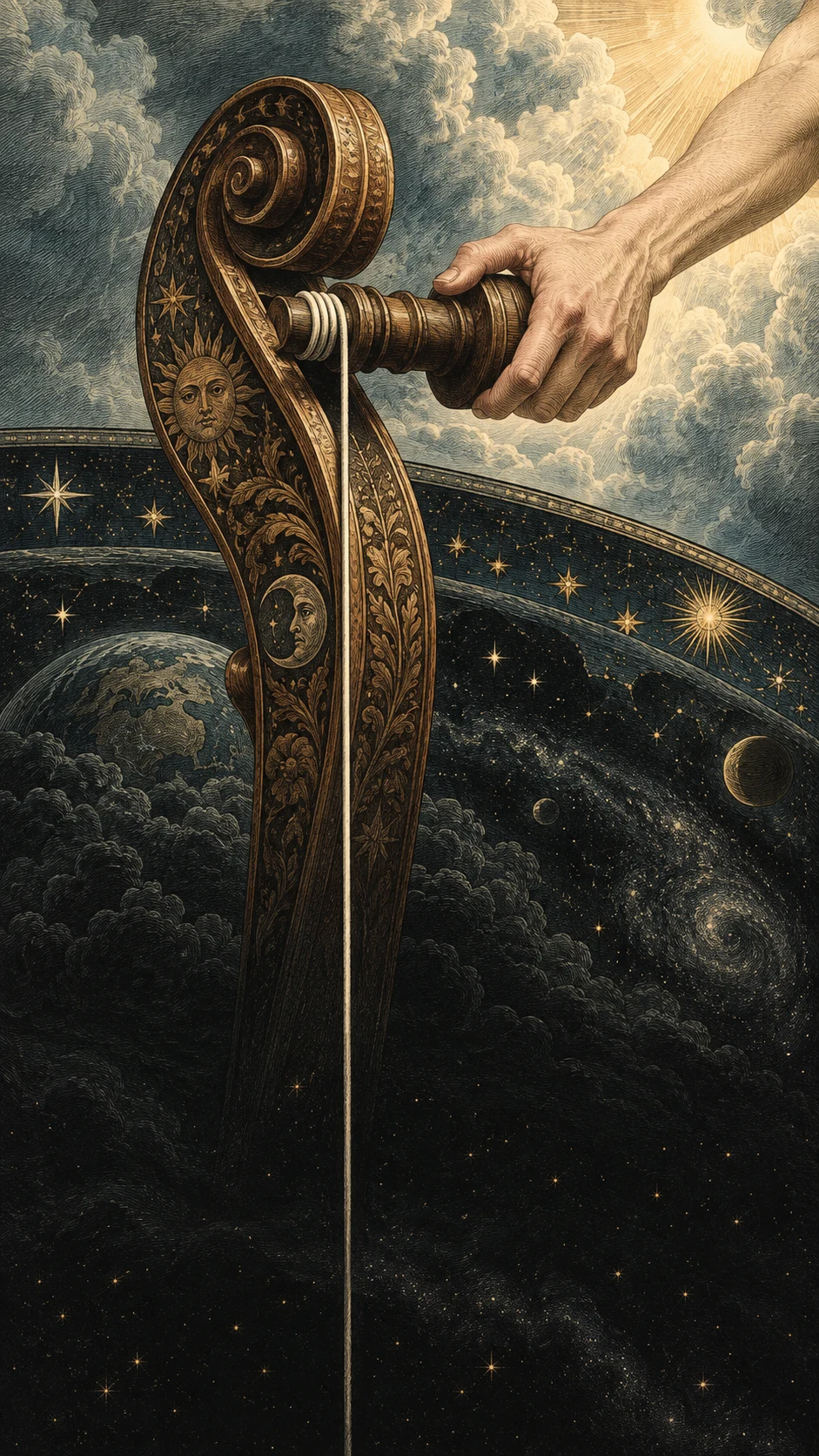
The essentials
These are the tradition’s central teachings.
Pythagoras taught in southern Italy during the sixth century BCE, and his followers formed communities with a shared way of life. Later philosophers developed this mathematical and religious inheritance. 1
Number makes the world intelligible. The proportions between musical notes offer a direct example: an octave sounds harmonious because its pitches stand in a ratio of two to one. 2
The soul survives death and enters other living bodies. Porphyry links this teaching to the kinship of living beings, extending moral concern beyond one human life. 1
Harmony joins different things into a whole. Philolaus describes the cosmos through limiters, which give definite shape, and unlimiteds, which receive it; harmony fits them together. 3
Learning changes the way a person lives. The Golden Verses require measured habits, justice toward others, and an examination of the day before sleep. 4
Purify the soul and learn its place among divine beings. The Golden Verses end with the promise of immortality after the mortal body has been left behind. 4
A small figure with a large claim
The tetractys arranges the first four numbers into a triangle. Open the explanations to see how its numbers also describe musical consonances.
The monochord · sounding length
The string and its tension stay the same. Shorter sounding length gives higher pitch. The lengths above are drawn to scale.
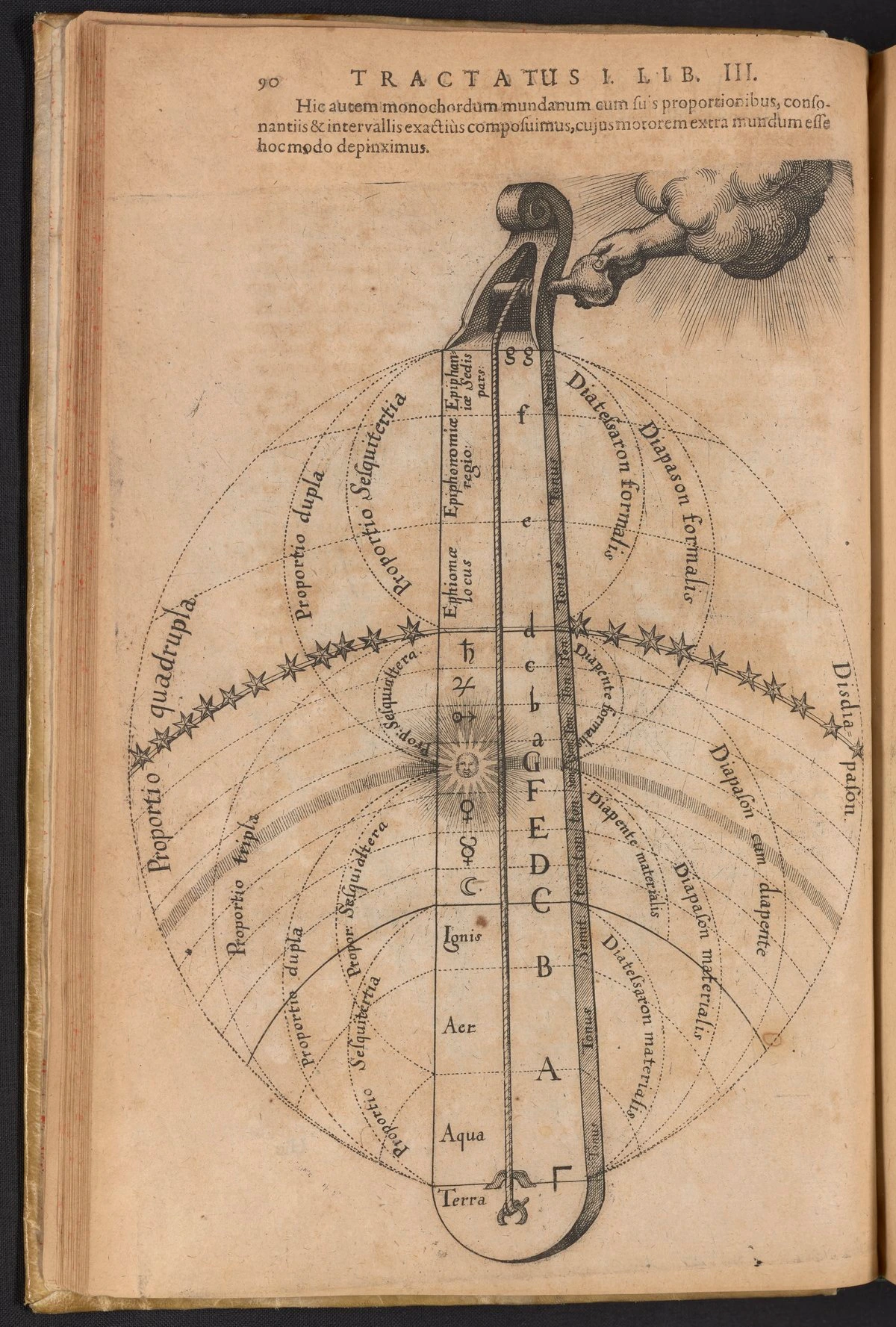
The historical image
Robert Fludd, 1617. A later image of musical cosmology. The complete plate retains the hand, scale, divisions, and labels.
Beginning with one point, each row adds another until four rows make a triangle of ten points. The figure shows how a complete arrangement can grow from a single unit while retaining a clear place for each of its parts.
An octave relates two pitches at a frequency ratio of two to one. On an ideal string under the same tension, halving the sounding length raises the pitch by an octave.
The ratios three to two and four to three give the fifth and fourth. Together they span an octave: 3/2 × 4/3 = 2. The first four numbers contain these central musical relations.
The first four numbers add up to ten, forming the complete triangle. In the Golden Verses, the pupil swears by the one who gave the tetractys to the soul. Its place in the oath shows the religious importance of a figure that brings number, musical harmony, and the origin of nature together.
The points show the traditional tetractys. Pitch ratios and string lengths explain its musical relations in modern terms. Philolaus’s surviving fragment on harmony names the octave, fifth, and fourth. 436
The work of transformation
The Golden Verses begin with duties to the gods and other people, then turn to food, sleep, anger, and the examination of one’s actions. The poem prepares the pupil for knowledge of divine things through a sustained reform of daily life.
Examine the day before sleep.
The poem opens with reverence for the gods, respect for an oath, and duties toward parents and friends.
The pupil learns to govern appetite and anger, with care for food, sleep, and the health of the body.
Before sleep, recall actions, errors, and neglected duties. Acknowledge good conduct as well as failures.
The pupil is told to regret wrongful actions and take encouragement from good ones. Repeated examination makes the day’s experience part of the education of the soul.
The Golden Verses transmit the later school’s ethical teaching under Pythagoras’s name. Their surviving form belongs to the tradition that followed him.
The teaching in the texts
A monochord consists of a single stretched string with a movable bridge. Sound the whole string, then divide its length in half: the shortened string sounds an octave higher. Two-thirds of the original length gives a fifth, and three-quarters gives a fourth. The ear hears consonances that the eye can follow as measured lengths.
This correspondence between number and sound helps explain the Pythagorean interest in music. The notes differ, yet their differences allow them to sound together in harmony. Philolaus gives harmony a similar role in his explanation of the cosmos. Things of different natures can form one world because they are fitted together in a definite way.
Iamblichus describes music as part of the school’s daily life. Pythagoras chose melodies to calm disturbances of the soul. Evening music prepared pupils for sleep, while morning music prepared them to resume activity. In this biography, he understands how sound affects a person and selects music for the change needed. Learning harmony involves hearing its proportions and experiencing its effects.
Fludd’s world monochord, published in 1617, extends the musical image across the heavens and the elements. A divine hand holds the tuning peg above the whole arrangement. His engraving belongs to a later Hermetic and Christian cosmology, where the proportions of the world are given by God. The instrument familiar to the student has become a picture of creation, with the sounding string passing through its several regions.
Porphyry attributes four teachings to Pythagoras: the soul is immortal, it enters other living beings, events recur, and living things are kin. These teachings describe a life whose history extends beyond a creature’s present appearance. A human body is one form through which that longer life passes.
The teaching about kinship follows from this understanding of the soul. Human beings and animals belong to a living family whose members can appear in different bodies. The way a person treats another creature therefore has religious significance. Restraint toward living beings follows from recognizing something shared beneath the differences in their visible forms.
The Golden Verses describe the preparation of a soul with such a future before it. The pupil is instructed to examine conduct, govern appetite, and seek an understanding of divine and human things. Near the end, the poem speaks of humanity’s divine ancestry and of sacred Nature revealing what is hidden. The daily discipline prepares the pupil to receive that knowledge.
The poem concludes with the soul leaving its mortal body for divine and immortal life. Its earlier instructions prepare the pupil for this destination. The person reviewing the day’s deeds is also preparing for a change in the soul’s condition after death. Porphyry’s teaching makes this care for conduct intelligible within a school devoted to number and contemplation. The pupil’s habits and treatment of other beings matter to a life that continues beyond the present body.
In Iamblichus’s Life of Pythagoras, admission to the school follows a period of testing. Pythagoras studies the character of those who come to him, and pupils undergo a discipline of silence. Their capacity to receive instruction has to be cultivated before they are entrusted with the fuller teaching.
Silence gives listening a sustained place in the pupil’s life. The student hears the teaching without immediately using it to display an opinion. Iamblichus also describes music that settles passions and prepares the soul for sleep or waking. These practices prepare the person who will study divine things. A troubled or undisciplined soul brings its disturbances into what it hears.
The Golden Verses extend the preparation into a nightly examination. Before sleep, the pupil is to recall what happened during the day, consider errors, and remember duties left undone. Good actions are to be acknowledged along with failures. The review makes the student responsible for seeing the day clearly and learning from what has been done.
The poem places these instructions on the way to knowledge of the gods, the human soul, and the nature of the world. Prayer accompanies the undertaking, with the gods asked to bring it to completion. The pupil’s effort prepares for an understanding that sacred Nature can reveal. The promised conclusion is the soul’s immortal life, for which the discipline of the school has been preparing it.
Across the centuries
The Samian teacher establishes the community remembered at Croton. 1
Limiters, unlimiteds, and harmony become the terms of a developed cosmology. 3
His account preserves the Pythagorean connection between number, music, and the heavens. 2
Porphyry and Iamblichus gather traditions about the teacher and his way of life. 5
Fludd gives the musical cosmos a memorable printed image. 7

Continue into the illustrated journey
Continue into Robert Fludd’s later vision of cosmic harmony. Four scenes explain the divine hand, the sounding string, and the proportions of his universe.
Explore the Monochord ↗Read at the source
Porphyry · translation by Kenneth Sylvan Guthrie
The Italian community, transmigration, recurrence, and kinship of living beings.
Aristotle · translation by W. D. Ross
The Pythagoreans on number, musical ratios, and the cosmos.
Fragments discussed and translated by Carl Huffman
Ancient fragments within a modern study of limit, number, and harmony.
Pythagorean tradition · Florence M. Firth edition, 1904
Conduct, evening examination, the oath, and the soul’s destination.
Iamblichus · translation by Thomas Taylor, 1818
Music, preparation, and the testing of pupils in the late antique biography.
OpenStax · University Physics, volume 1
The physical relation between an ideal string’s length and frequency.
Robert Fludd · Science History Institute
A later reception of musical cosmology, reproduced in the Monochord guide.