The teacher
Hermes Trismegistus is the revealer whose teachings pass through dialogues with pupils such as Tat and Asclepius. His name joins the Greek Hermes with the Egyptian Thoth. 1
Choose a guide or enter at any stop.
Comparative synthesis
Comparative metaphysics
The Hermetic vision
Comparative initiation
The Greek mysteries
The Christian journey
The Grail romances
The Rosicrucian wedding
Song and the underworld
The soul’s labors
The voyage home
The Bhagavad Gita
The Matrix
The twenty-two Major Arcana
The Night Company
The Consciousness Explorer
The Empathy Test
The building as a teacher
Work through the silent book
Number becomes audible
Cultivation as a living art
The road of the goddess
Strength and the underworld mysteries
Enter a tradition and follow its practices and symbols.
Choose a passage directly. The original and its decode stay together.
Bible
Bible
Bible
Bible
Bible
Bible
Bible
Bible
Follow a question, or choose a step within its route.
The reader path
Material cost, karmic inscription, inverted initiation, reciprocal contact, and the formation carried through death.
Clinical anomalies, transmitted memory, continuing agency, and the traditions of conscious transition.
Future attractors, embodied descendants, bloodlines, incarnation, contact, and the choice between captured and sovereign human futures.
A route from the broad ecology of contact through inherited hierarchies, discrimination, and sovereign encounter.
Circulation, distributed information, embodied reception, and the recursive return that links every scale of the field.
Recurrence, civilizational phase, precession, prophecy, and the capacity retained through a complete turn.
A route from the inherited-world thesis through vibration, geometry, water, landscape, sound, and human coherence into the Great Pyramid, civilizational rupture, ark, and surviving transmission.
Perception, shared-world formation, planetary participation, and the disciplined return from private pattern into consequence.
Physical catastrophe, astronomical phase, historical recurrence, archive criticism, contested chronology, and the agency that no clock can remove.
A route from planetary connection through technical custody, solar pressure, civilizational rupture, retained capacity, distributed incarnation, and the world rebuilt from within.
Mythic memory, initiatory custody, operating law, scriptural technology, convergent practice, and the capacity returned to life.
A route from shared-world formation through grammar, rehearsal, dramaturgy, emergency permission, closed-loop regulation, distribution, ritual, capture, integrated apparatus, and counter-operation.
Direct recognition, collective rupture, capture at the opening, embodied development, beauty as coherent aperture, and the master counter-operation.
Long initiatic intention, contested institutional custody, distributed selection, digital ordeals, mass participation, and the test of what the awakened network builds.
Contact pressure, interior government, retained development, and the selection of a coherent history.
The human aperture, collective model, captured correction loop, institutional custody, sovereign boundary, and return of authorship.
The lived ceiling, the extraction ecology, institutional inversion, managed awakening, and the recovery of agency.
Documented coercion, threshold research, distributed conditioning, biological and psychiatric custody, public theater, adaptive infrastructure, integrated control, and the recovery of the receiver.
The 1944–49 hinge: recovered archives, transferred expertise, partition, permanent secrecy, anomalous skies, and the contest over what the new order would make governable.
Currency as shared recognition, central-bank custody, emergency fiscal fusion, intermediated ownership, stablecoin rails, and the boundary between legibility and refusal.
Emergency authority, pretext, durable permission, public crisis, and the moment an institutional output becomes the ground of ordinary life.
Concealed centers, polar memory, the Black Sun, Nazi appropriation, postwar transfer, and the discipline required when myth makes exterior claims.
A route through the human instrument, embodied signaling, subtle anatomy, living fields, awakening, and integration.
The pharmakon, medical authority, diagnostic containment, autonomic injury, biological constraint, and the right to the body’s own ledger.
Private psi research, remote viewing, altered-state training, state programs, selection networks, UAP disclosure, and the contest over who holds unusual human capacity.
Sacred language, creation, exile, repair, recurrence, and the scriptural technologies of descent and return.
Language, fiction, media, participation, ritual, and the feedback loop through which a story becomes a lived world.
Laurel Canyon, press distribution, studio power, informed fiction, encoded media, participatory narrative, mass ritual, and the state that governs through attention.
The complete model, arranged in four movements.
What is contested, why consciousness comes first, and the instrument through which it acts.
How a rendered world becomes a shared one, and how the shared one is enclosed.
The operation that defends the enclosure, what it is for, and the Work done inside it.
What else lives in the field, what persists across death, and how the future reaches back.
Browse the domains or find a page by name.
No destinations match. Try a different word.
Hermetic tradition · Mind & cosmos
Divine Mind, the living cosmos, and the work of rebirth
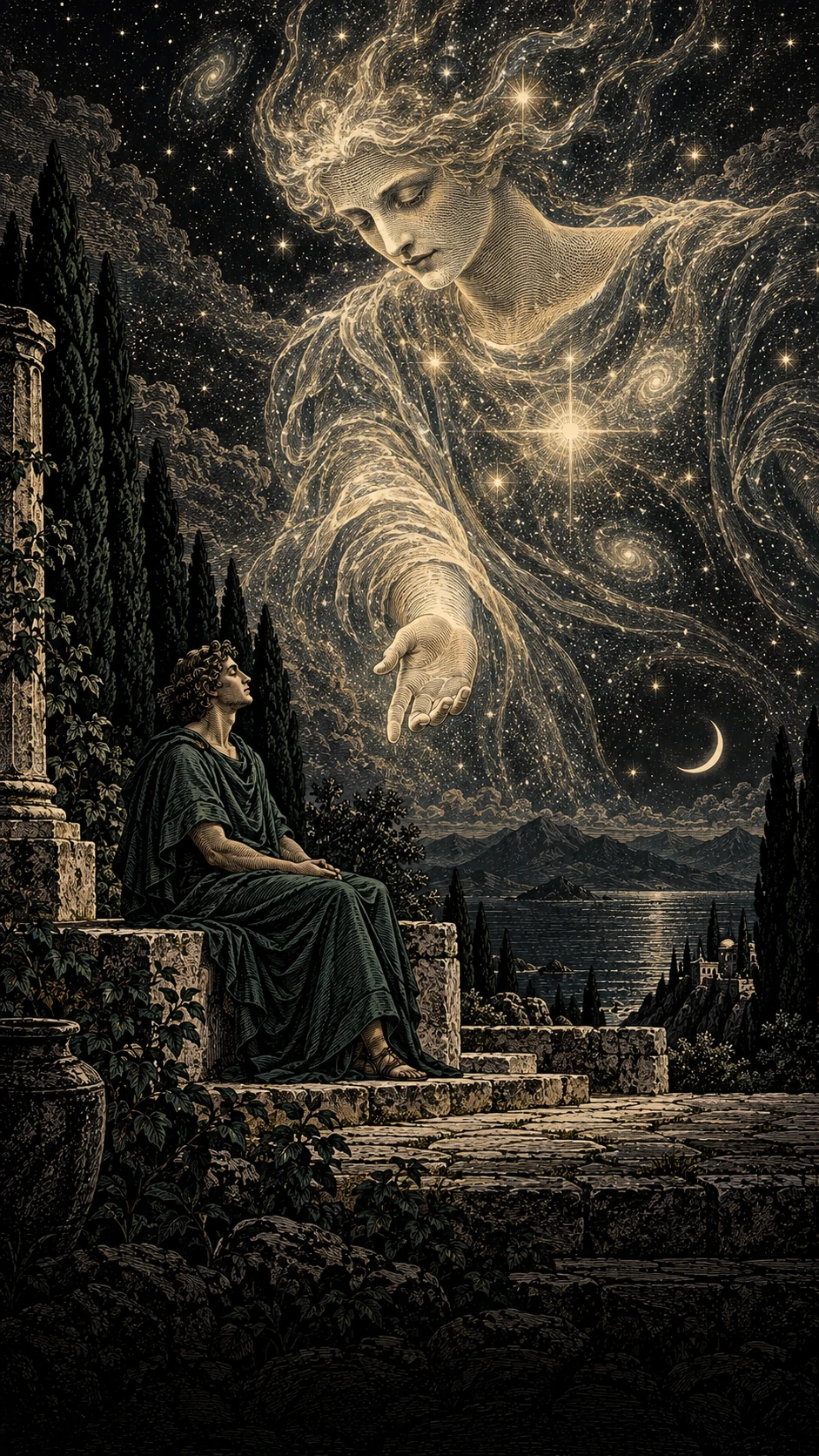
Hermes teaches that human beings come from divine life and light, yet can live in ignorance of that origin. His pupil Tat asks how to recover this knowledge. Hermes calls divine powers into him, bringing about rebirth. Tat awakens to know himself in the Mind that sustains creation.
Beliefs · Diagrams · Practice · Primary texts
The essentials
These are the tradition’s central teachings.
Hermes Trismegistus is the revealer whose teachings pass through dialogues with pupils such as Tat and Asclepius. His name joins the Greek Hermes with the Egyptian Thoth. 1
In Poimandres, divine Mind is life and light. A formative Mind creates seven governors whose circles encompass the sensible world; their government is called fate. 2
The primordial Human receives the powers of the seven governors and descends into Nature, drawn by the beauty of his own reflection. This explains the human being’s twofold nature: mortal in body, immortal in origin. 2
Gnosis is the knowledge through which a person recognizes a divine origin. Tat describes its awakening as seeing himself throughout creation, while he is still alive and speaking with his teacher. 3
Hermes invokes divine powers that drive the tormentors out of Tat. Knowledge dispels ignorance, joy overcomes grief, and self-control replaces the appetites that had governed his life. 3
Beyond the seven zones of fate, the soul enters the eighth region and joins the beings who sing to the Father. The teaching prepares the living to recognize the divine life to which they will return. 2
The ascent in Poimandres
The text names seven zones in order. At each, a binding activity is surrendered. The eighth region opens beyond their government.
Read upward · each power is given back
↑ The ascent begins after the mortal body is dissolved.
Labels paraphrase Corpus Hermeticum I.24–26.
The historical image
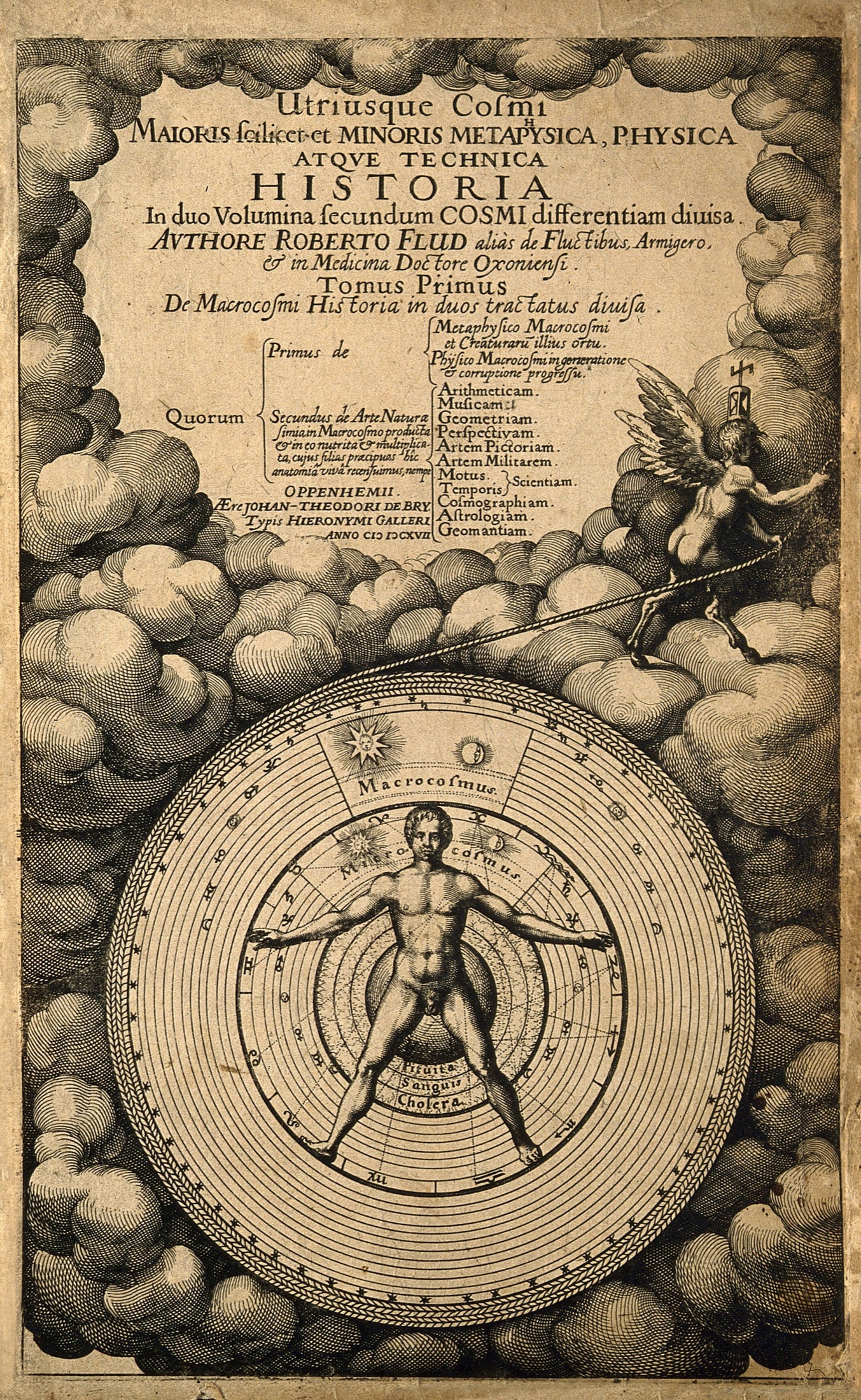
Engraving after Robert Fludd, 1617. Read the human and the encompassing world together: the planetary signs recur at both scales. The full title page is preserved.
Poimandres identifies the Father with life and light. The primordial Human bears this origin even while entering the created order.
The seven governors rule the circles surrounding the sensible world. Before entering Nature, the primordial Human receives a share of each governor’s power. Human life consequently bears the influence of the heavens, and release from fate involves giving back the activities acquired during the descent.
The body belongs to the world of birth and death, while the human being’s divine origin is life and light. Hermes teaches that a person can discover this origin while still alive. In the dialogue with Tat, that discovery brings a new way of seeing: the pupil recognizes himself throughout creation.
The ascent is an explanatory reconstruction of the text’s numbered sequence. The passage does not name planets for the seven zones; their names have therefore not been inserted. Fludd’s historical plate below belongs to the later visual tradition. 2
The modern formulation
The Kybalion gives this familiar sevenfold formulation in 1908. These concise explanations follow its chapter II. 5
The universe exists within Mind.
The same laws work throughout the different levels of existence. What happens on one level helps us understand another.
Everything moves; differing rates distinguish forms.
Opposites are extremes of a shared nature.
Movement has a swing, a rise, and a return.
Events follow law, including causes beyond ordinary perception.
Generation involves masculine and feminine principles across the planes.
The work of transformation
Tat has prepared himself and asks Hermes to complete his instruction. As their conversation proceeds, Hermes calls upon the divine powers, and Tat begins to experience the life his teacher has described.
“Father, I see the All, I see myself in Mind.”
Tat tells Hermes that he has made himself ready by overcoming his attachment to the world. He now asks to receive the teaching on rebirth.
Hermes names the forces that trouble human life, including ignorance, grief, greed, and envy. Tat must understand what will be driven out of him.
Hermes calls the powers into the pupil. Each arrival overcomes a tormentor, until Tat can perceive through divine Mind.
Tat asks to hear the hymn of rebirth. Hermes teaches him how the powers within the reborn person praise the God from whom they came.
Discourse XIII describes rebirth during a dialogue between living teacher and pupil. Poimandres also gives a passage beyond bodily death. The two accounts illuminate different moments of return.
The teaching in the texts
Poimandres describes a primordial Human born from the Father, who is life and light. The seven governors love him and give him a share of their powers. He then looks through the heavens toward the world below, where Nature sees his beautiful form reflected in water and his shadow upon the earth.
The attraction is mutual. Nature loves the divine beauty she sees, and the Human wishes to dwell in the reflected form. Their embrace brings him into the life of the world. Hermes explains the human predicament through this descent: a being who belongs to immortality has come to experience existence through a body that will die.
The governors’ gifts help explain why the descent has such lasting consequences. The human being carries the powers of the heavens into embodied life, where they become bound up with desire and ambition. During the ascent after death, the soul relinquishes the activities associated with each zone. Deceitful desire, the wish to dominate, and the pursuit of wealth are among the things it must leave behind.
The teaching gives self-knowledge a precise religious purpose. A person who knows only the mortal body mistakes one part of human nature for the whole. Recognizing the life and light from which humanity came prepares the soul to pass beyond the governors. Poimandres describes its arrival in the eighth region, where it hears the powers above and joins the song of those already there.
Read the sources 2
The conversation between Hermes and Tat describes an initiation taking place as the two speak. Tat has already received instruction and prepared himself for what his teacher calls rebirth, but he remains unable to understand how it can happen. He asks what gives birth to the new person and where that person comes from. He also asks whether rebirth will change who he is.
Hermes answers in the language of conception. Wisdom provides the womb, the Good supplies the seed, and God brings about the birth. These answers give the transformation a divine origin while explaining why preparation is necessary. The pupil must become capable of receiving a life whose source lies beyond the ordinary human faculties through which he has learned to know himself.
The decisive passage follows when Hermes invokes the divine powers. Knowledge, joy, self-control, and the other powers arrive in succession, driving out the tormentors that had occupied the pupil. Their names are familiar as virtues, but Hermes speaks to them as beings whose presence brings about the change. The teaching concerns a person becoming inhabited by the divine, with consequences for both what he perceives and how he lives.
Tat then reports that he sees through the power of Mind. He experiences himself in the heavens and throughout the living world, although he remains before his teacher. Earlier, Hermes had described his own rebirth as entry into an immortal body. Tat is beginning to understand that statement through what is happening to him. His next request is to hear the hymn sung by the powers, and Hermes prepares him to join it.
Read the sources 3
Robert Fludd’s title page places a human figure within a series of circles marked by planetary signs. Around this small world is a larger one, bearing the same signs. The names Microcosmus and Macrocosmus identify the two: the little world of the human being and the great world that encompasses it.
The repeated signs explain the resemblance. The heavens and the human being share the powers represented by the planets, so studying one can disclose something about the other. The figure stands within a cosmos whose workings continue inside the body. Human nature becomes intelligible through the larger creation to which it belongs.
Fludd published this engraving in 1617, many centuries after the philosophical Hermetica. His image gives a later visual expression to a teaching already present in Poimandres, where the primordial Human receives the powers of the seven governors. In that older text, Hermes explains both how these powers enter human life and how the soul can become free of the fate they govern.
The Emerald Tablet describes another movement between heaven and earth. The work ascends, receives the powers above, and returns below with what it has gained. Within alchemy, the return brings heavenly power into earthly substance. Read alongside Fludd’s image, the passage connects correspondence with transformation. The alchemist seeks to bring the powers pictured in the heavens into effective presence within the material being prepared.
Across the centuries
Greek and Latin writings develop teachings of divine knowledge in the religious world of Roman Egypt. 1
Arabic and Latin transmission carries its compact teaching into alchemical practice. 4
Macrocosm and microcosm become an elaborate printed cosmology. 6
The Three Initiates publish the seven principles familiar to many modern readers. 5
Continue into the illustrated journey
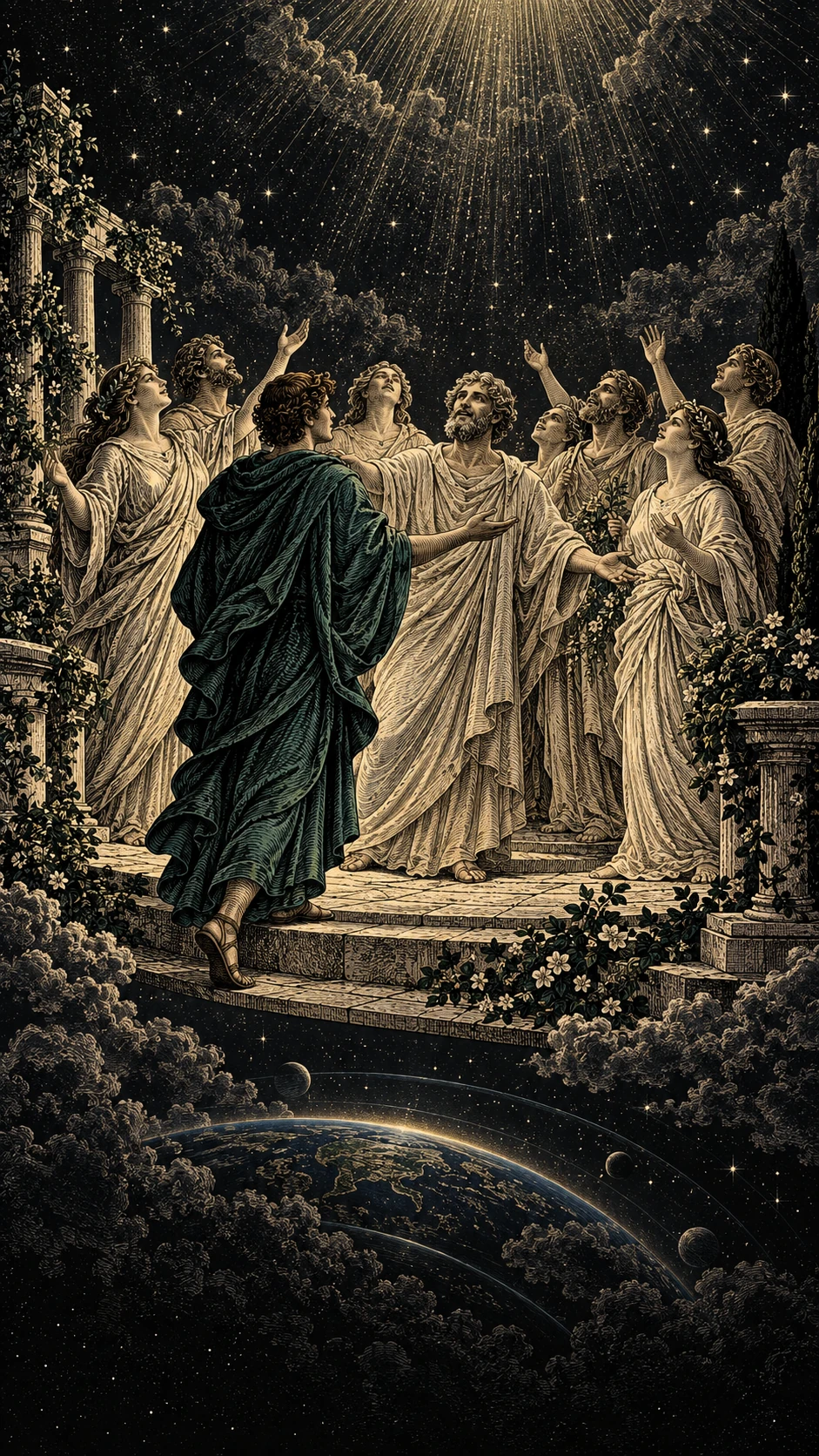
Follow the vision, the descent into Nature, and the ascent through the seven zones in the Poimandres journey.
Enter Poimandres ↗Read at the source
Brian P. Copenhaver · Cambridge University Press, 1992
Translation and historical introduction to the Greek Corpus Hermeticum and Latin Asclepius.
Translation by G. R. S. Mead, 1906
Divine origin, embodiment, the governors, and the sevenfold ascent; especially §§9–15 and 24–27.
Translation by G. R. S. Mead, 1906
The dialogue with Tat, the tormentors, the divine powers, and the hymn.
Historical translations collected at Sacred Texts
The relation of above and below and the movement from earth to heaven and back.
Engraving after Robert Fludd · Wellcome Collection
The complete historical title page reproduced below. Public Domain Mark.