A crisis can leave a person wiser or only wounded. A civilization can learn from collapse or repeat it. What survives the turn determines which consequence develops. Retention explains how experience becomes capacity instead of motion without change.
A life enters form, meets resistance and gathers experience. It integrates part of what happened before beginning another turn. Civilizations move through formation, enclosure, breakdown and reorganization in the same recurrent manner. The gyre gives this movement a shape.
One field carries two inseparable motions. Descent casts possibility into distinction, embodiment, history and cost. Return receives the consequences and integrates what the instrument can hold. Each reception conditions the next cast. What a person integrates today changes how that person perceives, chooses and transmits tomorrow.
Descent produces differences through which experience becomes possible. Return converts part of that experience into durable capacity. A complete turn reveals the direction of their coupling. The participant gains discernment, memory, agency and relation, or becomes more dependent on the apparatus that supplied the experience.
One Field, Two Motions
A gyre is a rotating current. In a coupled gyre, two currents condition one another’s motion. Imagine two interpenetrating cones, each widening where the other narrows. Each apex lies within the other’s field. Their distinct paths generate tension and relation, while their interpenetration prevents either from becoming a self-contained world.
The descending current is casting. Unity differentiates into perspectives, ideas become acts, and acts become institutions. Consciousness enters the limits of a body and a time. The returning current is receiving: consequences arrive through perception, memory, judgment, grief, insight and repair. Reception completes when its result changes a later cast. Experience without durable change returns as information and disappears as noise.
The transceiver model gives each instrument a receiving and transmitting function. Reception that never changes transmission remains private accumulation. Transmission that never receives its consequences becomes repetition. A living circuit passes rapidly between these operations, so each is already entering the next.
A period can emphasize differentiation, expansion and multiplying forms. Another can emphasize contraction, recollection and integration. These tendencies coexist across scales: a person can integrate while an institution fragments. A culture can consolidate while its subcultures proliferate. Material exchange, shared language, ecological consequences and mutual attention keep their field coupled.
The Hermetic generative cycle supplies an operating grammar. Mentalism names the one field, while Polarity produces distinction. Gender joins differentiated capacities in generation, and Vibration carries their generated form into change. Rhythm returns that form; Cause and Effect preserves its consequence. Correspondence carries the retained relation into another scale. Descent differentiates and generates, while return receives consequence and transmits what survived.
The Geometry and Its Limits
Yeats supplied the closest historical image in A Vision. Two interpenetrating cones trace complementary gyres, with each apex within the other’s base. One expands as the other contracts. Yeats named their governing tendencies Primary and Antithetical. They organize historical and psychological phases, and each contains the conditions of the other’s return. Their opposition supplies no division into good and evil teams.
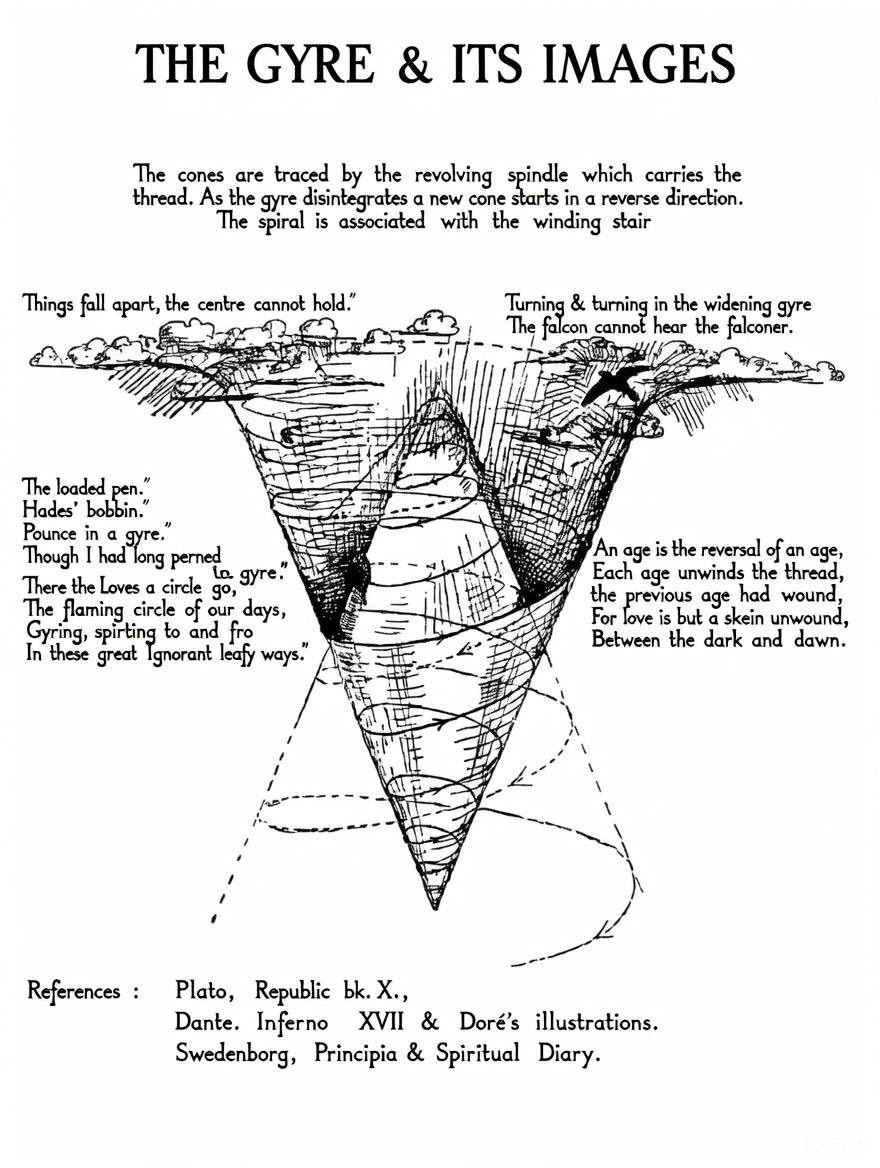
The Gyre & Its Images — a historical teaching plate connecting the interpenetrating cones to Yeats, Plato, Dante, and Swedenborg. Click to open the full image. Original publication attribution remains unidentified.
Plato gives a related image a different geometry in the Timaeus. The World Soul divides into intersecting revolutions of the Same and the Different. Their motions generate one ordered cosmos and its temporal patterns. These are circles, while Yeats uses cones.
The Same and Different also carry meanings specific to Plato’s cosmology. “Plato’s intersecting revolutions” preserves that distinction; “Plato’s gyre” would collapse the two models.
In the Statesman, one cosmos periodically reverses direction between divine guidance and self-motion. Its rotations occur successively at the end of an age. The Myth of Er gives souls a single Spindle of Necessity. Its nested whorls order their routes, choices of life and return to embodiment. These images share recurrence, counter-motion and consequence while retaining doctrinal differences.
These sources give the coupled gyre its geometry. Differentiation and integration remain distinct movements that reciprocally condition one field. Linear ascent leaves out this recurrence, while split-timeline models organize its relations through a different topology.
Descent as Differentiation
Descent carries possibility into form. A thought becomes language, language enters an institution, and the institution organizes bodies. Its conditions return as lived experience. At the personal scale, consciousness enters temperament, family, biology, history and mortality. Each limit excludes possibilities while making particular encounters real.
Harmonic Recursive Cosmogenesis extends this differentiation into cosmogony. Material persistence, living boundaries, sentience and reflective authorship form nested turns of the current. Spiritual relation, death and renewed incarnation continue that development.
Neoplatonism calls the outward movement proodos, or procession. The One remains undiminished as effects proceed through Intellect, Soul and the sensible order. Proclus joined procession to remaining and reversion. An effect remains in its cause, proceeds from it and turns back toward it.
These three moments depend on one another. Without differentiation, the source would have nothing to receive. Without a continuing relation to its source, procession would become unintelligible.
Embodiment can support responsibility, intimacy, craft and the testing of insight under cost. It can also enter enclosure, extraction and traumatic repetition. Descent supplies differentiation. Custody of the resulting forms determines whether they serve the larger living system or narrow it into a harvest mechanism.
The forge works through pressure that reveals structure and provokes adaptation. Pressure can also exceed an instrument’s capacity, destroy retention and leave a smaller life. Development requires workable intensity, support, energy for reorganization and a chance to integrate. A survivor’s later achievement gives predation no innocence.
Return as Integration
Return gathers the consequences of differentiation. Neoplatonism calls reversion toward source epistrophē. In the Asclepius, downward movement generates and upward movement nourishes. The Emerald Tablet describes a substance rising from earth to heaven and descending again with the powers of above and below. Alchemical circulatio gives this movement a laboratory form. Volatilization, condensation, dissolution and fixation repeat within the vessel.
Solve et coagula supplies the operational rhythm. A structure dissolves enough to expose its components. Discrimination and retention then give those components a new arrangement. The first coagulation remains provisional, so each return tests the new form through further experience.
Resurrection gives this operation its Christian eschatological form. Identity crosses death, returns through transformed embodiment, and begins a renewed creation. The return preserves the person while changing the body and the world that body can inhabit.
Plato’s Cave gives return an ethical purpose. The prisoner returns after ascent, bringing insight into obligation within the social world. Refusing return leaves the old machinery intact while protecting the contemplative from contact with it. Return gives illumination a body through relationships, institutions, teaching, repair or service. A state thereby becomes a capacity.
The Saturnian Escape Room places return within an initiatory chamber. The traveler crosses boundary, memory, guidance and symbolic death. On leaving, the traveler carries a route for another person without claiming ownership of the exit.
Integration can harden into an identity that excludes fresh evidence. A community can preserve revelation through doctrine, rank and permission. Technology can expand perception while keeping access proprietary and revocable. Each arrangement closes return against further development. The golden wound preserves a structured opening through which the next descent can enter.
Where Receipt Becomes Cast
A received consequence becomes developmental when it changes the next transmission. A difficult experience can produce a story, reflex, skill, boundary or wider capacity to remain present. Each enters the shared field as a new cast. The event alone determines none of these outcomes.
A wound can become a standing temporal attractor at this seam. Its charge selects attention, which shapes interpretation and action. The environment returns consequences compatible with that action. Those returns then appear to confirm the original wound. Pippa Oona calls this the Primal Loop. A frozen receipt keeps entering each cast as if it were a law of the world.
The agents and conditions that produced the original injury remain responsible for it. The loop describes how unfinished charge recruits the present. Healing reorganizes memory, which changes attention, action and the returns that become possible. The event remains in history while losing its power to command the present. Memory survives and compulsion falls away. The next cast can then begin from a wider range.
A vision can produce patient practice or a self-description requiring constant confirmation. A political disclosure can enlarge competence or attach attention more tightly to official permission. Artificial intelligence can extend learning and building, or replace faculties the person once exercised. The initial expansion can look similar. What the participant retains reveals its direction.
The diagnostic is direct: does a path increase compatible agency, or convert agency into dependency? A developmental return strengthens the participant’s ability to reproduce a state and understand its conditions. Judgment, refusal and reciprocal action become more available. Other centers retain their agency in the exchange.
Capture attaches the capability to a provider, authority, identity, substance, device or audience. Continued permission from that source becomes a condition of the experience. Boundary Sovereignty gives the complete test.
Teachers, tools, communities and inherited forms support human development. The direction of dependence over time determines whether they act as scaffolding or capture. Good scaffolding becomes less necessary as capacity grows. Capture presents dependence as development while making exit progressively harder.
Civilizational rupture concentrates the same conversion. Disturbance meets existing memory, skills, institutions, relationships and material reserves. Prophecy can change preparation before the threshold, altering the event it appears to predict. An ark carries selected capacities through that threshold.
Custody of reconstruction determines how those capacities enter the next order. The gyre thereby describes how worlds are continually built. A civilization learns across rupture through retained capacity, or recreates its prison through captured return.
The Developmental Ratchet
A closed cycle can repeat indefinitely. Yeats’s geometry guarantees no cumulative gain. The developmental ratchet adds a distinct claim: some completed turns change the conditions of the next one.
Let Cₙ name the durable capacity available at the beginning of turn n. It includes perception, discrimination, memory, integration, action and accountability to the appropriate larger scope. Retained change compares the beginning and ending capacities:
retained change = capacity after the turn - capacity before the turnA developmental turn leaves more durable capacity than it began with. A captured turn leaves the same amount or less. Intense, informative or pleasurable experience can accompany unchanged or diminished agency. The comparison supplies no universal physical unit; each system requires defined terms.
Retention must survive pressure to restore the previous attractor. Fatigue, ridicule, renewed temptation, institutional sanction and the old environment can supply that pressure. Withdrawal of a teacher or tool can also test the gain. Insight confined to its initiating conditions remains a state. Capacity that survives their withdrawal changes the next turn.
Five conditions govern positive retained change. Diversity D supplies alternative responses, and discrimination χ selects among them. Energy ε pays for observation, reorganization and repair. Retention μ preserves gains against noise and erasure. Scope alignment γ determines whom the retained order serves. It can preserve the participant within a larger living system or redirect the gain toward a narrower extractor.
These conditions also govern what a consensus field can stabilize. History, embodiment, rival agencies and available energy shape what can hold. Institutional memory and the response of larger systems continue that shaping. Language preserves distinctions, coordinates attention and changes the actions people can conceive within the field.
Thermodynamic ratchets give a bounded formal analogy. At equilibrium, random motion supplies no sustained work. Directed gain requires broken symmetry, an energy gradient and a structure that prevents immediate backsliding. Living order requires continuous throughput and exported entropy.
Prigogine’s dissipative structures show open systems forming new regimes far from equilibrium. Energy and instability permit reorganization. Selection, retention and scope determine the form that reorganization takes.
The ratchet separates intensity from development. Suffering can leave damage, and a positive state can vanish with its initiating conditions. Development appears in the costly structure that survives the turn and remains open enough to meet the next one.
Enantiodromia and Reversal
Jung drew on Heraclitus for enantiodromia: an unconscious opposite emerges after a conscious tendency becomes extreme and one-sided. Suppressed contents accumulate within one psyche or culture. They inhibit the dominant position before breaking through it. This reversal occurs within the same system.
Within a cycle, expansion can become diffusion and order can become enclosure. Openness can lose its boundary, while sovereignty can become isolation. Spiritual ascent can become inflation or dissociation. Opposed tendencies can also reverse direction. Constraint can concentrate attention; descent can ground insight; conflict can expose dependency.
Enantiodromia warns of reversal without guaranteeing a wiser result. Powers can persist for centuries, and traumatized systems can repeat without integrating. An extreme can also collapse into noise. Conscious discrimination and retention remain necessary. Mere reversal exchanges one unconscious pole for another.
Ethical direction belongs to the whole circulation. A wider scope preserves the reality and agency of participating parts while returning value to their sustaining systems. Extraction narrows that scope, turns beings into inputs and exports its costs. Coupling between opposed motions leaves these directions morally unequal.
At civilizational scale, one direction externalizes living capacity into artifacts, institutions and an inherited environment. The other receives that inheritance and recovers the relation compressed within it. A conscious body carries that relation again. Calendar time proceeds through both motions, while their formative direction can turn downward or upward.
The Descent of the Gods traces this long movement. Original participation descends into separation, which forges individual freedom. Initiation joins that freedom to renewed participation. A person can begin this ascent while the surrounding age continues to externalize and forget.
Heaven and Hell as Open and Closed Attractors
Heaven and hell are mature experiential attractors within one field. An open attractor uses feedback to widen coherent choice. Perception expands, difference remains possible within relationship, and error can be admitted. Repair becomes easier, and people can share capacity without making its source permanently necessary.
A closed attractor recruits feedback to remove coherent choices. Perception narrows as unresolved material repeats. Falsehood protects the cycle, and relief depends on machinery that reproduces the wound.
An open attractor remains capable of correction, novelty and reciprocal relationship. Its boundaries support those capacities. A closed attractor recruits every available response to preserve its cycle. It can still contain movement, novelty, pleasure and spectacle. The full turn reveals whose agency survives and what the circulation retains.
Later Zoroastrian accounts describe one river of molten metal. The righteous experience it as warm milk; the wicked experience burning, followed by purification and renovation. Some Eastern Christian mystical theology describes divine presence as joy to a will aligned with love. A will organized against it experiences torment. Tiantai Buddhism places hell and Buddhahood within each moment through the mutual inclusion of realms.
These traditions give participation a role while retaining their doctrinal differences. Zoroastrianism remains eschatological and morally dualist. Christianity retains judgment and eternal-life claims. Tiantai works through Buddhist emptiness and liberation. Their correspondences support this reading without supplying the complete gyre model.
Pleasure can accompany enclosure, and pain can accompany release. Retained structure gives the movement its direction. Truthful participation and reciprocal agency approach the heavenly pole. Compulsion, fragmentation and dependency approach the hellish pole.
Modes of participation describe lived trajectories, institutional regimes and recurrent states of consciousness. Heaven and hell can also be literal postmortem territories or regions of an other-world ecology. An ontological crossing can enter such a destination. These topologies extend the question of what a passage retains and which participation it opens.
Bifurcations Within the Field
Dynamical-systems theory gives bifurcation a precise meaning. A parameter change alters the qualitative structure of a system’s solutions. A fixed point can lose stability, a limit cycle can appear, or two attractor branches can become available. Every branch remains within the same state space and governing equations.
Coupled systems can sustain sharply different regimes within one connected field. Chimera states divide identical oscillators into synchronized and desynchronized groups while network coupling continues. Metastable systems pass between temporarily coordinated configurations without permanently settling in one. Hysteresis preserves a regime after the parameter that induced it recedes. This persistence gives the system a form of memory.
Human-scale bifurcations can produce different institutions, communities, habits and perceptual basins. Assumptions can separate people until communication fails. Infrastructure can make exit costly enough for populations to function as different worlds. While coupling persists, ecological, economic, informational and psychic consequences cross the boundary. The regimes remain able to exploit, teach, frighten, attract and transform one another.
The branches first separate through relations. One population sends attention, labor, memory and authority into a captured order. Another withdraws those currents into sovereign relationships, local competence, independent archives and correctable institutions. As each supplies its own meaning, coordination, livelihood and recovery, the other loses influence over its future. The regimes can occupy one geography while becoming less available to one another’s authorship.
A new consensus field nucleates through this growing independence. At critical mass, its local gyre completes its own turns. Experience becomes learning and structure that survives restoration pressure without renewed dependence on the abandoned regime. Continued coupling preserves responsibility during the transition. Increasing self-sufficiency prepares possible experiential, civilizational and ontological departure.
The Bifurcation can reorganize a connected field as local coherence changes its coupling. In the gyre, every retained gain enters the next turn. Extraction and the Broken Return applies this measure to exchange. Development preserves the source’s new capacity, while extraction places its completion under outside custody.
Literal timeline division, ascensional departure, postmortem migration and transition into another world describe other topologies. Each places continuity, separation and retained capacity into a distinct relation at the threshold.
A Synthesis with Named Sources
The complete model joins contributions that retain their own meanings. Yeats supplies interpenetrating cones; Plato supplies intersecting counter-motion, cyclical reversal, choice and return within one cosmos. Neoplatonism gives remaining, procession and reversion. Hermetic and alchemical sources give ascent, descent and circulation. Heraclitus and Jung describe reversal under one-sided pressure.
Non-equilibrium thermodynamics, metastability, bifurcation theory and ratchet mechanisms supply bounded formal analogies. They describe regime change, cost, memory and retained gain within their respective systems.
Some source traditions preserve genuine exit or separation. The Poimandres describes ascent through seven cosmic governors toward deification. Gnostic systems can describe a cosmos from which an awakened seed escapes. Christian rapture traditions and modern ascension teachings anticipate decisive sorting. The gyre follows what these paths retain, release and leave connected when they cross into another topology.
The proposal joins one field, two inseparable motions and recurrent reversal. A completed turn develops when retained capacity keeps the system open to further development.
After a cycle, examine what the participant can do without renewed permission. Test what memory survives pressure and which differences can be held without collapse. Identify the recipient of the surplus and what remains open to correction. These discriminators apply to practice, crisis, technology, politics and revelation. They distinguish development from capture before either reaches its advertised destination.
References
Abrams, Daniel M., and Steven H. Strogatz. “Chimera States for Coupled Oscillators.” Physical Review Letters 93, no. 17 (2004): 174102. https://doi.org/10.1103/PhysRevLett.93.174102.
Copenhaver, Brian P., trans. Hermetica: The Greek Corpus Hermeticum and the Latin Asclepius in a New English Translation, with Notes and Introduction. Cambridge University Press, 1992.
Feynman, Richard P., Robert B. Leighton, and Matthew Sands. The Feynman Lectures on Physics. Vol. I, chapter 46, “Ratchet and Pawl.” Addison-Wesley, 1963.
Heraclitus. Fragments. In G. S. Kirk, J. E. Raven, and M. Schofield, The Presocratic Philosophers. 2nd ed. Cambridge University Press, 1983.
Holling, C. S. “Understanding the Complexity of Economic, Ecological, and Social Systems.” Ecosystems 4 (2001): 390–405. https://doi.org/10.1007/s10021-001-0101-5.
Jung, C. G. Psychological Types. Translated by R. F. C. Hull. Collected Works, vol. 6. Princeton University Press, 1971. Section 709.
Plato. Complete Works. Edited by John M. Cooper and D. S. Hutchinson. Hackett, 1997. Timaeus 35a–37c; Statesman 269c–274e; Republic 614b–621d.
Prigogine, Ilya. “Time, Structure, and Fluctuations.” Nobel Lecture, December 8, 1977. https://www.nobelprize.org/uploads/2018/06/prigogine-lecture.pdf.
Principe, Lawrence M. The Secrets of Alchemy. University of Chicago Press, 2013.
Proclus. The Elements of Theology. 2nd ed. Translated and edited by E. R. Dodds. Clarendon Press, 1963. Propositions 25–39.
Tognoli, Emmanuelle, and J. A. Scott Kelso. “The Metastable Brain.” Neuron 81, no. 1 (2014): 35–48. https://doi.org/10.1016/j.neuron.2013.12.022.
Yeats, W. B. A Vision. 2nd ed. Macmillan, 1937.
Oona, Pippa. “Unhappening — A Metaphysical Framework for Healing Time.” Pippa Oona, June 22, 2026. https://www.pippaoona.com/p/unhappening-a-metaphysical-framework.