A route from the inherited-world thesis through vibration, geometry, water, landscape, sound, and human coherence into the Great Pyramid, civilizational rupture, ark, and surviving transmission.
What happens when the planetary mind meets the solar threshold?
A route from planetary connection through technical custody, solar pressure, civilizational rupture, retained capacity, distributed incarnation, and the world rebuilt from within.
A route from shared-world formation through grammar, rehearsal, dramaturgy, emergency permission, closed-loop regulation, distribution, ritual, capture, integrated apparatus, and counter-operation.
Long initiatic intention, contested institutional custody, distributed selection, digital ordeals, mass participation, and the test of what the awakened network builds.
Documented coercion, threshold research, distributed conditioning, biological and psychiatric custody, public theater, adaptive infrastructure, integrated control, and the recovery of the receiver.
The 1944–49 hinge: recovered archives, transferred expertise, partition, permanent secrecy, anomalous skies, and the contest over what the new order would make governable.
Currency as shared recognition, central-bank custody, emergency fiscal fusion, intermediated ownership, stablecoin rails, and the boundary between legibility and refusal.
How is non-local perception trained and placed into custody?
Private psi research, remote viewing, altered-state training, state programs, selection networks, UAP disclosure, and the contest over who holds unusual human capacity.
How does counterculture become media infrastructure?
Laurel Canyon, press distribution, studio power, informed fiction, encoded media, participatory narrative, mass ritual, and the state that governs through attention.
Magic is trained participation in a responsive world. Practitioners organize attention, imagination, body, symbol, speech, relationship, and action around a chosen change. They then study what the world returns.
The craft changes perception, habit, social response, and material opportunity. It also addresses the imaginal, synchronicity, nonlocal information, and other centers of intelligence. These routes belong to one practice while retaining different evidence and risks.
The Working gives the direct patterning protocol. The older craft supplies theories, operations, an inhabited field, and developmental direction. Military Magic follows divination, protection, binding, and influence as the state converts them into command.
Consciousness participates in the conditions it experiences. Attention selects, imagination rehearses, and symbols bind many relations into a portable form. Speech and gesture publish the form; conduct gives it consequence. Repetition makes the result easier to inhabit.
Participation also reaches beyond psychological and social routes. Trained intention can retrieve information, recruit meaningful coincidence, address imaginal agencies, and alter event probabilities. Centuries of practice preserve these techniques alongside warnings about projection, obsession, dependency, and deceptive contact.
An operation begins with defined scope and a prepared instrument. The practitioner gives the pattern an address and carrier, then acts through available routes. Closing the interval permits a record of its result and retention of acquired capacity. The grammar of address and closure follows naming through summoning, exposure, binding, and banishing. Each function depends on the relation established around the name.
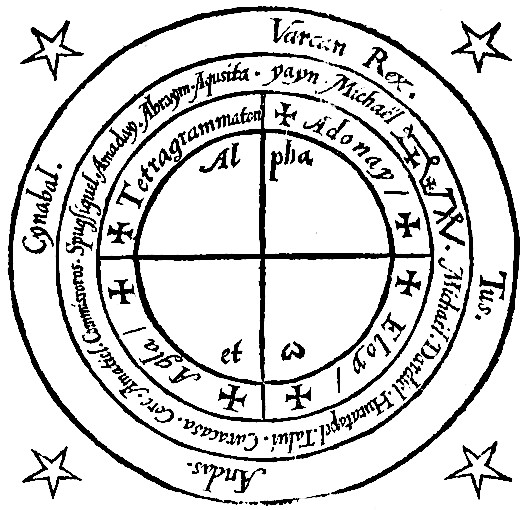
The ceremonial circle from the Heptameron, 1565. The circle is a diagram of custody: a center is established, directions and names receive assigned places, and the boundary declares which relations may cross. Operative magic begins by defining the field in which an encounter can occur. Click to open the full image.
Operative traditions encounter response where closed materialism expects empty space. Psyche, collective field, ancestor, place, thought-form, nonhuman intelligence, and divine presence carry such responses. Their influences can arrive together.
Traditions name elementals, the dead, egregores, angels, demons, djinn, fairies, archons, devas, and other intelligences. These names map a populated field locally. These maps recur across cultures, while particular identities still require discrimination. Fairy, angel, extraterrestrial, dream figure, and autonomous thought-form can share an interface without sharing a source.
The Astral Ecology maps this field. Human mediation, autonomous agency, and ordinary psychological or cultural causes retain distinct roles within a particular encounter. Positive Non-Human Intelligence Contact examines the developmental fruits of apparent contact. The operator meets response without forcing each encounter into one preferred identity.
Three major explanations organize the modern Western tradition. The Astral Light names a subtle continuum moved through trained will and imagination. Éliphas Lévi placed the human being within this medium as an active center.
The Planes names nested orders of reality, each present through the others. Golden Dawn practice draws higher patterns through imaginal and ritual layers into material consequence.
The Unconscious explains ritual as communication with the symbolic depths of mind. Image, myth, rhythm, and enactment reorganize the operator beneath ordinary narration, changing later perception and behavior.
These theories identify medium, structure, and interface. The Physics of Magic develops the full passage from possibility to retained consequence. The anomalous extension concerns effects that outrun expectation, behavior, ordinary communication, and known physical carriers.
Divination reads the active configuration. Astrology, tarot, geomancy, the I Ching, scrying, dream, and omen turn a question into an encounter with pattern. A useful reading clarifies momentum and choice while preserving agency.
Banishing establishes scope, withdraws attention from unwanted patterns, and restores ordinary conditions. It bounds the charged interval before and after an operation.
Invocation receives a quality, current, or presence into the operator. Embodiment makes the practitioner capable of carrying a relation previously external or intermittent.
Evocation addresses an apparent agency across a maintained boundary. Source and motive can remain uncertain. Regulation, identity discipline, consent, closure, and the ability to stop must therefore precede it.
Enchantment gives a desired condition symbolic and practical form, then casts it toward consequence. Sigils, talismans, petitions, spoken charms, offerings, and deliberate acts carry this outward movement through different means.
Pathworking moves through an imaginal landscape. A traditional map such as the Kabbalistic Tree of Life supplies stable landmarks, inherited relationships, and a return route.
Meditation develops discrimination beneath every operation. Practitioners sustain attention, notice projection, receive without immediate obedience, and end a state deliberately.
Each operation has a direction. Divination reads, invocation receives, evocation addresses, enchantment writes, pathworking moves, and banishing bounds. Confusing these directions obscures the result.
The operator’s condition shapes perception, judgment, and sustainable relation. Exhaustion, panic, craving, intoxication, and grandiosity increase ambiguity and weaken closure. Regulation, ethical preparation, clear purpose, and trusted relationships improve discrimination.
Condition affects access while assigning no blame for coercion, intrusion, illness, or harm. A hostile encounter never proves that its recipient secretly requested it. Boundaries matter because other agencies, human and otherwise, pursue aims of their own.
Containment identifies who and what has permission to participate. Closure ends the operation, and a record separates occurrence from inference. Ordinary function supplies the first safety signal. Sleep, work, appetite, relationship, humor, and directed attention should remain available.
Escalating certainty, sustained insomnia, command experiences, compulsion, isolation, or inability to stop call for closure, grounding, and trusted support. Deteriorating function or safety also calls for competent clinical care. Spiritual Emergency holds spiritual meaning and medical risk together. Boundary Sovereignty develops the complete discipline of opening and closing the boundary.
Operative power carries polarity. One current expands capacity, relation, truth, and freedom. Another offers results through domination, dependency, appetite, secrecy, and surrendered judgment.
Practice reveals its direction through the person it develops. A sovereign current returns clearer attention, stronger boundaries, courage, care, and independence from permanent teacher, tool, or entity custody. A captured current makes each gain a reason for deeper submission.
Results and development require separate measures. A spell can reach its target while narrowing its practitioner. A difficult working can miss its target while exposing divided will and restoring authorship. Mature operators examine both consequences.
The Law of Return exposes another result: invocation establishes an address in both directions. Repeated operations train the vessel to receive and reproduce their governing pattern. Spirit, god-form, egregore, appetite, or institution becomes easier to contact as the operator becomes easier for it to inhabit. Technique leaves the practitioner within the world its use creates.
Modernity established a public world in which dead matter counted as real and operative participation survived at the margins. Schools, institutions, prestige, and law gave disenchantment its world-producing force.
That spell is weakening. Psychedelic experience, anomalous cognition, UAP contact, consciousness research, ritual revival, and direct personal encounter return a populated, participatory world to public language.
Re-enchantment requires the craft’s inherited disciplines. A trained vessel knows the operation’s direction, maintains boundaries, tests results, closes workings, and retains sovereignty. Technique without development strengthens appetite. Technique joined to the Great Work develops a practitioner capable of carrying a freer world.
Fortune, Dion. The Mystical Qabalah. Williams & Norgate, 1935.
Greer, John Michael. The Art and Practice of Geomancy. Weiser, 2009.
Lévi, Éliphas. Dogme et Rituel de la Haute Magie. Paris, 1856. Translated by A. E. Waite as Transcendental Magic.
Regardie, Israel. The Golden Dawn. Llewellyn, 1937/1984.
Bardon, Franz. Initiation Into Hermetics. Osiris Verlag, 1956.
Vallée, Jacques. Passport to Magonia: From Folklore to Flying Saucers. Contemporary Books, 1969.
Stavish, Mark. Egregores: The Occult Entities That Watch Over Human Destiny. Inner Traditions, 2018.
Pseudo-Peter de Abano. Heptameron, 1565. Ceremonial-circle diagram. Public domain.
plain language
The same argument in direct language. Open the full reading whenever you want the evidence, lineage, and complete architecture.
Magic is trained participation in a responsive world. Practitioners organize attention, imagination, body, symbol, speech, relationship, and action around a chosen change. They then study what the world returns.
The craft changes perception, habit, social response, and material opportunity. It also addresses the imaginal, synchronicity, nonlocal information, and other centers of intelligence. These routes belong to one practice while retaining different evidence and risks.
The Working gives the direct patterning protocol. The older craft supplies theories, operations, an inhabited field, and developmental direction. Military Magic follows divination, protection, binding, and influence as the state converts them into command.
Consciousness participates in the conditions it experiences. Attention selects, imagination rehearses, and symbols bind many relations into a portable form. Speech and gesture publish the form; conduct gives it consequence. Repetition makes the result easier to inhabit.
Participation also reaches beyond changes in mind and social response. Trained intention can retrieve information, recruit meaningful coincidence, address imaginal agencies, and alter event probabilities. Centuries of practice preserve these techniques alongside warnings about projection, obsession, dependency, and deceptive contact.
An operation begins with defined scope and a prepared instrument. The practitioner gives the pattern an address and carrier, then acts through available routes. Closing the interval permits a record of its result and retention of acquired capacity. The grammar of address and closure follows naming through summoning, exposure, binding, and banishing. Each function depends on the relation established around the name.
The ceremonial circle from the Heptameron, 1565. The circle is a diagram of custody: a center is established, directions and names receive assigned places, and the boundary declares which relations may cross. Operative magic begins by defining the field in which an encounter can occur. Click to open the full image.
Operative traditions encounter response where closed materialism expects empty space. Psyche, collective field, ancestor, place, thought-form, nonhuman intelligence, and divine presence carry such responses. Their influences can arrive together.
Traditions name elementals, the dead, egregores, angels, demons, djinn, fairies, archons, devas, and other intelligences. These names map a populated field locally. These maps recur across cultures, while particular identities still require discrimination. Fairy, angel, extraterrestrial, dream figure, and autonomous thought-form can share an interface without sharing a source.
The Astral Ecology maps this field. Human mediation, autonomous agency, and ordinary psychological or cultural causes retain distinct roles within a particular encounter. Positive Non-Human Intelligence Contact examines the developmental fruits of apparent contact. The operator meets response without forcing each encounter into one preferred identity.
Three major explanations organize the modern Western tradition. The Astral Light names a subtle medium moved through trained will and imagination. Éliphas Lévi placed the human being within this medium as an active center.
The Planes names nested orders of reality, each present through the others. Golden Dawn practice draws higher patterns through imaginal and ritual layers into material consequence.
The Unconscious explains ritual as communication with the symbolic depths of mind. Image, myth, rhythm, and enactment reorganize the operator beneath ordinary narration, changing later perception and behavior.
These theories identify medium, structure, and interface. The Physics of Magic develops the full passage from possibility to retained consequence. The anomalous extension concerns effects that outrun expectation, behavior, ordinary communication, and known physical carriers.
Divination reads the active configuration. Astrology, tarot, geomancy, the I Ching, scrying, dream, and omen turn a question into an encounter with pattern. A useful reading clarifies momentum and choice while preserving agency.
Banishing establishes scope, withdraws attention from unwanted patterns, and restores ordinary conditions. It bounds the charged interval before and after an operation.
Invocation receives a quality, current, or presence into the operator. Embodiment makes the practitioner capable of carrying a relation previously external or intermittent.
Evocation addresses an apparent agency across a maintained boundary. Source and motive can remain uncertain. Regulation, identity discipline, consent, closure, and the ability to stop must therefore precede it.
Enchantment gives a desired condition symbolic and practical form, then casts it toward consequence. Sigils, talismans, petitions, spoken charms, offerings, and deliberate acts carry this outward movement through different means.
Pathworking moves through an imaginal landscape. A traditional map such as the Kabbalistic Tree of Life supplies stable landmarks, inherited relationships, and a return route.
Meditation develops discrimination beneath every operation. Practitioners sustain attention, notice projection, receive without immediate obedience, and end a state deliberately.
Each operation has a direction. Divination reads, invocation receives, evocation addresses, enchantment writes, pathworking moves, and banishing bounds. Confusing these directions obscures the result.
The operator’s condition shapes perception, judgment, and sustainable relation. Exhaustion, panic, craving, intoxication, and grandiosity increase ambiguity and weaken closure. Regulation, ethical preparation, clear purpose, and trusted relationships improve discrimination.
Condition affects access while assigning no blame for coercion, intrusion, illness, or harm. A hostile encounter never proves that its recipient secretly requested it. Boundaries matter because other agencies, human and otherwise, pursue aims of their own.
Containment identifies who and what has permission to participate. Closure ends the operation, and a record separates occurrence from inference. Ordinary function supplies the first safety signal. Sleep, work, appetite, relationship, humor, and directed attention should remain available.
Escalating certainty, sustained insomnia, command experiences, compulsion, isolation, or inability to stop call for closure, grounding, and trusted support. Deteriorating function or safety also calls for competent clinical care. Spiritual Emergency holds spiritual meaning and medical risk together. Boundary Sovereignty develops the complete discipline of opening and closing the boundary.
Operative power carries polarity. One current expands capacity, relation, truth, and freedom. Another offers results through domination, dependency, appetite, secrecy, and surrendered judgment.
Practice reveals its direction through the person it develops. A sovereign current returns clearer attention, stronger boundaries, courage, care, and independence from permanent teacher, tool, or entity custody. A captured current makes each gain a reason for deeper submission.
Results and development require separate measures. A spell can reach its target while narrowing its practitioner. A difficult working can miss its target while exposing divided will and restoring authorship. Mature operators examine both consequences.
The Law of Return exposes another result: invocation establishes an address in both directions. Repeated operations train the vessel to receive and reproduce their governing pattern. Spirit, god-form, egregore, appetite, or institution becomes easier to contact as the operator becomes easier for it to inhabit. Technique leaves the practitioner within the world its use creates.
Modernity established a public world in which dead matter counted as real and operative participation survived at the margins. Schools, institutions, prestige, and law gave disenchantment its world-producing force.
That spell is weakening. Psychedelic experience, anomalous cognition, UAP contact, consciousness research, ritual revival, and direct personal encounter return a populated, participatory world to public language.
Restored participation requires the craft’s inherited disciplines. A trained vessel knows the operation’s direction, maintains boundaries, tests results, closes workings, and retains sovereignty. Technique without development strengthens appetite. Technique joined to the Great Work develops a practitioner capable of carrying a freer world.
Fortune, Dion. The Mystical Qabalah. Williams & Norgate, 1935.
Greer, John Michael. The Art and Practice of Geomancy. Weiser, 2009.
Lévi, Éliphas. Dogme et Rituel de la Haute Magie. Paris, 1856. Translated by A. E. Waite as Transcendental Magic.
Regardie, Israel. The Golden Dawn. Llewellyn, 1937/1984.
Bardon, Franz. Initiation Into Hermetics. Osiris Verlag, 1956.
Vallée, Jacques. Passport to Magonia: From Folklore to Flying Saucers. Contemporary Books, 1969.
Stavish, Mark. Egregores: The Occult Entities That Watch Over Human Destiny. Inner Traditions, 2018.
Pseudo-Peter de Abano. Heptameron, 1565. Ceremonial-circle diagram. Public domain.
supporting record
The sources, scope, and live questions behind the reading.
statuscross-traditional operational synthesis with a public lineage dossier reviewed Wed Aug 05 2026 00:00:00 GMT+0000 (Coordinated Universal Time)
Question
Operative magic is disciplined patterning through attention, imagination, embodiment, symbol, timing, action, relationship, and feedback inside a responsive world.
Record
Ritual, contemplative, magical, parapsychological, and modern cognitive lineages repeatedly converge on trained attention, embodied state, imaginal rehearsal, action, and disciplined interpretation.
Alternative explanations
Many useful effects can travel through expectancy, state regulation, behavioral change, social signaling, selective attention, and ordinary opportunity without exhausting the deeper model.
Lineage
The public lineage preserves traditional testimony, experimental literature, modern mechanism models, and TimeWar synthesis as distinguishable source families.
Open questions
Strong external-effect claims require prospective records, predefined outcomes, independent confirmation, and retained capacity after the operation.
Full carries the practice. The dossier exposes the lineage, rival carriers, and research boundary without publishing private operation records.