Origins
Orpheus appears in Greek art and poetry by the sixth century BCE. Rites and writings bearing his name circulated through different communities and teachers. 9
Tradition 01 · Ancient Greece
The soul, its memory,
and the passage through death.
The Orphic initiate prepares for a journey that continues after death. Gold tablets buried with the dead name the springs to seek and the guardians to approach. They give the words by which a soul declares its divine ancestry. Preparation begins during life, through purification and the worship of gods who can grant a blessed place in the world below.
Beliefs · Cosmology · Initiation · Primary texts
The essentials
These are the tradition’s teachings,
stated in direct language.
Orpheus appears in Greek art and poetry by the sixth century BCE. Rites and writings bearing his name circulated through different communities and teachers. 9
The soul survives bodily death. The funerary tablets give the deceased a voice and a divine ancestry to declare in the world below. 1
After death, the soul must find its way through an unfamiliar world. The Petelia tablet warns against one spring and directs the traveler toward the water of Memory, where guardians must be approached. 1
An Orphic life involves purification in daily conduct and worship. Plato describes followers who abstained from animal flesh and made bloodless offerings, extending their religious discipline to the food they ate. 6
Dionysus and Persephone stand close to the soul’s fate. Orpheus supplies the authority of a singer who crossed into Hades while alive. 11
The initiate seeks a blessed life after death. The gold tablets speak of release, welcome from Persephone, and a place among divine beings and heroes. 1
A map of beginnings
The diagram follows Time, the egg, and the firstborn god.
Open a name to look more closely.
In the genealogy reported by Damascius, primordial Time has a serpentine form and is accompanied by Necessity. Chronos, Time, is distinct from Kronos, the later ruler and father of Zeus.
The cosmic egg contains the life from which the world will emerge. It gives a familiar image to a difficult teaching: the many forms of creation begin together, before they have become separate beings. From the egg comes Phanes, the firstborn god who brings this hidden life to light.
Phanes emerges from the egg as a radiant, winged god who bears both sexes. The powers of generation are united within him before they appear separately in the beings that follow. His birth explains how the life enclosed in the egg first becomes visible.
The succession of divine rulers
Orphic poems also trace the passing of divine sovereignty. This sequence of rulers is distinct from the account of primordial generation above.
The creation diagram follows the genealogy reported by Damascius; the royal sequence draws on Rhapsodic testimonies. Orphic writings preserve several accounts of the beginning. 35
The complete historical chart
G. R. S. Mead’s synthesis
of Orphic and Neoplatonic theology.
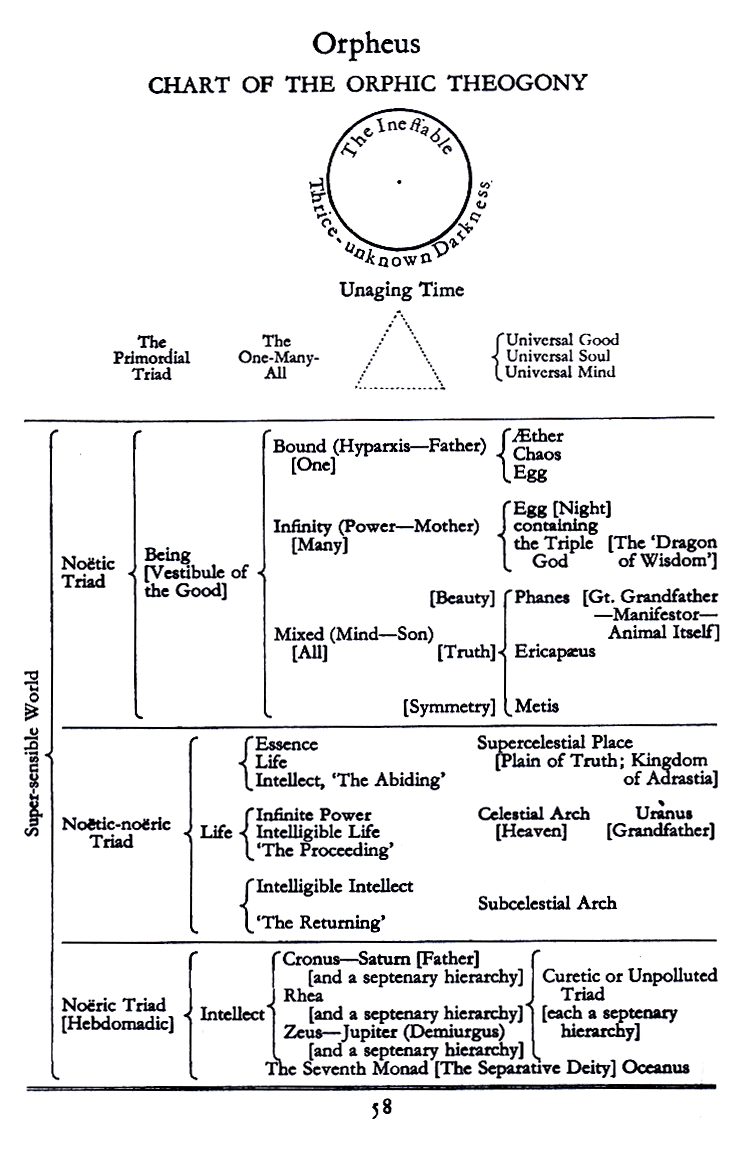
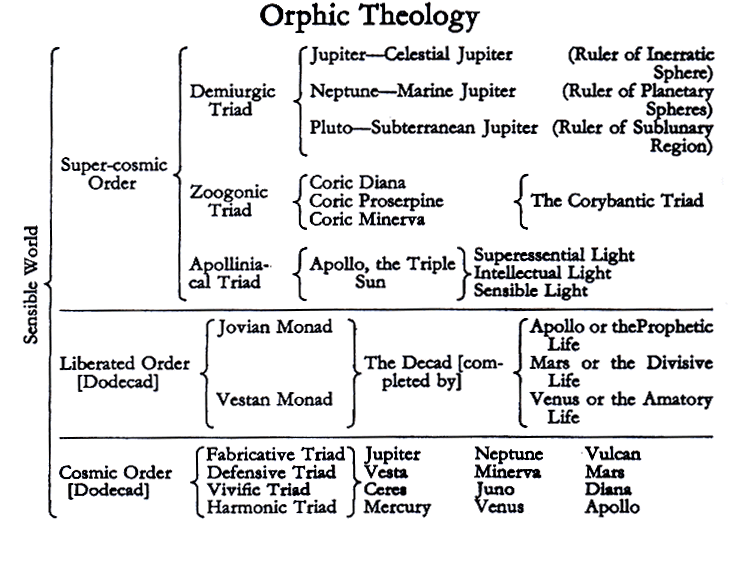
Mead arranges the gods by their place in the world’s creation. The chart begins with an unknowable source and descends through the divine beings responsible for life, intelligence, and the forms of nature. Their names explain what they do: some create, some preserve, and others bring the parts of the world into harmony. The soul belongs to this creation. Learning its divine origins helps explain how it can return.
Thrice-unknown Darkness
The One-Many-All
Universal Good · Universal Soul · Universal Mind
These divine powers give the world its existence, life, and intelligence.
These groups of gods govern the heavens and the world we perceive.
Retypeset from Mead’s chart, pp. 58–59. Line breaks and brackets are adapted to tables; names, associations, and groupings are retained. On a phone, swipe a table sideways to read its two columns.
| Principle or divine order | Names and correspondences |
|---|---|
| Bound (Hyparxis—Father) [One] | Æther · Chaos · Egg |
| Infinity (Power—Mother) [Many] | Egg [Night] containing the Triple God [The “Dragon of Wisdom”] |
| Mixed (Mind—Son) [All] | [Beauty] Phanes [Gt. Grandfather—Manifestor—Animal Itself] [Truth] Ericapæus [Symmetry] Metis |
| Principle or divine order | Names and correspondences |
|---|---|
| Essence · Life · Intellect, “The Abiding” | Supercelestial Place [Plain of Truth; Kingdom of Adrastia] |
| Infinite Power · Intelligible Life · “The Proceeding” | Celestial Arch [Heaven] · Uranus [Grandfather] |
| Intelligible Intellect · “The Returning” | Subcelestial Arch |
| Principle or divine order | Names and correspondences |
|---|---|
| Cronus—Saturn [Father] [and a septenary hierarchy] Rhea [and a septenary hierarchy] Zeus—Jupiter (Demiurgus) [and a septenary hierarchy] | Curetic or Unpolluted Triad [each a septenary hierarchy] |
| The Seventh Monad [The Separative Deity] | Oceanus |
| Principle or divine order | Names and correspondences |
|---|---|
| Jupiter—Celestial Jupiter | Ruler of Inerratic Sphere |
| Neptune—Marine Jupiter | Ruler of Planetary Spheres |
| Pluto—Subterranean Jupiter | Ruler of Sublunary Region |
| Principle or divine order | Names and correspondences |
|---|---|
| Coric Diana · Coric Proserpine · Coric Minerva | The Corybantic Triad |
| Principle or divine order | Names and correspondences |
|---|---|
| Apollo, the Triple Sun | Superessential Light · Intellectual Light · Sensible Light |
| Principle or divine order | Names and correspondences |
|---|---|
| Jovian Monad · Vestan Monad The Decad [completed by] | Apollo or the Prophetic Life Mars or the Divisive Life Venus or the Amatory Life |
| Principle or divine order | Names and correspondences |
|---|---|
| Fabricative Triad | Jupiter · Neptune · Vulcan |
| Defensive Triad | Vesta · Minerva · Mars |
| Vivific Triad | Ceres · Juno · Diana |
| Harmonic Triad | Mercury · Venus · Apollo |
The historical image
Orpheus, p. 58. Full scan: the source, primordial triad, and levels of Being, Life, and Intellect.
The historical image
Orpheus, p. 59. Full scan: all three orders and the four triads of the cosmic dodecad.
G. R. S. Mead, Orpheus, first published 1896; chart reproduced from the edition transcribed at the linked source. This later synthesis extends the ancient creation accounts introduced above. The two complete scans preserve the original typography and bracket structure.
Knowledge carried across death
The Petelia tablet gives the traveler
a sequence to remember.
A declaration of origin
“I am the son of Earth and Starry Heaven. But my race is heavenly.”
The traveler will be thirsty, but must pass the spring beside the white cypress and seek the water of Memory.
Tell the guardians that you are a child of Earth and starry Heaven. The declaration tells them who stands before them.
Request a drink from the spring of Memory. The knowledge learned in life now guides the dead.
The text promises the traveler a place among the heroes after the water is given.
The route follows Petelia. The displayed declaration is translated from the Getty tablet, which gives different directions at the spring. 21
The teaching in the texts
Three readings explore the teaching.
Each begins with something specific.
The Petelia gold tablet was made to accompany someone into death. Its inscription describes a spring beside a white cypress and tells the traveler to avoid it. Farther on is the water of Memory, watched by guardians. The soul must approach them and ask for a drink, explaining that it is parched with thirst.
The traveler is given words with which to introduce himself: he is a child of Earth and starry Heaven. The declaration explains why the guardians should receive him. The person who has died belongs to the mortal world through Earth, while the heavenly ancestry identifies a life that continues beyond the body. A similar declaration on the Getty tablet makes this claim explicit by naming the speaker’s race as heavenly.
Memory therefore concerns something more enduring than the events of the life just ended. The soul must remember where it comes from at the moment when that knowledge determines its way forward. The instructions anticipate the difficulty: the traveler will be thirsty, and the first spring will offer relief. Knowing which water to refuse is part of the preparation carried into death.
When the guardians give the water, the Petelia inscription promises the traveler a place among the heroes. The tablet follows a complete passage from danger and need to recognition and welcome. Its small sheet of gold preserves the teaching for one particular person. That person’s burial joins instruction learned among the living to the journey now awaiting the soul.
In Nonnus’s telling, the child Dionysus is looking into a mirror when the Titans approach him. He changes shape as they pursue him, passing through several forms before they tear him apart. His reflected image and passage through different bodies give the violence a significance that later readers follow into the soul’s life in matter.
Olympiodorus takes up the myth in his commentary on Plato’s Phaedo. After the Titans consume Dionysus, Zeus strikes them with his thunderbolt, and human beings arise from the soot of their remains. Because the Titans had eaten the god, something of Dionysus passes into humanity. The same origin accounts for the Titanic and divine elements within human nature.
This interpretation gives purification a reason. The human being contains a divine life that can be obscured by the appetites inherited with it. To purify oneself is to become capable of recognizing and honoring that life. The myth explains why this work reaches into bodily existence. The god is present in the creatures who must learn how to live with him.
Olympiodorus introduces this explanation while discussing the prohibition on taking one’s own life. The body belongs to Dionysus, and its sacred origin places a claim upon the person who inhabits it. His reading makes the care of embodied life part of the teaching about the soul. The divine inheritance is already present, and the person’s treatment of the body follows from that belonging.
Many of the Orphic Hymns begin with the name of an incense to be offered. The verses then call upon a deity, recount the powers by which that god is known, and ask for a favorable presence. The words belong to an act of worship in which burning an offering and invoking a god are performed together.
The names and epithets help explain whom the worshipers expect to meet. A deity is called upon as the giver of life, a ruler of the heavens, or a power over the dead. Through these names, the worshiper approaches the divine being responsible for something already experienced in the world. The prayer asks that this power come with blessings and receive those who have gathered to honor it.
Purification concerns the condition in which a person makes such an approach. Plato’s description of the Orphic life joins abstention from animal flesh with bloodless offerings. Food and sacrifice are governed by the same religious commitment. The worshiper’s preparation consequently extends through the days between ceremonies, shaping the life of the person who will stand before the gods.
The surviving hymn collection belongs to Roman imperial times, centuries after Plato and the earliest funerary tablets. These texts preserve different parts of the Orphic inheritance. The hymns allow us to hear how gods were invoked by living worshipers; the tablets preserve words for approaching divine beings after death. In both, knowing whom one is approaching and how to speak is part of the religious teaching.
A tradition across centuries
The mythical singer belongs before Troy.
The surviving texts have their own dates.
Orpheus appears in poetry and in an Argonaut scene at Delphi. 9
The Derveni commentary reads hidden meanings in a poem attributed to Orpheus. Its surviving roll was copied in the fourth century. 10
Gold tablets preserve declarations and directions for the afterlife. 1
A collection of 87 invocations takes shape in Asia Minor. 8
Neoplatonists interpret divine genealogies and dismemberment as teachings about reality and the soul. 5
Continue into the illustrated journey
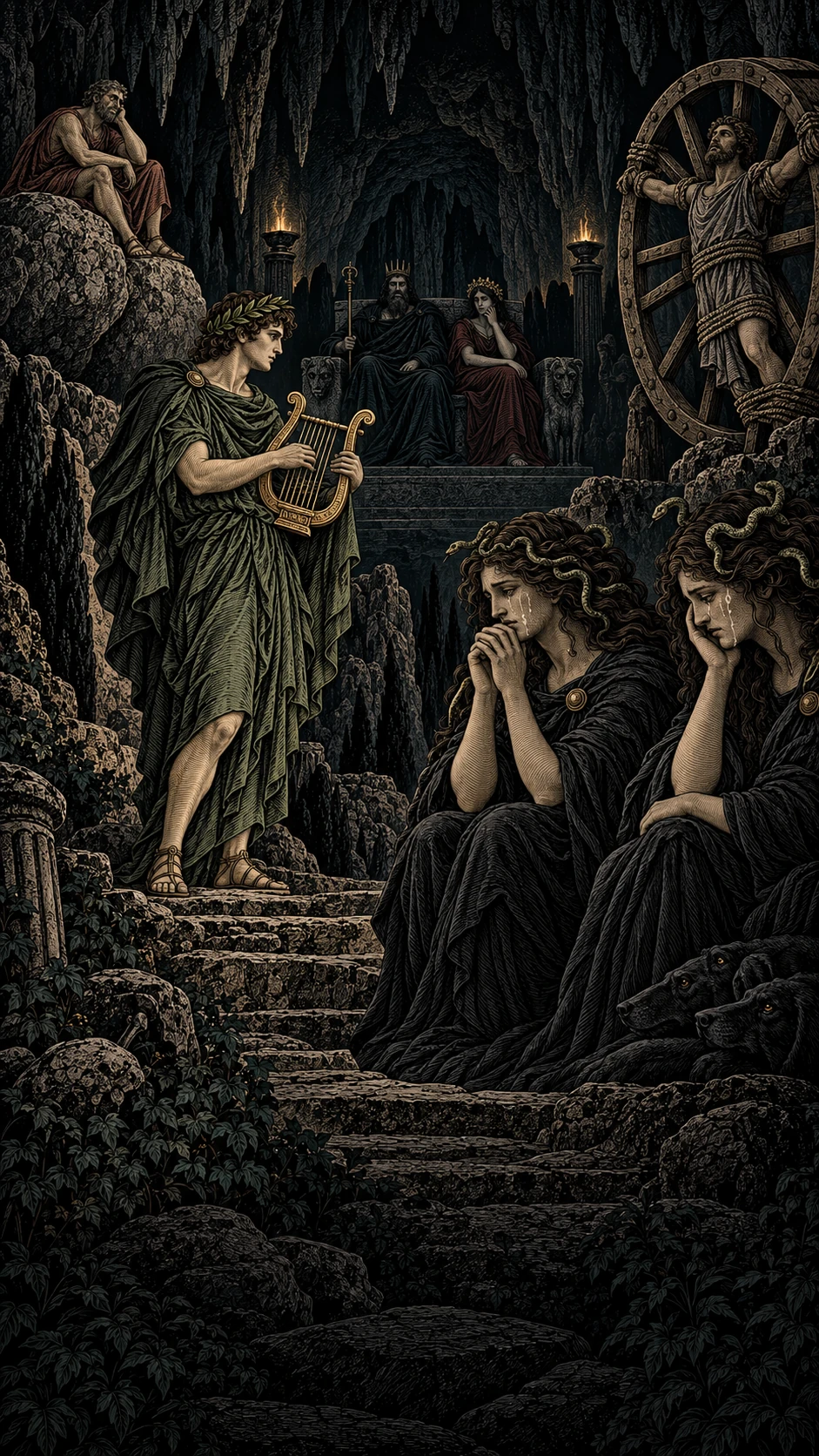
Follow Orpheus from the wedding torch to his reunion with Eurydice. The five scenes follow Ovid, with Virgil’s different telling beside them.
Enter the Orpheus guide Illustration created for the guideRead at the source
These passages and artifacts
inform the introduction.
Museum interpretation and translations by Roy D. Kotansky; Getty tablet 75.AM.19.
Collection record 1843,0724.3. The gold inscription and its later pendant case have different dates.
Fragment 54 and the Rhapsodic fragments. The diagram separates generation from the succession of divine rulers.
The divine child, the mirror, the Titans, and dismemberment; passages collected at Theoi.
The Greek Commentaries on Plato’s Phaedo, volume I (1976). Humanity from the Titans and the body’s belonging to Dionysus.
The Orphic life, abstention from animal flesh, and bloodless offerings.
Invocations and their incense headings; historical translation.
Johns Hopkins University Press, 2013. Modern translation and introduction.
Close Encounters of the Feathered Kind: Orpheus and the Birds. Early attestations and the Delphi metope.
Introduction to the papyrus and its allegorical commentary on an Orphic poem.
The descent for Eurydice, followed in Book XI by Orpheus’s death and reunion. The guide compares Ovid with Virgil.