A bardo is an intermediate state between the ending of one mode of experience and the stabilization of another. Tibetan Buddhism applies the term to death and rebirth, waking life, dream, meditation, and dying.
Recognition governs the passage. When an ordinary world-model loosens, its appearances acquire tremendous force. Liberation requires recognition of awareness’s nature before fear, attraction, and confusion rebuild a world through habit.
The Text and Its Lineage
The Bardo Thödol, commonly called the Tibetan Book of the Dead, means “Liberation Through Hearing in the Intermediate State.” It belongs to a larger teaching cycle revealed by Karma Lingpa in the fourteenth century. He revealed it as terma, hidden treasure attributed within the Nyingma tradition to the eighth-century master Padmasambhava.
Padmasambhava is the traditional source; Karma Lingpa is the treasure revealer. The surviving text is a medieval Tibetan ritual and doctrinal compilation. Calling it an eighth-century book erases the lineage’s distinction between concealment and historical revelation.
Readers speak the text aloud to a dying or dead person. Hearing carries instruction as ordinary orientation fails. The reader identifies what is happening and urges awareness to recognize appearances as mind’s display.
The Six Bardos
Many Tibetan presentations distinguish six intervals. The bardo of living and dying is ordinary embodied life, when preparation remains possible. The bardo of dream exposes the constructed, plastic character of experienced worlds. The bardo of meditation trains stable recognition as perception changes.
The painful bardo of dying dissolves bodily elements, senses, and familiar orientation. The luminous bardo of dharmatā presents clear light and peaceful and wrathful visionary forms. The karmic bardo of becoming carries momentum toward another birth when recognition has not brought liberation.
Texts and teachers divide these intervals differently. Each follows a transition in which established organization dissolves, naked awareness becomes more available, and habit begins organizing experience again.
Recognition and Projection
The text identifies peaceful and wrathful deities with awareness’s luminous display and the practitioner’s awakened qualities. They exceed a simple account of external gods awaiting the dead. Fear of wrathful forms and desire for peaceful forms can both obstruct recognition.
Recognition requires more than the instruction “follow the light.” Luminosity, beauty, terror, authority, and familiarity remain appearances whose nature requires recognition. Their intensity does not remove that task.
appearance
    ↓
recognition or recoil
    ↓
attention stabilizes a relation
    ↓
relation becomes trajectory
The form can carry real instruction while mind shapes its appearance. Identification binds awareness to the form; recognition through it liberates. The bardo maps the risk of mistaking an overwhelming interface for its source.
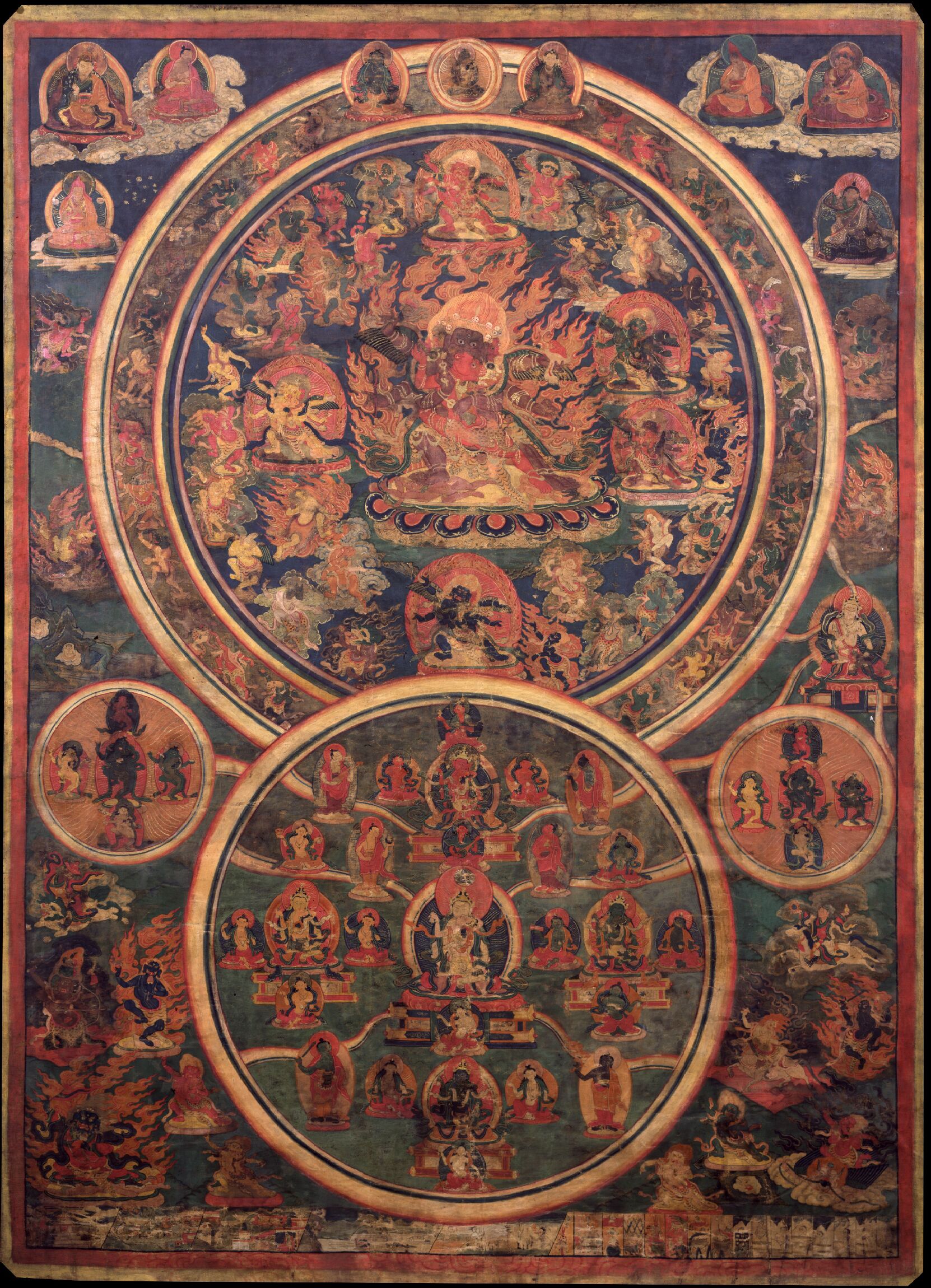
Peaceful and wrathful deities of the bardo, Nyingma lineage, eighteenth century. Both orders occupy one display because attraction and terror test recognition together. Awareness must meet overwhelming form without fleeing, grasping, or surrendering its center. Public domain. The linked image opens at full size.
Karma as Momentum
Karma is trained momentum. Repeated attention, action, attachment, and avoidance make particular responses easier. When body and social world cease stabilizing experience, those tendencies remain as organizing forces. The next world forms along grooves prepared during life, without an external sentence or cosmic points system.
Death and the Sorting Hierarchy follows the larger relation in which affinity becomes trajectory. Tibetan Buddhism gives continuity a particular doctrinal meaning. It denies a permanent soul traveling unchanged between bodies. One flame lighting another expresses causal inheritance without an eternal independent self.
That distinction remains necessary within the shared operation. A Western immortal-soul doctrine cannot substitute for the Tibetan account without erasing its central teaching.
Practice Before Death
Dream yoga, deity yoga, meditation on mind’s nature, phowa, ethical discipline, and contemplation of death prepare lucid transition. Phowa concerns the transfer of consciousness. These practices train awareness to remain lucid while its current world changes.
Their practical sequence joins recognition, presence, remembered instruction, judgment, and release:
recognize the constructed display
remain present without grasping
remember the instruction
do not surrender judgment to appearance
release the next compulsion
Death intensifies a capacity already trained under other conditions. It brings an existing skill to its most demanding passage.
Relation to the Wider Death Archive
Bardo literature supplies an operational map. It does not provide clinical confirmation of its stages. Near-Death Experiences gathers reports surrounding resuscitation; Terminal Lucidity gathers unexpected returns of communication. Reincarnation and the Continuity of Memory follows claimed continuity across lives. None verifies every Tibetan stage.
Modern reports repeatedly contain altered time, encounters, life review, deceased figures, luminous presence, disembodiment, fear, attraction, boundaries, and return. These correspondences matter alongside differences. NDEs usually end in resuscitation; bardo teachings describe completed death within a Buddhist path to liberation.
The text treats transition as trainable and appearances as dangerous to read literally. Its authority arises through this depth of practice. A medieval ritual text and a hospital transcript retain different sources and functions.
The Bardo as a Transitional Field
A bardo opens wherever an old world loses authority while the next remains negotiable. Death gives the most complete instance. Awakening, breakdown, dream, initiation, historical rupture, and collapsing consensus reproduce that structure at smaller scales.
Recognition changes what habit builds from the interval. The transition still occurs, but awareness gains a different relation to its next form.
References
Karma Lingpa. The Tibetan Book of the Dead: The Great Liberation by Hearing in the Intermediate States. Translated by Gyurme Dorje. Penguin Classics, 2006.
Cuevas, Bryan J. The Hidden History of the Tibetan Book of the Dead. Oxford University Press, 2003.
Fremantle, Francesca. Luminous Emptiness: Understanding the Tibetan Book of the Dead. Shambhala, 2001.
Thurman, Robert A. F., trans. The Tibetan Book of the Dead. Bantam, 1994.
Padmasambhava. Natural Liberation: Padmasambhava’s Teachings on the Six Bardos. Translated by B. Alan Wallace. Wisdom Publications, 1998.
Nyingma lineage. Peaceful and Wrathful Deities of the Bardo, eighteenth century. Public-domain thangka preserved through Himalayan Art Resources.