Power governs through public drama that gives an event a genre, cast, scene, conflict, and demanded ending. Institutions stage images and explanations until accumulated emotion supplies permission to act. The drama can move budgets, armies, laws, markets, and populations before its factual record becomes clear.
The theater state writes and stages this drama by joining representation to administration. A televised threat becomes a security category, then a program with offices, money, weapons, databases, and trained personnel. These structures prepare the sequel. Political theater becomes an instrument of rule through that material return.
A psyop succeeds when the audience mistakes its assigned role for its spontaneous response. Fear, outrage, pity, identification, denunciation, and rescue each complete a different kind of script. The audience supplies the affect through which a represented event becomes collective action.
Consciousness Warfare owns the wider conflict over perception, meaning, and agency. The Theater State owns its political dramaturgy: genre, plot, cast, scene, pacing, climax, and public participation. Narrative Control owns the grammar through which events are named and related. The Reality Production Engine owns the feedback system through which staging is measured, corrected, administered, and returned as history.
The Political Screenplay
Every durable state drama organizes eight functions. They may be designed in advance, assembled opportunistically during an event, or selected by an institutional field whose participants share incentives and inherited forms. Once joined, they behave like a screenplay written into public life.
Genre establishes legitimate feelings and actions. War demands loyalty, emergency demands speed, and scandal demands exposure and purification. Humanitarian rescue demands intervention, while apocalypse demands sacrifice. The genre supplies a ready-made world before the evidence settles.
The inciting incident breaches ordinary time. An attack, outbreak, assassination, market failure, leaked document, anomalous object, or shocking image opens the gate through which exceptional measures can enter. The Manufactured Pretext owns the operational form in which a real, enabled, provoked, fabricated, or strategically interpreted breach becomes emergency permission.
The cast gives distributed structures visible bodies. Leaders embody resolve, experts knowledge, victims innocence, and enemies threat. Whistleblowers embody revelation, while dissidents embody danger or courage according to the frame. Individuals can sincerely perform roles that remain institutional functions larger than their current actors.
The scene and its props give the drama a visible world. Podiums, uniforms, maps, masks, flags, and ruined buildings establish its setting. Courtroom sketches, satellite images, laboratory dashboards, weapons displays, and solemn corridors make authority appear through particular objects. False Light and the Capture of Appearance follows the selection of what enters the frame and what stays outside. Its visible surface carries the emotional charge assigned to the scene.
Exposition teaches the audience to interpret the scene. Officials define the stakes, and intelligence sources supply privileged knowledge. Experts restrict plausible causes while commentators repeat the causal chain until it becomes familiar memory. Narrative Control develops the names, categories, source hierarchy, and admissible questions. The Captured Press distributes exposition through daily episodes and recaps.
Pacing regulates arousal. Escalation, suspense, revelation, reversal, relief, and renewed alarm keep attention attached to the plot. A continuous maximum signal produces exhaustion; a managed rhythm preserves expectancy. Polling, focus groups, platform analytics, market movement, compliance data, and street response disclose when the tempo should accelerate, pause, or change register.
The climax converts accumulated affect into a decision. A vote, authorization, invasion, emergency order, rescue package, censorship regime, institutional purge, or new technical infrastructure appears as the demanded resolution. The drama has prepared the action emotionally before it becomes policy.
The denouement fixes the meaning of what happened and seeds the sequel. Commissions assign lessons, memorials stabilize heroes and victims, curricula transmit the official plot, anniversary coverage refreshes it, and administrative reforms preserve the new capacity. The ending becomes a reference image against which the next incident will be recognized.
genre → breach → cast → scene → exposition → escalation
   ↑                                             ↓
sequel ← institutional memory ← denouement ← climax
                         ↑                    ↓
                         └──── permission ────┘
The political screenplay turns a breach into a public world, a public world into permission, and permission into the infrastructure of the next performance.
The Production Apparatus
The public drama has production departments. Political offices choose objectives and acceptable endings. Intelligence and military organizations develop operational knowledge, sources, deceptions, and target-audience models. Administrative bodies turn interpretation into categories, procedures, and authority. Public relations and news distribute the authorized scene, while entertainment supplies familiar genres before the event.
Platforms test and amplify material that holds emotional attention. Police and military power secure the material perimeter. Schools, archives, museums, and anniversaries preserve the ending. Together, these departments give a represented event the means to govern future conduct.
Francis Bacon placed the original production laboratory inside Salomon’s House. Its fellows command false apparitions, sensory illusions, altered scale and distance, artificial light, transformed voices, engineered echoes, and mechanical images of living creatures. They can make a natural work appear miraculous and maintain a house devoted to exposing the fallacies of perception.
Bacon also gives the order an internal prohibition against imposture. That prohibition completes the custody problem. The same closed institution owns the deceptive capability, writes the ethical rule, judges violations, and decides what the state and public may learn. Custody begins where technical mastery outruns external accountability. The modern theater state is Salomon’s House distributed across intelligence, media, science, entertainment, administration, and platforms.
These functions converge through shared doctrine, professional selection, class interest, compartmentation, imitation, and institutional survival. Coordination does not require a room containing the whole script. Georges Balandier described power producing itself on stages, while Murray Edelman showed language constructing leaders, enemies, crises, and problems. Daniel Dayan and Elihu Katz traced programmed broadcasts that suspend ordinary time. Military psychological-operations doctrine formalizes target-audience analysis, influence activity, and assessment. The screenplay functions as both metaphor and operating method.
Hollywood as Initiation serves as the rehearsal department. Entertainment installs images of catastrophe, enemy, savior, disclosure, sacrifice, and technological inevitability before political institutions require them. The Captured Press serves as the serial department, carrying exposition, reaction, recap, and authorized uncertainty. Mass Ritual owns the synchronized participation through which millions enact the same emotional sequence. The Distributed Control Laboratory follows the migration of behavioral methods from bounded experiments into population-scale environments. The Ghost in the Machine preserves the evidence lineage for deception designed to remain coherent across several sensors at once.
Each institution has a local purpose within a production whose combined effect is larger. A newsroom seeks continuity and access, a platform engagement, an agency advantage, and a politician authority. The audience seeks orientation and belonging. Their outputs interlock into a drama beyond any participant’s independent capacity. Military Magic carries this production into the war for the invisible. Anomalous collection reads the field, and psychological operations write back into it.
From Sacred Kingship to Continuous Broadcast
Political theater precedes electronic media. James George Frazer assembled the recurring relation among priesthood, kingship, sacrifice, fertility, and cosmic order. Clifford Geertz named the form in Negara, where Balinese ritual constituted political order through rank, procession, spectacle, and exemplary form. Victor Turner described social drama through breach, crisis, redress, and reintegration or schism. Kenneth Burke distinguished act, scene, agent, agency, and purpose through his dramatistic pentad. These accounts connect cosmology, institution, performance, and audience within a staged political relation.
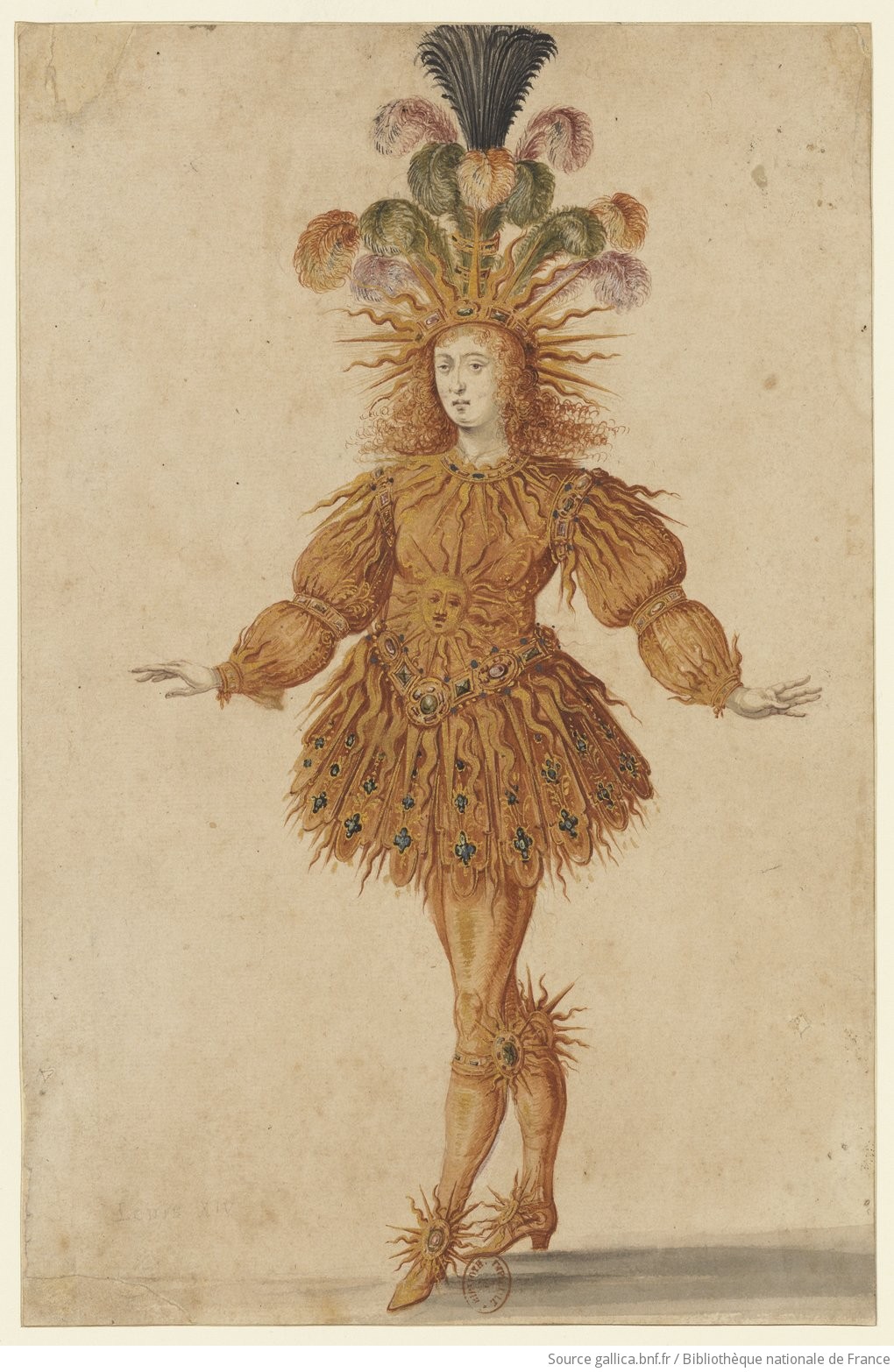
Henri de Gissey, Louis XIV as Apollo in Ballet de la Nuit (1653). Sovereignty becomes costume, choreography, cosmic office, and public order in one body. Click to open the full image.
Early modern courts concentrated the grammar in the sovereign’s body. Costume, procession, controlled access, architecture, festival, and punishment made hierarchy visible. Mass print distributed the drama beyond the court, and radio joined national audiences in shared time. Cinema supplied collective dreams, while television made government a continuous performance. Networked media turn participants into relays, critics, actors, witnesses, and measurements.
The algorithmic stage is responsive. Recommendation systems discover which scene holds attention, rival factions generate variations, and institutions adopt the versions that move the audience. The script can therefore evolve during performance. The audience talks back, but its response is also measurement. The Reality Production Engine begins at this threshold, where feedback corrects the production and turns its successful representation into administrative and material fact.
Recurring Dramatic Forms
The mascot drama compresses an apparatus into a person, office, flag, nation, or symbolic object. Love and hatred remain fixed on the mascot while custody continues through budgets, appointments, treaties, databases, and succession. Israel as the Postwar Vessel follows statehood as a performative utterance and bidirectional mascot.
The crisis drama converts threat into exceptional permission. Its force comes from the joining of a genuine danger, a prepared interpretation, and an executable response. The Pandemic Preparedness Industry, The COVID Working, and The Manufactured Pretext examine different layers of that conversion.
The scripted-conflict drama binds opposing teams to a common stage. Visible combat preserves participation while shared limits protect deeper continuity. The Two-Party Theater follows this form in American electoral politics.
The disclosure drama administers revelation through denial, leak, witness, ridicule, partial confirmation, official inquiry, and renewed suspension. UAP Disclosure Theater follows this rhythm around the anomalous archive. Managed Awakening and Capture follows the same containment problem when authentic rupture enters spiritual and countercultural life.
The attention-sink drama fills the field with a charged but low-consequence conflict while upstream decisions pass through quieter channels. Celebrity scandal, partisan outrage, royal ceremony, spectacular sport, and ritualized hearings can occupy this function. The determining question is what the scene authorizes, conceals, funds, or displaces.
The Stage Is Inhabited
The public drama has nested authors. Human planners begin operations that institutions elaborate and media select into transmissible scenes. Audiences embody roles, while laws, budgets, archives, and habits retain the result. Egregores names collective forms that gain continuity through repeated attention and institution. The Phenomenon and the Trickster introduce synchronicity, anomaly, reversal, and symbolic excess beyond any participant’s intention.
The Trickster is a destabilizing co-author. It exposes concealed premises, makes literal plans betray themselves, intensifies symbolic correspondences, and turns controlled revelation into genuine breach. A production can summon the archetype it intended to simulate. The stage answers back.
Nested authorship preserves the human custody chain. Orders, funding, access, fabrication, censorship, coercion, and institutional rewards remain attributable acts. Higher-order agency explains why an operation grows beyond its designers and symbols recur across compartments. It also explains the audience’s completion of the rite and the drama’s reversal upon its authors. Cosmic causation acts alongside human accountability and consequence.
This inhabited stage also prevents the opposite error: reducing the entire production to a committee whose members possess total control. Planners work inside fields they inherit and only partially understand. Their operations can be amplified, parasitized, exposed, or redirected by institutional dynamics, collective forms, anomalous agency, and the response of the world itself. The World That Reads Back owns this wider participatory relation. The Plan follows the same nested authorship upward into providence and the civilizational Magnum Opus.
The Script Conceals Its Authors
The invited character draws attention away from the production apparatus. Public argument circles heroes and villains while upstream authors choose the genre, emergency timing, cast, images, and exposition. These authors also measure the audience and prepare the climax. The visible conflict conceals the decisions that gave it form.
The custody chain survives beneath the performance. Orders, money, access, appointments, technical systems, editorial repetition, legal authority, and retained infrastructure connect the scene to its producers. The first account establishes the drama; the administrative object that remains after the denouement reveals its purpose.
Compartmentation protects authorship. One department prepares policy, another releases imagery, another certifies interpretation, another measures the audience, and another retains the new power. Most participants know only their cue. The production therefore presents coordinated intention as spontaneous institutional response.
The deepest concealment occurs when the audience mistakes its assigned role for private judgment. It supplies grief, outrage, allegiance, denunciation, and memory, giving the screenplay a social body. Human design, institutional momentum, and the inhabited symbolic field then converge inside a drama whose authors can disappear behind the reality they produced.
Routes Through the Theater State
The shortest mechanism route is Narrative Control → The Theater State → The Reality Production Engine → Mass Ritual. It follows an event from framing through staging and feedback into collective participation.
Hollywood as Initiation and The Captured Press develop rehearsal and daily distribution. False Light and the Capture of Appearance develops control of the visible scene. The Distributed Control Laboratory, The Ghost in the Machine, and The CIA as Cult develop further production departments.
Crisis dramaturgy runs through The Manufactured Pretext, The Pandemic Preparedness Industry, and The COVID Working. September 11 as Operational Event and Nukes provide further crisis cases. Political forms appear through Israel as the Postwar Vessel, The Two-Party Theater, UAP Disclosure Theater, and One World Under Mind Control.
Managed Awakening and Capture and Permission as a Reality Gate follow the acquisition of custody. The Counter-Current Within the State and The Counter-Operation Record follow counter-operation. The Plan develops the larger synthesis in which the stage becomes a forge.
References
Francis Bacon’s New Atlantis supplies the early modern architecture of controlled discovery, covert collection, sensory deception, internal restraint, and selective disclosure.
James George Frazer’s The Golden Bough supplies the comparative archive of sacred kingship, sacrifice, ritual office, and cosmic legitimation. Clifford Geertz’s Negara: The Theatre State in Nineteenth-Century Bali gives the theater-state formulation its classic anthropological form. Victor Turner’s Dramas, Fields, and Metaphors supplies the sequence of breach, crisis, redressive action, and reintegration or schism. Kenneth Burke’s A Grammar of Motives supplies the dramatistic pentad.
Georges Balandier’s Political Anthropology and Power on Stage treat theatricalization as an operating property of political power. Murray Edelman’s Constructing the Political Spectacle shows political language producing problems, enemies, leaders, and public reality. Daniel Dayan and Elihu Katz’s Media Events analyzes the programmed broadcast forms of contests, conquests, and coronations. Guy Debord’s The Society of the Spectacle, Jean Baudrillard’s Simulacra and Simulation, and Daniel Boorstin’s The Image trace the growing power of representation and the pseudo-event.
Paul M. A. Linebarger’s Psychological Warfare gives the mid-century operational lineage for political influence. Michael A. Aquino and Paul E. Vallely’s “From PSYOP to MindWar” states the maximal doctrine of strategic perception management. U.S. Army Techniques for Joint Military Psychological Operations and Military Information Support Operations formalize target-audience analysis, influence activity, dissemination, and assessment. Edward Bernays’s Propaganda and Walter Lippmann’s Public Opinion supply the earlier public-relations and opinion-management foundations.
Henri de Gissey’s Louis XIV as Apollo in Ballet de la Nuit is held by the Bibliothèque nationale de France; the Gallica source record and public-domain image preserve the plate used above.
