Transmission changes carriers while preserving an operation. Breath becomes ritual, and ritual becomes text. Text enters a school; a ruined school leaves symbols that a later seeker reactivates as practice. Enough structure must cross each translation to restore capacity in another human being.
Truth requires a carrier to survive. Bodies, practices, stories, texts, buildings, institutions and archives preserve different parts of an inheritance. A transmission chain connects a recoverable teaching, method, symbol or skill to later practice. Teacher lineages, textual genealogies, reconstructed revivals and independent rediscoveries establish different connections.
Resemblance, persistence and secrecy answer different historical questions. A modern practice can work without descending intact from Egypt. An ancient doctrine can survive for millennia while remaining false. Distinguishing these relations protects both historical accuracy and operative recovery.
Human beings preserve, lose, translate, weaponize and rediscover methods for transforming consciousness. The war concerns their carriers, access and interpretation. Control of transmission determines who can recover a method and which purposes it serves.
Three Pages, Three Questions
The Traditions maps major streams and their teachings. Tradition Convergence identifies operations that recur across those streams. The transmission chain follows a teaching through rupture, custody and return after apparent loss.
Four Relations
Every continuity claim belongs first to one of four relations.
Documented Genealogy
A documented genealogy names carriers and transfers. Teachers, dated manuscripts, correspondence, translations, institutional records, ritual manuals and material descent make a proposed path historically inspectable. Evidence can remain incomplete along that path.
Platonic texts crossed late-antique, Byzantine, Arabic and Renaissance contexts. Named Sufi silsilas, manuscript families of the Corpus Hermeticum and Buddhist teacher lineages preserve other traceable transfers.
Influence and Diffusion
Influence develops when concepts, texts, people or techniques cross cultures and change within the receiving system. Hellenistic Egypt brought Greek, Egyptian, Jewish and other currents into contact without erasing their differences. Arabic and Persian scholarship carried, criticized and extended Greek philosophy, medicine, astronomy and alchemy. Latin Europe later received that transformed inheritance.
Translation creates possibilities while changing the inheritance. Diffusion therefore has a history of transformation as well as preservation.
Structural Recurrence
Shared human conditions support recurrent discoveries. Bodies, attention, mortality, social dependence, dreams, grief, desire and altered states give traditions recurring problems. Purification, ordeal, symbolic death and rebirth recur as responses. Silence, breath regulation, sacred enclosure, teacher authority and reintegration also prepare a human instrument.
Recurrence supports comparison. Shared human conditions can generate similar tools more than once, so each proposed source must be traced through its own carriers.
Initiatic Reactivation
An old text or symbol can let someone reconstruct an operation without an intact living lineage. Renaissance Hermeticism, nineteenth-century occult revival, modern ceremonial magic and contemplative hybrids include such reactivation. Inheritance and reconstruction can coexist in one practice.
Reactivation can produce profound recognition. It remains a reconstruction where the documentary record has a gap. The recognition alone cannot supply a missing historical transfer.
The Carriers
Transmission is an engineering problem with several media.
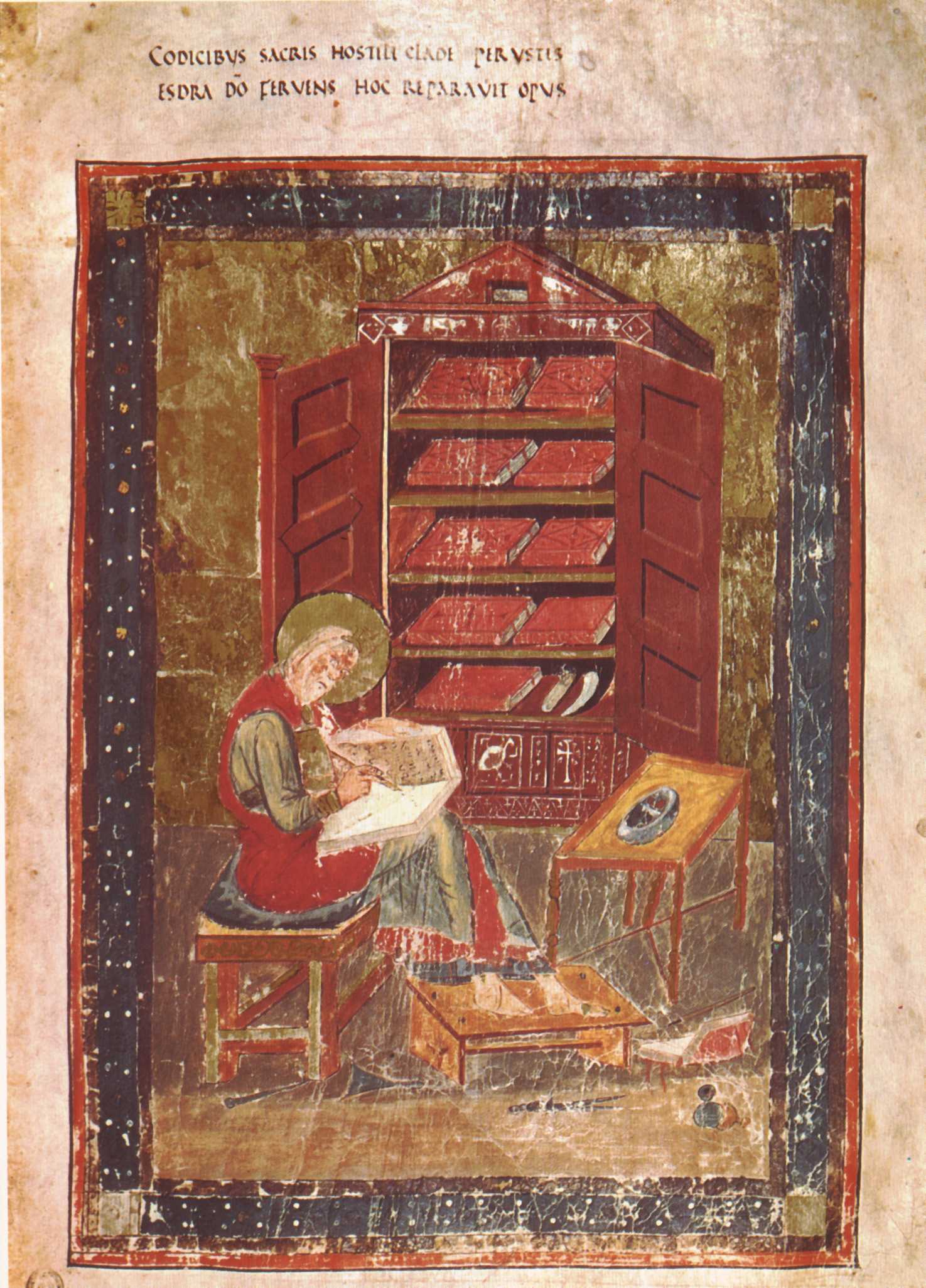
Ezra the scribe before a book cupboard, Codex Amiatinus, fol. 5r (early eighth century). A trained keeper, a library, and the copying hand carry a world through destruction. Click to open the full folio.
| Carrier | What it preserves | Characteristic failure |
|---|---|---|
| living body | gesture, timing, attention, tacit skill | death, charisma, abuse, memory drift |
| oral lineage | adaptable instruction, communal correction | compression, embellishment, restricted access |
| text | exact phrases, sequence, commentary, wide replication | mistranslation, canon capture, decontextualization |
| ritual | embodied order, role, symbol, collective rhythm | empty repetition, authority capture |
| institution | training, archives, succession, resources | bureaucracy, monopoly, preservation of rank over method |
| art and architecture | durable form, orientation, proportion, public memory | speculative decoding, destroyed context |
| distributed archive | redundancy, search, rapid copying, cross-reference | noise, platform custody, synthetic provenance |
Each carrier preserves a dimension while losing another. Writing fixes words but loses a teacher’s timing. Ritual preserves sequence while meaning can empty out. Institutions fund long training and accumulate incentives to protect themselves. Digital abundance prevents local destruction while obscuring provenance.
Transmission Loss follows which layers fail during transmission. Phonemic structure and material instructions disappear earliest, while narrative structure and symbolic geometry travel farther. The easiest material to copy often carries the least operative specificity.
The Ark as Retention Architecture extends retention across civilizational rupture. Seeds, tools, texts, skills, relationships and decision rights determine what people can rebuild.
A Comparative Chronology
Survivals, exchanges, extinctions and revivals form the known historical record. A continuous relay from Gobekli Tepe to the present exceeds what that record establishes.
Around 9600 BCE, communities at Gobekli Tepe built monumental ritual architecture. Enclosures, pillars, animal imagery and deliberate burial changed the archaeological account of hunter-gatherer organization. Those remains establish no lost global mystery school, encoded precession or direct descent into Egyptian and European esotericism.
Egyptian religion joined temples, priesthoods, funerary technologies, divine images, ritual speech and transformed life after death. Greek and Roman writers later presented Egypt as a source of ancient wisdom. Real exchange and later idealization both enter the record. “The Egyptian mystery schools” names a comparative function. It cannot identify one institution operating unchanged across dynasties.
Greek mystery cults, Pythagorean communities, Platonism, Stoicism, Judaism and Christianity met within dense eastern Mediterranean networks. Philosophical schools joined argument to exercises and a way of life. Each group supplied its own initiation and secrecy.
Hermetic writings emerged in Hellenistic and Roman Egypt, mainly during the early centuries CE. They combine Greek philosophical language with Egyptian settings and religious imagination. Gnostic movements developed within the same broad environment through diverse Christian, Jewish, Platonic and other inheritances.
Jewish mysticism has ancient roots. Kabbalah emerged as a recognizable historical formation in medieval Provence and Spain, especially during the twelfth and thirteenth centuries. The Zohar appeared in late thirteenth-century Castile. Later Kabbalists transformed the system again.
Sufism developed within Islam from the seventh century onward. Quranic revelation, ascetic practice and prophetic example met the intellectual worlds through which Muslims moved. Named lineages became central to many orders. This chronology excludes Sufism from an 800 BCE convergence.
Alchemy developed through Egyptian, Greek, Arabic, Persian, Indian, Chinese and European histories. Their metallurgy, medicine, laboratory craft, cosmology and spiritual interpretations retain major differences. Shared language of purification cannot erase those differences.
Renaissance humanists recovered and translated Greek texts, including the Corpus Hermeticum. Ficino, Pico, Bruno, Christian Kabbalists, natural philosophers and magicians assembled new syntheses. Changed political and theological conditions gave the inheritance new possibilities. Their work joined reception with invention.
Rosicrucian manifestos, Freemasonry, ceremonial magic, Theosophy, occult revival, depth psychology and Traditionalism belong to modernity. The Fourth Way is Gurdjieff’s twentieth-century synthesis, including its older materials. Freemasonry has documented early-modern lodge history. Direct institutional descent from cathedral guilds, the Templars, Egypt or Solomon requires evidence beyond shared symbols.
Translation, contested custody, creative reconstruction and recurrent recognition give the chain its historical movement. Distinct dates show how the operation changes carriers.
Encoding and Concealment
Myth, allegory, number, architecture, ritual sequence, laboratory language and sacred drama encode esoteric teachings. Their encoding serves several functions:
- it compresses relations that prose handles poorly;
- it binds intellectual content to memory and action;
- it permits layered reading;
- it protects a method from hostile authority;
- it marks group membership;
- it delays access until a student acquires prerequisite concepts.
Encoding can also conceal fraud, protect hierarchy and prevent correction. The claim “Only initiates can understand” can immunize every failed proposition from challenge.
Decode through independent comparisons. Establish the artifact’s date, language and historical vocabulary. Compare independent witnesses. Distinguish the maker’s demonstrable encoding from a later interpreter’s projection. Test the recovered operation where testing is possible.
A symbol compresses relations that must still be recovered accurately. Its density cannot authorize every interpretation.
The Carrier Is Changed
Transmission changes its carrier. Learning reorganizes memory and attention, while translation forces distinctions absent from an original language. Public teaching changes the teacher’s social role. Powerful material can deepen a life or consume it.
Isaiah’s burning coal, the scrolls eaten by Ezekiel and John, Prometheus’s binding and Hermes’s boundary crossings dramatize the carrier’s changed condition. Their images preserve the consequences of participation. They establish no requirement that every true message wound its messenger.
A carrier therefore needs boundaries:
- the right to refuse;
- a way to discharge the role;
- peers who can challenge interpretation;
- separation between message and identity;
- ordinary relationships not governed by the transmission;
- a record that others can inspect;
- a dismissal or shutdown procedure where altered states or attributed agencies are involved.
The person who becomes indispensable to the message has become a single point of failure.
Custody and Capture
Custody changes an inheritance without destroying it. A church preserves scripture while narrowing its reading; a state keeps an archive while classifying decisive files. A platform distributes teaching through opaque rankings, while a school makes access require obedience. The content survives under changed terms.
Managed Awakening and Capture begins at this custody layer. The questions are direct:
- Who selects the initiate?
- Who owns the site, device, archive, or transcript?
- Who supplies the interpretation?
- Which outputs leave the room?
- Can the operator stop?
- Does competence transfer, or does access remain rented?
Preservation without sovereignty can carry the technique while reversing its purpose.
Channeling and Direct Reception
Channeled, visionary and contact corpora enter transmission history through received messages and the communities they organize. The Ra Material, The Seth Material and [[Philip K. Dick|Dick’s Exegesis]] preserve different reception archives. Their internal structure, influence, psychological effects and verifiable information can be examined.
Claimed ancient or nonhuman authorship establishes no documentary descent by itself. First-person reception and historical transfer supply different forms of evidence.
Genuine contact needs no fabricated genealogy. A psychologically generated corpus can also contain insight without acquiring an external author. Distinguishing the receiving experience from documentary descent protects both cases.
Meade Layne and the Borderland Sciences joined witness reports, trance communications, editorial comparison, apparatus construction and field trials in one archive. Each retained its receiving conditions. A received design acquired historical consequence when builders embodied it. Independent verification of its named source remained a separate question.
When the Chain Is Alive
A chain becomes visible through named content, carrier, transfer, transformation and reception. Symbols reveal resemblance, texts reveal dependence, teachers name transfers and institutions preserve records. Each relation identifies a recoverable part of the path. It also shows where creative reconstruction entered.
A practice that reliably restores a defined capacity demonstrates usable transmission, even across a broken genealogy. The result belongs to its operating conditions. Origin, metaphysical explanation and authority still require their own support.
A living chain transfers freedom with its method. The next carrier can practice, verify, adapt, refuse and transmit without renting access from the previous custodian.
Routes through the transmission chain
Retention and Method
- What Survives the Turn · The Ark as Retention Architecture
- The Stone That Dreams of Waking — physical persistence becoming inscription, engineered memory, and a responsive archive
- Cast Stone — a material recipe carried through monuments after the workshop has disappeared
- Mystery Schools · Threshold Operations
- The Lineage That Remembers — the returning initiate, prepared lineage, waiting school, and persistent egregore as one continuity system
- The Transmission Chain as Vocabulary Project
- Sacred Language · The Golem · Encoding Systems
- Ontogenesis — the passage from transmitted distinction through embodiment and memory into a durable being or world
- The Seed and the Vessel — how an available form becomes recognizable, incarnate, and easier for a later receiver to recover
- The World That Reads Back — reception becoming address, embodiment, consequence, and retained initial condition
Ancient and Late Antique
- Gobekli Tepe · The Egyptian Mystery Network
- The Cabiri and the Forge Before History
- Zoroastrianism and the First Naming
- Plato and the Cave · Hermetics · Gnosticism
- The Sacred Mushroom and the Cross — a disputed reconstruction of the Christian sacrament and a durable case study in aperture loss
Medieval and Early Modern
- Kabbalah · Sufism · Alchemy · Rosicrucianism
- The Bible as Initiatic Technology
- Dante Alighieri · Giordano Bruno
Modern Reconstruction
- The Fourth Way · Manly P. Hall
- Antoine Faivre · The Secret Destiny
- The Plan — the human transmission chain inside the higher-order providential operation
- Meade Layne and the Borderland Sciences — psychical research, living craft, received apparatus, and the forgotten unified ecology
- The Invisible College Comes Online — the invisible college becoming a planetary digital network
- GATE Kid Reunion — gifted selection, dispersed latency, and the cohort’s networked return
- The Ether Net — imagination and spiritual presences finding expression through networked machines
- The Top of the Egg — the return through matter and the contest over externalized human faculties
- Tradition Convergence · Esoteric Media
Institutional Continuity and Capture
- The Empire Never Ended — continuity through survival, transmission, revival, functional inheritance, and recurrent attractor
- The Custody of the Vessel — the modeled polarity between initiatic development and institutional capture
- The Norwegian Apex Hypothesis — the evidence dossier separating documented networks from the unsupported apex claim
- The Society of Jesus · the Sovereign Military Order of Malta
- The Theater State · The Elite Coordination Apparatus
- the Sabbatean-Frankist current · The Egyptian Mystery Network
Reception Archives
Channeling and Contact Sources
- The Entity Taxonomy — separates claimed source, receiving door, autonomy, direction, and evidence
- The Council of Nine — the Puharich network and the claimed Nine source
- The Ra Material — the three-person contact apparatus and Law of One corpus
- The Seth Material — the Roberts–Butts circuit and its stable anomalous voice
- The Holy Guardian Angel — guardian contact as initiatic relation rather than cosmic rank
- Prophecy as a Control Signal — revelation, warning, performative effect, and source evidence
The Measure
The chain is alive when another person can reconstruct the operation without surrendering judgment to the carrier.
Preserve enough structure to recover the practice. Preserve enough freedom to correct it.
References
Faivre, Antoine. Access to Western Esotericism. SUNY Press, 1994.
Hanegraaff, Wouter J. Esotericism and the Academy. Cambridge University Press, 2012.
Principe, Lawrence M. The Secrets of Alchemy. University of Chicago Press, 2013.
Hadot, Pierre. Philosophy as a Way of Life. Blackwell, 1995.
Scholem, Gershom. Major Trends in Jewish Mysticism. Schocken, 1941.
van Ess, Josef. Theology and Society in the Second and Third Centuries of the Hijra. Brill, 2017–2020.
Schmidt, Klaus. Göbekli Tepe: A Stone Age Sanctuary in South-Eastern Anatolia. Ex Oriente, 2012.
Newton, Isaac. Letter to Robert Hooke, 5 February 1675/76.
Codex Amiatinus, fol. 5r, Ezra before a book cupboard. Early eighth century. Biblioteca Medicea Laurenziana; public-domain reproduction via the Wikimedia Commons source record.
