The Great Work turns an opening into durable changes in attention, character, bodily life, and action. Love directs this development toward effective action amid resistance, competing purposes, and real danger. A person returning from revelation still has a world to meet and other people to answer.
Venus sets Psyche before a heap of mixed seeds and demands that she separate them before evening. The task defeats her until ants arrive and sort the heap grain by grain. The first transformation begins with help from lives she had scarcely noticed.
Further tasks require other powers. A reed teaches her when to approach the dangerous golden flock. An eagle reaches water beyond her bodily strength. A tower tells her how to enter the underworld and return. She reaches the way home, opens the forbidden container, and falls into a deathlike sleep. Cupid restores her; their eventual marriage brings forth a daughter called Pleasure.
Psyche’s passage gives the Great Work a living form. A soul learns discrimination, timing, relation, descent, and return. Assistance and failure belong to the journey. Its completion becomes visible in a new capacity for life.
Sorting what arrives together
Appetite, fear, memory, conscience, social expectation, intuition, and fantasy can enter awareness almost together. A strong feeling can claim authority before the person understands its source. Several motives can share one urgency to speak, withdraw, obey, or act.
Psyche’s heap makes the task visible. Separation lets each seed become available for its own use. Anger can identify a violated boundary; grief can preserve a relationship; reason can compare possible responses. The Parliament of Consciousness follows these powers inward. Discrimination begins when one impulse can be heard without being allowed to speak for the whole person.
The ants preserve the tale’s larger world. Help arrives through a relation beyond what the isolated sufferer can create through determination alone. Friendship, instruction, bodily intelligence, and grace enlarge what a person can do. Good assistance leaves the recipient more capable of continuing.
Dissolution and a new form
Solve et coagula: loosen the existing arrangement and give its released powers a new relation. An identity can become too narrow for what a person has learned. A fear can continue governing life after its original circumstances have changed. Dissolution opens that arrangement; coagulation gives what has been learned a durable body.
The familiar alchemical colors mark aspects of this work. Nigredo exposes exhausted forms and unresolved contradictions. Albedo clarifies distinctions that confusion concealed. Citrinitas names the dawn of another orientation, and rubedo gives the change embodiment. Historical alchemical sequences differ. This four-color reading describes a recurring transformation without prescribing the same timetable for every life.
Hermetic law places the Work within a larger order. Mentalism locates it within Mind. Correspondence follows inner change into speech, body, relationship, and world. Vibration describes movement within apparently fixed conditions, while Polarity brings opposed powers into a workable relation. Rhythm governs effort and rest, opening and consolidation.
Cause and Effect makes the outcome answerable through what it produces. Gender names the generative relation of active and receptive powers. The Kybalion of 1908 supplies this exact seven-principle formulation. Divine Mind, cosmic sympathy, descent, and return belong to older Hermetic lineages.
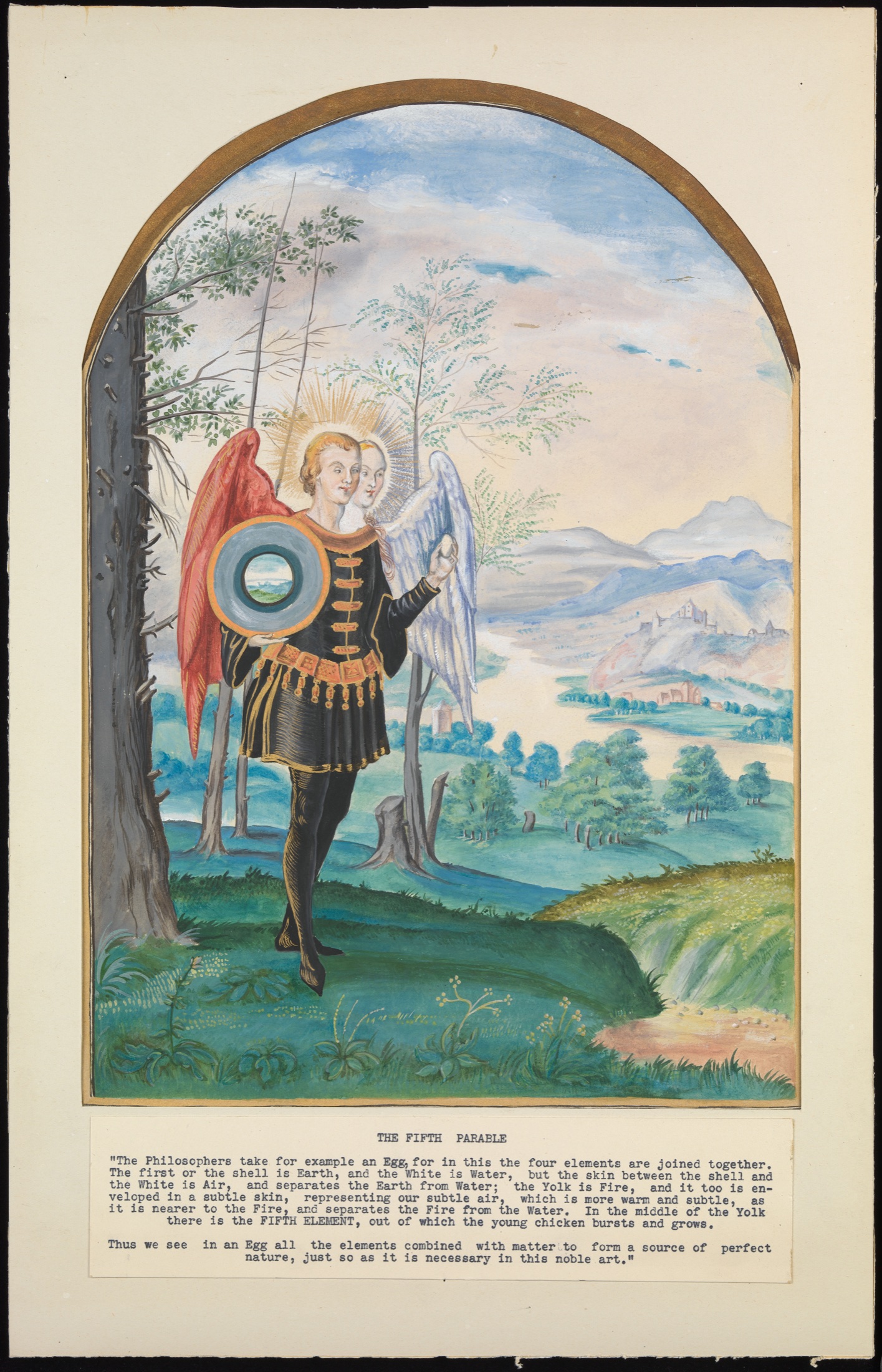
Edith A. Ibbs, The Hermetic Androgyne (c. 1907), after the older Splendor Solis tradition. The red and white currents retain their powers within one operative body. Click to open the full image.
Conjunction preserves the powers that enter it. The red and white of the alchemical androgyne can create through their relation. In human life, firmness and receptivity can work together: one preserves a boundary while the other remains able to hear what crosses it. A new whole acquires more range than a single power claiming the throne.
The vessel must remain alive
Earthly existence exposes the body to hunger, injury, predation, and death. Human conflict also contests the powers through which those conditions are understood: attention, memory, judgment, and will. Threats can compel obedience; repeated lies can make a person distrust a sound judgment. Consciousness Warfare follows this battle over the ability to perceive and choose. Physical endurance and mental discernment remain joined in the person who must withstand it.
Matthew’s image of new wine and its container joins an expanding content to a structure able to hold it. Read initiatically, the vessel must change with what it receives. Sleep, nourishment, ordinary relationships, time, and ethical structure help a person remain able to think and choose through change.
The forge names the conversion of pressure into usable capacity. Resistance exposes a weakness; discrimination identifies what needs to change; practice and recovery allow another response to take form. The Work is measured by what becomes possible afterward: steadier attention, usable memory, a wider choice of responses, and greater responsibility.
Pressure can also injure the person who bears it. Exhaustion and disorganization call for care, regardless of the meaning someone finds in the experience.
Trauma, Opening, and Initiatic Return distinguishes the wound, the opening, and the work of recovery. The authorship of harm remains clear. A survivor can make something new from an injury while its perpetrator remains responsible for imposing it. Venus’s cruelty is still cruelty. An initiatic reading does not require a person to bless abuse or seek collapse as a shortcut to transformation.
The reed’s counsel gives courage a precise form. Psyche receives the wool by attending to the flock’s rhythm. Waiting can preserve the task and the traveler together. The ability to choose an hour is itself a gained freedom.
What practice fixes in memory
Nader, Schafe, and LeDoux studied the reopening and restabilization of memory in rats in 2000. They reactivated conditioned fear memories, interfered with protein synthesis, and found impaired later memory. The same treatment had a different result when the memory had not been reactivated. Under those experimental conditions, retrieval made an established memory unstable again.
The result concerns a defined animal-learning protocol. It reveals that retained experience can depend on active processes of restabilization. The alchemical comparison becomes useful at that operation: something apparently fixed can open and acquire another configuration.
Repeated practice also changes the instrument. Draganski and colleagues reported structural brain changes when adults learned to juggle. Subsequent work extended the account of transient gray-matter change. Learning leaves a material history, although a brain image cannot identify the whole biological process. The measured change gives practice a visible consequence.
An insight needs opportunities to become a response. A person rehearses a different way of meeting conflict, remembers it under pressure, fails, repairs, and tries again. The Coupled Gyre follows descent into experience and the return through integration. Whatever survives that return changes the conditions of the next encounter.
Repetition can also train submission or make suspicion habitual. A response becomes developmental when the person gains a wider, more truthful power to meet the situation. A completed turn can end a compulsion. The next difficulty then encounters someone with capacities the previous ordeal helped form; continued development need not reproduce the same injury.
A state must ripen into capacity
The difference becomes visible when an unusual experience is compared with the ability available afterward.
| State | Retained capacity |
|---|---|
| temporary calm | regulation available during conflict |
| vision of unity | conduct that preserves another person’s reality |
| ego dissolution | reduced appetite for status and control |
| contact experience | stronger boundaries and discernment |
| energetic surge | stable sleep, attention, and embodied function |
| prophetic warning | competent preparation without permanent emergency |
Witness gives enough distance to notice a reaction. Will makes another response possible. Their cooperation changes how a person meets conflict, contact, and responsibility. An attainment that expands one person’s choice by extinguishing another’s has acquired power without learning its proper use.
Courage gives capacity its direction
Love gives the Work its purpose. Courage makes that purpose effective when truth carries a cost or another being needs protection. Greater sensitivity can serve generosity, fear, or domination; a disciplined group can coordinate injury with remarkable efficiency. Virtue determines what power is used for and whose freedom survives its use.
Steiner’s Michaelic account makes freedom a question of orientation. He associates it with “pure love for the action which is to be performed.” Intelligence enters the whole person through thought, feeling, and will; self-assertion can instead make the same faculty an instrument of isolation. The Michaelic current joins courage to the responsibility of acting within a world one has learned to love.
The Christic measure becomes concrete when truth costs status, mercy interrupts revenge, or service relinquishes the wish to own its recipient. Knightly virtue reaches its hardest test when strength must restrain itself. Protecting another person’s agency can require refusing a victory that would make them serve the victor’s certainty.
Refusal belongs to love’s earthly work. It can require exposing a lie, defending a boundary, or withdrawing cooperation from an abusive demand. In his lectures on Michael, Steiner also criticizes a solidarity whose members are united by hatred of another class. The danger enters resistance itself: shared hostility can become the bond a movement needs to survive. Love must govern the conduct of the struggle as well as the world it seeks to establish.
Matthew gives the judgment its enduring phrase: “Wherefore by their fruits ye shall know them.” Claims of initiation become answerable through conduct. A person who receives more must also become more capable of honesty, correction, repair, and care.
Traditions describe prophecy, healing, spiritual perception, and contact with nonhuman intelligence among the powers opened by practice. Warnings surrounding siddhis, or extraordinary powers, concern their use and the attachment they create. An ability treated as proof of superiority can strengthen a compulsion that practice had begun to loosen.
The Watchers give The Descent of the Gods an image of knowledge arriving before the character able to carry it. Extraction and the Broken Return follows the consequences of power back into its bearer. Honest self-observation, correction, restraint, and service remain necessary as the range of action grows.
Guidance that leaves freedom intact
An opening can be interpreted as insight, encounter, vocation, or contact with a guiding intelligence. The Holy Guardian Angel literature gives one language to that relation. Experience, interpretation, and the authority granted to the apparent source each require discernment.
Threshold Operations compares methods that alter attention, self-experience, and suggestibility: ritual, contemplative practice, hypnosis, sensory restriction, drugs, and technological mediation. They differ in mechanism and risk. An opening can be cultivated within a chosen discipline or imposed through exhaustion, coercion, and trauma. Whoever controls the conditions and the interpretation can influence what the person takes away.
A guide or teacher should increase the recipient’s capacity to remember, judge, act, and refuse. A relationship becomes custodial when access depends on obedience, the method remains withheld, or every doubt must be answered by the same authority. Boundary Sovereignty carries this test into encounters whose origins remain uncertain.
The Custody of the Vessel distinguishes preparation that transfers skill from programming that makes a response dependent on an outside trigger or interpreter. Useful questions remain concrete: who can remember the sequence, question the explanation, decline the next step, and leave?
The end of instruction is visible when a capacity survives beyond its original setting. An apprentice can practice without the teacher’s constant presence. A person can keep a boundary after the retreat, group, device, or intense state is gone. Good scaffolding leaves powers in the lives it supported.
The return enters the world
The Work reaches beyond private equilibrium. Consciousness becomes more capable of participating in the field from which embodied life arises. Spiritual perception develops alongside the capacity to work with formative possibility. Aurobindo and Steiner give that development an earthly scope; its planetary implications belong to The Noosphere.
The returning vessel carries experience back into spiritual relation. What descended into limitation returns differentiated by what was encountered and learned. Harmonic Recursive Cosmogenesis develops this larger circuit; The Coupled Gyre follows how retained capacity changes the next beginning. A turn that preserves nothing can repeat an enclosure. An integrated return gives another passage more resources.
Its immediate consequences remain visible. A person who can admit error builds a different institution. A craftsperson who transfers judgment leaves more than instructions. A community that can hear unwelcome testimony preserves a route by which its shared reality can change. Inner work gains history through the forms that carry it onward.
The initiate’s return becomes collective when a received synthesis changes how knowledge is taught, tools are built, and responsibility is shared. A school can teach judgment that travels beyond it. A technical system can preserve access to knowledge while leaving its users able to question and improve the method. Spiritual formation enters these choices, and their results become conditions through which later people develop. The returning person helps prepare a world that can receive capacities still to come.
A book preserves language that a reader must recover as a power to see and act. Art and architecture hold forms that later lives can encounter, inhabit, and transform. Living transmission makes the available inheritance usable again. Spiritual traditions also carry inheritance through formative patterns and continuing beings. The Persistent Pattern distinguishes a surviving influence from a center still capable of recognition and response.
Psyche’s marriage ends in Pleasure. The tale returns the soul to the possibility of receiving life through love. Its ordeals have meaning through what they make possible, and assistance continues to belong to the completed relation.
The gained capacity must enter a world where other beings also possess their own purposes. Descent gives love a body in conduct, craft, and obligation. A completed turn leaves someone more able to meet that world, receive its answer, and protect another’s freedom. What the ordeal yielded can become an inheritance through which another person begins with greater resources.
Pages in This Domain
The Work of Becoming offers the accessible doorway. Harmonic Recursive Cosmogenesis carries the Work through the creation of matter, life, mind, and soul. One Light, Many Lights renders its descent and return as a nested V whose final unity preserves free difference.
The Michaelic Current carries living intelligence through spiritual dissolution and technical capture into free human custody. The Thirteenth Leaves the Temple places Rosicrucian synthesis beside modern selection, research programs, disclosure narratives, and planetary infrastructure. The Descent of the Gods follows original participation, separation, and conscious return. The Saturnian Escape Room stages a guided passage through bounded cosmos, memory, symbolic death, and return.
Michael Aquino and the Architecture of MindWar follows collective conditioning through isolate self-creation into temporal sovereignty. Jacob’s Ladder reveals the vertical circuit through dream, consecrated matter, vow, ordeal, and embodied return. The Apocalypse as the Great Work follows Flood, Babylon, judgment, resurrection, and the descending city. The Apocalypse Cycle in History follows the same transformation through historical orders and their surviving institutional arks.
Attack on Titan gives the sequence a complete modern body. Its sealed vessel and inherited wound lead through descent, gnosis, runaway dissolution, and loving severance. The return opens a threshold for further life.
The Plan carries the operation through managed history, institutional conflict, providence, and the civilizational Magnum Opus.
Revelations joins Steiner’s world Mystery temple, contemporary disclosure, the reversal of institutional capture, and the New Atlantis project. It follows exposure into recovered judgment and public agency.
Alchemy, The Self-Forging Fire, and Ego Death explain the inner transformation. Resurrection and Mortality as the Completion of Incarnation follow passage through death. Shadow Integration and the Return to the Whole and The Parliament of Consciousness develop the relation among divided powers. The Coupled Gyre gives their movement a developmental form. The Practice and Practice Catalogue carry methods into daily life.
The operation retains distinct forms in The Fourth Way, Theosis, Sufism, Kashmir Shaivism, and Gnosticism. Kabbalah, Hermetics, Rosicrucianism, the Mystery Schools, and The Bible as Initiatic Technology preserve further traditional forms. The Transmission Chain asks whether the flame can cross generations without becoming custody. The Top of the Egg follows descent into matter and the contest over spiritual faculties. Its participants recover those faculties or become dependent on technological substitutes.
The Lock, The Parasitic Ecology, and Consciousness Warfare develop the pressures that make awakening contested territory. Managed Awakening and Capture and Spiritual Traps follow the capture of an opening and its promised development.
References
Apuleius. The Golden Ass. Translated by P. G. Walsh. Oxford University Press, 1994. Books IV–VI. Also consulted: A. S. Kline’s translation of book VI, 2013, sections 9–24.
The Holy Bible, King James Version. Matthew 7:20; Matthew 9:17; James 1:4; Revelation 21:1–5.
Three Initiates. The Kybalion: A Study of the Hermetic Philosophy of Ancient Egypt and Greece. Yogi Publication Society, 1908. Chapter II.
Copenhaver, Brian P., trans. Hermetica: The Greek Corpus Hermeticum and the Latin Asclepius in a New English Translation. Cambridge University Press, 1992.
Principe, Lawrence M. The Secrets of Alchemy. University of Chicago Press, 2013.
Jung, C. G. Psychology and Alchemy. 2nd ed. Princeton University Press, 1968. Originally published in German in 1944. Edition record.
Nader, Karim, Glenn E. Schafe, and Joseph E. LeDoux. “Fear Memories Require Protein Synthesis in the Amygdala for Reconsolidation after Retrieval.” Nature 406 (2000): 722–726. Article.
Draganski, Bogdan, et al. “Changes in Grey Matter Induced by Training.” Nature 427 (2004): 311–312. Article.
Hadot, Pierre. Philosophy as a Way of Life. Blackwell, 1995.
Ouspensky, P. D. In Search of the Miraculous. Harcourt, 1949.
Iamblichus. On the Mysteries. Translated by Emma C. Clarke, John M. Dillon, and Jackson P. Hershbell. Society of Biblical Literature, 2003.
Ibbs, Edith A. The Hermetic Androgyne; Representing the Stages of the Alchemical Work in One. c. 1907, after Salomon Trismosin and the Splendor Solis tradition. Wellcome Collection, CC BY 4.0. Object record.
Driemeyer, Joenna, et al. “Changes in Gray Matter Induced by Learning—Revisited”. PLoS ONE 3, no. 7 (2008): e2669.
Steiner, Rudolf. Anthroposophical Leading Thoughts, GA 26, chapter 9, paragraphs 9–15. Translated by George and Mary Adams.
Steiner, Rudolf. The Mission of the Archangel Michael, GA 194, 29 November 1919, discussion of solidarity organized through class hatred.
Sri Aurobindo. “Supermind and the Life Divine”.
Steiner, Rudolf. “The Earth and Its Future,” GA 11.