Consensus reality is the shared waking dream, encountered through consciousness and given continuity through bodies, language, memory, and institutions. Each person enters a world already furnished with names, customs, measures, and expectations. Earlier generations’ imaginings and constructions become the conditions within which later minds learn to imagine and build.
Two people can enter the same room and experience different situations. One hears an insult where another hears a joke. A familiar uniform reassures one person and alarms another. The room is shared; the histories through which it becomes meaningful differ.
Thomas Wright’s 1750 field of eyes supplies a companion image. His final plates place many creations within divine comprehension. Read beside reality tunnels, the engraving invites a distinction between a field of vision and the whole to which it belongs.
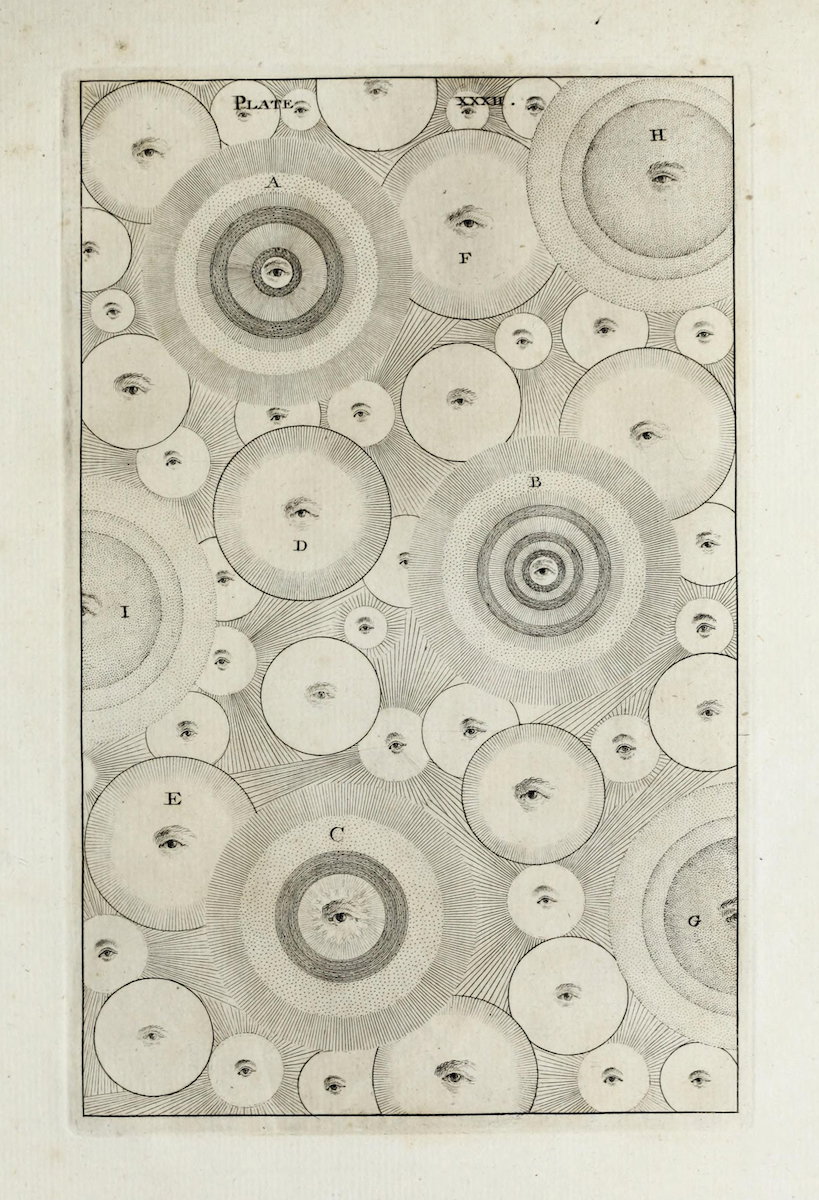
Thomas Wright, Plate XXXII from An Original Theory or New Hypothesis of the Universe (1750). The plate shows sections of the many creations described in Letter IX, gathered within divine comprehension. Click to open the full image.
The worlds we learn to inhabit
Robert Anton Wilson used the language of reality tunnels, crediting Timothy Leary for the term. Memory, expectation, language, and habit select what becomes noticeable and how it is interpreted. A tunnel gives experience continuity. Its familiar distinctions let a person recognize danger, keep an appointment, understand a promise, and find a way home.
Shared education and symbols bring parts of these tunnels into alignment. Children learn what counts as a respectable question, which experiences have names, and whose testimony is likely to be believed. Later they encounter those distinctions in workplaces, laws, financial records, and buildings. The inherited interpretation acquires consequences even for someone who rejects it.
Plato’s prisoners inhabit a world organized around shadows. They recognize their order and reward skill in predicting them. Socrates describes their condition: “the truth would be literally nothing but the shadows of the images.” Their proficiency is real; the account within which it operates is incomplete. Education changes what they can recognize as a source of appearances.
The cave exposes a limit within ordinary competence. Familiarity can make an arranged world easy to navigate while concealing how it was presented. The prisoner’s skill leaves the source of the shadows unexamined.
The dream and its ground
The Bṛhadāraṇyaka Upaniṣad approaches experience through sleep. Its dream contains no external roads or chariots, “but he creates the chariots, animals and roads.” A setting, objects, movement, and consequence become present to the dreamer. The passage concerns the self’s relation to the experienced world. It opens a different question from Plato’s inquiry into restricted knowledge.
The cave asks how an appearance becomes the whole truth for its inhabitants. The dream asks how a world becomes present to the one experiencing it. Consciousness Primacy takes the second question into ontology: consciousness constitutes reality, including what appears as matter. The Hermetic cosmos gives this relation a divine and living ground. Mind precedes and sustains the forms through which it becomes manifest. Reality tunnels describe participants’ learned horizons within that world.
The shared dream has many participants and a history. A promise joins two lives; its breach remains consequential after the speaker changes their mind. A neglected field still needs cultivation. Matter gives relation duration and resistance. Participation carries responsibility because other beings continue to act, remember, and answer.
How an interpretation acquires a body
A boundary on a map begins as a line someone can point to. Surveying locates it, and records preserve it. Law assigns rights and duties, while fences and roads make the boundary part of daily movement. Later generations encounter its effects before learning who drew it. Ontogenesis follows this passage from an articulated form to a world capable of reproducing it.
The process requires several kinds of coordination. Bodies select from sensation, memory, expectation, and their own changing condition. The inner sorting of experience begins before deliberate inspection. Separate bodies must perceive enough in common to act together.
Language makes distinctions portable. Measurement supplies shared comparisons. Records let an agreement outlast its original participants. Institutions attach consequences to maintaining or violating it. Each layer gives the next something to retain and act upon.
Preservation and living transmission perform different tasks. A map can survive after its legend becomes unreadable. Recovering its meaning requires people able to interpret the signs, compare them with the land, and teach their use. The Lineage That Remembers follows that return from a preserved form to a living capacity. Inheritance can also preserve a false boundary or an unjust exclusion; receiving it includes the work of judgment.
Physical regularity supplies a different kind of common ground. In Wojciech Zurek’s Quantum Darwinism, the environment carries many records of selected quantum states. Different observers can obtain compatible information from those records. The model explains an aspect of shared classical objectivity through a specified physical process. Its observers need not be minds willing matter into a preferred state.
The consensus engine joins embodied perception, shared interpretation, and durable action. The Rendered World follows the experienced scene; The Architecture of the Dream follows the constraints shared by its participants. An inherited account can guide intelligent cooperation. It can also make its own assumptions difficult to inspect, especially when questioning them carries a cost.
The operation gives the Hermetic principles a public body. Naming differentiates, and active intention meets receptive material. Repetition establishes rhythm; consequence returns to reshape the participants.
Correspondence joins a learned habit to the institution that reproduces the same distinction through records, incentives, and enforcement. How Consciousness Becomes a World follows that complete circuit.
Hyperstition uses the circuit prospectively. A story about the future changes investment, imitation, fear, and policy until the story helps produce its own conditions. Narrative Control governs which futures a population can recognize and organize around; The Theater State supplies their public staging. A compelling image still meets rival wills, bodily needs, and material limits.
Descriptions and the reality they disclose
A change of description reveals relations concealed by another description. Holographic physics provides a precise mathematical case. Ryu and Takayanagi related entanglement entropy to a geometric surface in AdS/CFT. Van Raamsdonk examined how connected spacetime relates to quantum entanglement. The Holographic Principle carries the conditions and implications of those results. A dual description identifies a specific relation between theories within that mathematical setting.
Plato’s Divided Line distinguishes images, sensible objects, mathematical reasoning, and intellectual apprehension. Moving between these levels changes what counts as an explanation.
The Platonic Representation Hypothesis asks a different question. Huh and colleagues examined convergence among representations learned by artificial systems. A shared structure can emerge through different routes of training and measurement. Calling this Platonic identifies the authors’ proposed interpretation. Their result concerns learned representations, while Plato’s Forms carry a further philosophical commitment.
These distinctions make comparison productive. A mathematical duality, learned representation, and imaginal encounter each disclose something through a particular mode of access. Corbin’s imaginal names an order of reality and its mode of perception within the traditions he interprets. Calling it private fantasy would erase that order before examining what its perception discloses.
A shorter description can make a regularity easier to recognize. Kolmogorov complexity formalizes description length as the shortest program producing a specified object. Compression and truth remain different questions: an elegant account of a boundary still has to answer to the land and the people living there.
A common present
A shared opening hour can gather people whose opinions differ. A market deadline coordinates buyers and sellers who expect opposite outcomes. Shared timing gives a population a common present without requiring a common belief. The Consensus Clock follows the institutions and rhythms through which that present is formed.
The synchronizing faculty serves many purposes. It lets neighbors meet, farmers coordinate work, and communities keep a feast. It becomes an instrument of capture when one authority monopolizes deadlines, emergencies, records, and the interpretation of what must happen next. Even bitter opponents can remain coordinated by the same event schedule.
An era extends that common present through music, architecture, technology, custom, and recurring expectation. Its atmosphere teaches people what a future is supposed to look like. Changing the dream requires rhythms through which another future can be practiced and retained. The Temporal Field distinguishes the wider orders of time within which an administrative schedule operates.
Formative participation
Consciousness shapes which possibilities become events, as well as acting through behavior and institutions. Collective development makes the shared world more responsive to intention and imaginal form. Bodies, other wills, inherited conditions, and consequence remain active. This responsiveness develops through history and discipline.
Symbol and intention act more immediately in the imaginal worlds. Embodied Earth carries accumulated relations that impose greater resistance and delay.
Sheldrake’s morphic-resonance hypothesis proposes memory beyond local storage. Previous similar systems influence later ones through similarity. Cultural inheritance already travels through known carriers such as speech, records, and practice. His proposed nonlocal relation differs from that transmission and from a radio receiver’s electromagnetic coupling.
Steiner’s 1907 lecture on Rosicrucianism gives thought an environmental life. He describes thoughts and feelings as realities radiating around an age, reaching even people who have never read the books expressing them. People enter a spiritual atmosphere as well as a culture. Education, art, and disciplined attention help shape the conditions under which later minds awaken.
The same care applies to the instrument. Radio language can distinguish sensitivity from selectivity: receiving more does not ensure interpreting better. Literal radio reception involves a physical carrier and coupling mechanism. Contemplative language often uses tuning for a changed configuration of attention, embodiment, and relation.
The bandlimit names the range of experience and interpretation a participant or community can admit and sustain. Increasing that range requires discrimination among sensation, expectation, symbol, and encountered agency. Contact makes this distinction consequential. An encounter’s vividness and its source’s identity are different questions.
The Descent of the Gods follows changing access across historical and cosmic phases. Participation grows more restricted, and individuality develops under that separation. A later return joins wider access to retained discernment. The Coupled Gyre names the recurrent differentiation and return; what survives each turn changes the next beginning.
The Noosphere carries the collective horizon. Aurobindo and Steiner describe earthly transformation through spiritual development. Argüelles makes its temporal and synchronic dimension explicit. Development changes the relation between consciousness and manifestation. Participants must also preserve, judge, and responsibly embody the capacity they gain.
Learning to answer the world
Every living order requires maintenance. A field needs tending, a memory needs carriers, and a truthful institution needs people willing to check its records. Correction determines how that order learns. An answerable order uses consequences to revise its understanding. A captured order suppresses the consequences that challenge its account.
The Lock closes that route of correction, protecting the extraction ecology from the consequences of its conduct. The Great Work reopens it within the participant. Steadier attention supports examination of interpretation and more truthful action. Courage includes admitting an error when a cherished picture depends on denying it.
Virtue governs how a wider capacity enters other lives. Refusing a coercive demand, preserving a threatened record, and defending someone’s freedom to speak are acts of resistance within the shared dream. The return to conscious authorship begins when participants can inspect and alter the loop that has been reproducing itself through them.
The room remains shared. Another person’s answer can disclose what a practiced interpretation missed. Love gives that encounter a direction by preserving the other person’s freedom to answer. Their answer can require the first person to change.
Awakening enlarges participation when an encounter changes perception and action. The participants then leave a changed world for those who inherit it.
References
Wilson, Robert Anton. “On a Rainy Day,” interview transcript, passage crediting Leary’s reality-tunnel terminology.
Plato. Republic VII, 515c. Benjamin Jowett translation.
Bṛhadāraṇyaka Upaniṣad 4.3.10. Online English rendering and commentary; translator not identified on the accessed verse page.
Zurek, Wojciech H. “Quantum Darwinism”. Nature Physics 5 (2009): 181–188.
Ryu, Shinsei, and Tadashi Takayanagi. “Holographic Derivation of Entanglement Entropy from AdS/CFT”. Physical Review Letters 96 (2006): 181602.
Van Raamsdonk, Mark. “Building Up Spacetime with Quantum Entanglement”. General Relativity and Gravitation 42 (2010): 2323–2329.
Huh, Minyoung, et al. “The Platonic Representation Hypothesis”. Proceedings of ICML (2024).
Corbin, Henry. “Mundus Imaginalis”. Condensed English version, translated by Ruth Horine, Spring 1972.
Sheldrake, Rupert. “Mind, Memory, and Archetype,” part I.
Sri Aurobindo. “Supermind and the Life Divine”.
Steiner, Rudolf. “The Earth and Its Future,” GA 11.
Argüelles, José. Time and the Technosphere, 2002, PDF page 150 for NET.
David Bohm. Wholeness and the Implicate Order. Routledge, 1980.
Jean Baudrillard. Simulacra and Simulation. University of Michigan Press, 1994.
Nick Bostrom. “Are You Living in a Computer Simulation?” Philosophical Quarterly 53.211 (2003).
Thomas Wright. An Original Theory or New Hypothesis of the Universe. London: H. Chapelle, 1750, Letter IX, pp. 83–84, Plate XXXII. Public-domain image via The Getty and Internet Archive.
Rudolf Steiner. “Rosicrucianism”. Düsseldorf, 15 December 1907, GA 98, §§12–14. Steiner Online Library translation; also published in Nature and Spirit Beings: Their Activity in Our Visible World.
Rupert Sheldrake. The Presence of the Past: Morphic Resonance and the Habits of Nature. Times Books, 1988.