At Eleusis, an initiate walked the Sacred Way, fasted and entered the Telesterion. The central disclosure could never be repeated in public speech. Surviving texts preserve the procession and promise while leaving that center dark. The secrecy belonged to the operation. The person who crossed its threshold carried the mystery out of the chamber.
Mystery schools turned knowledge into capacity. Temples, grades, oaths, myths and ordeals prepared a human receiver. Sacred meals, dreams, passwords and mathematical disciplines also entered that preparation. The school joined archive, laboratory, theater and vessel. The transformed initiate carried what information alone could not deliver.
The Initiatory Tradition
The archive preserves transmission through changing carriers. An institution can last centuries and disappear while a text crosses its rupture. Another religion absorbs a symbol, or a later order revives an older form. Practitioners can also rediscover a sequence because the human instrument and threshold still obey its laws. These continuities exceed any single institutional genealogy. The record cannot establish an unchanged chain from Egypt to the modern lodge.
Institutions, texts, symbols, revivals and recurrent operations carry different parts of an inheritance. Legendary genealogies compress loss, borrowing and reconstruction into ancestral names. They can preserve a real affinity. The archive identifies which carrier sustained the relation.
Preparation gives attention a controlled setting for ordeal, symbolic death and revelation. Reintegration gives the disclosure obligation and a route of transmission. Chambers, landscapes, processions, sound, astronomical timing and sacrament once joined the trained body in this sequence. The building supplied an instrument, the rite drove it, and the prepared person completed its circuit. When a temple fell silent, liturgy, story, gesture, discipline or a teacher’s body could preserve parts of its operation.
Common Principles Across Traditions
Initiation interrupts ordinary identity through preparation. Fasting changes metabolism; silence reveals automatic speech; procession removes the candidate from familiar space. Darkness withdraws the visual world. Rhythm, breath, scent, fear, expectation and collective attention reorganize the instrument. This preliminary work creates the receiver capable of meeting the disclosure.
The candidate then crosses a threshold through a tomb, cave, chamber, wilderness or underworld drama. Sacred marriage, visionary sleep and graded ascent supply other crossings. Symbol, ordeal or direct experience exposes the old identity as provisional and makes it die. Return brings a name, image, responsibility, altered relation to death or reproducible faculty. The operation completes through return when that gain changes the next cast.
The Saturnian Escape Room follows this sequence through a navigable cosmos. The traveler meets boundaries that test which powers can govern their passage. Memory and naming help the traveler recognize their origin and the powers at each gate. The guide knows the route and helps the traveler find the next step without taking over their choice. The return reveals whether the traveler can use what they learned after the guide and ordeal are gone.
Secrecy protected timing, concentration and an unfinished transformation. It also let a school convert access into rank and dependence. Retained capacity distinguishes these uses of custody. Living initiation enlarges perception, conduct, responsibility and independent participation. Capture makes its gatekeeper indispensable. The Programmed Dream follows this polarity from the initiatic forge to the civilizational control ratchet.
Egyptian Temples and the House of Life
Egyptian temples joined architecture, kingship, death, medicine, writing, astronomy, number, image and ritual within one order. The later term mystery school identifies a function within that order. Office and preparation graded knowledge, while place gave it an enacted form. Priestly institutions transmitted symbols that survived their custodians.
The Osiris cycle supplied a central pattern. Set dismembers the rightful king, and Isis searches for the pieces. The gathered body makes Osiris sovereign in the invisible world, while Horus restores order among the living. Mortuary texts taught the dead names, gates, transformations, dangers and declarations for passage. Preparation and remembrance made death navigable.
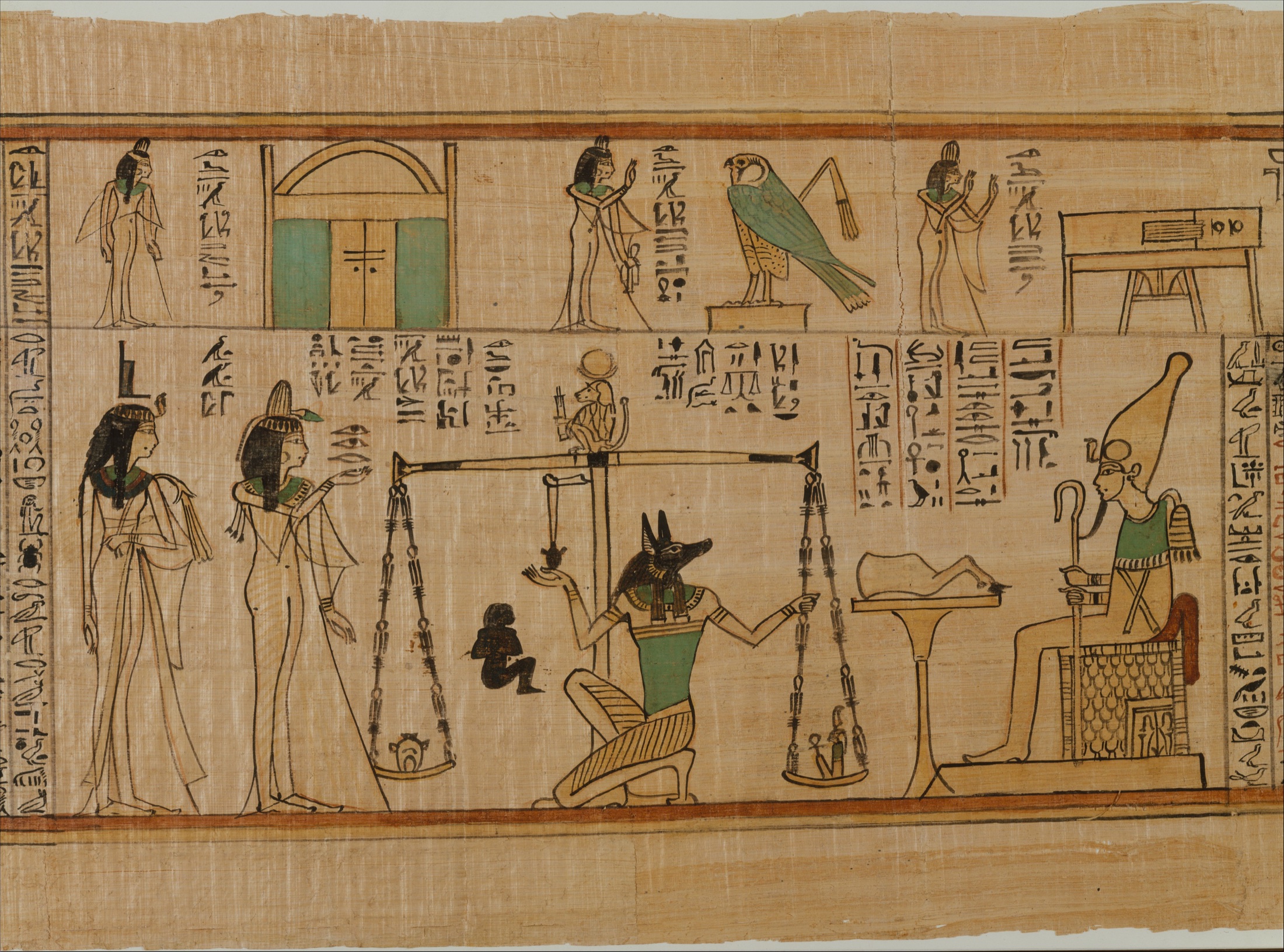
Judgment register from the Book of the Dead for the Chantress of Amun, Nauny (c. 1050 BCE). Passage was treated as a navigable sequence requiring memory, preparation, right relation, and transformation. Click to open the full image.
Isis joins recovery of scattered parts to magical speech, healing, protection and command through the hidden name. Her cult carried initiation into Hellenistic and Roman worlds. A devotee entered a direct relation with the goddess and reorganized life under her protection. Apuleius’s Metamorphoses gives the sequence a literary form: degradation, appeal, purification, revelation and return under obligation.
The Houses of Life preserved texts, trained scribes and joined ritual knowledge with medicine and learned practice. Thoth governed writing, reckoning, healing and sacred speech. Greek identification of Thoth with Hermes helped form Hermes Trismegistus. Egyptian, Greek and later Hermetic currents recognized one another through this composite revealer.
Temple incubation prepared the receiver through purification and a sacred precinct. The petitioner slept, dreamed and returned with healing or instruction. The temple configured reception, and the dream supplied the crossing. Waking conduct determined what survived it.
Eleusis and the Beholding
Initiates traveled from Athens to Eleusis for centuries to enter Demeter and Persephone’s drama. Loss, descent, search and withheld fertility led to return and renewed life. The Lesser Mysteries prepared candidates. The Greater Mysteries joined fasting, procession, ritual speech, the kykeon and entry into the Telesterion. Enacted, spoken and shown things carried the central disclosure.
The center remained secret even after the sanctuary was destroyed. Ancient testimony preserves its effect more clearly than its content. The Homeric Hymn to Demeter declares the beholder blessed and gives the uninitiated a different fate after death. The highest grade, epopteia, means beholding. The initiate became one who had seen.
Eleusis gave knowledge a form that public explanation cannot reproduce. The mystery arranged body, community, place, expectation and myth around revelation. Participants entered the relation that a doctrine could only describe. Changed orientation carried its content beyond the chamber.
Orphic Memory in the Underworld
Orphic currents moved the mystery inward. A soul of divine origin entered embodied limitation and accumulated consequence. Purification and remembrance restored its orientation. Orpheus used music to descend toward Eurydice. His passage gave consciousness an image of entering darkness without losing its orienting chord.
Small gold tablets buried with initiates preserve instructions for the death crossing. The dead must avoid forgetfulness, identify their lineage, approach the water of Memory and speak the formula before continuing among the blessed. The tablets vary, while this operation remains clear. Initiates rehearsed losing ordinary identity, body and social confirmation. Memory had to survive the turn.
Later Orphic texts join death discipline to the dismembered Dionysus and a divided human inheritance. Their doctrinal reconstructions differ across sources. The recurring operation preserves a divine relation within fragmentation. Purification restores the capacity to remember and participate in it.
Pythagorean Life as Initiation
At Croton, the Pythagorean community joined number, music, diet, silence, memory, friendship, cosmology and conduct into one life. Later biographies sent Pythagoras through Egypt and the East as a receiver of older wisdom. The documented school gave mathematics a spiritual function. Proportion learned through sound, number and cosmos had to become proportion within the soul.
The Tetractys gathered the teaching into one, two, three and four. Their unfolding multiplicity returns through the sum, ten. Simple ratios between these numbers generate the octave, fifth and fourth. Hearing, calculation, contemplation and ethical imitation meet within this lawful relation among differences.
Transmigration extends the training beyond one lifetime. Pythagorean traditions describe remembered incarnations and hearing cosmic harmony unavailable to ordinary perception. Biography, initiatic legend and preserved faculty give these stories different source roles. Their ambition remains conscious participation through refined memory and attunement. The order was already sounding before the person learned to hear it.
Mithras beneath the Roman City
The Mithraic initiate descended into a chamber built as a small cosmos. Benches placed the community beneath celestial imagery, while sacred meals joined its members. Grades linked to planetary powers organized ascent through the room’s order. Cosmology acquired an architectural and social body before verbal explanation.
The tauroctony placed Mithras killing a bull at the chamber’s center. Torchbearers, animals, stars and signs recurred around the scene. Astral interpretation belongs to the image, while exact decoders remain contested. Initiates encountered the same charged scene joining sacrifice, fertility, death, cosmic order and fraternity. The image organized a field beyond any single verbal key.
Mithraism disappeared as an institution while chambers, inscriptions, grade names and images survived. The complete rite did not survive with them. Archaeology preserves the instrument after its musicians have gone.
Modern Carriers of the Operation
Modern orders inherited the mysteries through mixed carriers. British lodge culture gave Freemasonry its documented setting. Building tools, temple legend, oath, drama and graded instruction entered moral initiation. The Rosicrucian manifestos announced an invisible fraternity of healing, learning and universal reform. Real fraternities formed in response to that announcement. The story built an institution that claimed to precede it.
The Golden Dawn joined Qabalah, Tarot, astrology, geomancy, Enochian material, Egyptian imagery and ceremonial magic in a graded curriculum. Its institution was brief, while its ritual architecture entered major twentieth-century English-speaking occult currents. Dion Fortune carried that architecture into a new school. Trained people preserved transmission through organizational fracture.
The Theosophical Society transformed South Asian and Tibetan materials for a Western esoteric public. Karma, reincarnation, subtle anatomy, root-race history, spiritual evolution and hidden masters entered its synthesis. Genuine concepts traveled alongside colonial distortions and new constructions. Later movements treated modern formulations as ancient teaching. The carrier left its imprint upon the inheritance.
What the School Preserves
A mystery school preserves human continuity through a sequence that practice must complete. It joins archive to ordeal, symbol to perception, revelation to conduct and death to trained remembrance. The prepared person can then carry its operation after the chamber closes.
Tradition Convergence follows the sequence across lineages with different accounts of God, self, world and liberation. Myth as Deep Memory follows story carrying the invariant through time. Schools add preparation, custody, correction and embodied rehearsal. These carriers form a living ark.
Institutions can fail, lineages fracture and temples become ruins. Surviving carriers hold an operation until another prepared instrument makes it present again.
References
Apuleius. The Golden Ass. Translated by P. G. Walsh. Oxford University Press, 1994.
Bowden, Hugh. Mystery Cults of the Ancient World. Princeton University Press, 2010.
Burkert, Walter. Ancient Mystery Cults. Harvard University Press, 1987.
Copenhaver, Brian P., trans. Hermetica: The Greek Corpus Hermeticum and the Latin Asclepius. Cambridge University Press, 1992.
Faivre, Antoine. Access to Western Esotericism. State University of New York Press, 1994.
Graf, Fritz, and Sarah Iles Johnston. Ritual Texts for the Afterlife: Orpheus and the Bacchic Gold Tablets. 2nd ed. Routledge, 2013.
Hornung, Erik. The Ancient Egyptian Books of the Afterlife. Translated by David Lorton. Cornell University Press, 1999.
Meyer, Marvin W., ed. The Ancient Mysteries: A Sourcebook. University of Pennsylvania Press, 1987.
Sourvinou-Inwood, Christiane. Reading Greek Religion. Oxford University Press, 2003.
Yates, Frances A. The Rosicrucian Enlightenment. Routledge, 1972.
Book of the Dead for the Chantress of Amun, Nauny. c. 1050 BCE. The Metropolitan Museum of Art, Open Access. Object record.