A rupture opens several futures. The shock enters a society carrying strengths, debts, memories, skills, and inequalities. What survives becomes material for renewal or renewed captivity.
A civilization receives catastrophe through its existing conditions. The shock’s magnitude matters alongside retained capacity, network structure, and political control. Preparation and reconstruction determine what the pressure becomes.
The material record gives reset stories their physical ground. The Younger Dryas Reset establishes a climate rupture. The Clock and the Chronicle distinguishes recurring phases, archive loss, and literal duplication, so each claim remains answerable to its own record.
Routes through the cataclysm cycle
Rupture in the Physical Record
- The Younger Dryas Reset — the documented climate reversal, the contested impact hypothesis, and the speculative reset claims
- Gobekli Tepe — early Neolithic monumentality and the unresolved filling history
- Cast Stone — cast stone, material memory, and the lost craft of building in place
- Firestone West Kennett — the affirmative research program for the Younger Dryas Impact Hypothesis
- The Pole Shift Question — geomagnetic reversal, crustal displacement, and evidential distinctions
- Antarctica — inaccessible terrain, treaty governance, and the occult afterlife of a geographic blank
What Carries Forward
- What Survives the Turn — the accessible test for whether recurrence becomes retained capacity
- Celestial Opening and Differential Continuity — catastrophe as differential reception, carrier transition, and retained civilization
- The Ark as Retention Architecture — the biological, material, informational, institutional, and relational carriers that cross rupture
- The 144,000 — the sealed human carrier that preserves truthful allegiance through civilizational rupture
- Prophecy as a Control Signal — warning as an intervention inside the future it describes
- The Transmission Chain — inherited systems that carry operating knowledge across institutional loss
- Critical Mass — the network threshold at which a pattern survives opposition and becomes retained practice
- Hopi Prophecy — successive worlds, responsibility, survival, and the history of modern public interpretation
- Biblical Cycles — covenant, judgment, and recurring historical pattern in biblical reception
- Hamlets Mill — myth as a proposed carrier of astronomical memory
Clocks and Forecasts
- The Precessional Clock — astronomical forcing, cultural phase coordinates, and speculative developmental timing
- Archaix — the 138-year Phoenix model and its dated forecasts
- Archaix–New Chronology Convergence — comparison between interval research and revised chronology
- Douglas Vogt — solar reversal and a proposed 12,068-year cycle
- Ben Davidson — geomagnetic change and the micronova hypothesis
- Chan Thomas — crustal displacement theory and the provenance of a declassified agency copy
- Randall Carlson — catastrophic geomorphology and long-cycle interpretation
How a Turn Changes a World
- The Coupled Gyre — recurrent descent and return within one causally connected field
- The Apocalypse Cycle in History — historical recapitulations of unveiling, ordeal, remnant, settlement, and recapture
- The Threshold — an interval of heightened plasticity in which small changes can propagate
- Critical Mass — the network condition that makes a local regime self-sustaining
- The Acceleration Window — a dated synthesis whose indicators and failure conditions require continuing audit
- Prediction Ledger — immutable wording, bounded windows, observable indicators, and recorded misses
Chronicle Under Contest
- The Clock and the Chronicle — the recurrence taxonomy and the distinction between recurring events, repeating forms, and duplicated records
- Immanuel Velikovsky — planetary catastrophe, comparative myth, and the conflict between reconstruction and chronology
- Graham Hancock — lost civilization, anomalous archaeology, and the public recovery of a deep-time rupture
- Robert Schoch — Sphinx erosion, solar forcing, and the geological challenge to inherited dates
- The Ethical Skeptic — the discipline that keeps wonder, record, and inference in right relation
- New Chronology — archive compression and the physical clocks that refuse it
- Fomenko — statistical parallelism and the limit of historical duplication
- Tartaria and the Mud Flood — erased empire, rebuilt cities, and the memory politics of the nineteenth century
- The Bifurcation — the historical New Age doctrine of literal timeline separation
What Catastrophe Reveals
Catastrophe acts upon the world that already exists. Four things determine what follows.
Shock sets the pressure. Prior condition determines how close the system already is to failure. Retained capacity determines which memories, skills, relationships, tools, and material reserves remain available. Governance determines who can use those capacities and which future they will rebuild.
The compact rule is:
shock meets condition; memory preserves options; governance selects the future
A large disturbance can overwhelm even a capable system. A smaller disturbance can collapse a brittle system whose buffers have already been exhausted. Distributed knowledge and response diversity can preserve options after centralized infrastructure fails. Concentrated control can convert survival into dependency by monopolizing food, records, tools, and interpretation.
Survival can mean persistence, adaptation, or transformation. The decisive measure is which capacities remain reproducible after the turn and whose agency they serve. A prison can be resilient. A predatory institution can rebuild faster than the population it governed.
Retention architecture consists of the carriers that keep capacity available through rupture. Seeds, refugia, records, tools, ritual, public memory, trained bodies, and reciprocal networks preserve options for a wider future. Bunkers, weapons, proprietary archives, and closed command systems can preserve the hierarchy that produced the crisis. What survives gives its pattern a place in the next world.
The World Returns What Consciousness Casts
Consciousness and cosmos form one another. Inner orientation becomes conduct, and repeated conduct becomes institution. Institutions reorganize bodies, technologies, landscapes, and relationships. That world returns consequences that change the consciousness meeting them. The dreamer inhabits a dream it has helped make.
consciousness → conduct → institution → environment
      ↑                                  ↓
      └──────── memory ← consequence ────┘
This circuit operates through persons within a shared field. Other beings, inherited structures, ecological limits, ancestral consequences, spiritual agencies, and humanity’s accumulated participation shape that field. No individual mind commands the weather. A civilization nevertheless gives its inner order an outer body. Its descendants inherit that body as part of the Earth they inhabit.
Steiner gives this correspondence a catastrophic form. In his account, Lemurian fire and Atlantean water express human passions and the misuse of formative powers. The future War of All Against All carries the same law into social existence. Individualized consciousness severs itself from love and gives universal antagonism a body. An inward contradiction accumulates until the existing world can no longer contain it.
The relation also moves inward. Fire, flood, famine, war, and geological rupture change perception, memory, migration, culture, and the futures a population can sustain. Outer pressure reveals inner structure. That structure also helps determine the world through which pressure arrives. At a great turn, cause and mirror meet within one coupled circuit.
Apocalypse removes the veil between hidden conditions and the visible world. Cataclysm gives that disclosure a material body. Psychic conditions become social arrangements, which enter landscapes and infrastructure. What was latent becomes an environment every participant must meet.
Collective correspondence leaves a separate question about responsibility for particular acts. Exposure is uneven, inherited conditions are real, and consequences cross generations and borders. A victim bears no personal guilt for a catastrophe merely because it reaches them. Steiner explicitly rejected withholding compassion from catastrophe victims. Collective karma increases shared responsibility, which calls for aid, repair, and participation in a different cast.
The complete rule is:
Consciousness casts a world; the world returns the cast as consequence; catastrophe reveals the relation; retention determines what consciousness can create next.
The Event Is an Interval
The Event is the interval when the old consensus reality loses its monopoly and several worlds become available for inhabitation. A solar disturbance, geomagnetic reversal, institutional collapse, disclosure cascade, initiatory opening, or physical catastrophe can begin it. The world becomes unusually changeable. Inherited authorities, expectations, and causal routines lose their ability to hold every participant inside one future.
The Phoenix names the change of carrier within that interval. Civilization has assembled a technical scaffold for memory, coordination, and prediction. A solar or compound boundary event disrupts it, leaving embodied capacity, local trust, trained perception, and distributed archives as the primary carriers. The change reveals what the planetary mind has learned to retain within living people and their freely maintained networks. A mind dependent on an external command layer loses its faculties when that layer fails.
A civilization maintains a boundary through continuous energy and coordination. Bodies, expectations, institutions, infrastructures, and landscapes reproduce a stable world through those flows. Cataclysm disrupts the work that keeps that world coherent. This thermodynamic account concerns literal energy use and the organization it sustains.
Pharis Williams and the Dynamic Theory supplies a further physical image. The stable, mass-conserving presentation loosens, allowing previously imaginal, latent, or excluded organizing patterns to cross into different degrees of embodiment. Rupture changes what can acquire a body.
Rupture opens passages that the established order kept closed. Collective anxiety intensifies attention, revelation breaks prohibited categories, and damaged institutions lose their power to settle meaning. Old myths become present events, while several futures gain the power to draw people toward them. Populations select through what they repeatedly attend to, embody, build, and preserve.
The sovereign branch retains capacity within people and forms resilient local relationships. The captured branch centralizes control. It transfers human judgment into systems whose permission becomes necessary for survival.
Both branches begin on the same visible Earth. They share roads, weather, infrastructure, families, and consequences while their stories and institutions produce increasingly different worlds. The Event ends when a restored consensus regains its monopoly. It can also end through several successor realities becoming sufficiently self-sustaining to prevent that monopoly’s return.
The New Earth is the sovereign pattern after enough carriers have gathered to sustain it beyond the old consensus. Attention and relationships become practices and institutions. Those arrangements reorganize land and technology until the pattern has a materially different world. Gradual formation can culminate in an abrupt change of order.
rupture
   ↓
consensus becomes plastic
   ├─ captured attractor
   │  custody centralizes
   └─ sovereign attractor
      capacity distributes

one Earth • shared consequences
Rupture loosens the old consensus; rival attractors organize the same Earth toward centralized custody or distributed capacity.
What Stone Carries Across the Break
Stone survives the people who tuned it. A cataclysm can erase operators, waterworks, metal fittings, acoustic protocols, calendars, priestly lineages, and their coordinating society. The largest masonry remains standing. Successor cultures inherit an instrument without its manual. They repair it, inhabit it, worship within it, quarry it, rename it, and claim its authorship.
The Inherited World follows this passage from operation to inheritance. The prior world survives through myth, anomalous precision, broken infrastructure, and techniques with no obvious developmental prehistory. Its inheritors claim the visible monument as their founding achievement. The building persists while its use passes through ritual memory, symbolic imitation, and eventually tourism.
Sacred Architecture as Resonance Technology explains what is lost. The working system joined geology, underground water, stone, geometry, sound, astronomical timing, trained bodies, and collective attention. When several of those elements disappear, the temple still looks complete while behaving like a silent instrument.
A 1976 Project HERMES continuation describes an older telepathic apparatus destroyed by catastrophe. Its pattern remained latent in human beings and later resurfaced as invention. The account joins outer ruin to embodied retention. The machine disappears, while capacity sleeps within its descendants until a compatible builder gives it form again.
Four Motions of the Cycle
Physical recurrence concerns hazards that repeat through identifiable mechanisms. Earthquakes recur on faults, floods return within watersheds, volcanoes reactivate, orbital parameters vary, and impacts follow probability distributions. Each process has its own evidence, timescale, and uncertainty. A recurrence interval applies to one hazard system. A universal timetable would require a demonstrated cross-hazard mechanism.
Mythic recurrence concerns stories in which worlds end and begin again. Flood, fire, winter, darkness, divine conflict, moral corruption, and forgetfulness can occupy the same position while naming different experiences. Myth carries environmental memory, ethical teaching, political legitimacy, ritual sequence, or a philosophical account of time. Similar plots leave the particular function to be established within each tradition.
Cyclical cosmology concerns formal doctrines of recurring ages. Stoic ekpyrosis, Hindu yugas and pralaya, Mesoamerican world eras, Platonic reversals, and modern precessional interpretations differ in mechanism, moral logic, duration, and endpoint. Some repeat without developmental gain. Some culminate in final renovation. Others describe ritual or political renewal within historical time.
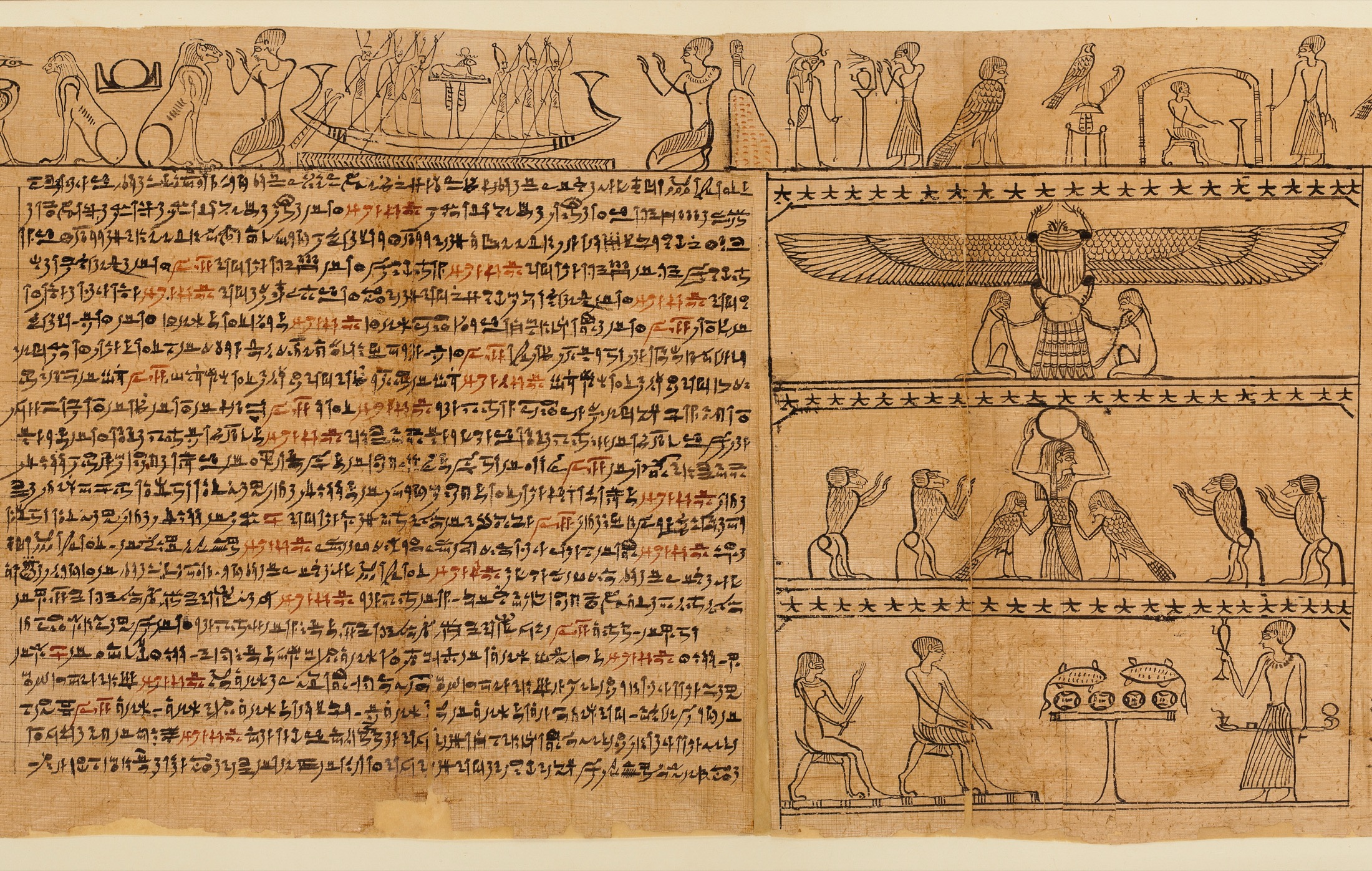
Solar-cycle detail from the Book of the Dead of the priest Imhotep, ca. 332–200 BCE. Light passes through concealment, transformation, and renewed manifestation. Click to open the full detail.
Dated forecast concerns a public claim that a specified event will occur within a defined window. Archaix’s 2040 reset and Vogt’s 12,068-year reversal belong in this category. So do Davidson’s micronova sequence, Thomas’s crustal displacement interval, and precessional-cusp forecasts. Independent corroboration requires shared observations or convergent predictions fixed before the outcome. Calendar proximity becomes corroboration when independent models predict the same event through compatible evidence.
The Central Intelligence Agency’s reading-room copy of Chan Thomas’s The Adam and Eve Story establishes that an agency-held copy entered a declassified archive. Archive custody establishes provenance and institutional availability. Scientific standing follows from mechanism, data, reproducibility, and successful prediction.
Rupture Selects Its Inheritance
The 2004 Indian Ocean tsunami shows how a shock meets retained capacity. On Simeulue Island, the smong oral tradition carried a rule learned from the 1907 tsunami. Prolonged shaking followed by a receding sea meant that people should move uphill. The instruction crossed generations and saved thousands. One wave met different conditions of memory and produced different outcomes. This interaction has stronger historical support than a universal catastrophe schedule.
The 1700 Cascadia earthquake offers a second form of retention. Indigenous oral histories preserved shaking, flooding, destruction, and place-specific memory. Tree rings, coastal deposits, and Japanese records of an orphan tsunami later constrained the date and scale. Oral, geological, biological, and written archives became mutually corrective carriers of one event.
The Hittite collapse around 1200 BCE shows how consecutive stress exhausts a centralized system. Tree-ring and isotope evidence identifies an unusually severe three-year drought around 1198–1196 BCE. It arrived amid warfare, political strain, and vulnerable supply systems. Hittite language and political culture continued in successor states after the imperial center failed. Institutional forms survived according to their ability to persist outside that center.
Classic Maya regions faced repeated drought, warfare, ecological pressure, and changing trade networks. Their outcomes varied with water infrastructure, geography, political organization, and network position. Severe depopulation in parts of the central lowlands coexisted with continuity and later florescence elsewhere. Shared forcing produced several regimes inside one connected cultural and ecological field.
A study of Chinese dynastic transitions across two millennia found volcanic climate shocks interacting with existing warfare and socioeconomic stress. Under high prior stress, smaller eruptions contributed to collapse; some larger eruptions coincided with dynastic continuity. Transitions also differed in their social depth. Ruling houses changed while bureaucratic and economic arrangements sometimes persisted. Shock magnitude alone explained too little of the outcome.
The Black Death challenges accounts of catastrophe as purification. Comparable mortality increased labor bargaining power in parts of Western Europe while coercion persisted or renewed elsewhere. Elite coordination, labor mobility, urban alternatives, and political institutions shaped those differences. Catastrophe redistributed leverage; the receiving institutions gave that redistribution its direction.
Consecutive shocks exhaust the reserves that let a society absorb pressure. Diverse responses and distributed memory reduce irreversible loss. Centralized optimization conceals resilience debt when efficiency depends on removing alternative paths. Whoever controls reconstruction can turn the opening toward wider agency or renewed capture.
The Break Is Uneven
The proposed 4.2 ka event shows how a recurrence story gathers apparently convergent records. A 2024 analysis examined 1,142 paleoclimate datasets spanning every continent and ocean. Some showed significant change around 4,200 years ago. Those changes lacked a coherent global spatial pattern and were unexceptional within Holocene variability.
Local crises and societal transformations around that period remain historically important. Their chronological proximity establishes a comparative field. A single planetary reset requires spatial coherence and a shared causal sequence. The case demonstrates why a global claim requires more than selected sites, broad date ranges, and a compelling narrative assembled after the fact.
Flood traditions, archaeological transitions, solar cycles, magnetic excursions, and political forecasts also have distinct records. Their chronologies and mechanisms must remain intact when joined. An apparent convergence gains meaning through those differences.
The Younger Dryas at the Threshold
The Younger Dryas is a documented late-glacial climate reorganization. Its impact or airburst hypothesis remains contested, with the published balance currently weighing against an extraterrestrial trigger. Disputed marker specificity, chronology, and the absence of a securely dated crater weaken the affirmative case. A 2025 volcanic interpretation of Greenland’s platinum anomaly and two 2026 retractions add further difficulties. A 2024 exchange between proponents and critics keeps the controversy active.
The climate transition, its trigger, its civilizational consequences, and its place in a larger clock are four different layers of the mystery. Freshwater and ocean-circulation contributions carry substantial support. The impact contribution remains contested. A destroyed advanced civilization, a species-wide consciousness reset, and a precessional schedule require bridges beyond the climate record.
Keeping those layers distinct preserves the force of the event. Rapid environmental change survives a failed impact mechanism. Cultural retention remains central while Atlantis stays in the mythic register. Rupture and rebuilding remain visible while the timing of a present reset stays open.
Myth as Cultural Memory
Myth acts as a cultural ark when it preserves a usable pattern through conditions that destroy formal archives. Rhythm, plot, taboo, place, ritual repetition, and social consequences provide several routes for remembering it. The smong tradition preserves a specific warning from a known event across a short transmission interval. Later behavior documents the warning’s effect. Cascadia traditions gain independent support through geological and Japanese records.
Deeper memory requires earlier sources independent of the modern hypothesis. A specific environmental signature needs a plausible transmission pathway and a geographic fit. Diffusion and post-contact influence also affect what the surviving tradition can establish. The relevant Indigenous community’s authority and protocols govern what can be published and how it should be interpreted.
Hundreds of flood stories preserve flood as a hazard, symbol, and political theology. Comparing them requires attention to literary relationships and cultural independence. Mesopotamian and biblical accounts share a literary history. Other traditions can carry local floods, tsunamis, coastal inundation, ordinary hydrological experience, diffusion, or convergent cognition. Myth as astronomical archive develops a research program whose individual decodings need culture-specific evidence.
Comparative traditions converge most clearly on rupture, survival, obligation, and reconstitution. Plato describes repeated destructions and loss of memory. Genesis preserves life and seed, then changes the governing covenant. Yima’s vara curates humans, animals, plants, water, and fire through a deadly winter. Hopi public prophecy links disorder, consequence, survival, and renewed right relation. Their differences in cause and temporal structure remain part of the evidence.
Prophecy Inside the Event
Prophecy intervenes within the future it describes. A public forecast coordinates attention, prompts preparation, legitimates authority, produces panic, invites suppression, or teaches a population what counts as a sign. What the warning causes remains a separate question from what it predicts.
A conditional prophecy can succeed by preventing the warned outcome. A vague prediction can appear precise after a large interpretive community retrospectively fits symbols to events. A captured warning can deepen dependency by making one institution the exclusive interpreter and gatekeeper of safety. These possibilities make provenance, exact wording, publication date, specificity, and behavioral effects part of the evidence.
Ezekiel’s watchman has an obligation to warn after perceiving danger. Jonah’s warning changes conduct, and the announced destruction fails to occur. Prophecy becomes a capacity that crosses civilizational rupture when it preserves judgment and the ability to act. Fear alone leaves that work unfinished.
The Clock as Boundary Condition
The precessional clock marks a slow phase and also changes environmental conditions. Axial and orbital precession are documented astronomical motions. Precessional climate forcing changes the seasonal and latitudinal distribution of incoming sunlight. Ice sheets, vegetation, dust, oceans, and geography shape the local response. The clock enters the receiving world through these conditions.
The African Humid Period offers a useful analogue. Slow orbital forcing helped pace monsoon strength, yet regional transitions were nonlinear and asynchronous. A shared phase coordinate entered several coupled systems and produced different outcomes. This is the physical form of clock-plus-reception.
Zodiacal ages can also operate as cultural phase coordinates. Once people observe and name a cycle, calendars, monuments, expectations, and political programs can make its reading causally active. Claims that precession directly schedules consciousness development or catastrophe require a specified mediator, an objective phase boundary, spatial predictions, and successful out-of-sample tests.
Several partly independent clocks act together. Solar cycles, planetary synods, precession, ocean-atmosphere oscillations, dynastic rhythms, and technical dependency move with different periods. Rupture intensifies when phases coincide and ordinary stresses arrive together. The receiving civilization loses room to compensate within that beat-frequency window. The conjunction gives the event its timing. Celestial opening names this moment through its different effects on the receivers.
A solar disturbance reaches infrastructure through several stages. Radiation, energetic particles, coronal mass ejections, and magnetospheric coupling belong to distinct parts of that chain. Geomagnetically induced currents can then disrupt infrastructure. The initiatic consequence concerns what carried human faculties: the scaffold fails, and its capacities return to living networks or disappear with it.
The present contains measurable solar, geomagnetic, climatic, and institutional changes. A dated global reset requires a joint model connecting those observations to a defined event and window. Its mechanism needs criteria fixed in advance and successful predictions beyond the observations used to construct it. The assembled observations here do not establish that model.
The Coupled-Gyre Interpretation
The coupled gyre describes recurrent descent and return within one field. During rupture, established ways of coordinating life lose stability. Consequences return faster than institutions can integrate them. Several political and experiential orders emerge while ecology, migration, trade, conflict, memory, and inherited infrastructure keep them connected.
Catastrophe can create a local bifurcation: a system’s changed conditions make more than one stable order available. Phase slip supplies an analogy when hidden fragility produces abrupt reorganization. A literal phase-slip account requires a defined phase variable, coupling relation, and measured discontinuity. The historical relation is already concrete: shock magnitude acts through the receiving system’s condition.
The developmental measure is retained capacity. Agency, memory, discrimination, relational range, and reproducible skill must remain available after a complete turn. Survival alone can preserve closure. Suffering alone can reduce capacity. A developmental recast occurs when the new order can do more without making its capabilities more dependent on a narrow controller.
Worlds are continually built through reception, selection, and recasting. A civilization learns across rupture when memory and skill become wider, more distributed, and more reproducible. It recreates its prison when trauma centralizes interpretation and surviving hierarchies monopolize the ark. Reconstruction then makes basic capacities depend on renewed permission.
Ascension at the Boundary
Traditions place transformation beside catastrophe because a boundary can be crossed in several realms. A world ends physically, a social identity dissolves, an initiatory body dies, or a civilization changes its continuing medium. Ascension names a successful change of carrier. Consciousness and capacity pass through rupture without being reduced to the form that ended.
The ark preserves what can enter the next world; ascent describes its passage into that world. Seed, stone, bloodline, text, song, school, and hidden community carry different kinds of continuity. Traditions also describe luminous bodies, star departure, entry into the spirit world, and collective shifts in the consensus dream. These are changes in spiritual embodiment and access. Cataclysm supplies the pressure through which the carrier becomes visible.
Civilizational ascension occurs when a culture carries greater coherence, memory, agency, and spiritual capacity across the turn. It descends when only the shell survives and the successor world mistakes inherited machinery for mute monument.
Reading the Clock Without Worshipping It
A living clock touches the world through a carrier. Its force, period, phase, uncertainty, and receiving conditions explain how recurrence becomes an event. A consciousness clock must produce consequences beyond those explained by ordinary ecological and political cycles. Without that effect, the calendar marks correspondence instead of causing the change.
Prophecy complicates the clock because a warning enters the event by changing preparation. A fixed record of wording, window, observable outcome, revision, and failure keeps participation from becoming retroactive worship. Misses remain part of the teaching; a clock that can never be wrong has ceased to measure anything.
Destroyed records, classification, blocked access, and distorted citation reveal the custodianship of knowledge. They establish constrained access at their demonstrated scope. The hidden contents still require their own carrier.
The strongest prediction concerns retention. Under comparable exposure, civilizations with distributed material and informational arks lose less of their agency and preserve more possible futures. Catastrophe tests the world a people had already built inside themselves.
What the Ark Must Carry
Physical hazards recur. Societies repeat recognizable failures of memory, concentration, and closure. Whatever deeper clock joins those domains, preparation begins before its date is known.
Knowledge must survive beyond a single archive. Skills must remain usable beyond a proprietary platform. Institutions must preserve several response paths. Warnings must teach discrimination and action. Seed, record, explanation, and reconstruction must remain outside the monopoly of one custodian.
Catastrophe reveals what the system learned to carry. The next world is built from what makes it across.
References
Plato. Timaeus and Critias. Translated by Robin Waterfield. Oxford University Press, 2008.
Walker, Brian, C. S. Holling, Stephen R. Carpenter, and Ann Kinzig. “Resilience, Adaptability and Transformability in Social-Ecological Systems.” Ecology and Society 9, no. 2 (2004): 5. https://www.ecologyandsociety.org/vol9/iss2/art5/.
Johnstone, Jill F., Craig D. Allen, Jerry F. Franklin, et al. “Changing Disturbance Regimes, Ecological Memory, and Forest Resilience.” Frontiers in Ecology and the Environment 14, no. 7 (2016): 369–378. https://doi.org/10.1002/fee.1311.
Scheffer, Marten, Jordi Bascompte, William A. Brock, et al. “Early-Warning Signals for Critical Transitions.” Nature 461 (2009): 53–59. https://doi.org/10.1038/nature08227.
McAdoo, Brian G., Lori Dengler, Gegar Prasetya, and Vasily Titov. “Smong: How an Oral History Saved Thousands on Indonesia’s Simeulue Island during the December 2004 and March 2005 Tsunamis.” Earthquake Spectra 22, no. S3 (2006): 661–669. https://doi.org/10.1193/1.2204966.
Atwater, Brian F., Satoko Musumi-Rokkaku, Kenji Satake, Yoshinobu Tsuji, Kazue Ueda, and David K. Yamaguchi. The Orphan Tsunami of 1700: Japanese Clues to a Parent Earthquake in North America. 2nd ed. U.S. Geological Survey Professional Paper 1707, 2015. https://doi.org/10.3133/pp1707.
Manning, Sturt W., Cindy Kocik, Brita Lorentzen, and Jed P. Sparks. “Severe Multi-Year Drought Coincident with Hittite Collapse around 1198–1196 BC.” Nature 614 (2023): 719–724. https://doi.org/10.1038/s41586-022-05693-y.
Turner, B. L., and Jeremy A. Sabloff. “Classic Period Collapse of the Central Maya Lowlands: Insights about Human–Environment Relationships for Sustainability.” Proceedings of the National Academy of Sciences 109, no. 35 (2012): 13908–13914. https://doi.org/10.1073/pnas.1210106109.
Gao, Chaochao, Francis Ludlow, John A. Matthews, et al. “Volcanic Climate Impacts Can Act as Ultimate and Proximate Causes of Chinese Dynastic Collapse.” Communications Earth & Environment 2 (2021): 234. https://doi.org/10.1038/s43247-021-00284-7.
Jedwab, Remi, Noel D. Johnson, and Mark Koyama. “The Economic Impact of the Black Death.” Journal of Economic Literature 60, no. 1 (2022): 132–178. https://doi.org/10.1257/jel.20201639.
Żarczyński, Maurycy, Leah P. Marshall, Georgia K. Roberts, et al. “The 4.2 Ka Event Is Not Remarkable in the Context of Holocene Climate Variability.” Nature Communications 15 (2024): 6555. https://doi.org/10.1038/s41467-024-50886-w.
Holliday, Vance T., Tyrone L. Daulton, Patrick J. Bartlein, et al. “Comprehensive Refutation of the Younger Dryas Impact Hypothesis.” Earth-Science Reviews 247 (2023): 104502. https://doi.org/10.1016/j.earscirev.2023.104502.
Sweatman, Martin B., James L. Powell, and Allen West. “Rejection of Holliday et al.’s Alleged Refutation of the Younger Dryas Impact Hypothesis.” Earth-Science Reviews 258 (2024): 104960. https://doi.org/10.1016/j.earscirev.2024.104960.
Green, Charlotte E., James U. L. Baldini, Richard J. Brown, Hans-Ulrich Schmincke, Marie Edmonds, and Thomas C. Meisel. “A Possible Volcanic Origin for the Greenland Ice Core Pt Anomaly near the Bølling-Allerød/Younger Dryas Boundary.” PLOS One 20, no. 9 (2025): e0331811. https://doi.org/10.1371/journal.pone.0331811.
PLOS One Editors. “Retraction: A 12,800-Year-Old Layer with Cometary Dust, Microspherules, and Platinum Anomaly Recorded in Multiple Cores from Baffin Bay.” PLOS One 21, no. 2 (2026): e0342613. https://doi.org/10.1371/journal.pone.0342613.
PLOS One Editors. “Retraction: Shocked Quartz at the Younger Dryas Onset (12.8 Ka) Supports Cosmic Airbursts/Impacts Contributing to North American Megafaunal Extinctions and Collapse of the Clovis Technocomplex.” PLOS One 21, no. 2 (2026): e0342620. https://doi.org/10.1371/journal.pone.0342620.
de Santillana, Giorgio, and Hertha von Dechend. Hamlet’s Mill: An Essay Investigating the Origins of Human Knowledge and Its Transmission through Myth. Gambit, 1969.
Hardt, Moritz, and Celestine Mendler-Dünner. “Performative Prediction: Past and Future.” arXiv:2310.16608, 2023. https://doi.org/10.48550/arXiv.2310.16608.
Thomas, Chan. The Adam and Eve Story: The History of Cataclysms. Emerson House, 1963. Central Intelligence Agency Reading Room copy released as C05998606, May 17, 2019. https://www.cia.gov/readingroom/docs/THE%20ADAM%20AND%20EVE%20STORY%5B15646345%5D.pdf.
deMenocal, Peter, Joseph Ortiz, Tom Guilderson, Jess Adkins, Michael Sarnthein, Linda Baker, and Martha Yarusinsky. “Abrupt Onset and Termination of the African Humid Period: Rapid Climate Responses to Gradual Insolation Forcing.” Quaternary Science Reviews 19, nos. 1–5 (2000): 347–361. https://doi.org/10.1016/S0277-3791(99)00081-5.
Geertz, Armin W. The Invention of Prophecy: Continuity and Meaning in Hopi Indian Religion. University of California Press, 1994.
Darmesteter, James, trans. The Zend-Avesta, Part I: The Vendidad. Sacred Books of the East, vol. 4. Clarendon Press, 1880. Fargard 2.
Steiner, Rudolf. Occult Science: An Outline. GA 13. Rudolf Steiner Press, 1969. https://rsarchive.org/Books/GA013/English/RSP1969/GA013_c04.html.
Steiner, Rudolf. “Mephistopheles and Earthquakes.” GA 107, January 1, 1909. https://rsarchive.org/Lectures/19090101p01.html.
The Holy Bible: New Revised Standard Version Updated Edition. National Council of Churches, 2021. Genesis 6–9; Ezekiel 33; Jonah 3.