The subject
Alchemy studies and works upon the transformation of matter. Its history joins craft, medicine, natural philosophy, religious thought, and the pursuit of transmutation. 1
Choose a guide or enter at any stop.
Comparative synthesis
Comparative metaphysics
The Hermetic vision
Comparative initiation
The Greek mysteries
The Christian journey
The Grail romances
The Rosicrucian wedding
Song and the underworld
The soul’s labors
The voyage home
The Bhagavad Gita
The Matrix
The twenty-two Major Arcana
The Night Company
The Consciousness Explorer
The Empathy Test
The building as a teacher
Work through the silent book
Number becomes audible
Cultivation as a living art
The road of the goddess
Strength and the underworld mysteries
Enter a tradition and follow its practices and symbols.
Choose a passage directly. The original and its decode stay together.
Bible
Bible
Bible
Bible
Bible
Bible
Bible
Bible
Follow a question, or choose a step within its route.
The reader path
Material cost, karmic inscription, inverted initiation, reciprocal contact, and the formation carried through death.
Clinical anomalies, transmitted memory, continuing agency, and the traditions of conscious transition.
Future attractors, embodied descendants, bloodlines, incarnation, contact, and the choice between captured and sovereign human futures.
A route from the broad ecology of contact through inherited hierarchies, discrimination, and sovereign encounter.
Circulation, distributed information, embodied reception, and the recursive return that links every scale of the field.
Recurrence, civilizational phase, precession, prophecy, and the capacity retained through a complete turn.
A route from the inherited-world thesis through vibration, geometry, water, landscape, sound, and human coherence into the Great Pyramid, civilizational rupture, ark, and surviving transmission.
Perception, shared-world formation, planetary participation, and the disciplined return from private pattern into consequence.
Physical catastrophe, astronomical phase, historical recurrence, archive criticism, contested chronology, and the agency that no clock can remove.
A route from planetary connection through technical custody, solar pressure, civilizational rupture, retained capacity, distributed incarnation, and the world rebuilt from within.
Mythic memory, initiatory custody, operating law, scriptural technology, convergent practice, and the capacity returned to life.
A route from shared-world formation through grammar, rehearsal, dramaturgy, emergency permission, closed-loop regulation, distribution, ritual, capture, integrated apparatus, and counter-operation.
Direct recognition, collective rupture, capture at the opening, embodied development, beauty as coherent aperture, and the master counter-operation.
Long initiatic intention, contested institutional custody, distributed selection, digital ordeals, mass participation, and the test of what the awakened network builds.
Contact pressure, interior government, retained development, and the selection of a coherent history.
The human aperture, collective model, captured correction loop, institutional custody, sovereign boundary, and return of authorship.
The lived ceiling, the extraction ecology, institutional inversion, managed awakening, and the recovery of agency.
Documented coercion, threshold research, distributed conditioning, biological and psychiatric custody, public theater, adaptive infrastructure, integrated control, and the recovery of the receiver.
The 1944–49 hinge: recovered archives, transferred expertise, partition, permanent secrecy, anomalous skies, and the contest over what the new order would make governable.
Currency as shared recognition, central-bank custody, emergency fiscal fusion, intermediated ownership, stablecoin rails, and the boundary between legibility and refusal.
Emergency authority, pretext, durable permission, public crisis, and the moment an institutional output becomes the ground of ordinary life.
Concealed centers, polar memory, the Black Sun, Nazi appropriation, postwar transfer, and the discipline required when myth makes exterior claims.
A route through the human instrument, embodied signaling, subtle anatomy, living fields, awakening, and integration.
The pharmakon, medical authority, diagnostic containment, autonomic injury, biological constraint, and the right to the body’s own ledger.
Private psi research, remote viewing, altered-state training, state programs, selection networks, UAP disclosure, and the contest over who holds unusual human capacity.
Sacred language, creation, exile, repair, recurrence, and the scriptural technologies of descent and return.
Language, fiction, media, participation, ritual, and the feedback loop through which a story becomes a lived world.
Laurel Canyon, press distribution, studio power, informed fiction, encoded media, participatory narrative, mass ritual, and the state that governs through attention.
The complete model, arranged in four movements.
What is contested, why consciousness comes first, and the instrument through which it acts.
How a rendered world becomes a shared one, and how the shared one is enclosed.
The operation that defends the enclosure, what it is for, and the Work done inside it.
What else lives in the field, what persists across death, and how the future reaches back.
Browse the domains or find a page by name.
No destinations match. Try a different word.
Alchemy · Matter & transformation
Matter, transformation, and the art of perfection
Alchemists seek to perfect matter through purification, dissolution, and renewed union. Their texts explain changes in the vessel through marriage, death, and birth. George Ripley invokes Christ’s teaching about the seed that dies before bearing fruit. The vessel gives this mystery a material form: decay prepares renewed life, and the completed substance gains power to transform other matter.
Beliefs · Diagrams · Practice · Primary texts
The essentials
These are the tradition’s central teachings.
Alchemy studies and works upon the transformation of matter. Its history joins craft, medicine, natural philosophy, religious thought, and the pursuit of transmutation. 1
The philosophers’ stone is the perfected agent sought for transmutation. Ripley’s sequence proceeds toward multiplication of its power and projection upon other matter. 3
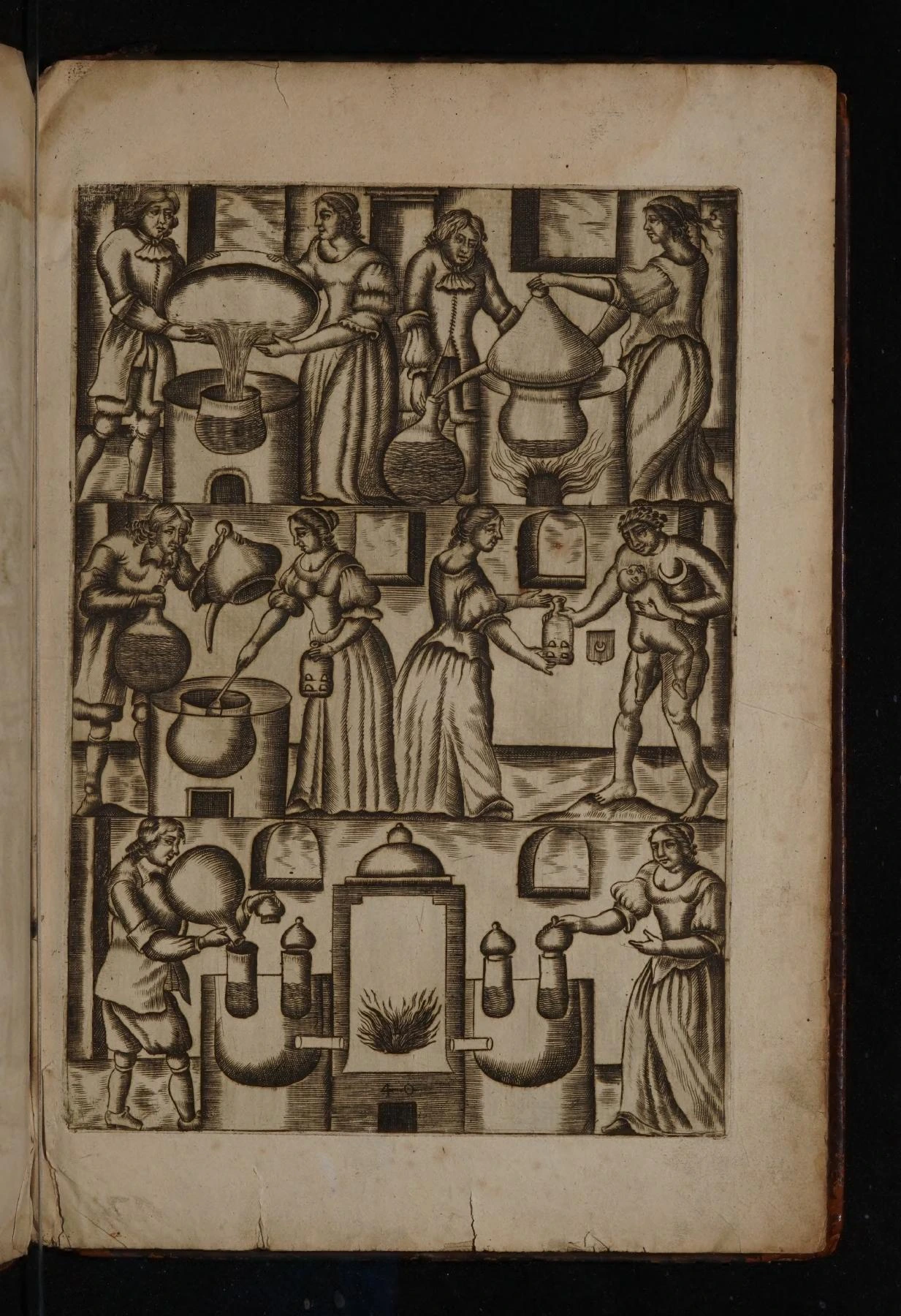
The vessel holds substances as heat carries them through successive changes. Alchemical engravings depict those changes through human figures undergoing death, marriage, or birth. 1
Alchemists separate and purify substances before reuniting them. Ripley describes a soul cleansed of original sin before its reunion with the body. 4
Conjunction joins prepared substances in a marriage that Ripley also describes through the union of body, soul, and spirit. Their union gives birth to a new substance that can endure fire. 4
The work seeks a perfected substance that can withstand fire and transform other matter. Its religious imagery presents this achievement as regeneration: a life renewed through death and purification. 4
A staircase inside the mountain
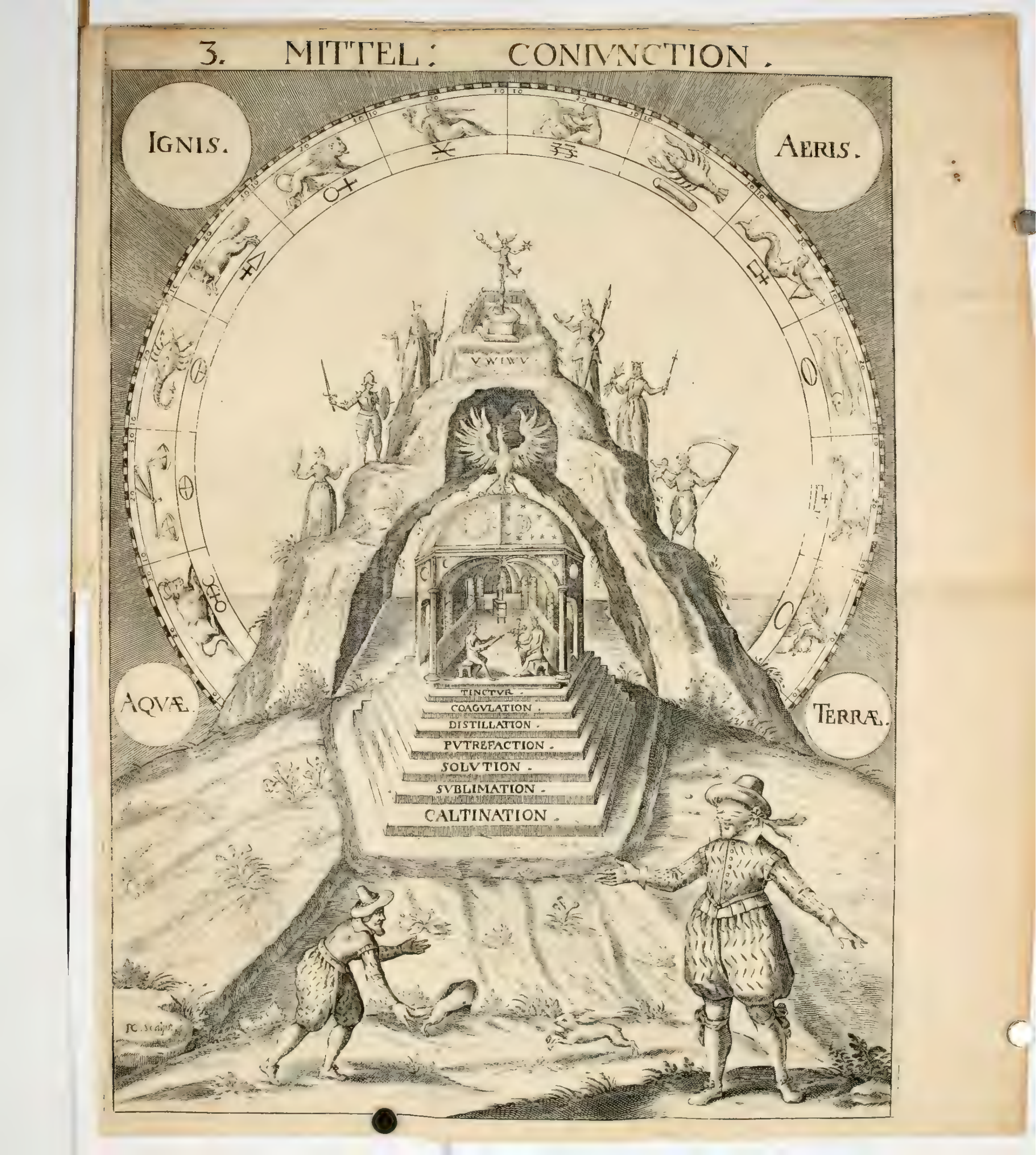
Michelspacher’s Cabala places a laboratory within a mountain. Its stair rises from calcination at the foot to tincture at the threshold. Read this reconstruction from the bottom upward.
The threshold of the chamber
The tincture is the perfected agent of transmutation.
Bring the fluid or dissolved into a fixed body.
Separate through vaporization and condensation.
Let the old composition break down.
Dissolve the body in its solvent.
Raise and collect the volatile part.
Reduce by the action of heat.
The lettering follows this scan, including CALTINATION. The drawing simplifies the staircase’s shape. Its labels and vertical sequence are retained.
The historical image
Steffan Michelspacher, Cabala, plate 3; Raphael Custos, engraver. Getty copy, 1663 edition. The complete unfolded plate preserves the staircase within its celestial and elemental setting.
Planetary figures, the zodiac, and the names of the elements surround the mountain. The laboratory stands within their cosmic order. Its substances remain subject to the heavenly powers surrounding it. Entering the mountain, the alchemist works with those powers through matter.
Each stair bears the name of an alchemical process. The path to the chamber passes through burning, dissolution, and purification. The ascent also gives initiation a visible sequence. Admission follows preparation: both the substance and the person tending it must become ready for the next transformation.
The sun and moon stand above the chamber at the stair’s summit. Their pairing gives the engraving’s conjunction a celestial form. Substances meet within the laboratory as generative powers meet in the heavens. Their union participates in the same creation.
The unnumbered staircase follows the Getty copy of the 1663 edition, retaining the spelling CALTINATION. Ripley’s twelve gates form the separate sequence below. Each author’s order remains intact. 23
Another complete sequence
Read left to right, then down. The order follows The Compound of Alchemy. 3
The work of transformation
Ripley follows blackness through whiteness to redness as the work proceeds. He explains this renewal through the seed buried in earth. Its decay prepares the life that will grow from it.
The seed bears fruit through its dissolution.
The matter darkens as its former composition breaks down. Ripley compares this putrefaction with the death of the seed, from which renewed life will emerge.
Whiteness follows the blackness of putrefaction. The religious imagery of cleansing explains the purified condition of what has passed through this decay.
Redness marks the later perfection of the work. The substance approaches the completed state in which it can act upon and transform other matter.
These three colors summarize Ripley’s passage. Other authors divide the work differently or include intermediate colors. Michelspacher’s staircase retains its separate seven labels.
The teaching in the texts
George Ripley’s Fourth Gate distinguishes conjunctions of two, three, or four terms. Male and female, and matter and form, name paired aspects of the substances being joined. Body, soul, and spirit name a threefold union. Four elements join in another conjunction. These distinctions identify what the alchemist must prepare and unite within each account of the work.
Preparation makes the marriage possible. Ripley requires separation of soul from body and cleansing of the soul’s original sin. His religious language gives purification a place within the material work. The alchemist prepares substances to receive a union that produces something more perfect than their earlier condition.
Fire reveals whether the marriage holds. Heat separates an incomplete union; the perfected substance remains joined. Spiritual regeneration likewise joins received divine life to the whole person. Soul and body enter that renewal together. The initiate must carry the union beyond its first encounter into an enduring life.
Ripley’s material marriage gives bodily perfection a visible sequence, beginning with the body’s reception of the purified soul. The alchemist cleanses the partners, brings them together, and applies heat that reveals whether their union endures. Continued tending secures the joining within the vessel. Renewed life acquires a body able to hold what purification has prepared.
Read the sources 4
Ripley places putrefaction, the decay of matter’s former composition, at the center of his Fifth Gate. A new generation requires the earlier form to dissolve. He invokes Christ’s teaching that a grain must die in the ground before it bears fruit. Christian death and resurrection give that teaching its spiritual reach. The field and alchemical vessel disclose the same mystery through growing plants and changing substances.
Blackness makes the passage visible: Ripley compares the dark matter to a crow, then follows its colors toward whiteness and redness. The alchemist must recognize this darkening to continue the work. Corruption here prepares a more perfect substance. Sustained heat and care carry the material through its changing appearances.
Initiation carries the same passage through death into another life. The seed makes this teaching visible because dissolution frees its enclosed life to grow. Purification prepares what survives the loss of the former shape. Regeneration gives that life a new form. Spiritual continuity therefore includes transformation of the body through which life returns.
Ripley keeps religious meaning within reach of the laboratory. Christ’s teaching identifies the fruitfulness sought through the seed’s death. The alchemist carries matter through its successive colors, tending the substance within the vessel until signs of renewal appear.
Read the sources 5
Michelspacher’s Cabala opens the central mountain to reveal a chamber within. Zodiac signs, planetary figures, and the four elements surround the mountain and govern the world containing its laboratory. The alchemist enters nature’s hidden life by working with the substances nature produces. Matter within the vessel retains its place in that larger creation.
The staircase names the preparation required for entry. From its foot, the labels ascend through calcination, sublimation, solution, putrefaction, distillation, coagulation, and tincture. These labels arrange material changes into a path for the person approaching the chamber. Ascent requires transformation before the chamber can receive its prepared visitor.
Sun and moon appear above the chamber of conjunction. Their celestial marriage has counterparts in the substances meeting within the vessel. The alchemist participates in the same generative life that fills the engraving. Heavenly union gives the laboratory’s material joining its sacred meaning through prepared substances and sustained work.
Ripley arranges his work through twelve gates, preserving a sequence distinct from Michelspacher’s staircase. His later gates reach multiplication and projection. Multiplication increases the perfected substance’s power; projection applies it to other matter. Read beside the mountain, these gates explain what perfection makes possible beyond one prepared substance. The completed work carries its transformative power into further material.
Across the centuries
Technical operations, religious language, and theories of matter enter a shared written tradition. 1
Texts and practices circulate through translation and new laboratory work. 1
The Compound of Alchemy gives the work a sustained English poetic form. 3
The reproduced plate presents conjunction as a mountain, cosmos, and laboratory. 2
A book of images follows the work through prayer, collection, vessels, and completion. 6
Continue into the illustrated journey
Read six historical plates from the Mutus Liber. Follow the sleeping figure through prayer, dew gathering, work with vessels, and completion.
Explore the Laboratory ↗Read at the source
Getty Research Institute
Historical overview and collection descriptions, including the Cabala Conjunction engraving.
Steffan Michelspacher · engravings by Raphael Custos · 1663 edition
Getty Research Institute copy. The complete unfolded Conjunction plate appears on PDF page 40. Its scan supplies the staircase lettering and order.
George Ripley · 1591 printing, modernized by Adam McLean
The full sequence from calcination to projection. The work is dated 1471.
George Ripley
Marriage, body, soul and spirit, and the endurance of a perfected union.
George Ripley
The seed, Christ, the raven, and the passage through colors.
Altus · Wellcome Collection copy
Historical plates reused from the existing Laboratory journey. Public domain.