The infinite
Ein Sof means “without end” and names the divine beyond every measure and image. The sefirot reveal how this inexhaustible source gives life to particular beings and worlds. 5
Jewish tradition · The divine life & repair
The living Tree and the work of repair
A person opens a hand to someone in need. In Moses Cordovero’s teaching, that gesture reaches into heaven: kindness awakens mercy above, allowing blessing to descend where judgment threatened to prevail. Kabbalah studies this intimacy between human life and the divine. Its Tree names the wisdom, love, and judgment through which God sustains creation. The teaching asks what becomes possible when a person learns to live in their likeness.
Beliefs · Diagrams · Practice · Primary texts
The essentials
These are the tradition’s central teachings.
Ein Sof means “without end” and names the divine beyond every measure and image. The sefirot reveal how this inexhaustible source gives life to particular beings and worlds. 5
The sefirot are the ten divine emanations named in the Tree. Wisdom, Understanding, Lovingkindness, and Judgment belong to one living whole, sustained by the God who brings them forth. 1
Shekhinah is God’s indwelling presence, associated with Malkhut, the last sefirah. She accompanies Israel in exile; prayer and the commandments work toward her reunion with the divine bridegroom. 4
The Zohar follows Rabbi Shimon bar Yohai and his companions as they uncover the Torah’s hidden life. Its teachings circulated in medieval Spain and became central to later Kabbalah. 9
In Isaac Luria’s teaching, the lower vessels of the world of Tohu break under intense light, leaving sparks with their fallen fragments. Tikkun is the work of restoring what has been disordered. 6
Study, prayer, and mitzvot — the commandments — draw the person into the work of sanctifying life. Cordovero makes the demand immediate: someone formed in the divine image must also act in that image. 2
The ten names and the light that sustains them
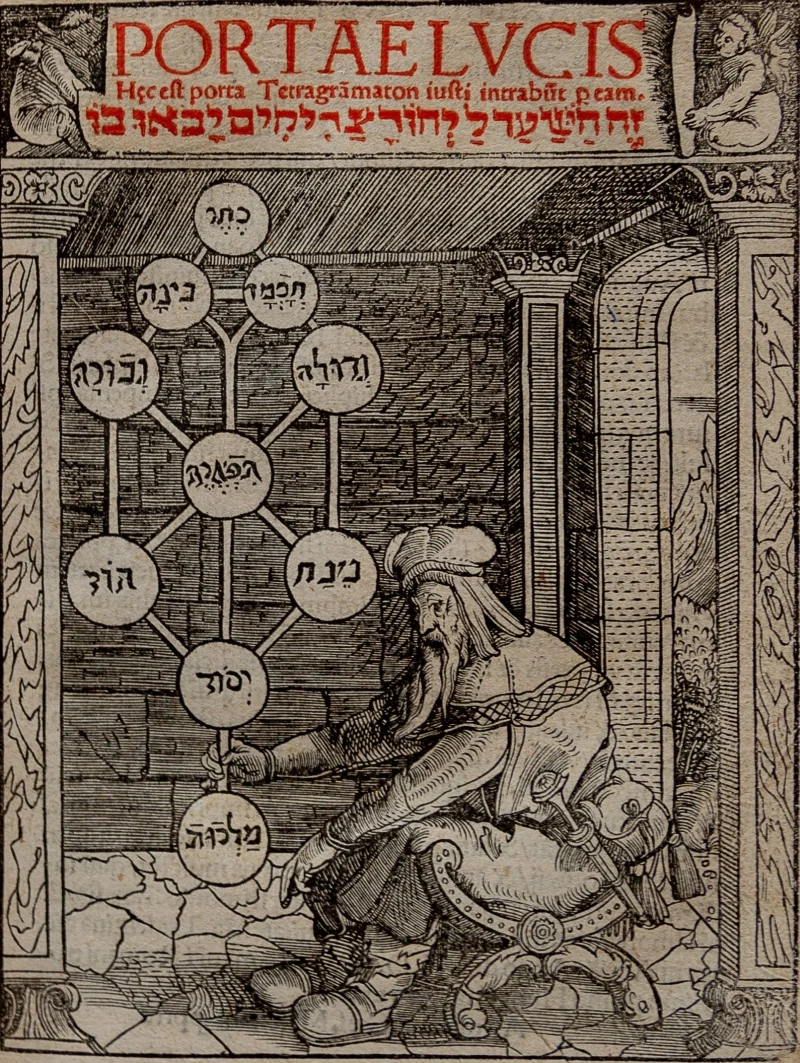
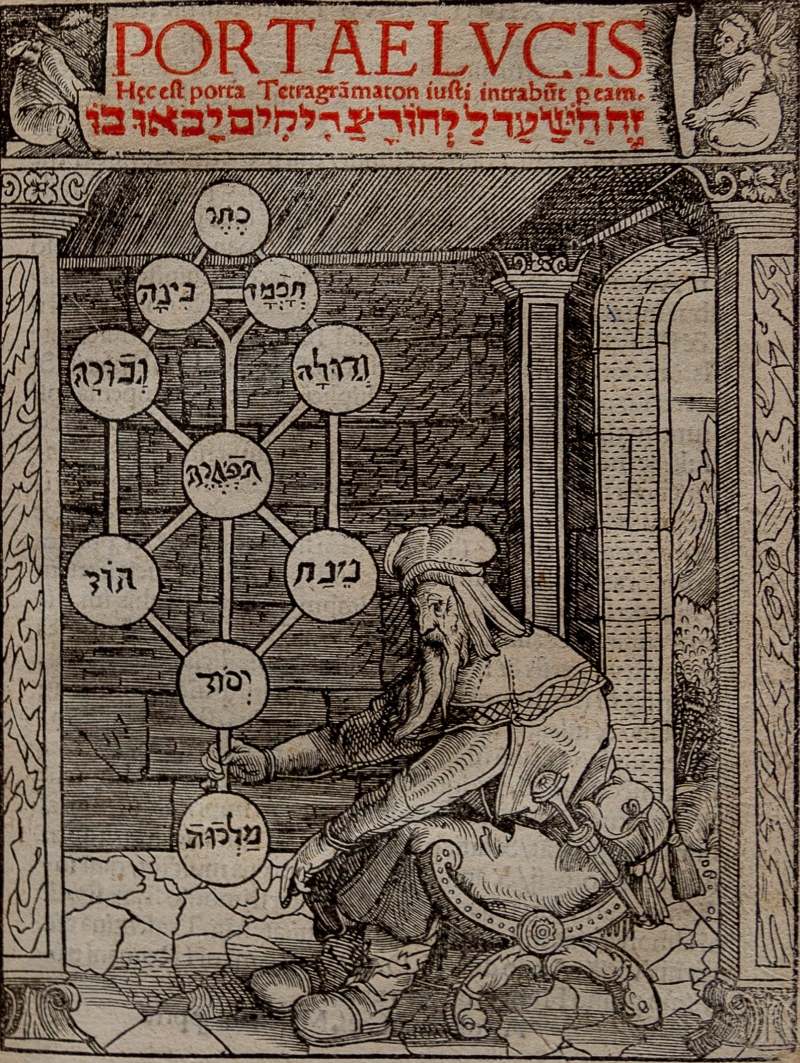
Begin at the Crown and follow the names downward. The 1516 woodcut gives each sefirah a Hebrew name, while its branches join them into a single tree. The key beside it preserves their placement and supplies plain English meanings. Farther below, a separate diagram follows Hayyim Vital’s account of the opening through which creation becomes possible.
A key to the 1516 woodcut
Names and branches follow the printed tree, with spacing and curves simplified. Hebrew is set without vowel points. Gedulah means Greatness; this sefirah is also called Hesed, Lovingkindness.
The historical image
Portae Lucis, Augsburg, 1516. Paulus Ricius’s Latin rendering of Joseph Gikatilla’s Sha’arei Orah carries Jewish teaching into a Christian Renaissance readership. The complete title page preserves the tree, its Hebrew lettering, and its architectural setting.
The tree is held in a human hand. Its uppermost circle bears the word Crown; the lowest, Kingdom. The scholar’s book and the branching figure bring study and contemplation into the same image.
A later teaching · Etz Chaim, gate 1, branch 2
Vital begins with light filling all existence, equal throughout.
The light withdraws equally around a central point, leaving a circular opening.
A thin line of light enters from above. Through it, the worlds receive what sustains them.
An earlier text · Sefer Yetzirah, chapter 1
Keter crowns the Tree. Hokhmah means Wisdom; Binah means Understanding. Cordovero begins his teaching on Keter with humility: the highest sefirah continually bestows good upon what lies beneath it. Human wisdom must learn the same generosity.
The woodcut uses Gedulah, Greatness, for the place also called Hesed, Lovingkindness. Gevurah means Might and carries the work of judgment. Tiferet stands between them. The divine life includes mercy and the strength to judge; the center holds them together.
Netzah can also be translated as Endurance; Hod is Splendor. Yesod means Foundation and bears the symbolism of the covenant. In the Patach Eliyahu, Netzah and Hod correspond to the two legs, while Yesod is associated with the organ of generation.
Cordovero speaks of Malkhut as the King’s daughter and the divine bride. She receives the blessing of the sefirot above her. The person who welcomes her must prepare through study, the commandments, and care in the life shared with others.
The name key retains the woodcut’s ten Hebrew labels, their relative positions, and its branching arrangement; lettering, spacing, and branch curves are modern. The circular figure below is a modern explanation of Etz Chaim 1:2, a different and later account. Jewish Kabbalah, Renaissance Christian Cabala, and later Hermetic Qabalah have distinct histories. 1113458
The work of transformation
Cordovero’s Palm Tree of Deborah brings the sefirot into the reader’s own actions. The divine image makes a demand upon the person who bears it. His examples concern the hand that gives, the anger that subsides, and the willingness to help someone repair the harm they have caused.
“the essence of the Highest Image and Likeness is His actions”
God continues to sustain a person even while that person sins. Cordovero asks the reader to study that patience and allow room for repentance.
Forgiveness includes the work of cleansing what has been damaged. The person who can help must face the question of what repair now requires.
Someone who has angered you can still have cared for others. Cordovero asks that their kindness remain present in your judgment of them.
Repentance should be met with renewed love. Cordovero describes the return to God as a closeness greater than the one that preceded the estrangement.
The later chapters bring these teachings into prayer, Torah, and household life. The person prepares to welcome the divine presence through what they do throughout the day.
These are selected teachings from chapters 1 and 9, arranged for an introduction. They are not a historical sequence of initiation grades. Cordovero’s first chapter develops thirteen attributes of mercy; subsequent chapters follow the sefirot.
The teaching in the texts
In Patach Eliyahu, Elijah praises the hidden God and names the sefirot through which the worlds are governed. God unites and sustains them as a soul gives life to a body. The teaching makes divine unity available to contemplation through a living form.
Its account of that form is precise. Lovingkindness is the right arm, Might the left, and Beauty the torso. Wisdom is the brain and Understanding the heart. Malkhut is the mouth, associated with the Oral Torah. These correspondences belong to the text’s image of a body; the printed Tree arranges the same names in a different figure.
Cordovero explains what this divine likeness requires of a person. Resembling the divine limbs is a beginning. A hand must also learn to give; a person with the power to punish must learn what mercy requires. The divine image becomes visible in action. Knowledge of the sefirot therefore reaches into the treatment of other people.
In the sixth attribute of mercy, Cordovero describes a heavenly chamber whose angels receive the kindness people show one another. When judgment accuses Israel, these angels bring that goodness before God. The generous act continues beyond the moment in which it was performed. It has entered the life of heaven, where it can help preserve a people threatened with destruction.
The explanation begins earlier with a more unsettling example. A wrongful deed creates a destructive spirit, a prosecutor that stands before God and names the person who brought it into being. God sustains even this creature while allowing the sinner time to repent. Mercy holds open an interval in which a person can change what they have made. Repentance reaches into the harm’s spiritual existence as well as its human consequences.
These passages give the ethical teaching its force. People continually bring things into the world through their actions, and those things continue to act. Cordovero asks the reader to become attentive to that responsibility while learning the patience of the God who sustains creation. The ability to forgive belongs to strength: the offended king possesses the means of vengeance and continues to give life.
When Cordovero returns to ordinary anger, he asks the reader to remember whatever goodness remains in the person who caused it. A kindness shown to someone else can be enough to begin softening the judgment. The human act follows the heavenly one. The person who learns mercy makes room for the same mercy to reach others.
Read the sources 2
In the chapter on Malkhut, Cordovero asks the reader to imagine leaving home. Even the traveler who carries provisions has lost the ease of familiar surroundings. The Shekhinah’s exile is more severe: she has been separated from the fullness that belongs to her. Someone who voluntarily leaves comfort for sacred study begins to understand what it means to accompany her.
The student can become a chariot for the divine presence. Cordovero recalls Rabbi Shimon and his companions going out from their homes to occupy themselves with Torah. Their wandering joins them to the Shekhinah in her estrangement. A journey through the country becomes a way of sharing her condition and carrying her presence into the places where the teaching is spoken.
He also brings the subject into married life, speaking to the male householder of his obligations toward his wife. Sustenance, clothing, and conjugal care acquire a celestial meaning. The generosity he receives must pass onward, while the union below corresponds to the union of the divine bride and bridegroom. The teaching gives the household a place within the sacred life described by the Tree.
Prayer gathers these obligations into conscious intention. By reciting the Shema and keeping appointed times for Torah study, the worshiper works toward the reunion of Malkhut with Tiferet. Cordovero pictures the Shekhinah as the King’s daughter, received by someone who has prepared himself to welcome her. The hours of study and the deeds of the day become part of that preparation.
Read the sources 4
Hayyim Vital begins his account of Luria’s cosmology with an unbroken fullness of light. Creation becomes possible through tzimtzum, the withdrawal that leaves an opening within that fullness. A thin ray enters the opening, allowing the worlds to receive light in measure. Vital’s image explains how distinct beings can come into existence while continuing to receive their life from the infinite.
Later comes the shattering. In the world of Tohu, the lower vessels cannot contain their intense illumination. They break, and sparks remain with the fragments that descend. Restoration brings the sefirot into fuller cooperation. The story gives earthly disorder a history reaching back into the formation of the worlds.
The later Hasidic work Tanya brings the gathering of sparks into familiar actions. Its thirty-seventh chapter describes the physical objects used in a commandment. Permitted animal parchment becomes part of tefillin, and honestly acquired money is given in charity. Food strengthens the body that studies Torah or prays. What the person does with these things lifts their vitality into holiness.
This teaching gives embodiment a task. The soul enters circumstances in which it can take up particular things and turn them toward sacred use. Prayer requires breath, and giving requires something that can pass from one hand to another. The repair of creation proceeds through the life being lived here, with its materials, obligations, and opportunities to act.
Across the centuries
Sefer Yetzirah describes creation through ten sefirot and twenty-two Hebrew letters. Its short account of number, speech, and the directions of space supplies a foundation for later interpretation. 8
Moses de León brings the Zohar into circulation. The work speaks through Rabbi Shimon bar Yohai and his companions; traditional attribution places its teaching in the second century. 9
Paulus Ricius publishes Portae Lucis, a Latin rendering of Joseph Gikatilla’s Sha’arei Orah. Its title-page Tree records the passage of Jewish teaching into Renaissance Christian study. 11
Safed becomes a great center of Kabbalistic teaching. Cordovero develops his account of the sefirot; Luria’s pupils transmit the cosmology of contraction, shattering, and repair. 10
Schneur Zalman of Liadi’s Tanya develops the inherited teaching through bodily action and sacred study. Fulfilling a commandment elevates the things used in it. 7

Continue into the illustrated journey
Continue into the Hierarchy journey for a separate exploration of emanation and return through Greek, Hermetic, and Christian sources. Read it alongside the Tree while keeping each tradition’s names and teachings in view.
Explore the Hierarchy journey ↗Read at the source
The divine unity, ten sefirot, and bodily correspondences. The translation distinguishes the source text from commentary. The body’s mouth is Malkhut even though the tree places Malkhut at its foot; the two figures are not superimposed.
The divine image and thirteen attributes of mercy. Attributes 1–3, 6, and 7 supply the accounts of patience, the destructive spirit, forgiveness, heavenly reception of kindness, and repentance. The community translation is released under CC0.
The Crown, humility, and the bestowal of good on every creature. This chapter extends the image of the body into the student’s disposition and conduct.
Malkhut, voluntary exile, the Shekhinah, marriage, and intention during prayer and Torah study. Its household teaching addresses a married male reader within the religious obligations of its setting.
The equal light, circular opening, and thin ray that remains joined to its source at the upper end. The diagram follows that passage, before the subsequent account of concentric sefirot. Later schools differ over how literally to understand the withdrawal; this is a diagram of the text’s imagery.
Cites Etz Chaim, gate 9, chapter 8, and Mevo She’arim, gate 2, chapter 8. Identifies the lower vessels of Tohu that shatter and the sparks remaining with their fragments. The account does not say that all ten vessels are destroyed.
Later Hasidic development of the elevation of sparks through commandments, their physical materials, and the bodily energy used in Torah and prayer. The specific examples belong to this text, not to the 1516 woodcut.
Public-domain translation of the ten sefirot and twenty-two letters. The text has several recensions. Its tenfold account does not itself supply the named medieval tree shown here.
The book’s contents, medieval circulation, traditional attribution, and later textual history. Tikkunei Zohar is a related composition with its own history.
Historical setting of Cordovero and Luria, the development of the Zohar’s teaching in Safed, and the place of cosmic repair.
Complete public-domain image, sourced to British Museum 1870,1008.1942. The fourth sefirah is labeled Gedulah, Greatness. The guide retains this name and the left/right placement of every circle. This is a Renaissance Latin edition of a Jewish work, not a medieval Hebrew manuscript.