Pressure can become material for development. An illness can expose an unsustainable life. A failed institution can teach a community how to govern itself. A contemplative crisis can dissolve an identity that has become too narrow. In each case, pressure interrupts an existing organization and supplies material for another one.
Pressure can also produce injury, fragmentation, learned helplessness and deeper dependence. The self-forging fire converts part of a disturbance into durable capacity. Its measure appears after the exceptional condition passes. What can the person or community now perceive, remember, choose, repair and do from its retained strength?
Development belongs to discrimination, integration, support, and retention. Responsibility remains with the agents and conditions that caused or permitted the injury. Later growth transforms consequences while leaving authorship of the harm where it began.
Fire, Vessel, and Operation
Alchemy supplies the governing image. Fire loosens bonds, separates components, changes rates of reaction, and allows new compounds to form. The vessel sets a boundary within which volatile materials can circulate and recombine. The operator regulates heat, duration, sequence, and exposure.
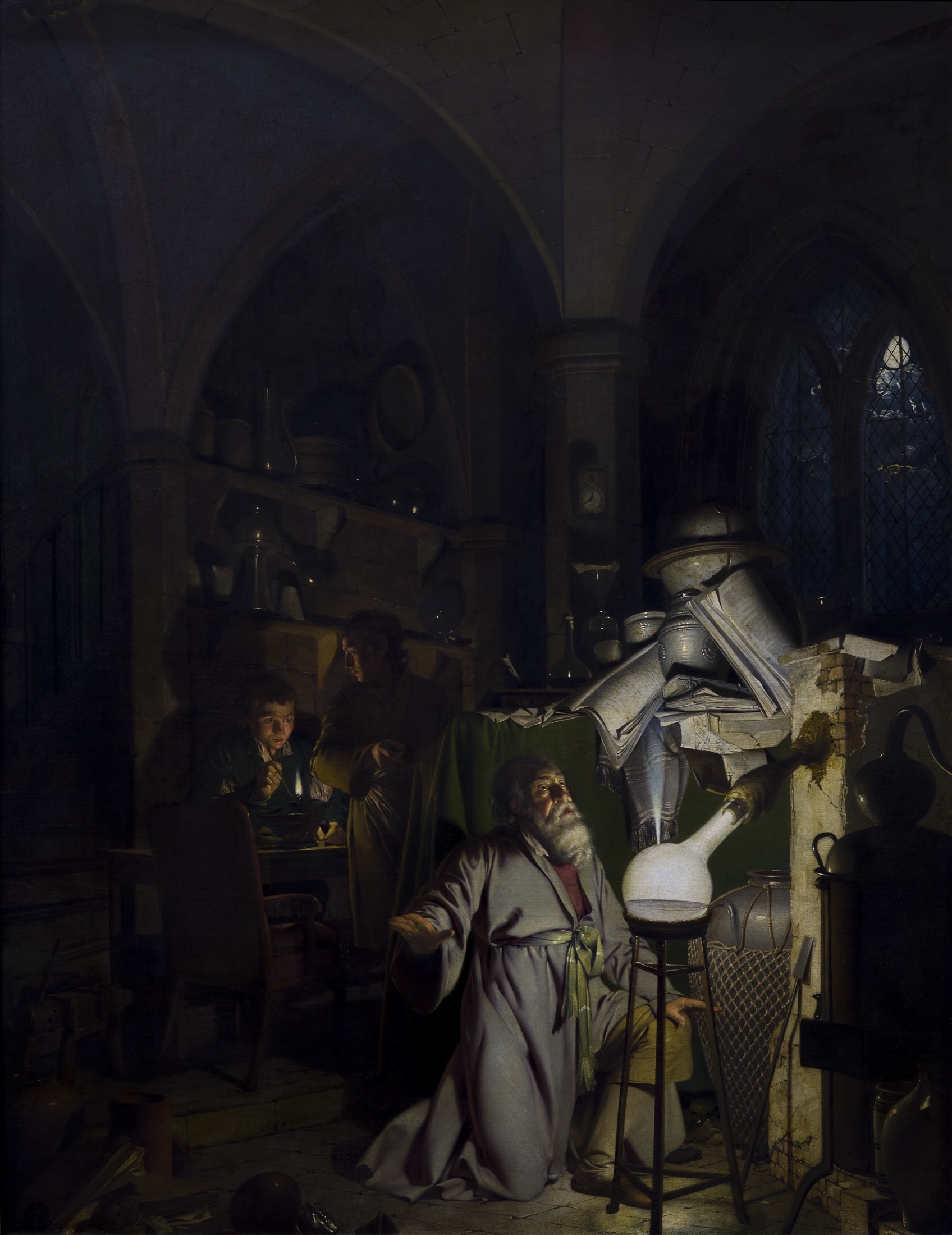
Joseph Wright of Derby, The Alchemist Discovering Phosphorus (1771; reworked 1795). Fire, vessel, operation, and revelation meet in one room: the experiment changes the operator as the operator changes matter. Click to open the full image.
Historical alchemists pursued material operations alongside religious and philosophical ones. Lawrence Principe’s account of early modern practice keeps the furnace material. Transformation requires a workable process, suitable container and active regulation. The initiatic reading extends this operation into human development.
The alchemical solve et coagula joins dissolution to coagulation. Dissolution releases a pattern from a form that has reached its carrying limit. Coagulation establishes a new form capable of retaining the result. The gain needs that body, while the inherited structure needs loosening to change. The Work alternates these operations until the new organization survives outside its exceptional conditions.
The vessel helps determine the outcome. At human scale, bodily regulation, physical safety and language make experience available for integration. Trustworthy relationships, ritual structure, skilled guidance, time, sleep and material resources sustain that work. These conditions explain why similar events leave different capacities and injuries. Boundary Sovereignty governs which pressure enters, what the vessel retains and when the operation closes.
The Developmental Window
Workable exertion followed by recovery strengthens tissue, while chronic or overwhelming stress destroys the range needed to adapt. Human crisis follows a limited version of this bodily analogy. Dose, duration, control, prior injury, support and recovery affect whether pressure becomes learning, delayed collapse or lasting harm. Initiation requires proportion, timing and recovery. Intensity alone leaves those conditions unresolved.
The golden wound remains open enough to change and bounded enough to retain the change. Rigidity blocks learning. Unbounded openness scatters the work. The developmental window lives between them.
Three operations can expose a being to pressure. Their difference lies in dose, recovery, custody, and who retains the result.
FORGE
bounded ordeal
→ sufficient agency and recovery
→ capacity retained by the tested being
→ sovereignty expands

INCINERATOR
ordeal exceeds the living interval
→ organization is damaged or destroyed
→ no developmental return is completed

FARM
viability is deliberately maintained
→ stress and recovery are controlled externally
→ the subject remains depleted or developmentally static
→ retained capacity accumulates in the operator
The incinerator overwhelms the vessel. The farm preserves enough viability for continued extraction while keeping exertion, recovery, memory and renewed action under external control. The forge returns the gain to the being that passed through the fire.
From Disturbance to Capacity
A disturbance becomes self-forging through a sequence of operations.
First, a difference interrupts automatic repetition. Conflict, anomaly, disciplined practice, technological change, grief, contradiction and chosen tasks each supply such a difference.
Second, the system discriminates among the signals carried by the event. It separates accurate warning from panic and instruction from identity. Useful constraint becomes distinguishable from imposed submission. Material facts become distinguishable from attached meanings. Discernment prevents intensity from becoming its own evidence.
Third, the system rehearses a new action, understanding, relationship or structure near ordinary life until it becomes available there. Insight confined to a ceremony, crisis, teacher, device or altered state remains dependent on that opening.
Fourth, a carrier retains the gain. Memory, embodied skill, written procedure, institutional reform, changed environment and reciprocal relationship carry development through different means. The persistent pattern is the organization that survives translation across states.
Fifth, the result is tested at a wider scope. A cult can strengthen its inner circle by exporting injury to members. A state can learn from crisis by expanding permanent emergency power. A platform can increase coordination while making participants dependent on a private gatekeeper. Development requires accounting for the larger living systems bearing those costs.
The Ratchet
The Coupled Gyre places the forge where consequence becomes the next cast. Pressure supplies the event, while retention supplies the ratchet. Discernment, repair, consent, skill, courage and independent action become gains when they remain available after the exceptional state recedes.
Real alternatives supply possibility. Discrimination selects. Energy pays for reorganization. A carrier preserves the result. Scope reveals whom it serves. Memory can retain a skill, a trauma response, or an institutional pathology; only the next turn shows whether the retained pattern became gold.
Extraction and Development
Extraction systems can generate pressures that provoke recognition and resistance. Censorship can teach readers to study provenance. Surveillance can motivate secure communication. An abusive institution can produce unusually capable organizers among those who oppose it. These are causal consequences of conflict.
The developmental response belongs to the survivor. Chosen challenge, protection and competent support can often build the same capacity at lower cost. Calling every wound curriculum turns injury into a metaphysical alibi. It transfers authorship of the growth from the survivor to the source of harm.
A wound can be transmuted after the fact. Its transmutation belongs to the wounded being, never to the power that inflicted it.
Custody distinguishes the circuits. An extractor retains control over relief, interpretation, belonging or renewed access. The participant gains competence inside the system’s terms while losing the ability to leave. Development transfers capacity to the participant and makes scaffolding less necessary over time. Refusal, exit, independent reproduction of the skill and revision of the teaching show that transfer.
Pressure names an input. Forging names what a living system does with part of it under enabling conditions. Keeping those levels distinct preserves responsibility and contingency.
Fate and Providence
Later Platonism and theurgy describe changing the soul’s relation to constraint. Iamblichus distinguishes fate from divine causes that exceed it. Theurgical participation aligns the soul with that higher order. Proclus describes remaining, procession and reversion. Effects proceed from their causes while retaining a relation that permits return.
These hierarchical, theological systems give pronoia, or providence, commitments beyond the forge’s requirements. Their operational insight concerns different degrees of understanding, agency and alignment within one external condition. The condition remains materially real. A transformed relation changes the actions available within it.
Assigning every event a hidden developmental purpose turns cruelty into benevolence at a higher level. That verdict shields the worldly operator and the metaphysical system from criticism. Providence gives response a direction within what has happened. Finding or creating that direction leaves the event’s ultimate intention a separate question.
Responsibility Survives Transformation
Survival demonstrates capacity while leaving necessity unproven. A person can develop after an injury while the injury remains an avoidable and inferior route.
Meaning leaves authorship with the survivor. An event can enter a coherent life while its perpetrator remains the source of the harm.
Metaphysical altitude leaves local obligation intact. Protection, treatment, restitution, prevention, and refusal remain appropriate when an event acquires spiritual meaning.
The forge names the affected system’s power to transform pressure. Moral credit belongs to the being that performs the transformation, while the force that supplied the flame retains responsibility for its effects.
The Gold Belongs to the One Who Forged It
Abuse remains abuse. Preventable harm remains preventable. Protection, treatment, restitution, refusal, and repair remain sacred after a survivor makes meaning from the wound. The survivor is the initiator of the growth.
The self-forging fire names the being’s power to convert consequence into retained capacity. Intensity, synchronicity, pain, pleasure and symbolic richness can accompany the work without determining its result. The gold appears in capacities retained afterward. Seeing, choosing, repairing, leaving, teaching, loving and acting become available independently of the force that supplied the flame. The fire reveals the work. The gold belongs to the one who forged it.
The Fire in Practice
The Coupled Gyre — the circulation in which receipt becomes the next cast
The Thermodynamics of the War — energetic cost, sorting, and the limits of physical analogy
The Great Work — the initiatic disciplines of dissolution, discrimination, and integration
The Shattered Vessel — overload, fragmentation, and failed containment
The Parasitic Ecology — extraction, dependency, and adversarial pressure
The Saturn Problem — limit, duration, consequence, and their mythic personification
References
Baldwin, James. “As Much Truth as One Can Bear.” The New York Times Book Review, January 14, 1962. Reprinted in The Cross of Redemption: Uncollected Writings, edited by Randall Kenan. Pantheon, 2010.
Bonanno, George A. “Loss, Trauma, and Human Resilience.” American Psychologist 59, no. 1 (2004): 20–28. https://doi.org/10.1037/0003-066X.59.1.20.
Calabrese, Edward J., and Linda A. Baldwin. “Defining Hormesis.” Human & Experimental Toxicology 21, no. 2 (2002): 91–97. https://doi.org/10.1191/0960327102ht217oa.
Feynman, Richard P., Robert B. Leighton, and Matthew Sands. The Feynman Lectures on Physics. Vol. I, chapter 46, “Ratchet and Pawl.” Addison-Wesley, 1963.
Iamblichus. On the Mysteries. Translated by Emma C. Clarke, John M. Dillon, and Jackson P. Hershbell. Society of Biblical Literature, 2003.
Linley, P. Alex, and Stephen Joseph. “Positive Change Following Trauma and Adversity: A Review.” Journal of Traumatic Stress 17, no. 1 (2004): 11–21. https://doi.org/10.1023/B:JOTS.0000014671.27856.7e.
Maercker, Andreas, and Tanja Zoellner. “The Janus Face of Self-Perceived Growth: Toward a Two-Component Model of Posttraumatic Growth.” Psychological Inquiry 15, no. 1 (2004): 41–48.
Principe, Lawrence M. The Secrets of Alchemy. University of Chicago Press, 2013.
Proclus. The Elements of Theology. 2nd ed. Translated and edited by E. R. Dodds. Clarendon Press, 1963. Propositions 25–39.
Tedeschi, Richard G., and Lawrence G. Calhoun. “Posttraumatic Growth: Conceptual Foundations and Empirical Evidence.” Psychological Inquiry 15, no. 1 (2004): 1–18. https://doi.org/10.1207/S15327965PLI1501_01.
Wright, Joseph, of Derby. The Alchemist Discovering Phosphorus. 1771, reworked 1795. Derby Museum and Art Gallery; public-domain reproduction via the Wikimedia Commons source record.
