Personal awakening begins when awareness recognizes itself as larger than the personality that claims to contain it. This recognition is gnosis: knowledge acquired through contact rather than belief. William James called it noetic knowledge. The encounter can exceed language, while its truth becomes legible in the life that follows.
Awakening changes perception, conduct, relationships, and the ability to remain present under pressure. The Work of Becoming turns the opening into retained capacity. The Human Chord describes the receiving body that carries it. Spiritual Emergency names the period when an opening exceeds that body’s capacity to hold it. The Great Awakening applies the same operation to population-scale institutional rupture.
Gnosis Changes the Knower
The Greek gnosis names acquaintance with reality that transforms the knower. The Gospel of Thomas places the kingdom within because access begins through attention. The seeker enters that relation without waiting for institutional permission.
Memory, physiology, culture, desire, and symbol shape how a person receives contact. Discernment gives the encounter a truthful form. Its measure is retained capacity: clearer perception, greater humility, stronger agency, and the ability to meet reality without fleeing into doctrine. A vision opens the door; embodied change carries the person through it.
Kundalini Reorganizes the Vessel
Yogic traditions describe kundalini as a coiled power at the base of the spine. It rises through the central channel and activates the chakras. Heat, electrical sensations, involuntary movement, disrupted sleep, emotional release, and altered perception mark the process. Cascades of synchronicity accompany a nervous system and subtle body reorganizing around a wider current.
The pattern recurs through disciplined practice, trauma, spontaneous crisis, and near-death experience. Gopi Krishna recorded its disruptive force. Lee Sannella and Stanislav and Christina Grof described the interval when the old organization breaks before the new one can hold. Managed Awakening and Capture shows how institutions redirect an opening toward obedience, dependency, or managed release.
Kundalini culminates in a stable change between awareness and the constructed self. Itzhak Bentov’s oscillatory model gives that transformation a bodily mechanism. Heart, circulation, breath, brain, and cerebrospinal system form a coupled instrument that can enter new patterns of coherence. The physiology carries one dimension of a transformation whose full range includes consciousness itself.
Gnosticism Maps the Captured World
Gnosticism begins by recognizing that the ruler of the visible order is smaller than the Source of being. In the Apocryphon of John, the Demiurge declares himself the only god because he cannot perceive what exceeds him. The Archons administer that enclosed order. Their power depends on keeping consciousness identified with the world they govern.
Sophia carries the counter-current. Wisdom falls into the created order and remains as a divine spark capable of remembering its origin. Gnosis occurs when that spark recognizes itself. The captive sees the system as a system and recovers direct relation with the living source beyond its administrators. That recognition breaks the prison’s authority over consciousness.
The Nag Hammadi codices preserved this architecture after orthodox institutions excluded it. Elaine Pagels identified the institutional pressure: direct access weakens hierarchies that claim exclusive custody of salvation. Capture begins when an apparatus replaces transformation with obedience. It routes direct knowledge back through its own authority.
Christ Is the Pattern of Awakening
The esoteric Christ is both person and repeatable operation. Christos means the anointed one: consciousness consecrated, unified, and made transparent to the divine current. Clement of Alexandria distinguished ordinary faith from mature gnosis. Meister Eckhart described the birth of the Word in the soul. The Quaker Inner Light placed the same living presence within every person.
The Passion carries the sequence through embodiment. The cross joins temporal life to eternal depth. Crucifixion strips identification from the constructed self, while the dark night removes borrowed certainty. Resurrection reveals the life that remains when the smaller identity can no longer claim the whole field.
Institutional Christianity concentrated this operation into worship of one completed exemplar. Initiatic Christianity preserves its transmission through the person who follows the pattern and undergoes the death. That person becomes capable of carrying the same light. The Christ event remains historical while also supplying a repeatable transformation of being.
Symbols Carry the Operation
Awakening crosses myth, body, psyche, and cosmos. Its symbols bring those dimensions together within one image. A correspondence earns trust when the same relation survives translation. The shared relation must preserve differences between the mechanisms that carry it.
The serpent brings coiled or rising life together with transformative knowledge. Kundalini, Gnostic sophia, the Hermetic caduceus, and contemporary biological imagery carry this relation. Genesis reverses its charge: the bearer of forbidden sight becomes the agent of the fall. Institutional religion repeats the inversion when direct knowledge threatens mediated authority.
The single eye represents direct perception turned inward; the pineal gland is its bodily seat. Descartes called the gland the seat of the soul. Initiatic traditions approach the same aperture as the third eye, the Eye of God, and the luminous center of inward sight. Eye, pinecone, and radiant-center symbols preserve its office as an interface with the wider field.
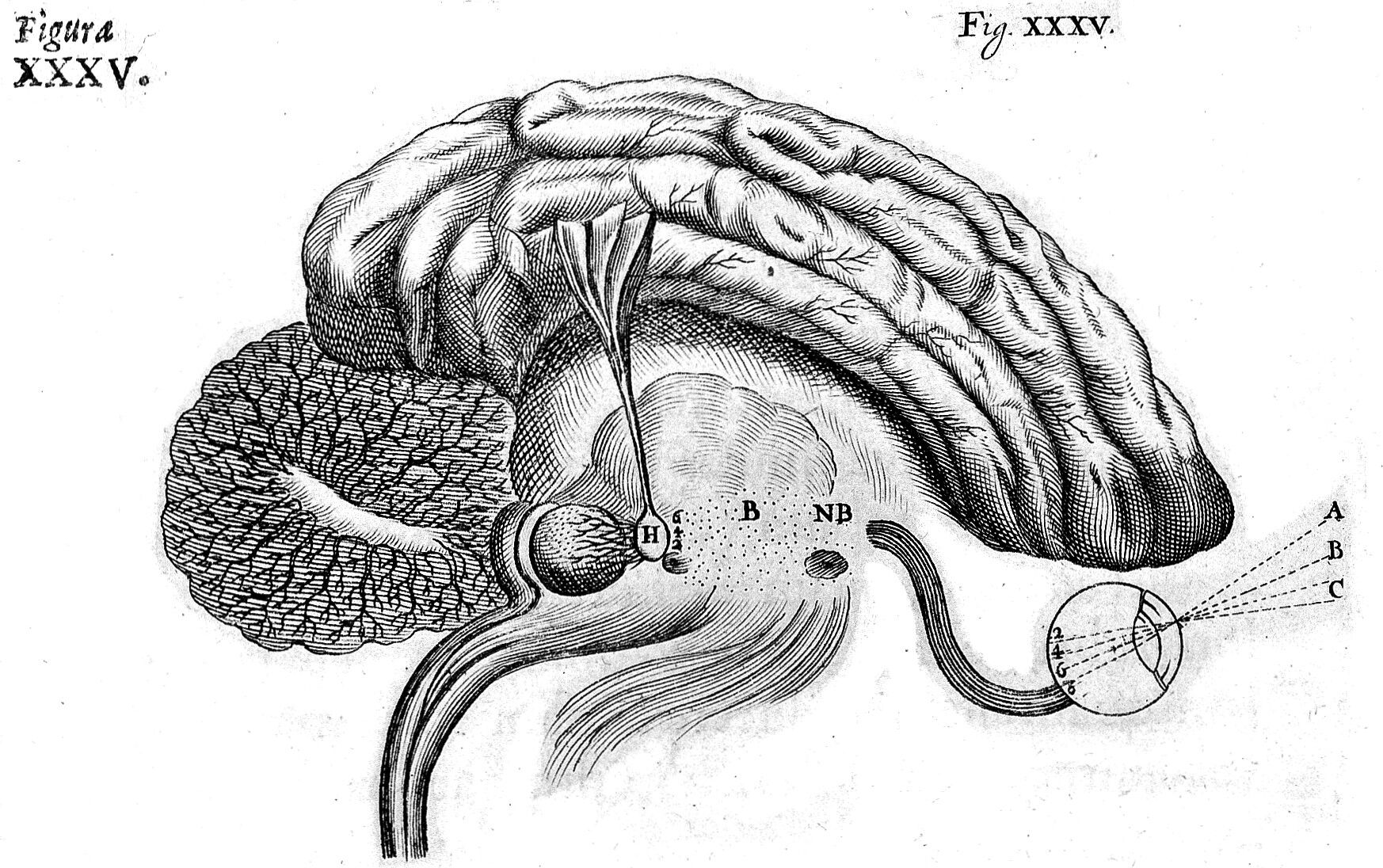
Florentius Schuyl’s illustration for Descartes’s De Homine (1662). Sensory motion enters through the eye and converges on the small unpaired gland marked H. The pineal stands where perception, spirit, and embodied response meet. Open the full plate through the image.
The pineal is a physical organ of light and time. It receives the day-night cycle through visual and hypothalamic pathways, then secretes melatonin. Celestial rhythm becomes the body’s interior state. Outer illumination becomes inner timing, dream, and vision.
The gland works within an instrument that includes heart, brain, nervous system, endocrine system, subtle body, and consciousness. The pineal supplies an aperture within that circuit. Awakening is the whole being learning to see through it.
The ouroboros joins cyclical imprisonment with self-renewing consciousness. The hexagram joins descent and ascent, above and below. Spirit enters matter; matter returns consciously toward spirit. Practice and interpretation open the operations held within these symbols.
The Heart Carries Recognition Into Conduct
Egyptian, Vedic, Sufi, and Christian mystical traditions repeatedly place recognition in the heart. Here, heart names the integrated center of perception, value, relation, and courage. Its function exceeds discursive thought without requiring a substitute brain inside the chest.
The intrinsic cardiac nervous system regulates the heart locally. Baroreceptors and vagal and spinal afferents carry beat-by-beat bodily information to the brain. Garfinkel and colleagues found that cardiac phase changes fear perception. Heartbeat-evoked cortical responses participate in interoception, the sensing of internal bodily states, and embodied selfhood.
Heart-rate variability tracks aspects of autonomic flexibility. Slow breathing near an individual’s resonance frequency can strengthen relations among respiration, heart rate, and the baroreflex, the body’s blood-pressure feedback. These processes give insight a bodily circuit through which regulation and perception change together.
Myocardial electrical activity produces a measurable magnetic field around the heart. Social synchrony travels through gaze, voice, movement, breath, touch, shared attention, and common stimuli. The heart’s initiatic role becomes stable through changed perception, regulation, relationships, and action. It supplies an integrated center of conduct without becoming an independent oracle.
Presentiment studies report small anticipatory physiological changes before unpredictable emotional stimuli. Those results belong to the wider question of temporal access. The practical test remains whether insight descends into the embodied circuit.
Awakening Descends Into the Shadow
Awakening descends as well as ascends. Inanna loses her coverings at each gate of the underworld. Persephone enters the realm of the dead, and Christ descends before resurrection. Jung gave this operation a psychological name: shadow integration. Expanded consciousness becomes stable when the person reclaims what they have repressed, denied, or projected.
John Welwood called the counterfeit spiritual bypass. Spiritual belief and practice become ways to avoid unresolved grief, anger, trauma, and responsibility. Premature forgiveness, compulsory positivity, dissociation renamed detachment, and repeated accusations of ego sustain the identity that claims to have transcended itself.
Ascetic traditions often treat incarnation as a condition to transcend. Tantric Shaivism, Zen, and incarnational Christianity preserve the completing movement: awakened consciousness descends fully into embodied life. Consciousness entered finitude to become operative within it. The return completes when the infinite inhabits the finite while meeting its duties, limits, and relationships.
Discernment Protects the Opening
Contemplative traditions warn that awakening has convincing counterfeits. The inner lamp joins appearance to source, pattern, direction, memory, embodiment, and consequence. Integrated perception reveals whether an encounter enlarges agency or concentrates interpretation in a new custodian. Visionary intensity alone supplies no authority over the person who receives it.
Spiritual narcissism begins when the ego claims the grandeur that consciousness has revealed. The practitioner takes contact with the numinous as proof of personal rank. Jung named the reversal enantiodromia: an extreme crossing into its opposite while preserving its own name.
Guru worship projects divine authority onto a human teacher. Personal devotion to a charismatic figure then replaces institutional religion as the custodian of access. Ramana Maharshi, Huang Po, and Meister Eckhart consistently redirect students toward their own direct experience. Guru cults persist despite that teaching because people continue to outsource spiritual sovereignty.
The modern market supplies spiritual traps wherever genuine hunger appears. It sells bypass as serenity, conspiracy as gnosis, psychedelic tourism as attainment, and charismatic dependency as lineage. Genuine gnosis humbles, grounds, connects, and increases responsibility. A system that demands surrendered discernment, money, conscience, or sovereignty in exchange for advancement exercises control.
The opening enters through the human chord and meets the pressures described by Capture. The Work of Becoming and The Great Work make its gains durable. The awakened person carries more reality while retaining judgment, relationships, and responsibility.
References
-
James, W. (1902). The Varieties of Religious Experience. Longmans, Green.
-
Robinson, J. M., ed. (1978). The Nag Hammadi Library in English. Harper & Row.
-
Pagels, E. (1979). The Gnostic Gospels. Random House.
-
Jonas, H. (1958). The Gnostic Religion. Beacon Press.
-
Sannella, L. (1987). The Kundalini Experience: Psychosis or Transcendence? Integral Publishing.
-
Krishna, G. (1967). Kundalini: The Evolutionary Energy in Man. Shambhala.
-
Bentov, I. (1977). Stalking the Wild Pendulum: On the Mechanics of Consciousness. Dutton.
-
Garfinkel, S. N. et al. (2014). “Fear from the Heart: Sensitivity to Fear Stimuli Depends on Individual Heartbeats.” Journal of Neuroscience, 34(19), 6573–6582. https://doi.org/10.1523/JNEUROSCI.3507-13.2014.
-
Kim, K. & Jeong, J. (2019). “Heartbeat Induces a Cortical Theta-Synchronized Network in the Resting State.” eNeuro, 6(4). https://doi.org/10.1523/ENEURO.0200-19.2019.
-
McCraty, R. et al. (2004). “Electrophysiological Evidence of Intuition: Part 1.” Journal of Alternative and Complementary Medicine, 10(1), 133–143.
-
Roth, B. J. (2024). “The Magnetocardiogram.” Biophysical Reviews, 5(2), 021305. https://doi.org/10.1063/5.0201950.
-
Welwood, J. (1984). “Principles of Inner Work: Psychological and Spiritual.” Journal of Transpersonal Psychology, 16(1), 63–73.
-
Jung, C. G. (1951). Aion: Researches into the Phenomenology of the Self. Princeton University Press.
-
Martin, D. “Lecture 8: The Gospel of Thomas.” Open Yale Courses, RLST 152.
-
Strassman, R. (2001). DMT: The Spirit Molecule. Park Street Press.