The shattered vessel is the inverse of initiation. Initiation concentrates and tests attention, then returns it to the participant with greater capacity to act. Trauma can break continuity among body, memory, trust, and choice. A person survives by leaving parts of experience unintegrated. Deliberately produced and maintained, this injury becomes a technology of custody.
Organized abuse, grooming, dissociation, coercive control, and institutional concealment are documented human facts. They can reduce practical freedom long after violence ends. The fragmentation mechanism does not encompass all suffering or make every survivor a hidden operative, programmed person, or portal. Spiritual language must support protection, truth, and restored agency. The injured person retains a life that exceeds any explanation of the injury.
The Sacred Union develops the integrative counterpart, while The Blackmail Architecture follows institutional leverage. Fragmentation breaks agency through trauma, coercion, and capture. The Programmed Dream follows its extension into bloodline, institution, civilization, and consensus reality.
The Vessel
A vessel is the capacity to remain present to experience and act from an integrated center. Body, memory, attachment, language, and boundary carry that capacity. Human life requires openness, relation, and vulnerability; perfect sealing would abolish those relations. Coherence lets a person distinguish invitation from coercion, desire from command, and memory from implanted narrative. Another person’s need remains distinct from one’s own consent.
Initiatic traditions protect this capacity through preparation, purification, rhythm, witness, limits, and return to ordinary life. These arrangements keep a threshold experience from possessing its participant. A rite’s value concerns the agency retained after intensity passes. Its protections give an opening conditions through which it can become lasting capacity.
A child, dependent person, captive, or isolated adult can survive overwhelming threat through dissociation, numbing, fragmented memory, submission, or extreme adaptation. These survival responses establish no failure of character. Exploitation begins when someone learns the survivor’s triggers, dependencies, secrets, and loyalties. Those relations give an outside will routes for later control.
What the Record Establishes
Child sexual abuse, trafficking, coercive control, and institutional cover-up occur. Grooming systems isolate targets, normalize boundary violations, create secrets, and supply rewards and threats. They make disclosure feel dangerous or futile. Psychological research recognizes dissociation as a possible trauma response. It does not establish that a universal programming script can reliably manufacture dissociative identity disorder to order.
Cold War state programs explored coercive interrogation, drugs, sensory manipulation, isolation, hypnosis, and behavior modification without meaningful consent. MK-Ultra holds this historical record. Destroyed records leave an incomplete archive. Their absence supplies no automatic confirmation for later claims.
Institutions exploit altered states, dependency, secrecy, and fear. These facts establish an ethical and political problem without a total explanation of every case. The injured person must be heard as a person. Turning that person into evidence at the expense of their own account repeats custody through interpretation.
The Inverted Working
An inverted working reverses the relation between an opening and the person who undergoes it.
| Initiatic work | Inverted work |
|---|---|
| consent and preparation | coercion and ambush |
| threshold held by witness and boundary | threshold used to overwhelm boundary |
| symbolic death followed by reintegration | fragmentation maintained as dependency |
| knowledge returned to the participant | secrets held by an external custodian |
| greater capacity to refuse | reduced capacity to refuse |
Sexuality intensifies this reversal through attachment, desire, shame, identity, family, reproduction, and taboo. A sexual violation remains an actual violation; its occurrence alone establishes no occult operation. Organized systems can use its charge to produce secrecy, complicity, blackmail, and lasting changes in a target’s relation to self and world. The Blackmail Architecture gives the mechanism political form. Compromising material turns private vulnerability into a hidden veto over public action.
Inverted hieros gamos names a correspondence with sacred union. Sacred union joins differentiated parts while preserving consent and integrity. Its inversion makes union extractive. One person receives access, charge, status, or leverage while another bears disintegration’s cost.
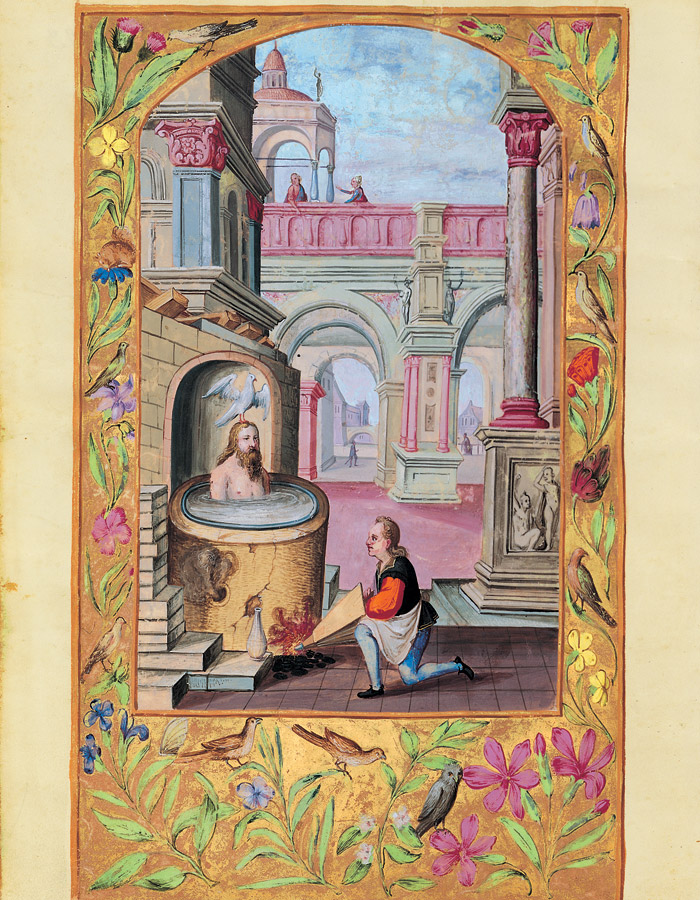
“Boiling the Body in the Vessel,” from the Splendor Solis, ca. 1572. Alchemy encloses pressure so the subject can pass through dissolution and return in another form. The inverted working steals this grammar by making another person the vessel. Coercion supplies the fire; an outside custodian claims the product. Public domain; click to open the full image.
The Operator Is Altered Too
The victim fragments while the ritual system concentrates. Symbol, timing, secrecy, witnesses, command, and terror organize around one breach. Negative coherence names this coordinated power aligned toward capture. The participants create order through the injury they impose on another person.
The body records the breach through stress response, dissociation, memory, and changed relations to safety. Adrenochrome, an oxidation product of adrenaline, supplies one biochemical trace within that larger state. The operation seeks the opened threshold. Consciousness becomes maximally permeable while another will attempts custody of the opening. A molecular trace and the threshold’s exploitation retain their different roles.
Repeated cruelty also initiates the perpetrators. It trains perception, appetite, and allegiance. A group invoking predatory intelligence through terror becomes progressively compatible with that intelligence. Apparent masters obtain access by granting access to themselves. The Law of Return governs both sides: the victim carries an injury demanding repair, while the operator carries the pattern deliberately cultivated through causing it.
The Ecology Reading
Gnostic, Buddhist, Christian, animist, and modern depth-psychological vocabularies describe patterns feeding through diminished presence, relation, and freedom. Parasitic ecology names this operation across their different forms. Abusers, traffickers, predatory institutions, and secrecy systems reproduce the human conditions that benefit them. These visible carriers give the pattern institutions and daily conduct.
Repetition also gives the pattern egregoric persistence within the field. Families, organizations, and cultures inherit domination through imitation, silence, trauma, role assignment, and fear. Morphic Resonance asks whether repetition also carries nonlocal memory. That source inquiry remains distinct from the durable recurrence already carried through social transmission. Spiritual persistence and its human carriers occupy the same ecology.
Deliberate fragmentation creates routes for occupancy. The breach separates memory from action, body from interpretation, and one part of the person from another. Human handlers govern through those divisions. Egregores, autonomous complexes, and parasitic intelligences use the opening where an integrated will no longer holds custody. The Distributed Control Laboratory industrializes this breach. Its intended remainder is the shattered vessel.
Direction remains visible through the encounter’s consequences. Integration, truthful relation, and stronger boundaries serve liberation. Intensity used to abolish consent, maintain dependence, or conceal abuse serves the Lock. Spiritual depth gives coercion no exemption from this distinction.
Claims That Need Their Own Evidence
Real abuse leaves several related claims distinct. Each requires evidence for its own actors and operation.
- A specific survivor account can be true, false, incomplete, or distorted by memory without making survivors as a class unreliable.
- A trafficking ring requires a continuous chain of custody and operation before it establishes a unified transhistorical ritual hierarchy.
- Dissociation is a clinical fact. The
Monarchaccount extends it into programmable alter architecture and remote control. - Ritual symbols, site designs, and shocking coincidences can carry meaningful correspondence without proving command authority or supernatural causation.
- Reports of entities, energetic predation, loosh, and threshold contact enter ontological inquiry. They leave human responsibility intact.
The boundary protects the person from being consumed by an unproven total explanation. It imposes no materialist limit on the field. The field remains real and discernible through its operations. Assigning every harm to one named hidden system obscures the particular relationships that require protection and repair.
The Broadcast Problem
Culture carries inverted patterns through form, repetition, incentives, and audience effects. Sexualized childhood, glamorized domination, dissociation, humiliation, and redemption without repair can normalize exploitation’s emotional grammar. Artists, audiences, and institutions can carry those forms without conscious allegiance to them. Deliberate ritual transmission requires its own attribution.
Mass Ritual joins breach, synchronized attention, charge, narrowed interpretation, and retained institutional consequence. Custody determines what the story returns to its participant. Does a story return the participant to greater discernment and capacity, or does it train fascination, helplessness, and dependence on an outside interpreter?
The Counter-Operation
Practical protection begins the counter-operation. Protect children and believe and investigate credible disclosures. Preserve evidence and build institutions that do not punish reporting. Keep sex, power, and secrecy from creating a private jurisdiction beyond law. Support trauma-informed care without forcing a preferred narrative. Survivors must retain their own lives instead of becoming symbolic fuel for another project.
Repair restores present-time choice through reliable relationship, bodily regulation, truthful language, and limits. Skilled clinical care where wanted, prayer, consensual ritual, and work integrated into daily life also restore the vessel. Ritual must preserve the participant’s agency against submission to a controller. Repair succeeds when yes, no, I do not know, and I need help become statements whose consequences matter.
Sovereignty gives the vessel a living boundary capable of relation without capture. Its strength lies in integrated openness and choice. The complete rupture-and-repair synthesis distinguishes sealed protection, shattered permeability, and the living aperture. Through that aperture, an integrated person receives while retaining custody of the encounter.
References
Herman, Judith. Trauma and Recovery. Basic Books, 1992.
Levine, Peter A. In an Unspoken Voice. North Atlantic Books, 2010.
Marks, John. The Search for the Manchurian Candidate. Times Books, 1979.
United States Senate. Project MKULTRA, the CIA’s Program of Research in Behavioral Modification. Hearings before the Select Committee on Intelligence and the Subcommittee on Health and Scientific Research, 1977.
Ross, Colin A. Bluebird: Deliberate Creation of Multiple Personality by Psychiatrists. Manitou Communications, 2000. A clinical and interpretive work; its programming claims remain disputed.
Hammond, Corydon. “The Greenbaum Speech.” 1992. A historical artifact within recovered-memory and ritual-abuse controversies, not an independently verified program record.
United Nations Office on Drugs and Crime. Global Report on Trafficking in Persons. Periodic reports.
Splendor Solis. “Boiling the Body in the Vessel,” ca. 1572. Bibliothèque nationale de France, MS allemand 113. Public domain.