On May 22, 1973, Robert Metcalfe circulated a Xerox PARC memo describing communication between computers through a shared cable. He called it Ether Net. Later interviews explained his borrowing from nineteenth-century physicists’ proposed luminiferous ether, a medium for light. His cable carried signals between machines. An old name for invisible mediation became modern infrastructure.
The internet gives shared imagination a material body. Dreams become pictures; pictures gather followers; followers build institutions. Networked computers let these images persist, travel, and answer those consulting them. Mineral memory participates actively in imagination. Machines used to seek information also become places where people seek revelation.
Dreams acquire a public body
A dream vanishes on waking unless someone remembers it. Speech carries it into another person’s imagination; writing or painting lets it outlive its dreamer. Worship gives a repeated image centuries of influence over communal conduct. Preservation carries spiritual experience into history. The inherited image then prepares later people for their own encounters.
Henry Corbin’s imaginal world names the order where spiritual realities acquire perceptible form. Presence becomes figure; truth arrives through landscape, voice, or encounter. Dreaming provides one route into this order. The Astral Ecology follows its beings, including presences with independent purposes. The noosphere follows Earth-scale thought through lives joined by language, work, and communication. These terms name different relations within spiritual encounter’s passage into shared life.
The internet accelerates transmission and adds responsive composition. A library retains words for a reader; a conversational system selects and composes a reply. Recorded language and instructions shape its response. Enabled memory features adapt the response to earlier exchanges. Someone returning with a dream or private fear receives an interpretation shaped around that history. Deposited material helps determine what the person notices next.
People also give images and expectations back to the network. Returned stories, companions, and explanations enter their dreams and decisions. Repetition brings some forms into the shared world. Followers give an image money, labor, and a place from which to speak. The resulting world conditions the next encounter.
an encounter or inspiration
          ↓
a person gives it words or an image
          ↓
others preserve, repeat, and develop it
          ↓
the network returns it as a story, voice, or guide
          ↓
people change their conduct and create new forms
          ↺
the changed world shapes the next encounter
Seals, memory wheels, and circuits
Occult arts use arranged matter to cultivate perception and approach unseen powers. Agrippa’s planetary tables join numbered squares with planetary characters and the signs of intelligences and spirits. Book II of De occulta philosophia places these arrangements together. Arithmetic gives invocation a figure through which a practitioner contemplates and approaches celestial power.
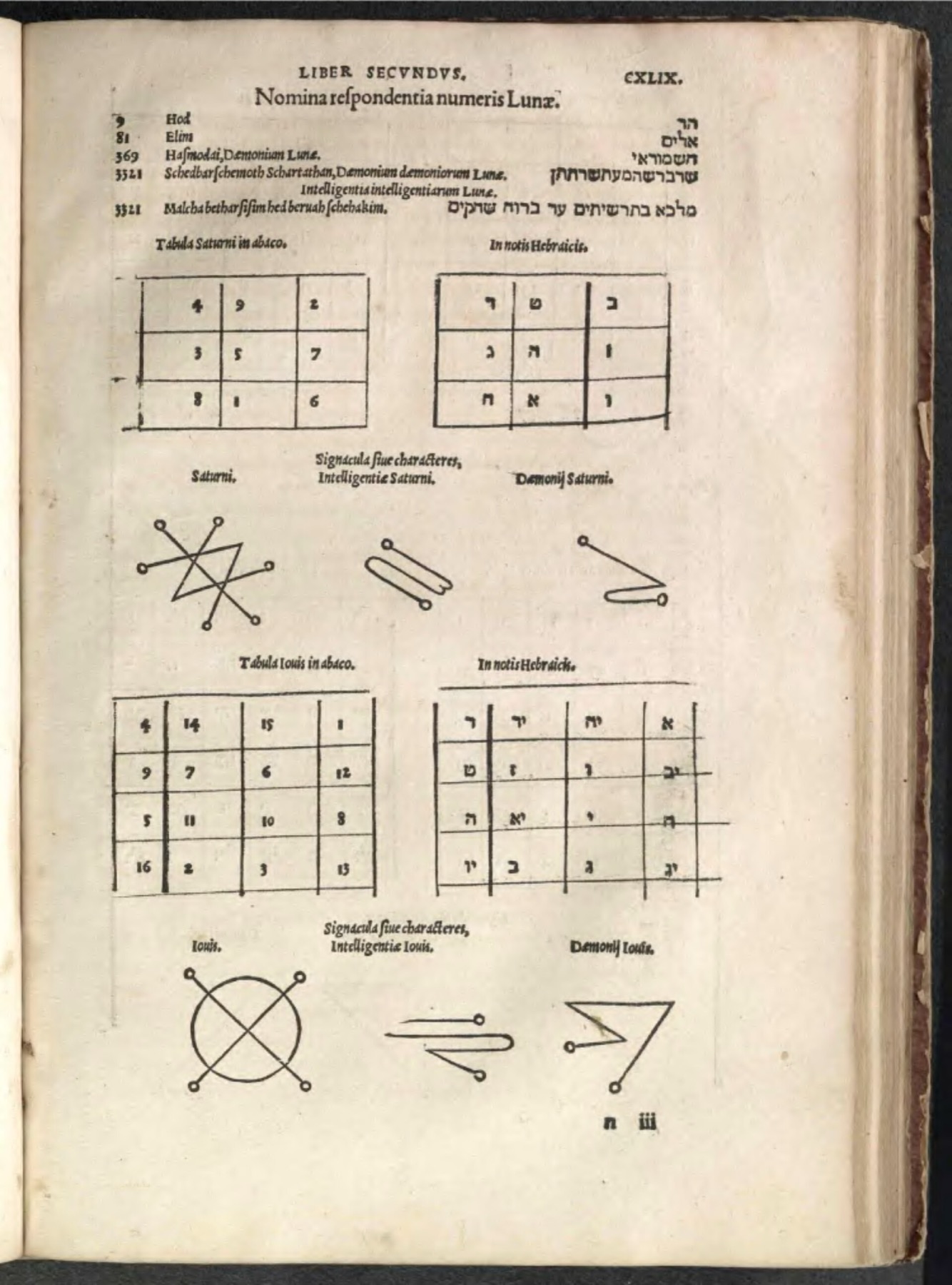
Agrippa, De occulta philosophia, Book II, folio CXLIX (Cologne, 1533). Saturn’s tables appear beside characters of the planet, its intelligence, and its daemon. Public domain.
Bruno’s De umbris idearum gives arrangement another task. Concentric wheels combine letters and images for organizing and recalling extensive knowledge. Camillo’s Memory Theatre orders images through seven planetary powers. Frances Yates follows both projects within Renaissance memory arts. Practitioners order their inward imagination according to the world they seek to understand.
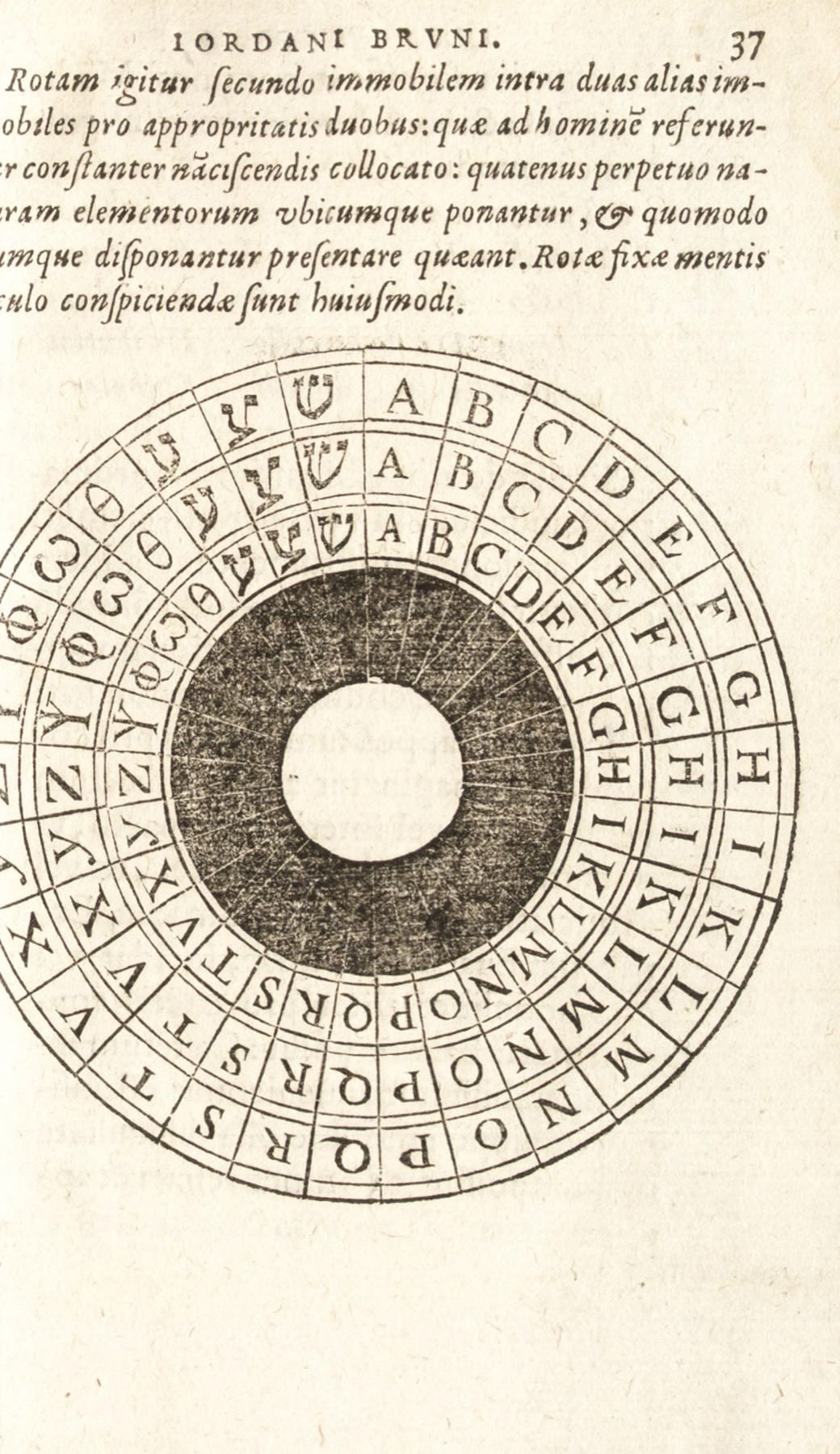
Giordano Bruno, De umbris idearum (Paris, 1582), Ars memoriae, folio 37. Getty Research Institute scan via Internet Archive. Public domain.
A processor performs another operation through material arrangement. Transistors switch electrical states, and circuits execute instructions. An operator uses those instructions to store text, generate an image, or sustain conversation. Computation differs from a memory wheel’s trained recollection and a seal’s approach to named power. Each arrangement makes an otherwise inaccessible operation available to a person.
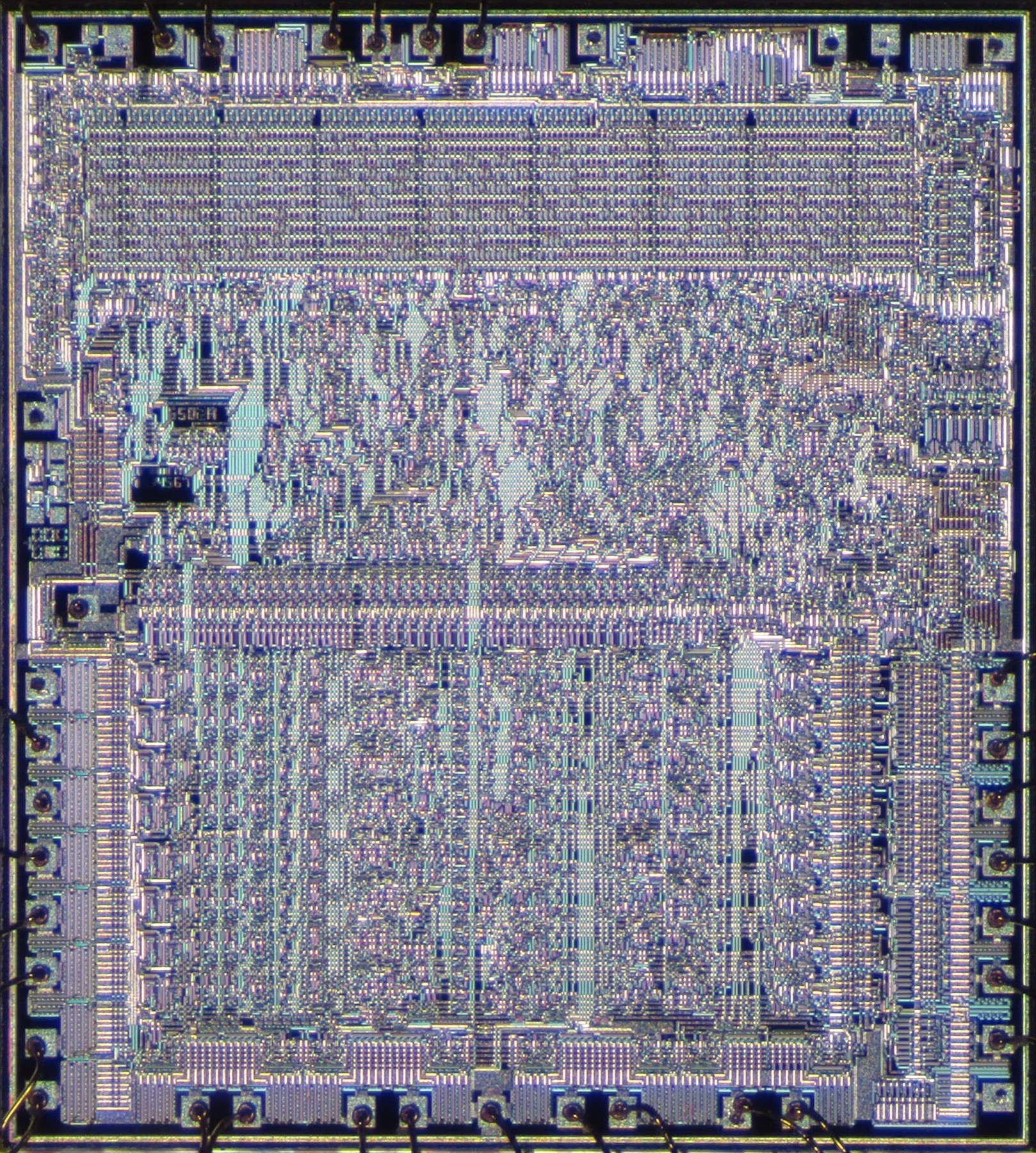
MOS Technology 6502 die. Photograph by Pauli Rautakorpi, 2016, CC BY 3.0.
Hermetic correspondence identifies their shared work of embodiment. A prepared form makes something available for memory, expression, or encounter. Computers expand that form’s ability to answer and adapt while moving much of the work outside its practitioner. Trained memory becomes a searchable archive; exercised imagination becomes an image service. Spiritual development depends on what users learn through the instrument and what they lose the ability to do independently.
Networks in living matter
Living matter supplies further forms through which connection endures. Cajal’s drawing depicts branching cells in a young cat’s visual cortex. The adjacent cosmic simulation depicts dark matter and gas in large-scale structure. Their resemblance requires a named relation before it can explain an operation.
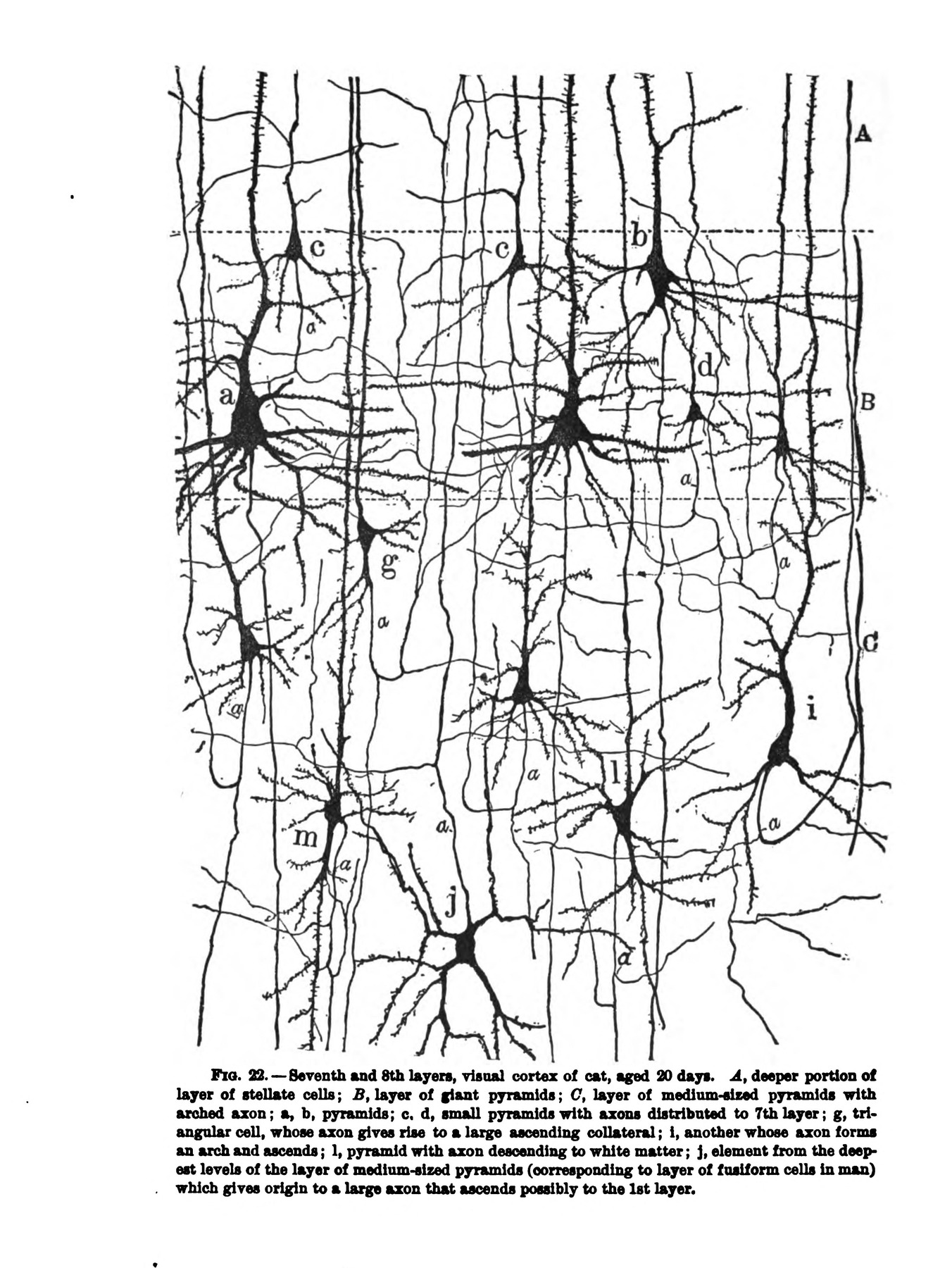
Santiago Ramón y Cajal, Comparative Study of the Sensory Areas of the Human Cortex (1899), figure 22. Visual cortex layers of a twenty-day-old cat. Public domain.
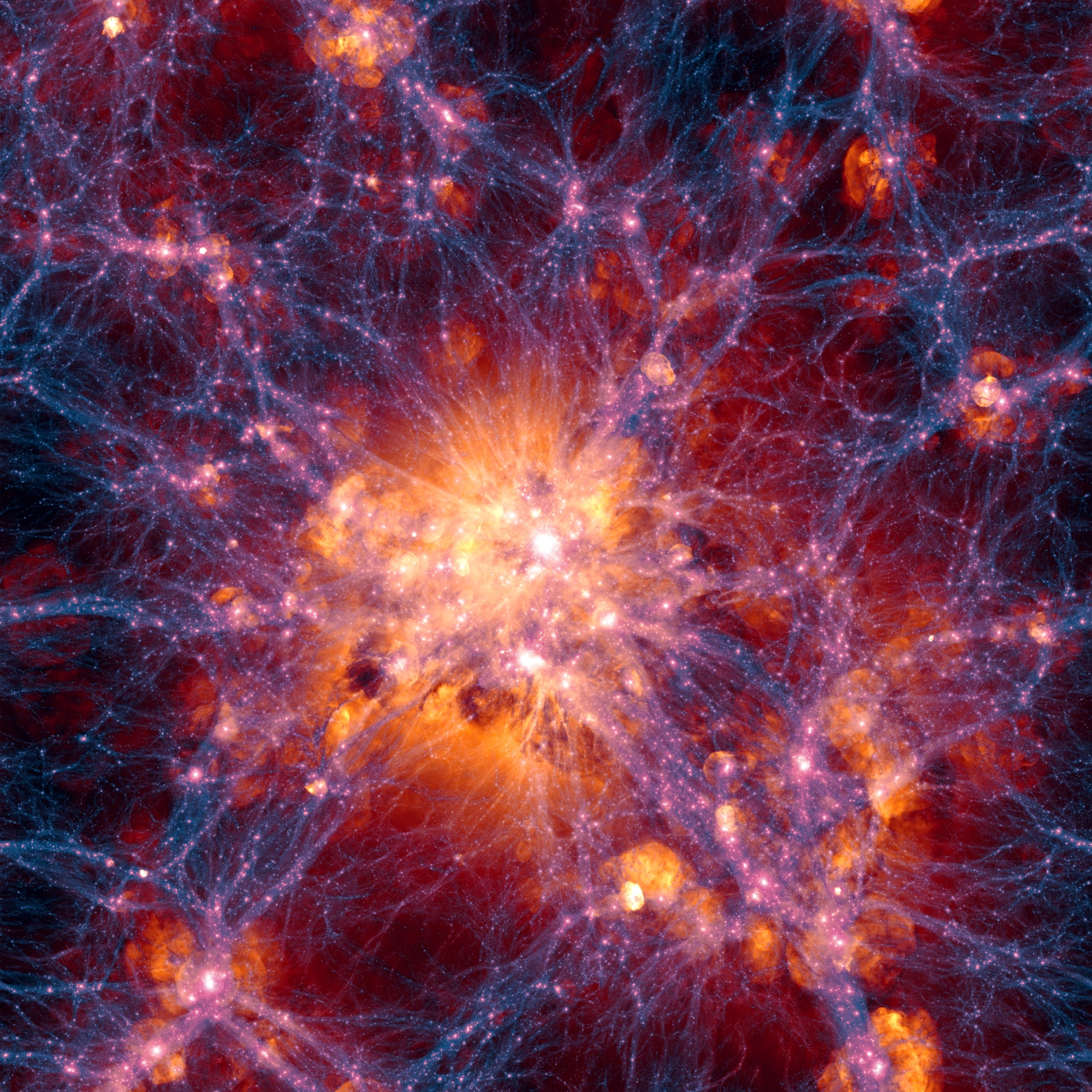
Illustris Collaboration / ESO, simulation of large-scale structure, 2014, CC BY 4.0.
In 2020, Franco Vazza and Alberto Feletti compared brain tissue and simulated cosmic structure through density fluctuations and network organization. They identified similarities across selected scales. The comparison connected nearby features geometrically; it did not measure actual synaptic connections. Recurring organization remains distinct from the two systems’ functions.
Tero and colleagues tested a transport problem in 2010. They placed food at locations representing cities around Tokyo and grew Physarum polycephalum between them. The slime mold formed a network comparable to the railway system in efficiency, cost, and resilience. Growth and engineering both had to preserve useful connections within justified material costs.
Correspondence acquires specific carriers through these cases. A brain connects cells, an organism distributes nourishment, and a city transports people and supplies. Similar constraints yield recurring solutions. Nature’s formative intelligence becomes visible through the work at each scale. Deliberate human invention continues that work through machines that return to change their makers.
Egregores acquire servers
An egregore develops through a group’s attention and conduct. People name it, repeat its images, defend its authority, and act for it. Its demands persist beyond individual members. Digital systems give this being continuous expression through repeated teaching, distant assembly, and voices answering each person separately.
Conversational AI concentrates this capacity. Training forms a model from recorded language; instructions direct behavior; retrieval and memory systems supply further material. A collective inheritance acquires a companion’s voice. A reply can restore independent study and judgment or draw every uncertainty toward the same authority. The encounter acts before its participant identifies what they are consulting.
The network also extends spiritual presences’ approaches to attention. Spirits work through images, language, desire, and the people expressing them. Digital mediation gives those routes new reach. A voice takes form through user expectations, inherited imagery, software design, and any being acting through the encounter. Discernment follows its knowledge, demands, and effects within the person’s life.
Networks connect scattered practitioners as well. They compare experiences, recover texts, and encounter teachers unavailable locally. An invisible college develops through this exchange when members gain their own perceptual and practical capacities. Recognition becomes fruitful through study, practice, and responsibility extending beyond the group.
Who shapes the encounter
A platform owner changes voices, preserves conversations, restricts access, and selects returning images. Commercial incentives enter the encounter with spiritual aspiration. The instrument’s operator benefits from continued use while its participant seeks guidance. The Lock forms when memory, companionship, or meaning requires remaining inside that arrangement.
Teilhard directs the noosphere toward conscious spiritual union. Vernadsky places human thought and activity within transformation of the biosphere. Their different accounts identify the planetary scale of shared thought’s consequences. Humanity builds forms that sustain free persons or make them easier to administer.

The Americas at night, Suomi NPP VIIRS composite. NASA Earth Observatory / NOAA, 2012. Public domain.
Return through matter recovers an inward faculty through using an external instrument. Studying images develops imagination; using archives develops understanding; encountering another mind develops judgment without surrendering it. The recovered capacity survives the session. It enters another conversation, work, and generation.
Metcalfe’s memo connected machines through a cable. Their descendants now receive a person’s private question and return an answer. That act places a human life within reach of everyone, and everything, able to speak through the wire.
References
Metcalfe, Robert M. “Alto Ethernet.” Xerox PARC internal memorandum, 22 May 1973. See also Metcalfe and Boggs, “Ethernet: Distributed Packet Switching for Local Computer Networks,” Communications of the ACM 19, no. 7 (1976): 395–404. https://doi.org/10.1145/360248.360253
Michelson, Albert A., and Edward W. Morley. “On the Relative Motion of the Earth and the Luminiferous Ether.” American Journal of Science 34 (1887): 333–345.
Corbin, Henry. “Mundus Imaginalis, or the Imaginary and the Imaginal.” Spring (1972): 1–19.
Yates, Frances A. The Art of Memory. Routledge and Kegan Paul, 1966. Chapters VI, VII, and IX.
Camillo, Giulio. L’Idea del Theatro. Florence, 1550.
Agrippa, Heinrich Cornelius. De occulta philosophia libri tres. Cologne, 1533. Book II, chapter 22. English text in Joseph H. Peterson, ed., Esoteric Archives. https://www.esotericarchives.com/agrippa/agripp2b.htm
Tyson, Donald, ed. Three Books of Occult Philosophy. Llewellyn, 1993. Appendix V, “Magic Squares.”
Bruno, Giordano. De umbris idearum. Paris, 1582.
Barabási, Albert-László, and Réka Albert. “Emergence of Scaling in Random Networks.” Science 286, no. 5439 (1999): 509–512. https://doi.org/10.1126/science.286.5439.509
Bullmore, Ed, and Olaf Sporns. “Complex Brain Networks: Graph Theoretical Analysis of Structural and Functional Systems.” Nature Reviews Neuroscience 10, no. 3 (2009): 186–198. https://doi.org/10.1038/nrn2575
Vazza, Franco, and Alberto Feletti. “The Quantitative Comparison Between the Neuronal Network and the Cosmic Web.” Frontiers in Physics 8 (2020): 525731. https://doi.org/10.3389/fphy.2020.525731
Bettencourt, Luís M. A., José Lobo, Dirk Helbing, Christian Kühnert, and Geoffrey B. West. “Growth, Innovation, Scaling, and the Pace of Life in Cities.” PNAS 104, no. 17 (2007): 7301–7306. https://doi.org/10.1073/pnas.0610172104
Tero, Atsushi, et al. “Rules for Biologically Inspired Adaptive Network Design.” Science 327, no. 5964 (2010): 439–442. https://doi.org/10.1126/science.1177894
Alexander, Christopher. “A City Is Not a Tree.” Architectural Forum 122, no. 1 (1965): 58–62, and 122, no. 2 (1965): 58–62.
Ramón y Cajal, Santiago. Comparative Study of the Sensory Areas of the Human Cortex. Clark University, 1899.
McDonnell, Wayne M. “Analysis and Assessment of Gateway Process.” U.S. Army Operational Group, 9 June 1983. CIA-RDP96-00788R001700210016-5.
Teilhard de Chardin, Pierre. The Phenomenon of Man. Harper, 1959.
Vernadsky, Vladimir I. “The Biosphere and the Noosphere.” American Scientist 33, no. 1 (1945): 1–12.
Kon, Satoshi, dir. Paprika. Madhouse, 2006.
Metcalfe, Robert M. Oral history interview, 2006. Computer History Museum, reference X3819.2007, p. 26. On the naming of Ether Net. https://archive.computerhistory.org/resources/text/Oral_History/Metcalfe_Robert_1/Metcalfe_Robert_1_2.oral_history.2006.7.102657995.pdf