Death ends embodied access. Awareness, memory, agency, and relationship then meet the release of the instrument that gave them familiar expression. The question concerns what remains coherent through that release.
A broken radio stops producing sound without revealing whether it generated or received the program. Brain injury, anesthesia, dementia, sleep, psychedelics, and stimulation likewise show the brain’s powerful influence on conscious expression. Those changes leave the relation between neural production and reception unresolved.
Near-death experience, paradoxical lucidity, deathbed encounter, mediumistic information, and childhood past-life memory test different parts of continuity. The interface fails while experience and relation are still being reported. Each archive asks what persists, what can be retrieved, what communicates, and what retains a center of agency.
Four Forms of Continuity
RETENTION
something persists

RETRIEVAL
a living receiver accesses it

COMMUNICATION
information crosses an addressed channel

IDENTITY
the same center of agency continues
Retention preserves a pattern without necessarily preserving a person. A field, family, body, place, text, or culture carries such patterns.
Retrieval gives a living receiver access to a record. The receiver can recover distributed information without communicating with its original owner.
Communication requires a source, address, encoding, channel, receiver, decoding, and a way to verify the proposed route. Resemblance alone leaves those operations unidentified.
Identity requires the same center of agency to continue. Accurate memory, recognizable mannerisms, and emotional continuity support that claim. Information also moves without carrying the original subject. What someone knew must remain distinct from who initiated, remembered, and answered.
The Evidence Map
Near-death experience supplies structured reports from some survivors of cardiac arrest around severe physiological crisis. Pim van Lommel’s 2001 study and Sam Parnia’s 2023 AWARE-II report supply prospective records. Precise timing against loss and recovery of brain function remains difficult. Hidden visual targets have not supplied decisive confirmation.
NDEs test the relation between consciousness and a failing brain. The afterlife interpretation requires further evidence of continuity and identity. That evidence has different carriers in the archives below.
Paradoxical and terminal lucidity describe meaningful communication returning unexpectedly in people with severe neurological impairment, often near death. Prospective research is replacing an archive dominated by retrospective reports. The phenomenon challenges an equation between visible impairment and the person’s complete absence. The source of restored capacity remains unresolved.
Childhood past-life memory cases supply the strongest organized archive of specific information apparently crossing a death boundary. The best cases record statements before identifying the deceased person. Verified details, behavioral continuity, physical marks, and absent known contact between families strengthen them.
These cases establish anomalous continuity of information. In some, personal reincarnation supplies the strongest reading. The whole archive still requires each apparent return to meet its own evidence.
Deathbed visions, crisis apparitions, shared-death experiences, and mediumship test relationship and communication. Specific information unknown to the receiver strengthens a case. Prospective records, independent checks, and resistance to cueing or leakage establish what crossed. Familiar appearance and emotional certainty record recognition without independently establishing identity.
These independent archives converge on structured experience, anomalous information, and persistent relation. Together they establish a cumulative continuity signal. The carrier and degree of continuing personhood remain questions for particular cases.
What Could Survive?
The word soul gathers several distinct forms of continuity:
- Phenomenal continuity means experience continues.
- Memory continuity means information from a life remains accessible.
- Personality continuity preserves preferences, attachments, temperament, and recognizable style.
- Agency continuity preserves a center that initiates, answers, refuses, learns, and acts after bodily death.
- Relational continuity keeps bonds between persons active across the threshold.
A complete doctrine of personal survival requires all five. A memory field requires only information to remain accessible. Reincarnation can preserve some layers while transforming others.
An ancestor encounter has several possible sources. A surviving person, lineage pattern, imaginal rendering, or intermediary wearing a familiar form can appear through it. Hybrid relations combine these operations. Each case must support the degree of continuity assigned to it.
The Sorting Hierarchy
Death releases one interface and exposes the person to what they have become. Traditions describe this exposure through judgment, life review, weighing, bardo, ascent, purification, affinity, and rebirth. Their images retain different metaphysical accounts.
Attention, attachment, conduct, recognition, and cultivated capacity organize the shared operation. These qualities shape perception and what follows. Sorting proceeds through tendencies already governing attraction, recoil, recognition, and response. An external celestial administration is unnecessary for that relation to operate.
embodied life
      ↓
release of the familiar interface
      ↓
exposure to a wider field
      ↓
recognition or misrecognition
      ↓
affinity becomes trajectory
The life review makes consequence experiential. The person encounters an act beyond the actor’s defended viewpoint. Its effects on others become part of the experience. The heart weighs itself because the pattern carries what it has done.
The Law of Return describes the temporal movement within this weighing. Conduct becomes disposition; disposition becomes affinity. When the familiar interface releases, affinity becomes trajectory. Consciousness meets the order it practiced becoming able to inhabit. The next world follows that formation rather than arriving as an unrelated reward or punishment.
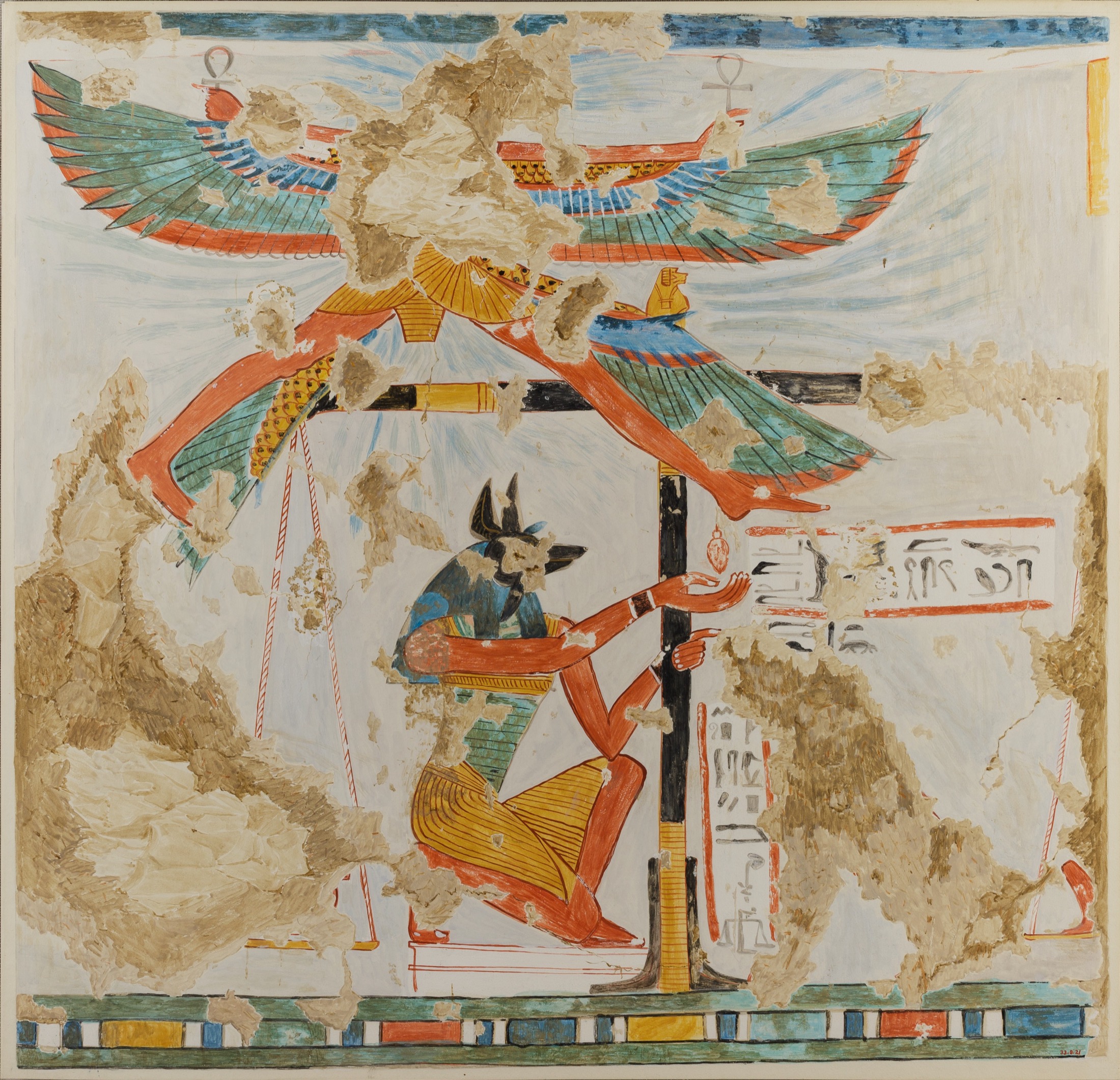
Nina de Garis Davies painted this facsimile of Anubis weighing the heart in Nakhtamun’s tomb. The scene dates to about 1290–1224 BCE. Judgment relates the pattern formed through life to the order it must now meet. Click to open the full image.
Tibetan bardo practice and Egyptian heart-weighing prepare consciousness for this encounter. Christian judgment and ars moriendi, the art of dying, preserve their own accounts. Platonic purification, Vedic final orientation, and initiatic death-before-death also train recognition at the threshold. These traditions retain different geographies while making the person’s formation consequential.
The Field-Memory Question
Morphic Resonance proposes that similar forms inherit or re-enter patterns established by earlier forms. Recurrence, habit, and availability follow from that proposed retention. A field preserves pattern without requiring a miniature person stored within it. Semantic messages require additional operations.
source
  ↓
address
  ↓
encoding
  ↓
field or carrier
  ↓
receiver
  ↓
decoding
  ↓
verification
A morphic field serves as a proposed carrier, memory, or attractor. It does not automatically supply a source, address, decoder, or author. “The information came from the field” begins the account without completing the communication route.
Ancestral inheritance carries trauma, gesture, story, physiology, expectation, and field-like pattern across generations. A recognizable dead relative also initiates contact as a continuing agent. Both relations can coexist without becoming the same operation.
Specific information that was not seeded into the receiver helps distinguish them. Independent verification and sustained reciprocal behavior move a case from inherited pattern toward personal communication.
Preparation
Attention cultivated during life shapes recognition at death. Desire, fear, and imagery require observation without automatic obedience or surrender of judgment. A person unfamiliar with that discipline has little basis for expecting sudden sovereignty when ordinary access dissolves.
Meditation, prayer, examination of conscience, dream practice, ritual closure, service, and repaired relationships train continuity. They build recognition under altered conditions. The person becomes able to meet more without losing their center.
Dying continues the work of living. Coherence supports recognition; honesty makes the review bearable. Sovereignty preserves the ability to answer without surrendering authority to the first luminous form that speaks.
Consciousness Beyond Neural Secretion
Consciousness exceeds an explanation that makes neural tissue the source of all awareness. The death archive preserves structured experience, recovered capacity, specific information, and persistent relation during bodily failure.
The biological interface ends. Patterns persist beyond a single moment and, in some cases, beyond the body. Information crosses boundaries that ordinary models leave unexplained. Some cases support continuing personal agency. The precise architecture of postmortem life remains less secure than the continuity signal.
The record leaves annihilation unestablished. Discernment remains necessary toward any map, guide, ancestor, light, or voice encountered at the threshold. A convincing appearance supplies no automatic authority.
Death releases the vessel, while formation governs coherence through that release. Resurrection begins where survival leaves off. The continuing person receives transformed embodiment and returns within renewed creation.
References
James, William. Human Immortality: Two Supposed Objections to the Doctrine. Houghton Mifflin, 1898.
van Lommel, Pim, et al. “Near-Death Experience in Survivors of Cardiac Arrest: A Prospective Study in the Netherlands.” The Lancet 358, no. 9298 (2001): 2039–2045. https://pubmed.ncbi.nlm.nih.gov/11755611/
Parnia, Sam, et al. “AWAreness during REsuscitation—II.” Resuscitation 191 (2023): 109903. https://pubmed.ncbi.nlm.nih.gov/37423492/
Peterson, Andrew, et al. “Paradoxical Lucidity in Persons with Severe Dementia: A Potential Paradigm Shift for the Neurobiology and Treatment of Severe Dementias.” Alzheimer’s & Dementia 18, no. 6 (2022): 1107–1116. https://pmc.ncbi.nlm.nih.gov/articles/PMC8807788/
Stevenson, Ian. “The Phenomenon of Claimed Memories of Previous Lives: Possible Interpretations and Importance.” Medical Hypotheses 54, no. 4 (2000): 652–659. https://med.virginia.edu/perceptual-studies/wp-content/uploads/sites/360/2016/12/STE49.pdf
Karma Lingpa. The Tibetan Book of the Dead. Translated by Gyurme Dorje. Penguin Classics, 2006.
Plato. Phaedo and Republic, Book X.
The Hebrew Bible. Ecclesiastes 12:7.