The place
Eleusis was a sanctuary west of Athens. A procession followed the Sacred Way from Athens to the sanctuary, where initiation took place in a great hall called the Telesterion. 6
Choose a guide or enter at any stop.
Comparative synthesis
Comparative metaphysics
The Hermetic vision
Comparative initiation
The Greek mysteries
The Christian journey
The Grail romances
The Rosicrucian wedding
Song and the underworld
The soul’s labors
The voyage home
The Bhagavad Gita
The Matrix
The twenty-two Major Arcana
The Night Company
The Consciousness Explorer
The Empathy Test
The building as a teacher
Work through the silent book
Number becomes audible
Cultivation as a living art
The road of the goddess
Strength and the underworld mysteries
Enter a tradition and follow its practices and symbols.
Choose a passage directly. The original and its decode stay together.
Bible
Bible
Bible
Bible
Bible
Bible
Bible
Bible
Follow a question, or choose a step within its route.
The reader path
Material cost, karmic inscription, inverted initiation, reciprocal contact, and the formation carried through death.
Clinical anomalies, transmitted memory, continuing agency, and the traditions of conscious transition.
Future attractors, embodied descendants, bloodlines, incarnation, contact, and the choice between captured and sovereign human futures.
A route from the broad ecology of contact through inherited hierarchies, discrimination, and sovereign encounter.
Circulation, distributed information, embodied reception, and the recursive return that links every scale of the field.
Recurrence, civilizational phase, precession, prophecy, and the capacity retained through a complete turn.
A route from the inherited-world thesis through vibration, geometry, water, landscape, sound, and human coherence into the Great Pyramid, civilizational rupture, ark, and surviving transmission.
Perception, shared-world formation, planetary participation, and the disciplined return from private pattern into consequence.
Physical catastrophe, astronomical phase, historical recurrence, archive criticism, contested chronology, and the agency that no clock can remove.
A route from planetary connection through technical custody, solar pressure, civilizational rupture, retained capacity, distributed incarnation, and the world rebuilt from within.
Mythic memory, initiatory custody, operating law, scriptural technology, convergent practice, and the capacity returned to life.
A route from shared-world formation through grammar, rehearsal, dramaturgy, emergency permission, closed-loop regulation, distribution, ritual, capture, integrated apparatus, and counter-operation.
Direct recognition, collective rupture, capture at the opening, embodied development, beauty as coherent aperture, and the master counter-operation.
Long initiatic intention, contested institutional custody, distributed selection, digital ordeals, mass participation, and the test of what the awakened network builds.
Contact pressure, interior government, retained development, and the selection of a coherent history.
The human aperture, collective model, captured correction loop, institutional custody, sovereign boundary, and return of authorship.
The lived ceiling, the extraction ecology, institutional inversion, managed awakening, and the recovery of agency.
Documented coercion, threshold research, distributed conditioning, biological and psychiatric custody, public theater, adaptive infrastructure, integrated control, and the recovery of the receiver.
The 1944–49 hinge: recovered archives, transferred expertise, partition, permanent secrecy, anomalous skies, and the contest over what the new order would make governable.
Currency as shared recognition, central-bank custody, emergency fiscal fusion, intermediated ownership, stablecoin rails, and the boundary between legibility and refusal.
Emergency authority, pretext, durable permission, public crisis, and the moment an institutional output becomes the ground of ordinary life.
Concealed centers, polar memory, the Black Sun, Nazi appropriation, postwar transfer, and the discipline required when myth makes exterior claims.
A route through the human instrument, embodied signaling, subtle anatomy, living fields, awakening, and integration.
The pharmakon, medical authority, diagnostic containment, autonomic injury, biological constraint, and the right to the body’s own ledger.
Private psi research, remote viewing, altered-state training, state programs, selection networks, UAP disclosure, and the contest over who holds unusual human capacity.
Sacred language, creation, exile, repair, recurrence, and the scriptural technologies of descent and return.
Language, fiction, media, participation, ritual, and the feedback loop through which a story becomes a lived world.
Laurel Canyon, press distribution, studio power, informed fiction, encoded media, participatory narrative, mass ritual, and the state that governs through attention.
The complete model, arranged in four movements.
What is contested, why consciousness comes first, and the instrument through which it acts.
How a rendered world becomes a shared one, and how the shared one is enclosed.
The operation that defends the enclosure, what it is for, and the Work done inside it.
What else lives in the field, what persists across death, and how the future reaches back.
Browse the domains or find a page by name.
No destinations match. Try a different word.
Ancient Greece · Rites & renewal
The two goddesses and the hope beyond death
At Eleusis, people sought initiation into the rites of Demeter and Persephone. The goddess who brings grain from the earth and the daughter who returns from the dead offered hope beyond the harvest. Their mysteries prepared the living to face death, knowing that the powers below receive initiates favorably.
Beliefs · Diagrams · Practice · Primary texts
The essentials
These are the tradition’s central teachings.
Eleusis was a sanctuary west of Athens. A procession followed the Sacred Way from Athens to the sanctuary, where initiation took place in a great hall called the Telesterion. 6
Demeter sustains the life of the fields. Her daughter Persephone becomes queen in the world below and returns for part of each year to her mother and the other gods. 1
Hades carries Persephone below, and Demeter searches for her. When the goddess withholds the harvest, the survival of humanity depends upon the daughter’s return. 1
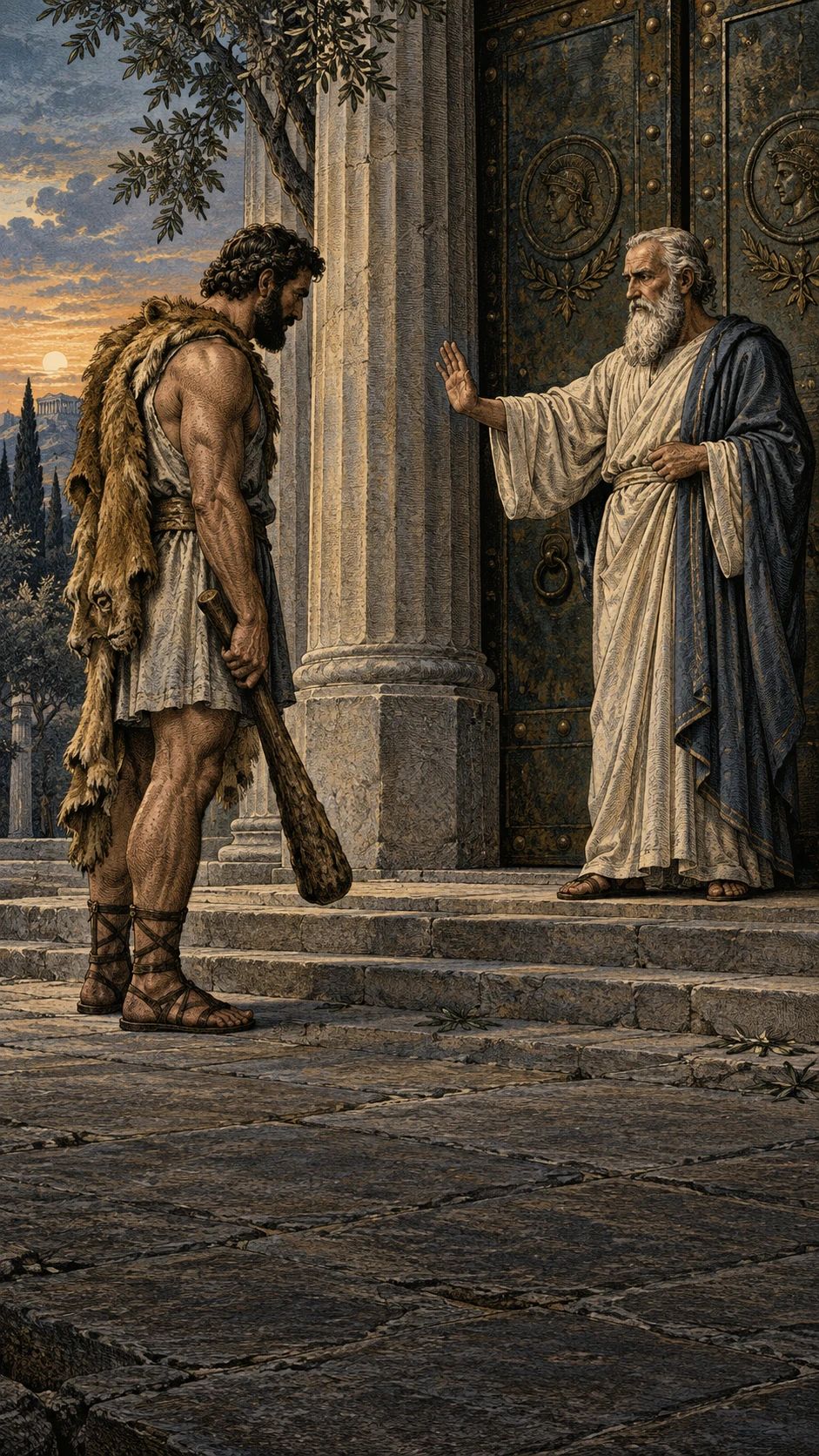
A person had to be made ready to approach the mysteries. In Apollodorus’s account, Heracles must first be cleansed of the killing of the centaurs before Eumolpus can initiate him. 2
Demeter teaches her rites to the rulers of Eleusis. The hymn describes the awe that prevents their disclosure and singles out the person who has seen them as blessed. 1
Initiation changes the prospect of death. Cicero praises the mysteries for teaching people how to live with joy and die with a better hope. 5
The daughter who returns
In the Homeric Hymn to Demeter, Persephone spends one third of the year below and two thirds with her mother and the other gods. Her return restores the mother and daughter to one another, and Demeter allows the earth to bear fruit again.
The settlement in the hymn
The story that establishes the cycle
The historical image
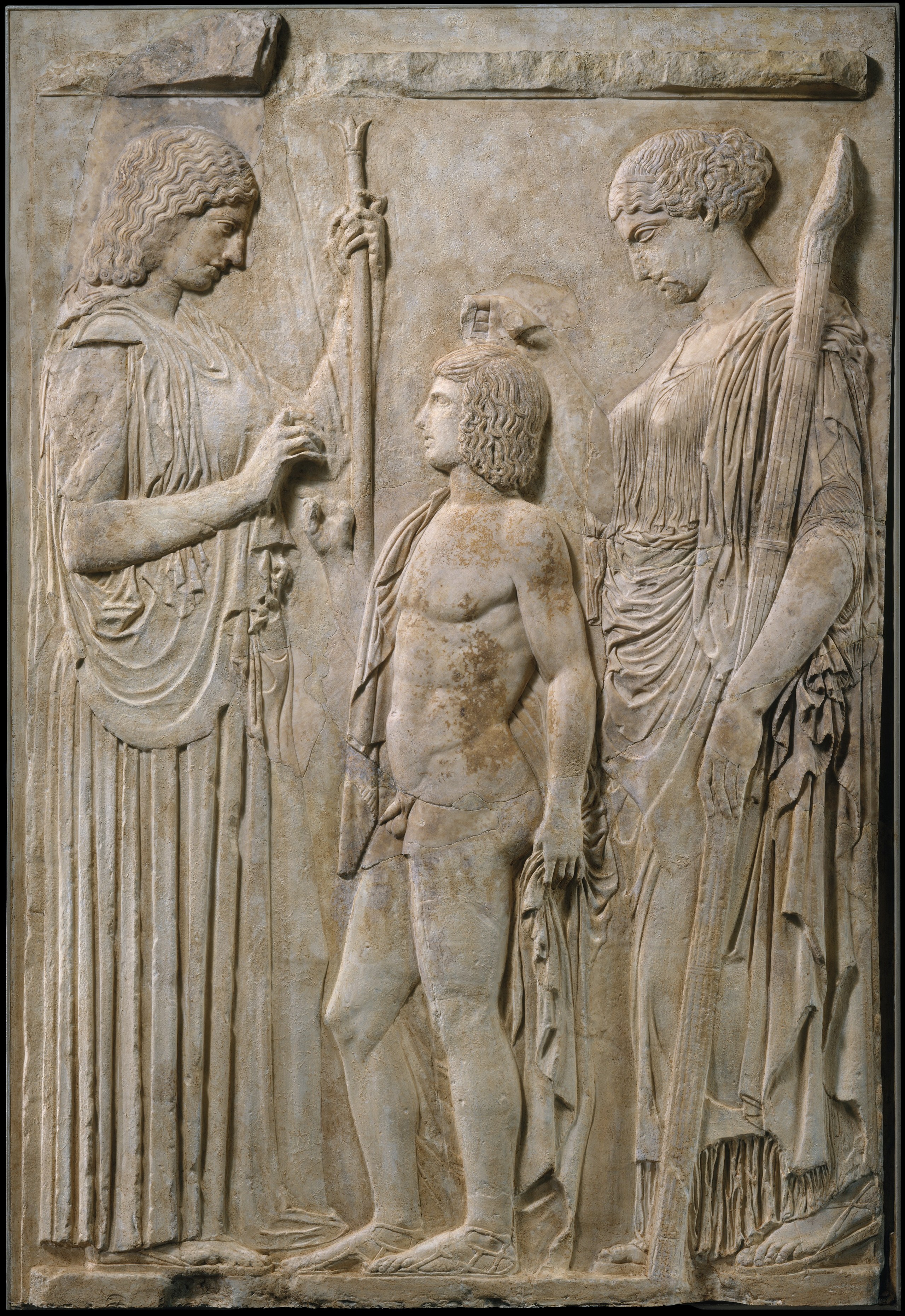
Demeter, the youth usually identified as Triptolemos, and Persephone. Ten Roman fragments, ca. 27 BCE–14 CE, mounted in a cast of the Greek original. The Met, 14.130.9. Public-domain photograph.
Read from left to right. Demeter gives grain to its human recipient; Persephone rules the world below. Both goddesses extend a hand toward the youth.
Demeter hides the seed in the earth while she mourns. Her grief reaches into the fields, and humanity faces famine. The return of her daughter makes it possible for the goddess to restore the life on which mortals depend.
The pomegranate eaten below binds Persephone to a recurring stay with Hades. The settlement gives her a life in both worlds. The daughter welcomed by Demeter is also the queen whom the dead will encounter.
The youth in the Great Eleusinian Relief is usually identified as Triptolemos, whom Demeter sends to teach the cultivation of grain. The two goddesses extend their hands toward him. The scene presents a mortal receiving their favor; the objects once held in the extended hands are no longer certain.
The circle follows the hymn’s division of the year, without assigning modern calendar months. The relief is shown in full: the Met’s ten Roman fragments are set into a cast of the surviving Greek original. The cycle is a modern explanation of the poem; the sculpture is an ancient image. 18
The work of transformation
The public procession brought candidates from Athens to Eleusis. Within the sanctuary, those admitted underwent rites whose sacred acts remained secret. Ancient testimony speaks most clearly about their consequence: the initiate returned to life with a changed understanding of death.
“to die with a better hope”
Purification prepares a person to approach the gods. Heracles’s story gives a particular example of a candidate whose earlier acts require cleansing.
The procession follows the Sacred Way from Athens. The journey brings the assembled worshipers to the sanctuary of the two goddesses.
The hall gathers those admitted to the mysteries. Its interior contains the Anaktoron, the chamber associated with the sacred objects.
Cicero joins the benefits of living well and dying with hope. The mysteries concern the life that continues after the ceremony as well as the death that still lies ahead.
These are the publicly attested preparations, setting, and promise. The secret acts within the hall survive in scattered testimony; their complete sequence has not been preserved.
The teaching in the texts
The Homeric Hymn to Demeter begins with Persephone gathering flowers when the earth opens and Hades carries her away. Demeter hears her daughter’s cry and searches for her. When she learns what has happened, she withdraws from the company of the gods and comes among mortals, eventually finding shelter at Eleusis.
Her grief changes the condition of the earth. Seed remains hidden, the fields fail, and the gods face the loss of the human beings who honor them. Demeter’s power to give food also gives her the power to withhold it. Zeus must arrange for Persephone to return before the mother will restore the harvest.
The reunion brings joy, but the pomegranate eaten below requires Persephone to return to Hades for part of each year. The daughter now moves between the company of the gods above and her place as queen below. Her mother’s welcome establishes a passage out of the realm that ordinarily receives the dead without releasing them.
The hymn places the foundation of the mysteries after this settlement. Demeter restores the fields and teaches her rites at Eleusis, then promises a blessed fate to those who have seen them. The same goddess gives humanity food for its present life and a sacred preparation for what follows death. Persephone’s return gives the promise its divine precedent. The two goddesses know the passage between worlds through their own lives.
Read the sources 1
Apollodorus puts Heracles’s visit to Eleusis immediately before his descent to fetch Cerberus. The hero seeks Eumolpus and asks to be initiated. But his killing of the centaurs prevents him from seeing the mysteries until he has been cleansed. Eumolpus first cleanses him, then admits him to the rites.
The sequence explains the religious meaning of purification. The bloodshed has consequences that accompany the person who committed it. Heracles’s desire to be initiated has to be answered by someone able to remove that impediment. Once Eumolpus has performed the cleansing, the hero can receive the preparation for which he came.
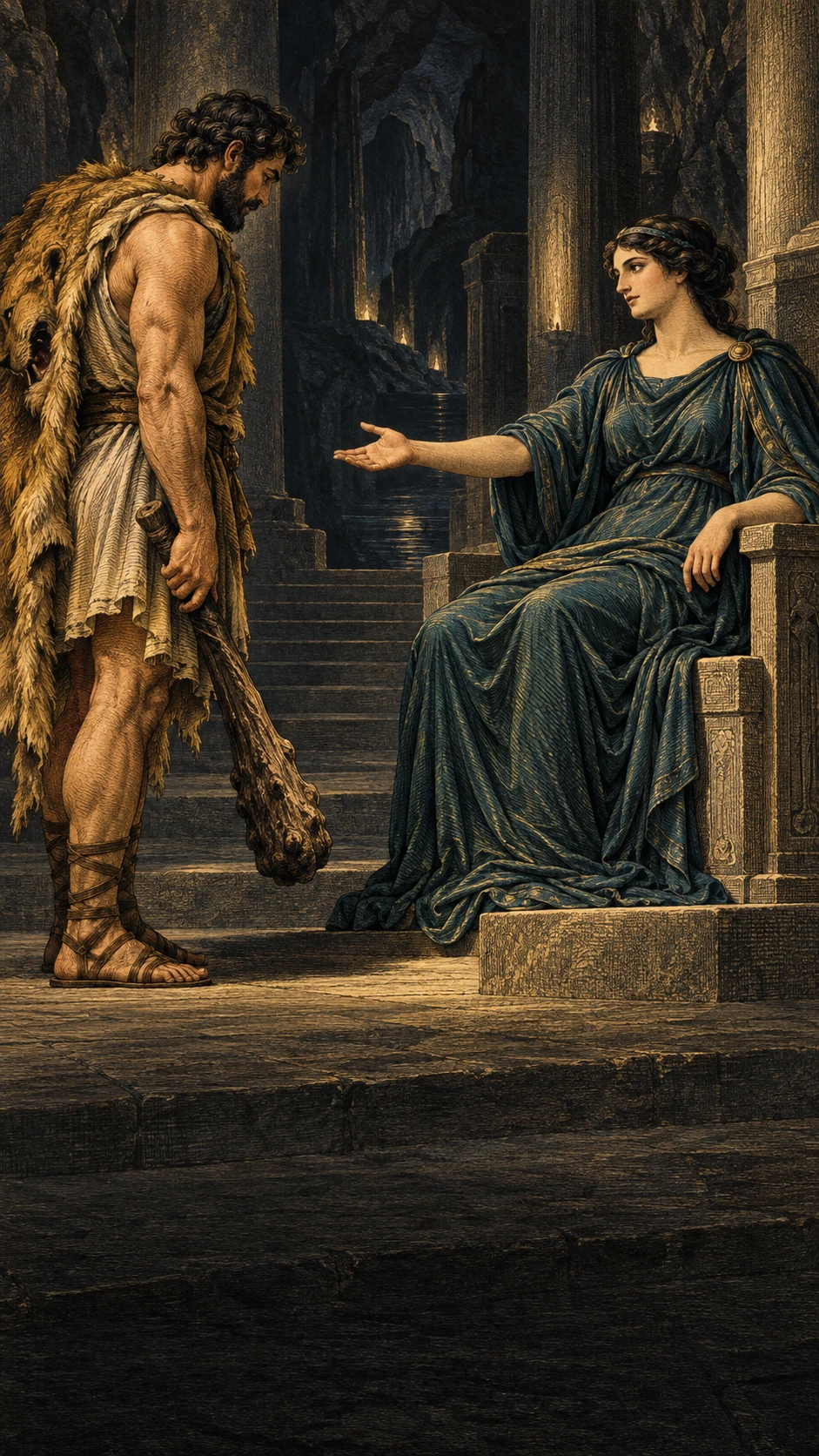
Diodorus preserves another telling in which Musaeus oversees the initiation. Heracles subsequently reaches the underworld and is welcomed by Persephone as a brother. Her favor makes the return possible. Both accounts connect initiation with a welcome from the goddess who rules among the dead. They give different names to the priest who prepares the hero.
Heracles remains alive throughout his descent, making his journey exceptional. The religious concern is one shared by the people who sought the mysteries: how to enter the world below under the favor of its rulers. His story gives that concern a visible preparation. Before the hero goes down, another person must cleanse him and show him the rites.
In a passage preserved by Stobaeus, Plutarch compares the soul’s experience at death with that of a person undergoing initiation. He begins with wandering, exhausting journeys through darkness, and the fear that comes before the end. The description includes trembling and sweat, giving the ordeal a bodily immediacy.
Then a wonderful light appears. The wanderer comes into open country and meadows, where voices, dancing, sacred music, and holy visions replace the earlier distress. The initiated person is now free to join the company of the holy. Plutarch follows a change in the soul’s experience from terror and confusion to recognition and welcome.
His comparison concerns mystery initiation broadly. It helps explain the hope associated with Eleusis without supplying a complete account of the ceremony within the Telesterion. Death and initiation resemble one another because the soul passes through an ordeal and discovers a life beyond what it had known. The person who has undergone the rite carries an experience with which to approach the greater passage still ahead.
Cicero describes the consequence in the language of an ordinary life. The mysteries teach their participants to live with joy and to die with better hope. His praise gives the religious experience a continuing place after the ceremony. The initiate goes home, but the prospect of entering the world of the dead has changed.
Across the centuries
The Homeric Hymn to Demeter joins the daughter’s return, the restoration of the harvest, and the goddess’s teaching of the mysteries. 1
Successive building phases enlarge the Telesterion as the sanctuary develops under Athenian patronage. 7
On the Laws names the Eleusinian rites among the gifts Athens has given human life. 5
The Roman fragments now at the Met reproduce the earlier Greek relief of the two goddesses and the youth between them. 8
After the hall is burned, reconstruction under Marcus Aurelius preserves the Classical plan with an extension to the north. 7
Continue into the illustrated journey
Follow his preparation at Eleusis, the welcome from Persephone, and the conditions under which he brings Cerberus into daylight.
Enter the Heracles journey ↗Read at the source
Hugh G. Evelyn-White translation, 1914
The hymn is reproduced in sections II–VII. See especially lines 398–403, 445–447, and 470–482 for the divided year and the founding of the rites. Bracketed seasonal comments on the host page are editorial additions.
Apollodorus · J. G. Frazer translation, 1921
Heracles’s purification by Eumolpus, initiation, and descent to fetch Cerberus.
Diodorus Siculus · C. H. Oldfather translation, 1935
Musaeus oversees the rites; Persephone welcomes Heracles. This version is kept distinct from Apollodorus.
Attributed to Plutarch · preserved by Stobaeus
The linked page reproduces F. H. Sandbach’s translation. The comparison concerns death and mystery initiation; it is not a surviving script of the Eleusinian ceremony. Paraphrased here.
Cicero · C. W. Keyes translation, 1928
The quoted passage praises the Eleusinian initiations for their gifts to life and the hope they give at death.
Acropolis Museum · exhibition
The procession from the Eleusinion in Athens along the Sacred Way to the Telesterion.
Ephorate of Antiquities of West Attica
The hall, Anaktoron, building phases, and reconstruction following the destruction of 170 CE.
The Metropolitan Museum of Art · 14.130.9
Roman fragments, ca. 27 BCE–14 CE, set into a cast of the Greek original in Athens. The youth is usually identified as Triptolemos. Photograph: Met Open Access, public domain.