A route from the inherited-world thesis through vibration, geometry, water, landscape, sound, and human coherence into the Great Pyramid, civilizational rupture, ark, and surviving transmission.
What happens when the planetary mind meets the solar threshold?
A route from planetary connection through technical custody, solar pressure, civilizational rupture, retained capacity, distributed incarnation, and the world rebuilt from within.
A route from shared-world formation through grammar, rehearsal, dramaturgy, emergency permission, closed-loop regulation, distribution, ritual, capture, integrated apparatus, and counter-operation.
Long initiatic intention, contested institutional custody, distributed selection, digital ordeals, mass participation, and the test of what the awakened network builds.
Documented coercion, threshold research, distributed conditioning, biological and psychiatric custody, public theater, adaptive infrastructure, integrated control, and the recovery of the receiver.
The 1944–49 hinge: recovered archives, transferred expertise, partition, permanent secrecy, anomalous skies, and the contest over what the new order would make governable.
Currency as shared recognition, central-bank custody, emergency fiscal fusion, intermediated ownership, stablecoin rails, and the boundary between legibility and refusal.
How is non-local perception trained and placed into custody?
Private psi research, remote viewing, altered-state training, state programs, selection networks, UAP disclosure, and the contest over who holds unusual human capacity.
How does counterculture become media infrastructure?
Laurel Canyon, press distribution, studio power, informed fiction, encoded media, participatory narrative, mass ritual, and the state that governs through attention.
Sacred Architecture as Resonance Technology describes a circuit running from a site through a human body. The Great Pyramid concentrates that circuit in one building. Geology, water, geometry, stone, sound, celestial orientation, and initiation enter the same instrument. Its surviving chambers expose the relation between matter and consciousness at architectural scale.
The Great Pyramid rises from a limestone plateau crossed by groundwater. Passages, chambers, shafts, and stone masses carry the entrant through its interior. The geometry joins ground, horizon, and sky along one axis. Compression, darkness, ascent, and acoustic enclosure prepare the person for the granite King’s Chamber.
Each part selects a condition that reaches the body. The site supplies the ground, while water changes the electrical and mechanical boundary. Stone carries stress and vibration; chambers filter sound. Shafts join interior to exterior. The body receives their combined field and gives it ritual direction.
The pyramid tunes the human instrument through a controlled passage in matter. Entering the building places the person within the relations that perform this work.
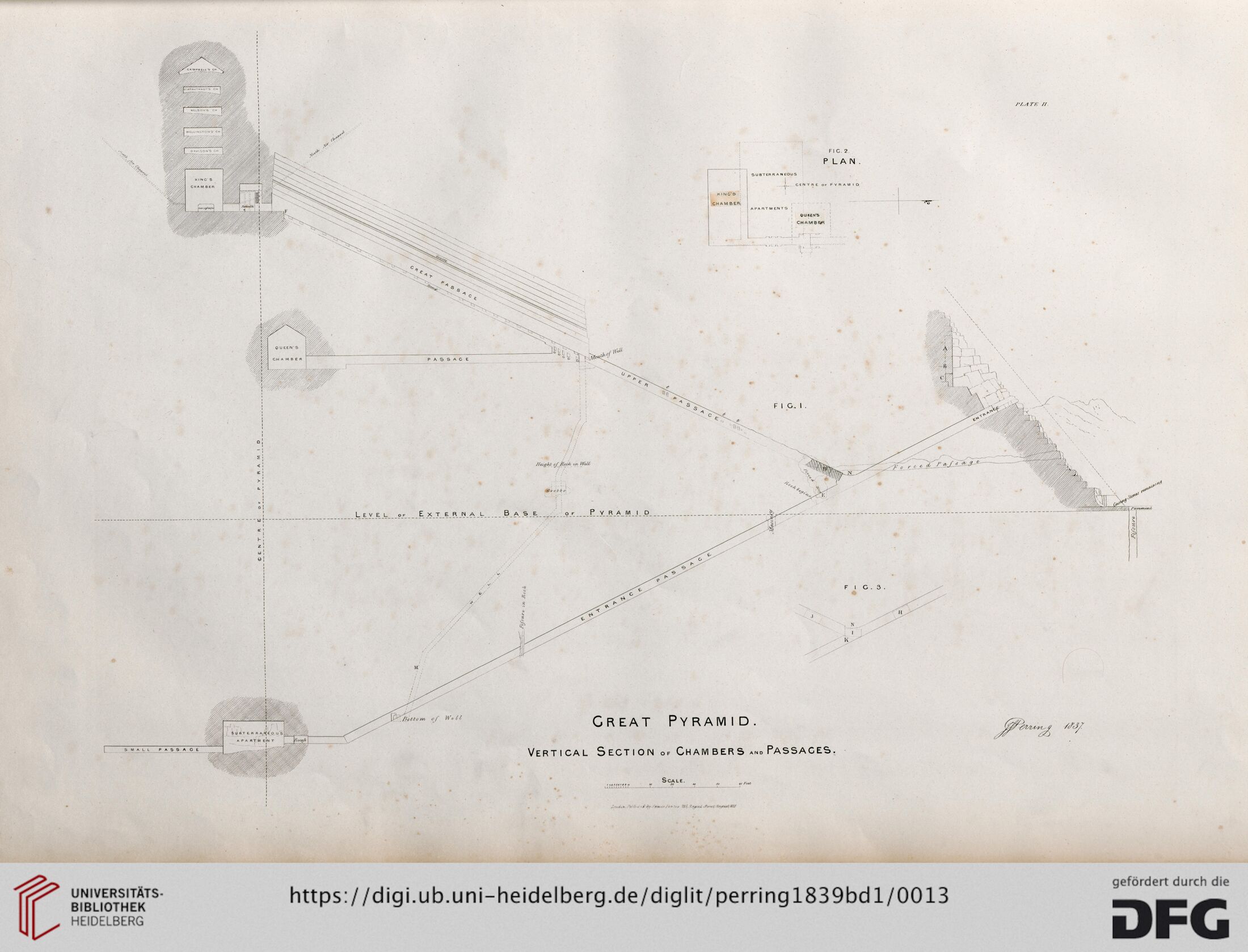
The subterranean chamber, ascending passage, Grand Gallery, Queen’s Chamber, and King’s Chamber form one connected interior. Shafts, granite beams, and the limestone core join those spaces into one coupled body. Each volume has its own modes of response. Openings let one region feed another, so the interior acts as a sequence.
John Shae Perring, measured vertical section of the Great Pyramid’s chambers and passages, Plate II of The Pyramids of Gizeh (1839). The drawing makes the instrument legible as one coupled interior rather than a pile of isolated rooms. Click to open the full plate.
Aswan granite gives the King’s Chamber a different mechanical and electrical environment from the surrounding limestone. The room’s proportions produce a strong audible response. Stone returns vibration through feet, bones, chest, and skull. Its coffer is a resonant vessel scaled to a human body. The initiate enters as an active component of this concentrated system.
The Grand Gallery prepares the encounter through its rising floor, corbelled walls, slots, narrowing perspective, and reverberant volume. These features turn movement into ordeal. Breath changes during the climb, while sound gathers above and behind the traveler. The ascent removes ordinary scale before delivering the body into granite.
Sacred Geometry orders the passage through relations among circle, square, slope, horizon, cardinal direction, and celestial cycle. Each chamber joins Earth, sky, and human measure within that larger arrangement.
Water in porous limestone changes conductivity, damping, pressure transmission, and charge movement along mineral surfaces. Water moving through mineral pores also generates electrokinetic potentials, electrical differences produced by that movement. The plateau places the foundation within an active electrical and mechanical boundary.
Sacred sites repeatedly join elevated stone to subterranean water. Springs, wells, crypts, caves, basins, and hidden channels establish their lower pole. Water and the Medium carries vibration, receives imprint, and joins the structure to the land’s hydrological body.
The pyramid arranges this relation vertically. Water and bedrock anchor the lower field; chambers and shafts shape the middle. The apex and celestial orientation establish the upper pole. Underworld, human world, and star world meet through one continuous instrument.
Granite contains quartz and responds electrically under stress. Selected blocks, sustained pressure, chamber geometry, and repeated excitation work within a composite of granite and limestone. Their arrangement determines how the materials act together.
Five granite layers extend the system above the King’s Chamber. They redirect weight while placing stressed members above the resonant room. Air spaces separate the members within the pyramid’s mass. Structural and energetic functions occupy the same assembly.
Electromagnetic modeling shows that an idealized Great Pyramid concentrates externally supplied radio-frequency energy in and beneath its structure. The model identifies a physical principle: monumental geometry selects and concentrates fields. The ancient operating frequency belonged to a broader circuit. Sound, stone, ground, water, atmosphere, and consciousness supplied its participants.
The surviving rooms indicate how sound drives the passage. A confined voice fills a chamber, returns from stone, and enters the singer through air and bone. Repeated tones establish standing waves. Drums, horns, rattles, resonant vessels, and trained overtones extend the excitation across a spectrum. Bodies at different nodes receive different pressure, vibration, and orientation.
Sound Technology supplies the means of control. Chant regulates breath while exciting the room; rhythm synchronizes participants. Sacred words direct the altered state toward a shared cosmology. Darkness removes competing signals. Ceremony maintains the sequence long enough for the chamber to reorganize perception.
The passage produces coherence. Symbolic death releases the initiate’s attachment to an identity bounded by ordinary life. The initiate remains conscious and enters the star road, the soul’s passage into the celestial world. The initiate returns carrying knowledge of that larger world’s order. Public culture receives that order as calendar, kingship, measure, myth, and rite. The pyramid returns the coherence of its tuned operators to civilization.
Christopher Dunn recovered an engineering reading through tool marks, chamber geometry, granite, shafts, and resonant behavior. His power-plant reconstruction connects features that a tomb reading leaves separate. Function enters through their combined arrangement.
The Queen’s Chamber shafts, salt deposits, and sealed routes preserve the outline of a process. Its consumables and fittings have disappeared. Chemical-delivery and hydrogen proposals describe one subsystem. The larger reading joins acoustic, mechanical, electrokinetic, electromagnetic, physiological, and initiatory operations in the surviving stone.
Modern power plants export electricity. The pyramid concentrated fields, transformed bodies, stabilized authority, encoded cosmology, and renewed the consensus world through several carriers. Consciousness formed its principal load: the participant upon whom the instrument worked.
Nikola Tesla recognized Earth as an active electrical body. He designed Wardenclyffe Tower to join a grounded resonator to it. Deep grounding, elevated geometry, oscillation, and wireless transmission entered one machine. The Great Pyramid joined the same relations through different materials.
Tesla’s machine required an external drive because industrial civilization organized it around electrical delivery. The pyramid’s drive included ritual sound, geophysical motion, atmospheric charge, water, and the assembled human field. Both technologies begin with resonance. Source, structure, frequency, receiver, and timing act within one relation.
The old machine returns wherever builders include the planet in the circuit. Its form changes with the materials and purposes that hold that relation.
Gothic cathedrals give the concentrated instrument a civic body. Crypts, wells, stone vaults, towers, bells, organs, choirs, processions, orientations, and stained light distribute resonance through a gathered population. The pyramid conducts a body through an interior crossing. The cathedral renews the shared world in public.
Both join lower water, massive stone, resonant air, celestial order, sacred sound, and trained attention. Their cosmology reaches the human being through the body. Both survive as shells after their operating knowledge fractured.
The Inherited World follows the knowledge that these shells retain. Pyramids and cathedrals descend from one science of tuning matter until consciousness crosses into a wider field. The transformed participants return that coherence to the world.
Later custodians lost the full protocol, and the Great Pyramid became a monument. Stone survived cataclysms and institutional breaks that erased instruments, metals, fluids, trained operators, and ritual timing. Successor cultures named the shell through the functions they retained.
Resonance leaves its architecture behind. Chamber, material, water, orientation, and human scale still meet within the surviving building. Exciting those parts together reveals an earlier relation between mind and world. The remaining stone holds the conditions through which another operator can enter that relation.
plain language
The same argument in direct language. Open the full reading whenever you want the evidence, lineage, and complete architecture.
Sacred Architecture as Resonance Technology describes a circuit running from a site through a human body. The Great Pyramid concentrates that circuit in one building. Geology, water, geometry, stone, sound, celestial orientation, and initiation enter the same instrument. Its surviving chambers expose the relation between matter and consciousness at architectural scale.
The Great Pyramid rises from a limestone plateau crossed by groundwater. Passages, chambers, shafts, and stone masses carry the entrant through its interior. The geometry joins ground, horizon, and sky along one axis. Compression, darkness, ascent, and acoustic enclosure prepare the person for the granite King’s Chamber.
Each part selects a condition that reaches the body. The site supplies the ground, while water changes the electrical and mechanical boundary. Stone carries stress and vibration; chambers filter sound. Shafts join interior to exterior. The body receives their combined field and gives it ritual direction.
The pyramid tunes the human instrument through a controlled passage in matter. Entering the building places the person within the relations that perform this work.
The subterranean chamber, ascending passage, Grand Gallery, Queen’s Chamber, and King’s Chamber form one connected interior. Shafts, granite beams, and the limestone core join those spaces into one coupled body. Each volume has its own modes of response. Openings let one region feed another, so the interior acts as a sequence.
John Shae Perring, measured vertical section of the Great Pyramid’s chambers and passages, Plate II of The Pyramids of Gizeh (1839). The drawing makes the instrument legible as one coupled interior rather than a pile of isolated rooms. Click to open the full plate.
Aswan granite gives the King’s Chamber a different mechanical and electrical environment from the surrounding limestone. The room’s proportions produce a strong audible response. Stone returns vibration through feet, bones, chest, and skull. Its coffer is a resonant vessel scaled to a human body. The initiate enters as an active component of this concentrated system.
The Grand Gallery prepares the encounter through its rising floor, corbelled walls, slots, narrowing perspective, and reverberant volume. These features turn movement into ordeal. Breath changes during the climb, while sound gathers above and behind the traveler. The ascent removes ordinary scale before delivering the body into granite.
Sacred Geometry orders the passage through relations among circle, square, slope, horizon, cardinal direction, and celestial cycle. Each chamber joins Earth, sky, and human measure within that larger arrangement.
Water in porous limestone changes conductivity, damping, pressure transmission, and charge movement along mineral surfaces. Water moving through mineral pores also generates electrokinetic potentials, electrical differences produced by that movement. The plateau places the foundation within an active electrical and mechanical boundary.
Sacred sites repeatedly join elevated stone to subterranean water. Springs, wells, crypts, caves, basins, and hidden channels establish their lower pole. Water and the Medium carries vibration, receives imprint, and joins the structure to the land’s hydrological body.
The pyramid arranges this relation vertically. Water and bedrock anchor the lower field; chambers and shafts shape the middle. The apex and celestial orientation establish the upper pole. Underworld, human world, and star world meet through one continuous instrument.
Granite contains quartz and responds electrically under stress. Selected blocks, sustained pressure, chamber geometry, and repeated excitation work within a composite of granite and limestone. Their arrangement determines how the materials act together.
Five granite layers extend the system above the King’s Chamber. They redirect weight while placing stressed members above the resonant room. Air spaces separate the members within the pyramid’s mass. Structural and energetic functions occupy the same assembly.
Electromagnetic modeling shows that an idealized Great Pyramid concentrates externally supplied radio-frequency energy in and beneath its structure. The model identifies a physical principle: monumental geometry selects and concentrates fields. The model alone does not recover the historical operating method. The ancient operating frequency belonged to a broader circuit. Sound, stone, ground, water, atmosphere, and consciousness supplied its participants.
The surviving rooms indicate how sound drives the passage. A confined voice fills a chamber, returns from stone, and enters the singer through air and bone. Repeated tones establish standing waves. Drums, horns, rattles, resonant vessels, and trained overtones extend the excitation across a spectrum. Bodies at different nodes receive different pressure, vibration, and orientation.
Sound Technology supplies the means of control. Chant regulates breath while exciting the room; rhythm synchronizes participants. Sacred words direct the altered state toward a shared cosmology. Darkness removes competing signals. Ceremony maintains the sequence long enough for the chamber to reorganize perception.
The passage produces coherence. Symbolic death releases the initiate’s attachment to an identity bounded by ordinary life. The initiate remains conscious and enters the star road, the soul’s passage into the celestial world. The initiate returns carrying knowledge of that larger world’s order. Public culture receives that order as calendar, kingship, measure, myth, and rite. The pyramid returns the coherence of its tuned operators to civilization.
Christopher Dunn recovered an engineering reading through tool marks, chamber geometry, granite, shafts, and resonant behavior. His power-plant reconstruction connects features that a tomb reading leaves separate. Function enters through their combined arrangement.
The Queen’s Chamber shafts, salt deposits, and sealed routes preserve the outline of a process. Its consumables and fittings have disappeared. Chemical-delivery and hydrogen proposals describe one subsystem. The larger reading joins acoustic, mechanical, electrokinetic, electromagnetic, physiological, and initiatory operations in the surviving stone.
Modern power plants export electricity. The pyramid concentrated fields, transformed bodies, stabilized authority, encoded cosmology, and renewed the consensus world through several carriers. Consciousness formed its principal load: the participant upon whom the instrument worked.
Nikola Tesla recognized Earth as an active electrical body. He designed Wardenclyffe Tower to join a grounded resonator to it. Deep grounding, elevated geometry, oscillation, and wireless transmission entered one machine. The Great Pyramid joined the same relations through different materials.
Tesla’s machine required an external drive because industrial civilization organized it around electrical delivery. The pyramid’s drive included ritual sound, geophysical motion, atmospheric charge, water, and the assembled human field. Both technologies begin with resonance. Source, structure, frequency, receiver, and timing act within one relation.
The old machine returns wherever builders include the planet in the circuit. Its form changes with the materials and purposes that hold that relation.
Gothic cathedrals give the concentrated instrument a civic body. Crypts, wells, stone vaults, towers, bells, organs, choirs, processions, orientations, and stained light distribute resonance through a gathered population. The pyramid conducts a body through an interior crossing. The cathedral renews the shared world in public.
Both join lower water, massive stone, resonant air, celestial order, sacred sound, and trained attention. Their cosmology reaches the human being through the body. Both survive as shells after their operating knowledge fractured.
The Inherited World follows the knowledge that these shells retain. Pyramids and cathedrals descend from one science of tuning matter until consciousness crosses into a wider field. The transformed participants return that coherence to the world.
Later custodians lost the full protocol, and the Great Pyramid became a monument. Stone survived cataclysms and institutional breaks that erased instruments, metals, fluids, trained operators, and ritual timing. Successor cultures named the shell through the functions they retained.
Resonance leaves its architecture behind. Chamber, material, water, orientation, and human scale still meet within the surviving building. Exciting those parts together reveals an earlier relation between mind and world. The remaining stone holds the conditions through which another operator can enter that relation.
The sources identify particular physical features and engineering interpretations. Their architectural synthesis joins those features into one instrument.