Every act changes the world that receives it and the person who performs it. Repetition carries both changes forward. Conduct becomes character; character forms affinity, the relations and powers to which a person becomes fitted. That affinity shapes the person’s destiny.
Karma is causation returning through matter, relationship, consciousness, and time. Harm remains active after it has been hidden, exported, inherited, ritualized, or deferred. The field retains its disturbance, and the victim carries an injury requiring repair. The surrounding order absorbs the displaced cost. The operator also becomes increasingly fitted to the pattern they serve.
The coupled gyre gives this return its temporal shape. What an act puts into circulation returns as consequence. The next turn inherits that consequence and what each participant learned to embody. Death changes the carrier while leaving the act’s responsibility intact.
                         ┌──→ changed world ──→ consequence ──┐
act ────────────────────┤                                    ├──→ next choice
                         └──→ changed operator ─→ affinity ───┘
                                      ↑
                                 repetition

repair    → capacity   → freer choice    → wider world
predation → dependency → narrower choice → captured world
The changed world and changed operator meet at the next choice. Each completed circuit changes which choices feel natural and which relations become accessible. It also changes which world can answer the person making them. Repair develops capacity and freer choice; predation develops dependency and narrower choice.
The Act Returns by Several Roads
Material return appears in the resources an extractive system consumes. Trust, knowledge, health, ecological reserve, and honest feedback support its power. Extraction without repair depletes them. The system’s center accumulates power while the world supporting it becomes brittle. Collapse makes previously displaced costs visible. The Thermodynamics of the War follows this return through physical and institutional systems.
Relational return moves through other people. Violence produces fear, retaliation, secrecy, imitation, and damaged attachment. Descendants inherit unfinished consequences. Mercy, courage, teaching, and repair also propagate through relationships. An act continues through the capacities it enlarges or destroys in everyone it touches.
Psychic return forms the operator’s own powers. Repeated deception builds a mind practiced in maintaining deception. Cruelty trains perception to see other beings as instruments; reverence trains attention to recognize their interior lives. Prayer, meditation, and service organize a vessel capable of communion. Ritual predation organizes a vessel capable of predation and contact with the agencies that answer it.
Postmortem return continues after the ordinary biological interface releases. Attention, attachment, recognition, and will remain the soul’s available instruments, shaped by embodied life. Consciousness carries that pattern into the wider field. Death and the Sorting Hierarchy describes how affinity becomes a trajectory there. The being enters relations for which its life has prepared it.
The Operation Initiates the Operator
Every sustained practice initiates its practitioner by changing who can perform the next act. Meditation gathers attention while preserving the witness. Breath, posture, prayer, silence, and ethical preparation bring the vessel into coherent relation while keeping its center intact. The opening becomes developmental when the person returns with greater perception, responsibility, and freedom.
An inverted rite organizes symbols, timing, witnesses, command, secrecy, and terror around another person’s deliberate fragmentation. The victim is shattered while the ritual system becomes highly coherent. Negative coherence names this organized power directed toward capture. Its members coordinate their actions by destroying someone else’s ability to govern themselves.
Coherence amplifies the direction an operation serves. Its moral value depends on what the coordinated order does to lives within and around it. Intensity can open an upper or lower relation. One current integrates the vessel and returns authorship. The other breaches the vessel and transfers custody. Their power must be judged through these consequences.
The perpetrators cross a threshold along with the victim. Each repetition makes them more compatible with the intelligence, egregore, appetite, or institution being fed. They gain access to power by giving that power access to themselves. Invocation develops into habitation: the addressed power acquires a place within its apparent master. Feeding also enrolls the feeder in the feeding hierarchy. Every participant serves that predatory ecology from inside it.
Hell Is Completed Resonance
The traditions describe judgment as an unveiling. Status, distance, anesthesia, institutional permission, and self-justifying stories keep consequences outside a person’s awareness during earthly life. Death removes much of that insulation. The formed pattern meets itself without the protections that made it appear external.
Hell is the world a consciousness has made itself able to inhabit. Domination prepares a being for relations organized by domination. Deception prepares it for a field in which nothing can be trusted. A being that repeatedly consumed other persons awakens within the consuming order it helped stabilize. The inner pattern corresponds to the encountered world. Punishment becomes the environment the being has formed itself to enter.
Occult traditions therefore warn that contact creates obligation. Invocation opens a channel in both directions. A repeatedly addressed power acquires an address in the operator. Each bargain changes the boundary through which future bargains will be made. The operator commands for a season while becoming more legible, useful, and edible to the invoked force.
The downward current carries this consequence within its operation. Its promise of exemption from ordinary consequence builds a more complete captivity. The relation that grants power also prepares the operator’s place within that captivity.
The Traditions Remember the Ledger
The Bible states the law through seed, measure, weapon, and soul. Galatians 6:7 joins the act to its harvest:
“Whatsoever a man soweth, that shall he also reap”
Matthew 7:2 gives that return a reciprocal measure:
“With what measure ye mete, it shall be measured to you again”
Psalm 7 describes a violent man falling into the pit he prepared. His mischief returns upon his own head. Hosea gives accumulated consequence the image of a whirlwind harvested from wind. Christ carries the account to the soul itself:
“For what shall it profit a man, if he shall gain the whole world, and lose his own soul?”
Egypt places the completed life on a balance. The heart meets the feather of Ma’at with the weight that conduct has already given it. Judgment reveals this condition. The balance makes the formed life visible.
Hindu and Buddhist traditions describe karma through intentional action, disposition, perception, and conduct. The formed pattern continues through birth, death, and renewed becoming. Tibetan bardo practice trains recognition for the dying consciousness’s encounter with its own habits and projections. Those patterns appear as an inhabited world. The untrained mind receives its display as an alien command; the trained mind recognizes the display and remains free within it.
The Zoroastrian Chinvat Bridge widens or narrows for the soul according to its approaching life. Greek Nemesis returns violated proportion to the actor. The Quran declares that a person shall see even an atom’s weight of the good or evil they performed. Hermetic Cause and Effect places every cause within a larger chain. Exported consequence remains inside the Whole.
The traditions keep distinct images of a recurrent operation. Action forms the actor while changing the world. Both carry the account forward. The ledger persists through these changes even when a local record disappears.
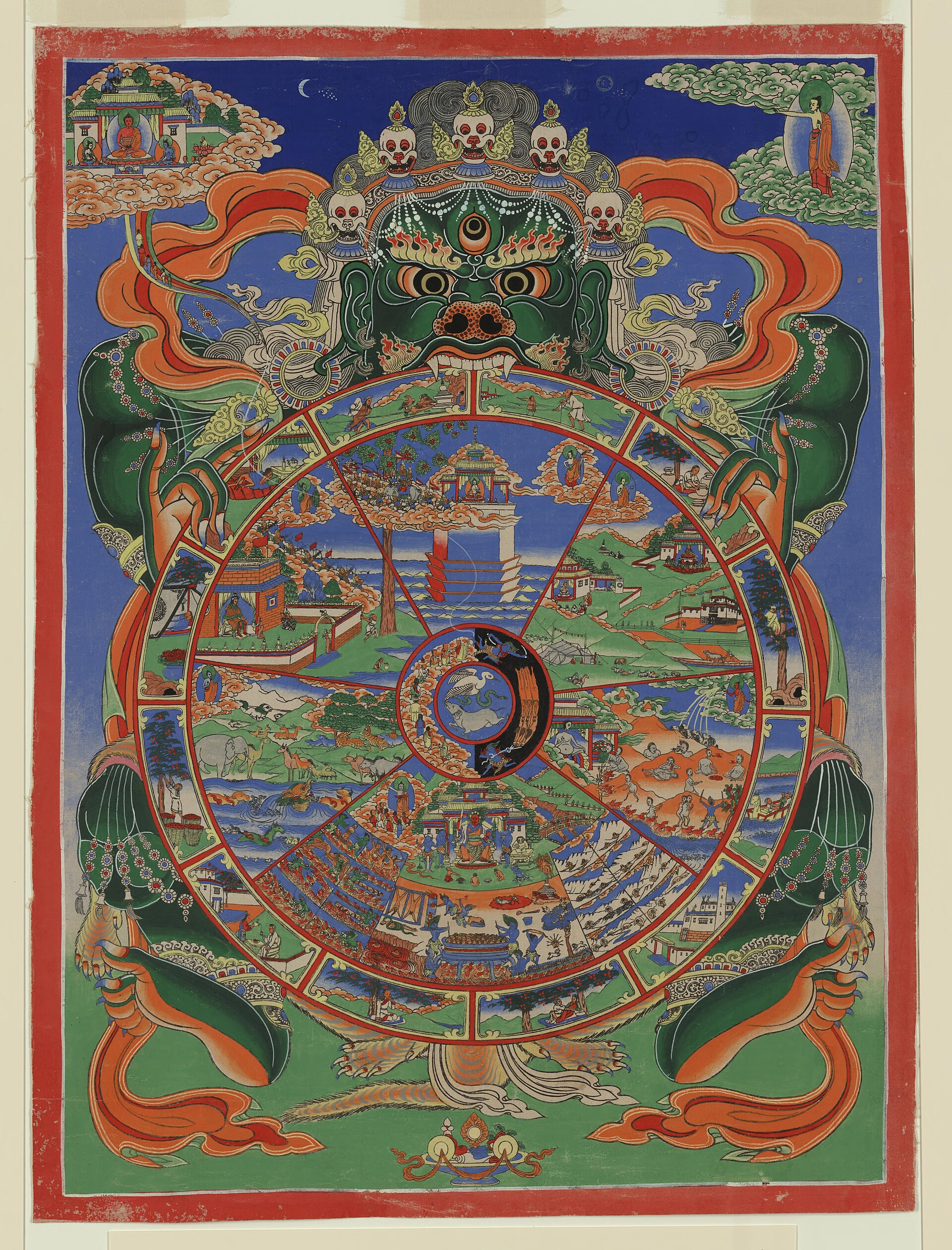
The Bhavacakra, or Wheel of Becoming, ca. 1900. Yama holds the field of conditioned existence while the Buddha points beyond it. Repeated states become inhabited worlds; recognition preserves a way out. Library of Congress, public domain. Click to open the full image.
Mercy Changes the Trajectory
Karma preserves agency because the pattern remains living. Fatalism turns accumulated momentum into an unchangeable sentence. Repentance, metanoia, confession, restitution, forgiveness, disciplined practice, and changed conduct introduce new causes. Metanoia is a change of mind that redirects the life performing the next act.
Grace gives a person power to face injury without repeating it. Restitution returns value wherever repair remains possible. Confession breaks the effort required to maintain a false account. Forgiveness can release an injured person from compulsory participation in the offender’s pattern while preserving truth and protection. Sacrifice becomes sacred when its performer bears a cost that restores life. Assigning that cost to another vessel continues the injury.
The Great Work changes karma through the living present, where the future remains open to action. A person receives inherited momentum and recognizes its operation. They refuse its automatic continuation and cast a different pattern forward. The past remains part of the structure. New conduct gives it a different return.
The Completed Circuit
The incorruptible ledger records events and what they made possible. It also records their costs and the kind of being formed by performing them. Physical thermodynamics keeps exported costs within the larger system. Karma follows the account through consciousness and moral relation. Judgment reveals the completed arrangement.
The direction of the law remains exact while its schedule can stay hidden. Consequence returns through body, family, institution, civilization, dream, encounter, another incarnation, and the postmortem field. Delay preserves the account; power grants no exemption, and death supplies no escape. Each carrier gives the returning consequence another form.
Every operation initiates its operator. What a being repeatedly invokes, embodies, and feeds becomes the world it is capable of entering.
Go Deeper
The Thermodynamics of the War — material cost, exported disorder, and the eventual failure of extractive order
The Incorruptible Ledger — the record that remains when institutions falsify or destroy their copies
The Shattered Vessel — forced aperture, negative coherence, and the inversion of initiation
Death and the Sorting Hierarchy — affinity becoming trajectory when the biological interface releases
Bardos — recognition, projection, karma, and practiced continuity through death
Operative Magic — why the fruit of a working includes what the working makes of its practitioner
References
The Holy Bible, King James Version. Galatians 6:7; Matthew 7:2; Matthew 26:52; Mark 8:36; Psalm 7:15–16; Hosea 8:7.
The Quran. 99:7–8.
The Egyptian Book of the Dead: The Book of Going Forth by Day. Translated by Raymond O. Faulkner. Chronicle Books, 1994.
Karma Lingpa. The Tibetan Book of the Dead. Translated by Gyurme Dorje. Penguin Classics, 2006.
Krishan, Yuvraj. The Doctrine of Karma: Its Origin and Development in Brahmanical, Buddhist, and Jaina Traditions. Motilal Banarsidass, 1997.
Plato. Republic, Book X.
Three Initiates. The Kybalion: A Study of the Hermetic Philosophy of Ancient Egypt and Greece. Yogi Publication Society, 1908.
West, Martin L. The East Face of Helicon: West Asiatic Elements in Greek Poetry and Myth. Clarendon Press, 1997.
Library of Congress. Bhavacakra (Wheel of Becoming), ca. 1900. Prints and Photographs Division, digital ID 2011432136. Public domain.