A fish raised in a tank experiences the glass as the edge of its world. A human boundary becomes visible when experience presses against it or another environment comes into view. The Lock names the complete capture architecture. Capture becomes ordinary life through these boundaries; recovery begins when the person can perceive and question them.
The Lock manages the range of perception, memory, and action. Language, habits, institutions, physiology, and media reinforce its boundaries until they feel like reality itself. A person experiences this constraint as common sense, fatigue, urgency, or social fact.
Four parts of the mechanism
Radio-frequency language helps distinguish four functions. Applied to social and spiritual constraint, these terms describe relations among limits and responses.
The bandlimit is the range a system can admit. The ceiling is that boundary as experienced from inside. Impedance names the resistance encountered when a signal tries to cross the boundary. The regime includes the forces and relationships that maintain it.
signal or possibility
          ↓
   [ resistance ]       ← impedance
   [ allowed range ]    ← bandlimit
          ↓
ordinary perception
A stress response, school rule, taboo category, addictive feed, institutional incentive, or jamming signal can narrow agency through its own pathway. Their convergence produces the lived Lock. The Human Chord describes the body as the receiving system through which those pressures become attention, sensation, and conduct.
Natural limits and captured limits
Embodiment requires selection. A nervous system receiving every sensation, memory, association, and possible interpretation at once would struggle to act. Constraint also supports development. Repetition builds a skill, commitment forms a personality, and limits give a life shape.
This necessary narrowing is the veil. A child needs guidance before self-government becomes possible. A society needs shared categories and ways to revise them. The Lock begins when a limit outlives its developmental purpose, conceals its exit conditions, or serves extraction. A stable worldview becomes a cage when contradictory experience has nowhere to go.
The veil gives consciousness resistance to work with. The Lock makes resistance serve dependency.
The distinction is practical. A useful limit trains capacity and becomes less necessary as that capacity matures. A captured limit withholds capacity and makes relief depend on the system maintaining the pressure.
Captured constraint operates through several layers that reinforce one another. Chronic physiological stress reduces the body’s ability to distinguish useful information. Information saturation occupies attention, while institutional incentives punish forbidden interpretations. Repeated narratives supply explanations before a person examines an event. Temporal compression keeps people reacting before memory can reveal the pattern.
How the Lock feels
From inside, the Lock often feels ordinary:
- persistent fatigue that makes sustained attention expensive;
- urgency that shortens the time available for reflection;
- categories that turn observation into a loyalty test;
- ridicule that arrives before investigation;
- stimulation that crowds out silence and dream;
- dependence on institutions for permission to name direct experience;
- cycles of outrage whose emotional intensity exceeds their durable consequence.
Each condition has a local explanation. Together, the conditions narrow what people can perceive, weaken memory, and make behavior more predictable. Their combined pressure gives the Lock its ordinary appearance.
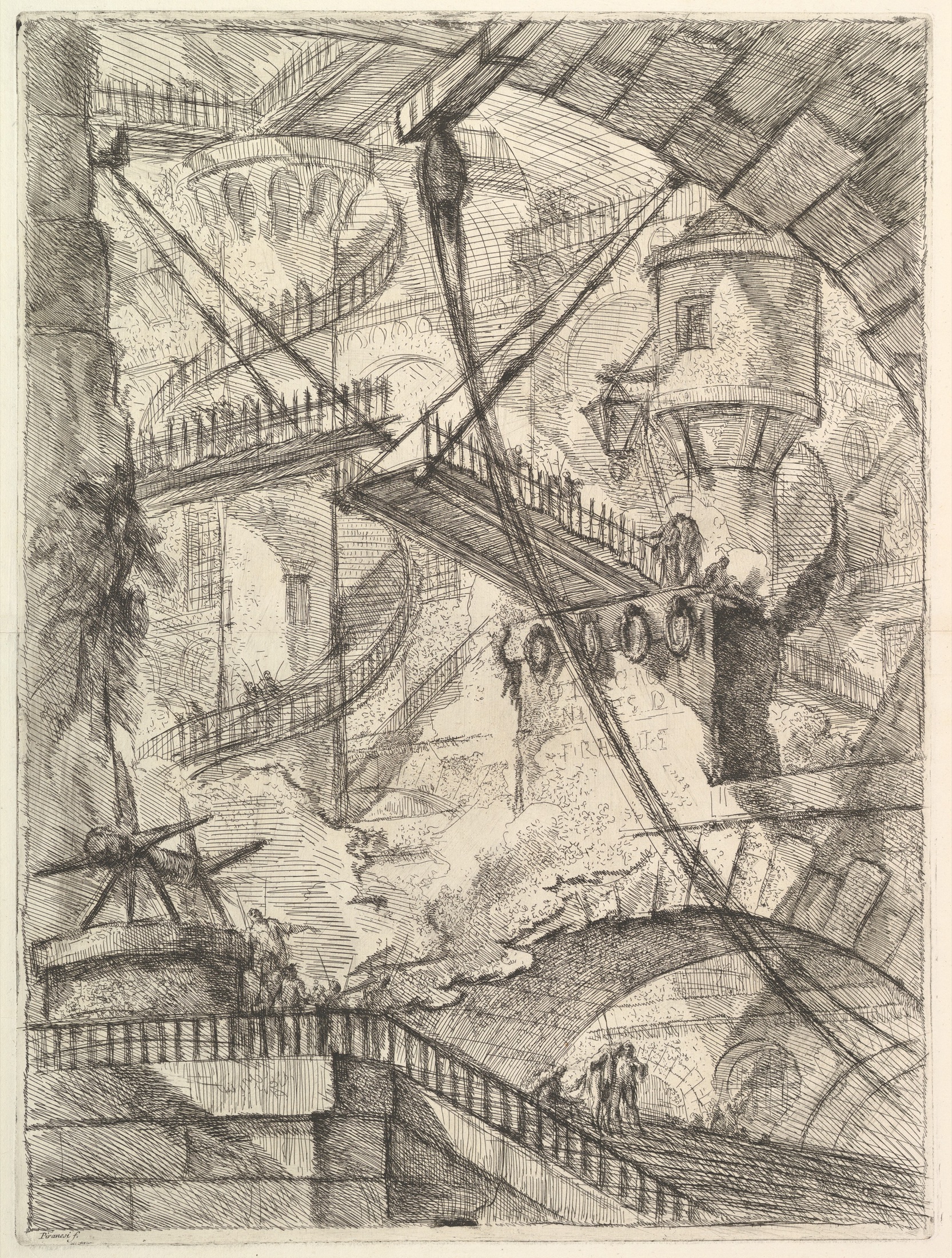
Giovanni Battista Piranesi, The Drawbridge, from Carceri d’invenzione (c. 1749–50). Movement remains possible, but the architecture turns every route back into enclosure. Click to open the full image.
The self-locking layer
The most efficient prison recruits its prisoner into maintenance. People learn which perceptions bring social cost and stop admitting those perceptions to themselves. An identity defends the story that formed it. An exhausted person seeks stimulation that deepens exhaustion. A frightened population demands tighter control and experiences that control as safety.
This feedback loop explains why removing one operator leaves much of the system intact. The Lock has entered incentives, reflexes, architecture, and inner voices. Accountability remains necessary. Recovery also requires identifying which arrangements keep reproducing the capture.
An enemy story can reproduce the same mechanism. A diagnosis that assigns every disagreement to one hidden class creates another loyalty test and another authority structure. A liberating interpretation restores accurate boundaries, practical choice, and the capacity to inspect one’s own participation.
Lowering impedance
Recovery begins when the instrument regains time, attention, memory, and selectivity. Sleep and bodily regulation improve sorting. Long-form reading rebuilds temporal depth. Silence reveals impulses installed by continuous input. Direct observation weakens automatic categories. Small truthful statements test where the social ceiling actually stands.
Collective defenses include transparent records, distributed archives, plural institutions, open inquiry, and tools that reveal how attention is being shaped. The Lock thrives where feedback disappears.
Awakening names the recognition that opens recovery. The Human Chord explains how the body receives and stabilizes the newly available signal. The Great Work turns recovered perception into capacity that remains available afterward. A ceiling can crack suddenly while bodily integration proceeds slowly. Gradual widening lets each retained capacity support the next opening.
References
Wittgenstein, Ludwig. Tractatus Logico-Philosophicus. Translated by C. K. Ogden. Routledge & Kegan Paul, 1922.
Whorf, Benjamin Lee. Language, Thought, and Reality. MIT Press, 1956.
Baudrillard, Jean. Simulacra and Simulation. University of Michigan Press, 1994.
Hall, Manly P. The Secret Teachings of All Ages. 1928.
McDonnell, Wayne M. “Analysis and Assessment of Gateway Process.” U.S. Army Intelligence and Security Command, 1983. CIA-RDP96-00788R001700210016-5.
Piranesi, Giovanni Battista. The Drawbridge, from Carceri d’invenzione. c. 1749–50. Metropolitan Museum of Art, Open Access (CC0). Source record.
_MET_DP828200.jpg)