The first books
The Fama Fraternitatis appeared in 1614, followed by the Confessio in 1615. They announced a hidden Christian brotherhood and invited the learned of Europe to take part in a general reformation. 3
Early modern Europe · Wisdom & reformation
The hidden fraternity and the work of renewal
A hidden door opens, and the brothers discover their founder beneath an altar, his body unconsumed and his books preserved. The chamber holds enough knowledge to begin their work again. The Rosicrucian manifestos promise that wisdom can survive a dark age. It returns through people prepared to heal, teach, and renew the world.
Beliefs · Diagrams · Practice · Primary texts
The essentials
These are the tradition’s central teachings.
The Fama Fraternitatis appeared in 1614, followed by the Confessio in 1615. They announced a hidden Christian brotherhood and invited the learned of Europe to take part in a general reformation. 3
The Fama’s founder travels in search of wisdom, studies with teachers abroad, and returns to Germany. When established scholars reject what he offers, he gathers a few companions and begins the fraternity. 1
The human being contains the greater world in miniature. The Fama compares this to a seed containing a tree: knowledge of nature also reveals what a person carries within. 1
The manifestos seek a recovery of divine wisdom through Christ, Scripture, and the study of creation. Their hope for reform belongs to the religious conflicts and expectations of early modern Europe. 2
The first rule requires the brothers to heal the sick without payment. They travel in ordinary clothes, share what they learn, and each prepare someone to succeed them. 1
Published in 1616, the related romance follows Rosenkreutz through seven days of testing and alchemical work. He helps prepare renewed royal bodies and witnesses the fire that brings them to life. 5
The chamber and the college
The Fama describes a vault with seven walls, a round altar, and a light above that shines without the sun. Its books and instruments have been gathered so that the fraternity could be restored even after its disappearance. The 1618 plates below give another early Rosicrucian author’s images of the brotherhood and the living world.
Fama Fraternitatis · plan of the chamber
The light is above the altar, in the center of the ceiling. Wall numbers are reading aids; the Fama names no planetary sequence for these seven sides.
Each wall · ten fields with figures and sentences
The text leaves their individual contents undescribed.
Words within the chamber
Post 120 annos patebo.
After 120 years I shall open.
Written above the hidden door.
Jesus mihi omnia.
Jesus is everything to me.
Written around the altar’s rim.
Four circled figures upon the altar
The Fama supplies these four inscriptions but leaves the figures themselves undescribed. The Latin is retained; the English gives their plain meaning.
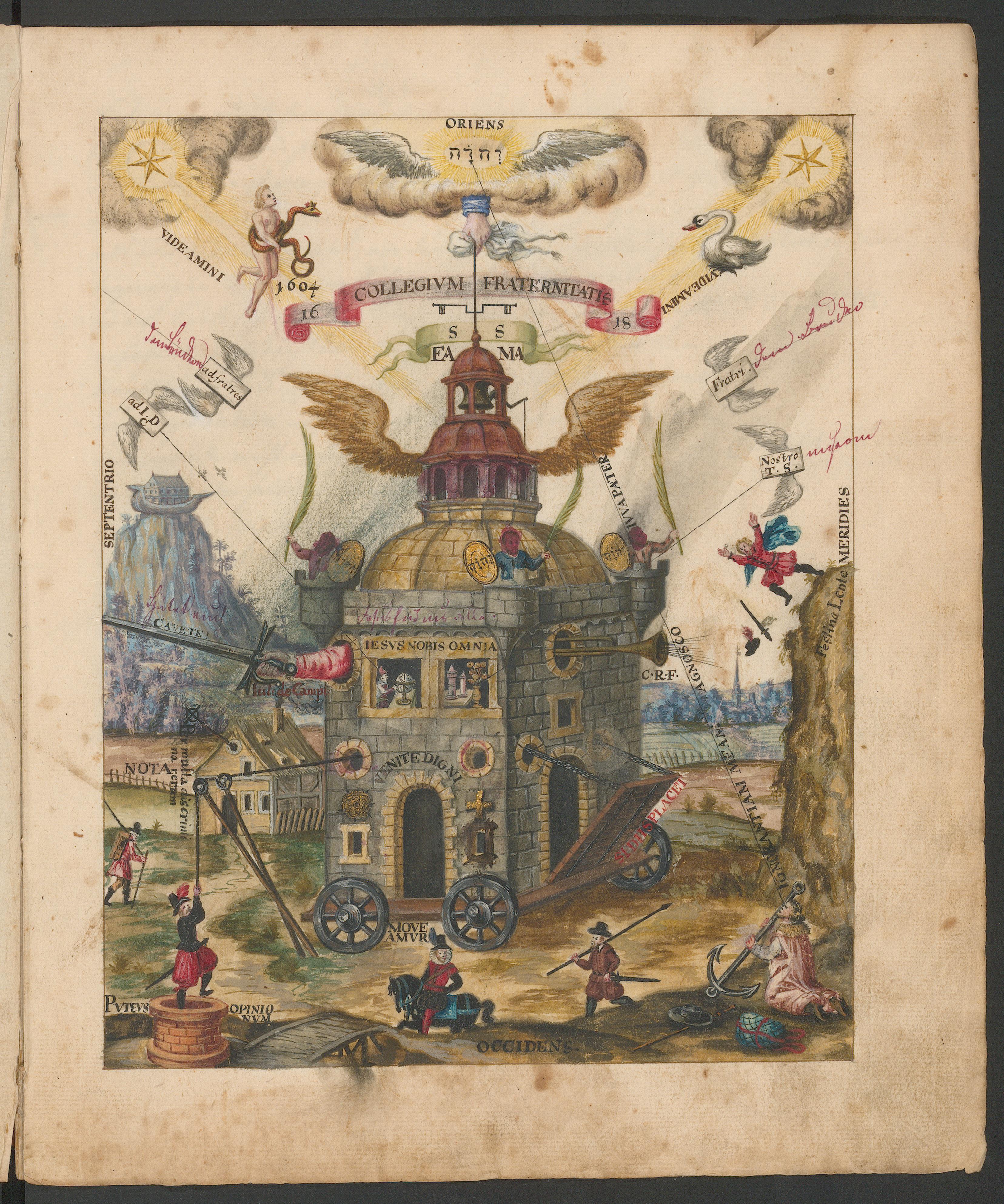
The historical image
Speculum sophicum rhodo-stauroticum, 1618, plate labeled 1a. Zürich, SCH R 201. The building bears the words IESVS NOBIS OMNIA: Jesus is everything to us. Wings, wheels, and sounding trumpets give the hidden college a visible presence.
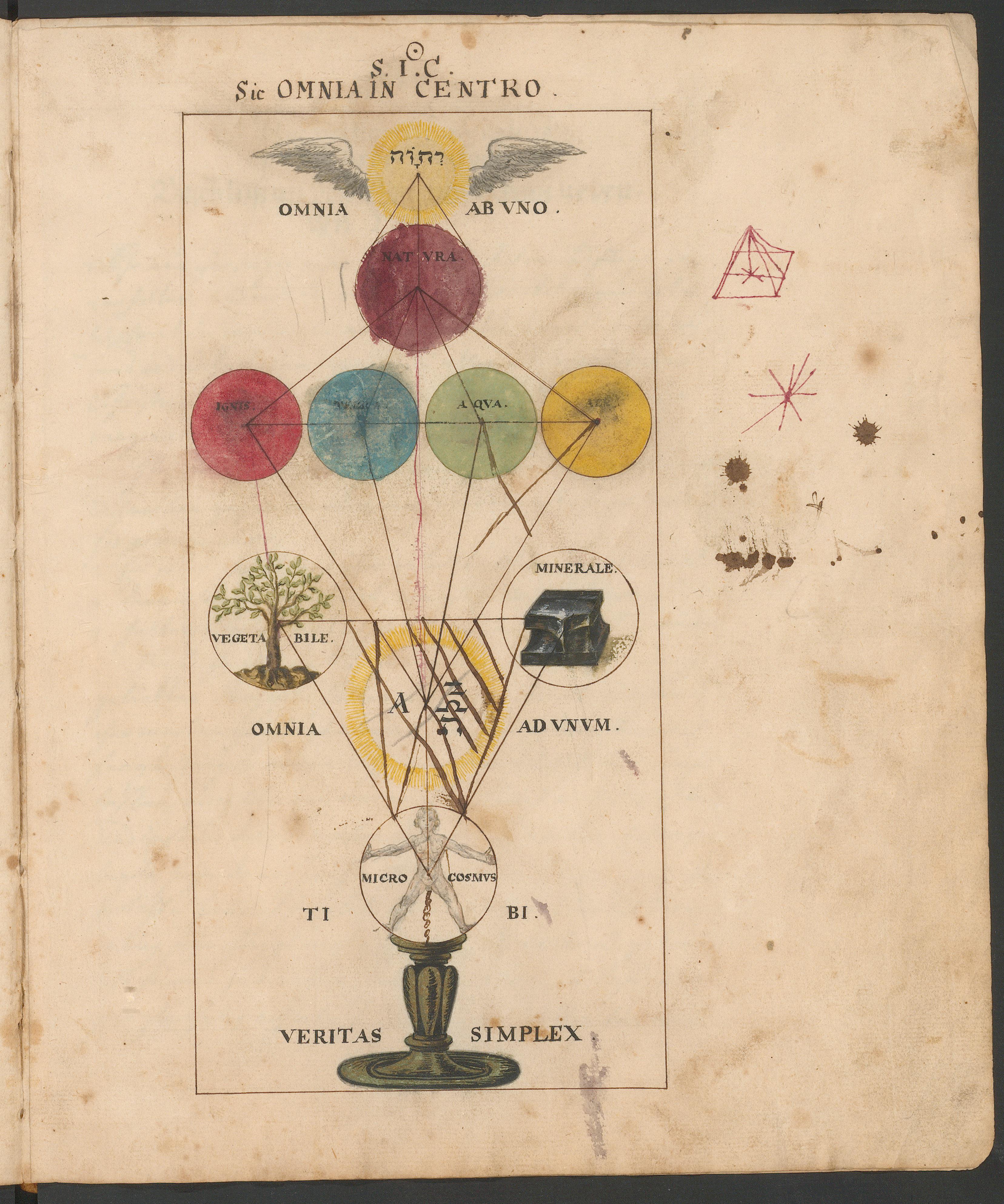
The historical image
The same 1618 volume, plate labeled 30a. OMNIA AB VNO appears above and OMNIA AD VNVM below: all from one, all toward one. The human figure is named MICROCOSMVS. The lines, coloring, and annotations belong to this surviving copy.
A separate book · the Chymical Wedding
A winged messenger brings the summons.
Rosenkreutz finds his way to the castle.
The guests are tested against seven weights.
The royal persons are beheaded.
Rosenkreutz sees the hidden Venus; the company travels to the tower.
The workers prepare new bodies and witness their awakening.
The workers take their oath; Rosenkreutz answers for his transgression.
The inscription calls the chamber a compendium of the universe. Its walls, ceiling, and floor carry an ordered teaching, while the altar covers the preserved body. The brothers enter a place in which the founder’s life and knowledge have been kept together for those who come after him.
The Confessio places Scripture beside the divine writing present throughout creation. A student must learn to read both. Its account of wisdom includes revelation and the ministry of angels, together with understanding developed through long observation and experience.
After the long labor in the tower, the new bodies have reached full size but remain without warmth or sensation. Rosenkreutz then sees a bright stream descend through a tube into a body. The arrival of soul completes what the alchemical workers have prepared.
The vault drawing follows the Fama’s stated features; the regular geometry and orientation are modern. The two complete plates come from a separate work published in 1618. Their coloring, lettering, and handwritten additions are retained as they appear in the Zürich copy. 1956
The work of transformation
Before dispersing into different countries, the brothers agree upon six rules. Their work requires useful knowledge, continued contact, and someone to carry it on after each member’s death. The Fama gives the agreements in this order.
“to cure the sick, and that gratis”
The brothers are to profess the healing of the sick and give it freely.
Members follow local custom in their dress. The rule prescribes no distinctive uniform.
They assemble at the House of the Holy Spirit on the appointed day, or write to explain their absence.
Each brother looks for a worthy person who can take his place after his death.
C.R. is to serve as their seal, mark, and character.
The fraternity is to stay concealed for one hundred years. This interval is distinct from the 120 years named above the vault’s door.
These are the Fama’s six agreements. The Knights of the Golden Stone take a different, five-part oath on the final day of the Chymical Wedding.
The teaching in the texts
The discovery begins with a repair to a building. A brother tries to move a memorial tablet, pulls at a nail, and dislodges part of the wall. Behind it stands a hidden door. Its inscription announces that it will open after 120 years. The brothers clear the entrance, give thanks, and wait until the following morning to enter.
Inside, a light in the ceiling illuminates a seven-sided chamber. A round altar stands in the middle. Around its rim are the words Jesus mihi omnia: Jesus is everything to me. Books and instruments lie in chests behind the walls. Mirrors, bells, lamps, and artificial music belong to the collection. The Fama explains their purpose directly: the whole fraternity could be restored from what this vault preserves.
The founder’s body lies beneath the altar, whole and unconsumed, with a book in his hand. The discovery joins the survival of the teacher to the survival of his teaching. His successors can encounter a life gathered into its works, its sacred commitments, and the instruments through which its knowledge became useful. The chamber gives them something they can study and carry out into the world.
The Fama then makes the opening of the door an image of what is beginning in Europe. Knowledge long concealed is becoming available to people capable of receiving it. The tomb holds the means of a new beginning because someone prepared for a future he would never see. The brothers kneel within its light before returning to the books left for them.
Read the sources 1
When Rosenkreutz returns to Europe, the scholars he approaches fear what his discoveries will cost them. The Fama says that accepting his teaching would require them to admit their errors and begin learning again. Their reputation has grown around the knowledge they already possess. Even a remedy becomes unwelcome when receiving it threatens the physician’s authority.
The Confessio develops the medical image. Philosophy is sick, and nature offers the means by which it can recover. The promised wisdom searches heaven and earth while giving theology and medicine a central place. Revelation, the service of angels, careful thought, and long experience all contribute to it. The brotherhood seeks people who can bring these ways of knowing into a fruitful life.
This helps explain the first rule. The sick person must receive the benefit of what the brother knows, freely. Members then report what they have observed during their travels, including errors that need correction. Their learning remains answerable to what happens when it is used. The requirement to prepare a successor extends that responsibility beyond the length of one life.
The books also make their Christian allegiance explicit. Scripture directs the life of the student, while creation bears the characters of the same divine author. Their reforming language includes fierce opposition to the papacy and to Islam, locating the summons within the confessional struggles of its age. The promised renewal reaches through these historical hopes into the patient’s room, where a brother must put his wisdom to work without demanding payment.
Near the end of the sixth day, Rosenkreutz and three companions believe they have disgraced themselves. Their guide accuses them of idleness and sends them away to the sound of mocking music. Once outside, they learn that they have been chosen for the final work. A winding stair brings them to an upper chamber where an old man receives them warmly.
They mix the ashes of the alchemical bird with prepared water, heat the substance, and pour it into two small molds. A male and female figure emerge, soft and flesh-like, each only four inches long. Fed with the bird’s blood, they grow into beautiful adult bodies. Yet they have neither warmth nor sensation. Rosenkreutz has watched their formation closely enough to recognize that something indispensable has still to arrive.
A tube is placed at the mouth of one body and directed toward an opening in the roof. As the green material wound around it burns, Rosenkreutz sees a bright stream of fire descend through the tube and enter the body. The ceremony gives the soul a way into the form the workers have prepared. Their art has served nature through every stage of the making; renewed life completes the work.
The following day, the workers receive knighthood and swear to use their talents for those in need. Rosenkreutz must also answer for having looked upon the forbidden Venus. He confesses and accepts the sentence of replacing the gatekeeper who once helped him. The book leaves a gap in its ending and reports his return home. His obligation is clear before that break: witnessing renewal leaves him responsible for what he has done.
Across the centuries
The manifesto announces the fraternity, recounts its founder’s travels, and describes the opening of his vault. It invites a response from the learned and unlearned. 3
The second manifesto explains the brotherhood’s Christian commitments and its expectation of a renewal of wisdom before the world’s end. 3
Johann Valentin Andreae’s romance follows seven days in the life of Christian Rosenkreutz. The year 1459 belongs to the story’s setting. 8
Theophilus Schweighardt, the name used by Daniel Mögling, publishes the Speculum. Its college and microcosm plates develop the early Rosicrucian vision in pictures. 9
Thomas Vaughan publishes an English translation under the name Eugenius Philalethes. The linked Wikisource transcription follows the 1658 edition. 4
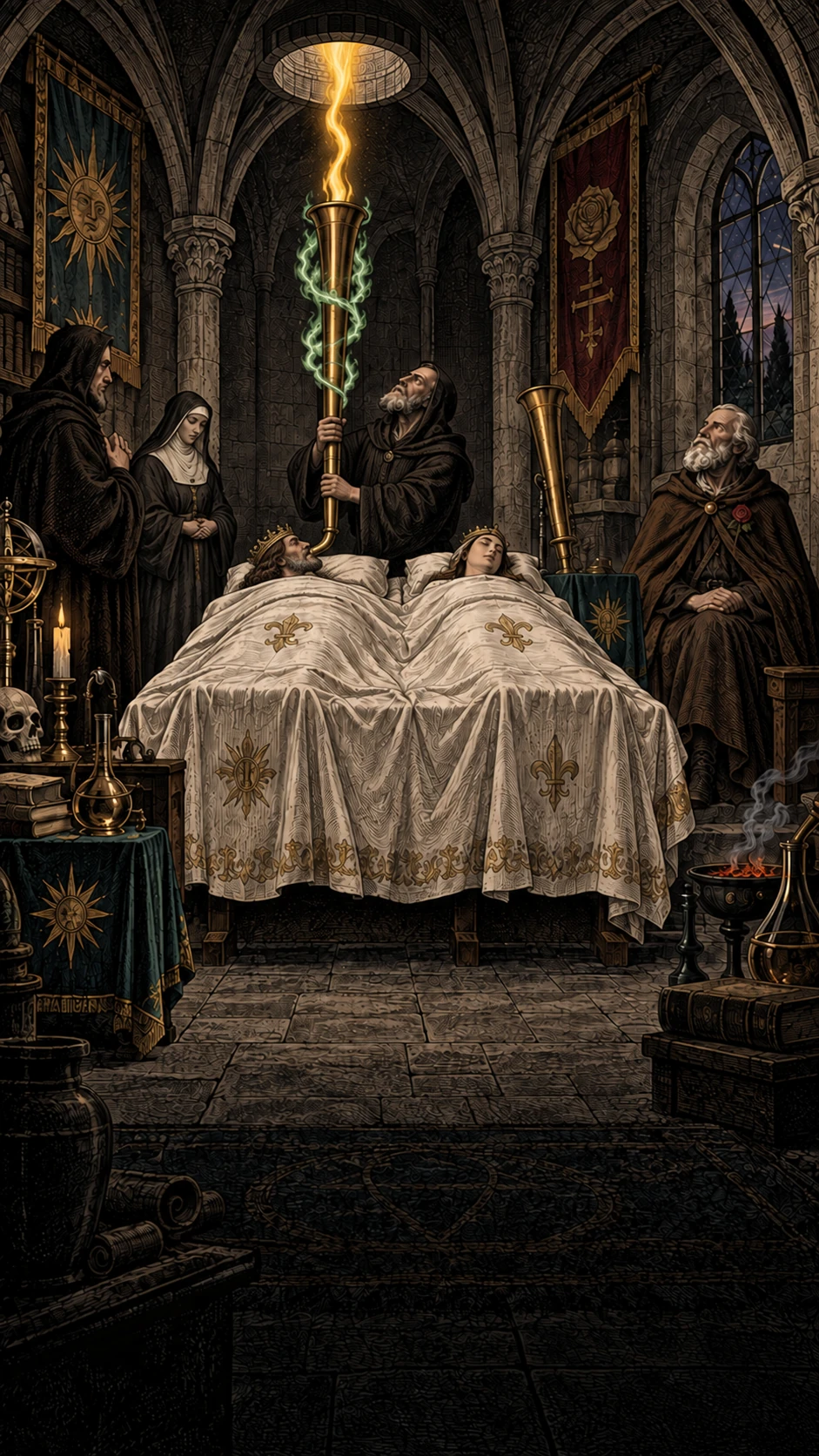
Continue into the illustrated journey
Follow Rosenkreutz from the invitation and the weighing through the royal death, the work in the tower, and the obligations that follow his knighthood.
Enter the Chymical Wedding ↗Read at the source
The founder’s travels, the microcosm, the six agreements, and the discovery of the vault. The diagram follows its seven sides, central altar, ceiling light, and named inscriptions. The founder’s biography is the manifesto’s narrative.
The renewal of philosophy, revelation and experience, the book of nature, Scripture, and the promised recovery of Adamic wisdom. Its religious polemic remains part of its historical setting.
The manifesto first appeared in German in 1614 and in Latin in 1615. Vaughan’s English Fame and Confession appeared in 1652; the 1658 reprint is available through the linked Confessio edition.
Digitized first English edition. The catalog records its 1652 publication; the separate Wikisource transcription used for the Confessio reproduces the 1658 reprint.
Seven-day narrative, including the invitation, the weighing, the royal death, and the work of renewal. The host labels it 1459, the narrative date; the German book was published in 1616.
The apparent dismissal of the four workers, the final preparation of the bodies, and the stream of fire entering through the tube.
The five obligations of knighthood, Rosenkreutz’s confession and sentence, and the final notice of missing leaves and his return home.
Identifies Andreae and the 1616 publication. Steiner’s later interpretation is a distinct reception of the romance; the close reading here follows Foxcroft’s text.
Zentralbibliothek Zürich, SCH R 201. Complete scans of the plates labeled 1a and 30a, Public Domain Mark. The library identifies the author and date; both original-resolution photographs remain available from the guide.