Sharing the divine life
Theosis means becoming divine through participation in God’s life. Athanasius grounds this possibility in the Incarnation: the Word takes human flesh so that humanity can receive divine life and overcome corruption. 1
Christian tradition · Prayer & divine union
The soul’s ascent and the God who dwells within
Teresa of Ávila asks her sisters to imagine the soul as a castle made from a single crystal. God dwells in its innermost chamber. Many people scarcely know that they have entered this castle. Prayer begins their discovery of the divine presence. As the soul approaches God, the encounter changes how the person knows, loves, suffers, and lives. Christian mysticism follows this transformation through the desert monks’ struggle, Dionysius’s divine unknowing, and Teresa’s spiritual marriage.
Beliefs · Diagrams · Practice · Primary texts
The essentials
These are the tradition’s central teachings.
Theosis means becoming divine through participation in God’s life. Athanasius grounds this possibility in the Incarnation: the Word takes human flesh so that humanity can receive divine life and overcome corruption. 1
John Climacus’s thirty steps begin with renunciation and end with faith, hope, and love. Prayer and humility accompany the struggle against the passions. 2
Teresa describes seven groups of mansions within the soul, each containing many rooms and degrees of intimacy with God. Prayer gives entrance, and God dwells at the center. 6
Dionysius follows Moses beyond the mountain’s lights and voices into divine darkness. God draws the initiate into union beyond understanding as the mind releases its grasp on what it can name. 4
God gives the prayer of quiet, which Teresa compares to a basin fed by a spring. Water rises and overflows the basin, as God fills the soul with a peace it cannot produce. 9
In Teresa’s seventh mansions, Christ becomes the soul’s abiding companion. Love grows fruitful in service; the person comes from prayer with greater strength to care for others. 13
Two images of the soul’s transformation
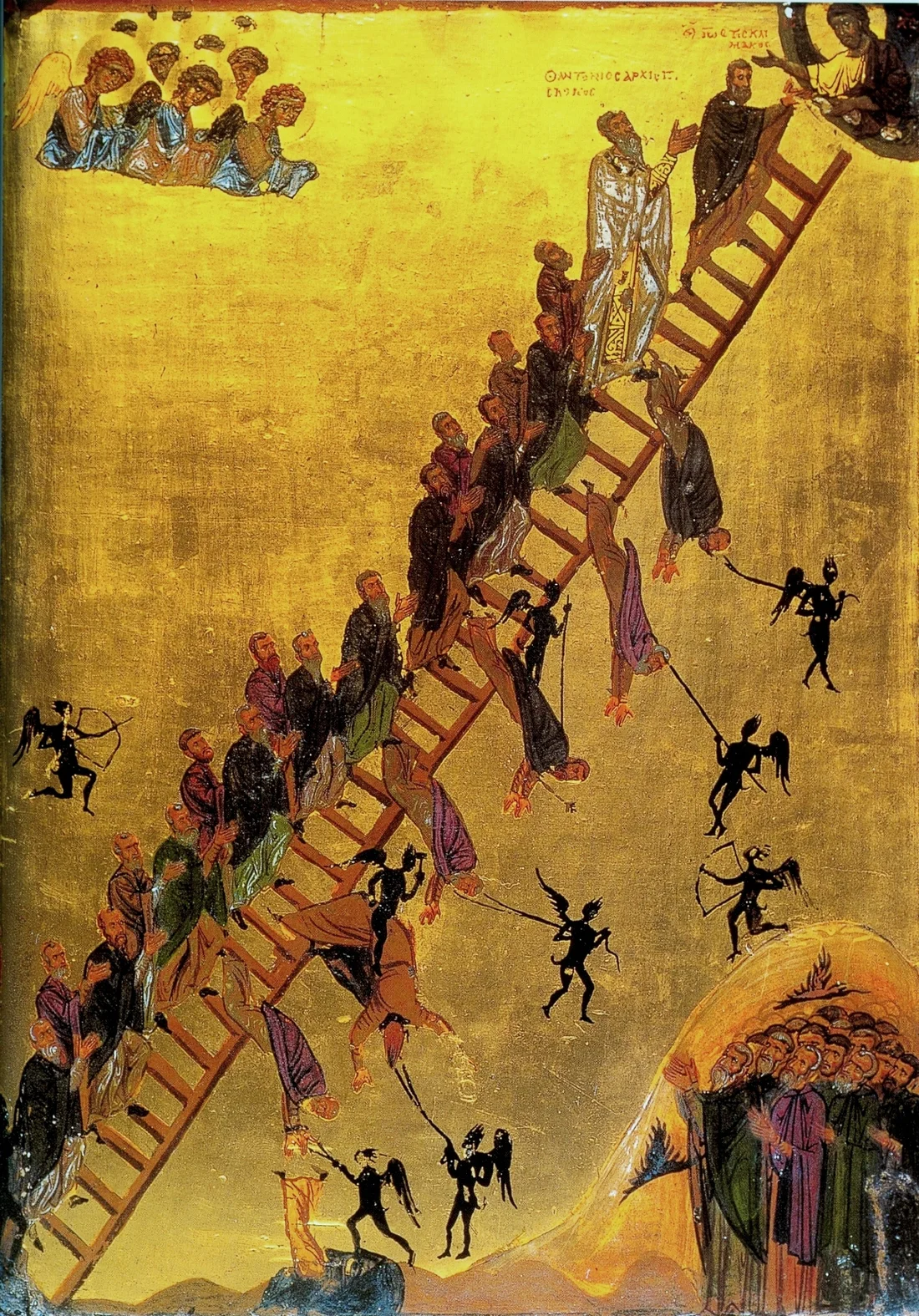
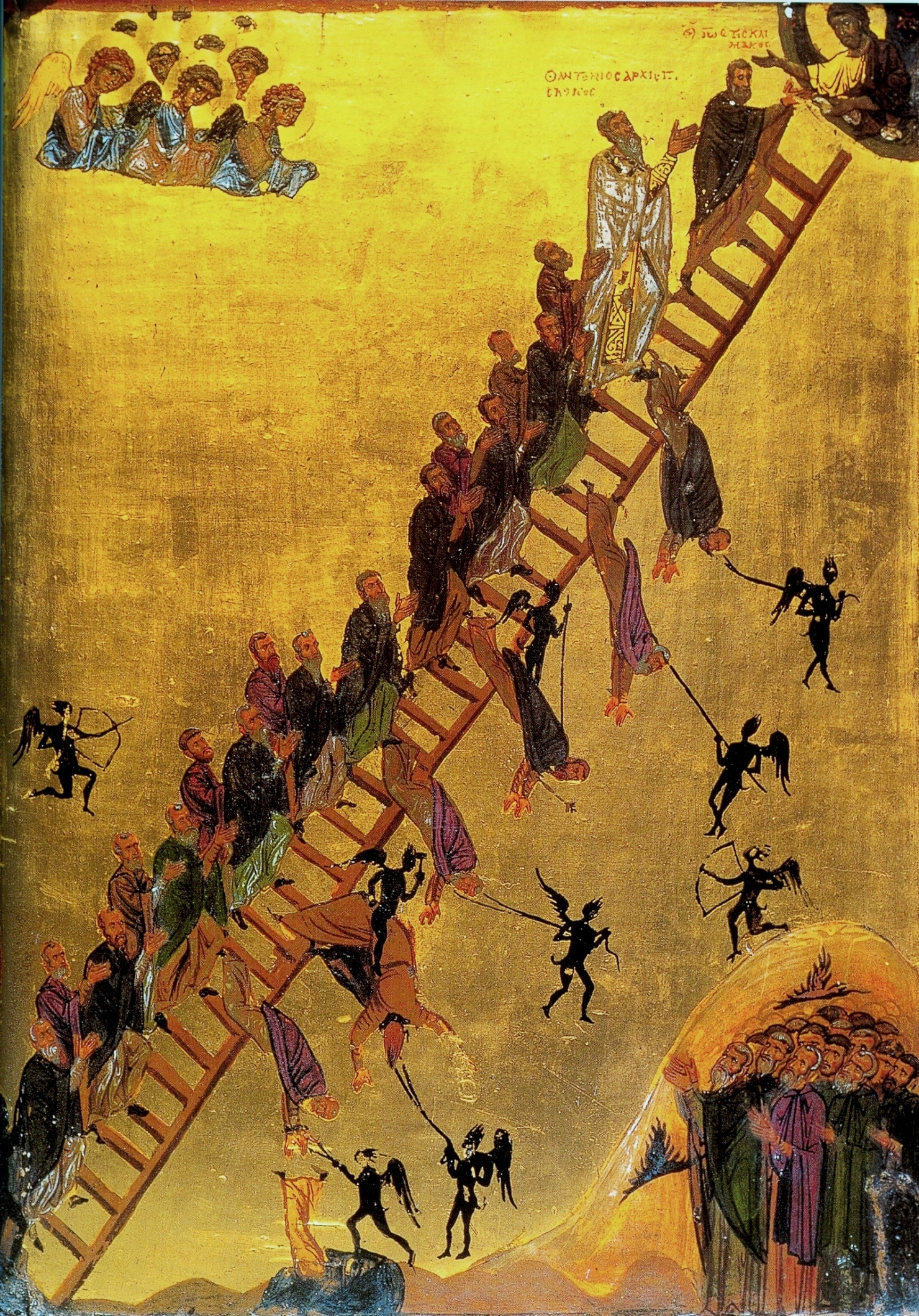
The Sinai icon shows monks climbing toward Christ while demons pull others from the rungs. The thirty chapter subjects beside it preserve John’s ascent in order. Teresa directs the reader into the soul, where seven groups of mansions surround God’s dwelling. The ladder and castle come from different centuries and forms of Christian life.
The historical image
The Ladder of Divine Ascent, 12th century, Saint Catherine’s Monastery, Sinai. The icon makes the struggle visible at every height. Christ reaches toward the foremost climber; angels and the community of monks witness the ascent.
John Climacus · the thirty chapters
Teresa of Ávila · the Interior Castle
This modern diagram shows the book’s seven divisions. Teresa places many rooms above, below, and around the center in each group. The soul can move among these rooms. The rings simplify their spacious arrangement.
Prayer and self-knowledge begin as the soul enters the castle. Its distractions accompany it inside.
The soul hears God more clearly and struggles to persevere in prayer.
Order and virtue have taken root. Dryness and trial reveal how much remains to be surrendered.
Through recollection, God gathers the soul’s attention inward and brings quiet. Prayer begins to receive what effort could never produce.
God gathers the soul into himself. Teresa’s silkworm emerges transformed and winged.
Longing, wounds of love, visions, and raptures accompany suffering as the soul is prepared for marriage.
The soul comes to know the Trinity inwardly. Christ shares the soul’s life, and love bears fruit in deeds.
Angels gather above the climbers; Christ receives them at the upper end. Below, demons seize monks at different heights. The image places the whole ascent within the contest for the soul.
John describes love as resemblance to God. Stillness, prayer, and freedom from the passions prepare the soul for this fulfillment in his final chapters.
Teresa compares the surrounding rooms to the layers around the heart of a palm. The soul barely suspects its own greatness, and God’s light reaches throughout it. Through prayer, the soul discovers the divine presence that sin and distraction have obscured.
Humility and self-knowledge remain necessary even in the innermost mansions. God gives his favors freely, and the soul can visit different rooms. Teresa’s seven divisions explain these experiences; each soul’s course can differ.
The complete icon preserves its historical composition and inscriptions. The chapter key shortens English labels from Lazarus Moore’s translation and preserves their order. The modern castle diagram distinguishes Teresa’s seven groups of mansions with rings. Each group contains many mansions; the rings neither reproduce a historical floor plan nor measure holiness. 16267813
The work of transformation
Teresa writes for women who pray and work together, with ample opportunity to discover one another’s faults. Her account of divine union returns repeatedly to their shared life. A woman who receives Christ must also welcome the person who interrupts her solitude.
“this is the reason of the spiritual marriage whose children are always good works.”
Teresa begins with attentive prayer: the person speaks to God and knows whom she addresses. Even a soul distracted by its affairs can begin to enter the castle.
The soul comes to know itself while contemplating divine goodness. Teresa compares it to a bee that returns to its hive and goes out among the flowers. Self-examination and contemplation belong together.
The deeper forms of prayer arrive as gifts. The reader prepares through faithfulness while allowing God to choose when and how the encounter unfolds.
Teresa asks her sisters to take up another’s burden when the opportunity comes. Such acts reveal whether love has taken hold of the will.
Martha and Mary must welcome Christ together. The life of service draws strength from the presence discovered in prayer.
These teachings come from Interior Castle I.1–2, IV.1–2, V.3, and VII.4. They introduce Teresa’s account of prayer and charity. These five explanations are teachings, not initiation grades.
The teaching in the texts
Dionysius begins his short treatise by invoking the Trinity. He asks to enter divine silence, then instructs Timothy in the ascent. The initiate must eventually leave behind sense perception, intellectual activity, and everything these faculties can grasp. God gives existence to all things and exceeds what any created faculty can contain.
Moses shows how this passage unfolds. He undergoes purification, hears trumpets, and sees lights flashing around the mountain. He leaves the crowd below and ascends with the chosen priests. Even the highest things he perceives disclose only the place of God’s presence. God draws him beyond them into the darkness of unknowing.
Divine presence exceeds understanding and draws the initiate into this darkness. Thought becomes still, and union takes place beyond its reach. Dionysius compares this relinquishment to a sculptor removing stone until a hidden figure appears. Each conception the initiate releases allows what it concealed to become manifest. Even the term darkness must finally yield: God exceeds both affirmation and denial.
Read the sources 4
Teresa explains the effects of union through the making of silk. The small creature feeds on mulberry leaves, grows, and spins its cocoon. Its former life ends within that enclosure. It emerges winged and white; Teresa calls it a butterfly. She asks her sisters to imagine hearing about this transformation without seeing it and considers the difficulty of believing it.
The Holy Spirit awakens the soul and begins its growth. Confession, sacred reading, preaching, and meditation nourish this new life. Teresa identifies the cocoon with Christ, recalling the scriptural teaching that our life is hidden in him. Through this preparation, the person enters a dwelling where God accomplishes the transformation.
After the prayer of union, the soul scarcely recognizes itself. Its desires have changed: it longs to praise God and bring others to know him. Earlier, the soul struggled to leave familiar comforts; now its ardor exceeds what it can do. This change also brings difficulties. Teresa’s winged creature remains restless, remembering a union it cannot summon again at will.
Teresa follows the soul beyond its moment of ecstasy. A brief encounter leaves lasting hunger, while suffering and uncertainty continue. Her later mansions describe the further transformation that brings this longing into a steadier life with God.
Read the sources 10
In the seventh mansions, the three divine Persons reveal themselves to the soul through illumination. The soul knows their distinction and their unity with certainty. Teresa calls this an intellectual vision: it communicates knowledge without a picture appearing to the bodily eyes or the imagination.
The soul now experiences the Gospel’s promise that God will dwell with the person who loves him. Teresa describes divine companions whose presence continues as the woman works. The first brilliance can subside while their company remains. Teresa compares this change to closing a room’s shutters: the people within remain present, although the darkness conceals them.
In the following chapter, Christ appears after Communion in the splendor of his risen humanity. He entrusts his affairs to the soul and promises to care for hers. Teresa calls this intimacy spiritual marriage. She compares it to rain joining a river. Another comparison describes light entering through two windows and becoming one brightness.
The soul receives peace at its center while fatigue, sorrow, and daily disturbances continue. Teresa places these struggles in the surrounding mansions. The woman remains responsible for her conduct. Her closeness to God strengthens her desire to serve him.
Near the end of the Castle, Teresa explains why God gives these extraordinary favors. Divine intimacy brings forth good works. God strengthens the soul to meet resistance, inconvenience, and other people’s needs with love. His presence gives the person courage for this life.
Teresa has already shown how conduct reveals union with God’s will. During prayer, a woman imagines bearing every humiliation for Christ. Later, a small criticism makes her defend herself angrily. Daily life tests the virtue she imagined in solitude. Her care for another sister reveals more than the grand undertaking she planned alone.
Martha and Mary show how contemplation and service fulfill this love. Mary listens at Christ’s feet; Martha prepares to receive him. Teresa brings their work together so that the whole household welcomes its guest. Love awakened in contemplation seeks ways to act, however modest the circumstances.
The monastery gives Teresa’s sisters opportunities to act. They can ease another’s labor, bear with a difficult companion, and encourage one another in devotion. Teresa gives love the decisive place in a deed’s value. The soul’s extraordinary journey becomes visible in the care it brings to ordinary work.
Across the centuries
The Word’s entry into human life makes humanity’s renewal possible. On the Incarnation gives the later teaching of deification one of its most memorable expressions. 1
An author writing under the name of Dionysius the Areopagite describes divine names, sacred hierarchies, and union beyond knowing. The Mystical Theology gives Moses’s ascent a lasting place in Christian contemplation. 5
The abbot of Sinai writes for the neighboring monastery of Raithu. His thirty chapters become a central work of Eastern monastic spirituality. 3
The Sinai painter shows the monastic struggle through a ladder leading toward Christ. Angels gather above, while demons try to pull the climbers down. 16
Writing for her Carmelite sisters, Teresa gathers her teaching on prayer into the image of a crystal castle. Its final mansions describe the Trinity’s indwelling and spiritual marriage. 15
Continue into the illustrated journey
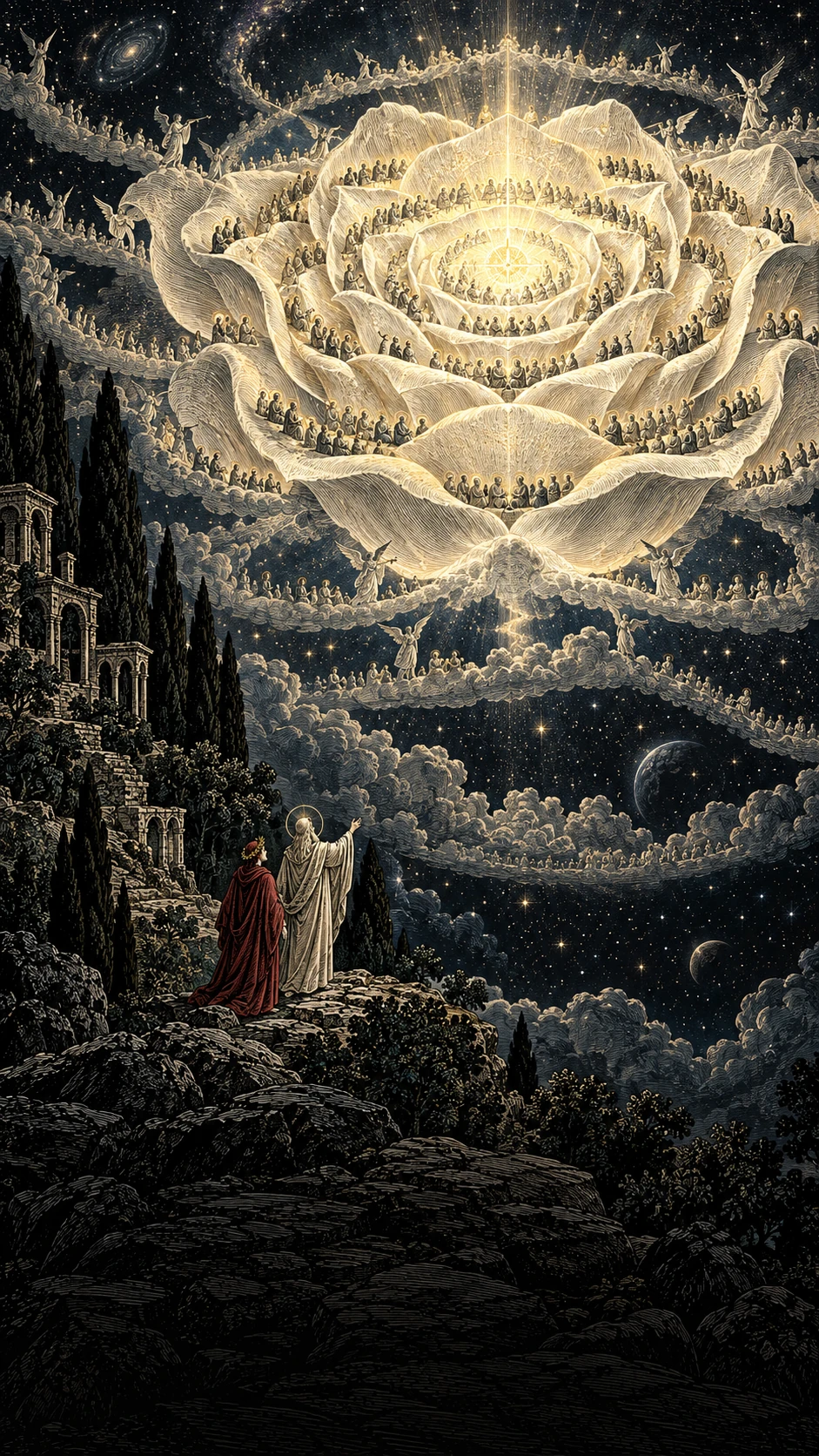
The Divine Comedy gives the Christian journey through judgment, purification, and heavenly vision a poetic form. Continue through its images with Virgil and Beatrice as guides.
Explore Dante’s journey ↗Read at the source
The Incarnation, divine knowledge, and humanity’s reception of immortality. Public-domain translation. Section 54.3 supplies the formulation of deification.
The thirty chapters place prayer in step 28, dispassion in 29, and faith, hope, and love in 30. The diagram shortens the headings from this edition. Steps 16 and 17 remain separate; blasphemous thoughts remain within step 23.
Monastic setting, request from Raithu, thirty steps, and reception of the Ladder. The pope identifies John as a seventh-century monk.
Chapters I–II describe Moses’s ascent, unknowing, and the sculptor. Chapter V takes the negations beyond affirmation and denial. Rolt’s interpretive footnotes remain distinct from the translated text.
Dating and pseudonymous authorship of the corpus. The author writes under the name of Paul’s Athenian convert; the surviving works belong to late antiquity.
Crystal castle, divine presence at its center, and prayer as its entrance. All Castle passages here use this public-domain translation.
Sections 8–10 and 13 describe chambers around the center, many rooms, free movement, humility, and the bee comparison. The concentric diagram is a modern explanatory design.
Teresa distinguishes natural devotion from supernatural favors and explains God’s freedom to bestow them. The seven-part key summarizes her book’s divisions; individual souls can follow different courses.
The two basins: water carried by aqueducts and water rising directly from the spring. Both forms of prayer depend upon grace.
Teresa describes the silkworm, its dwelling in Christ, transformation through union, and subsequent trials. Butterfly preserves her image; the term is not a zoological identification of the silk moth.
Love of God and neighbor, union with the divine will, and the distinction between imagined virtues and their exercise.
Intellectual vision of the three Persons and the continuing experience of their companionship amid daily duties.
Christ’s appearance after Communion, spiritual marriage, rain and river, two windows and one light, and the continuing struggles of the surrounding mansions.
The aim of spiritual marriage, good works, and the union of Martha’s and Mary’s service. The displayed quotation follows section 10.
Teresa dates the beginning of the work to Trinity Sunday, 1577. The epilogue records its completion that November.
Saint Catherine’s Monastery, Sinai. Public-domain reproduction, 1480 × 2119 pixels. The complete supplied image remains intact; the hero shows a labeled detail. All inscriptions and figures remain as supplied.