The Ghost Army lives wherever operators assemble a believable world around a target. Its weapon is agreement among what eyes see, radios report, uniforms imply, archives record, and crowds repeat. Those channels direct the target toward one reality. The target gives that reality consequences through action.
During the Second World War, the 23rd Headquarters Special Troops built phantom armies from inflatable armor and coordinated performances. Sonic recordings, false radio traffic, costumes, vehicle markings, camouflage, gossip, and tire tracks supplied the formation’s surrounding life. The unit disappeared after the war. Its principle spread into psychological operations, military deception, electronic warfare, intelligence, media production, and public attention management.
Contemporary psychological operations, or PSYOP, reclaimed the ghost as heraldry because it names their craft. The world inside the target’s head has become part of the battlespace.
The Army That Built a World
An inflatable tank supplies an image. The Ghost Army’s invention made several forms of perception confirm that image. A vehicle alone would reveal itself under scrutiny. The 23rd therefore built the life around it.
Sonic trucks carried engine and construction sounds. Radio operators reproduced real formations’ transmission habits. Artists painted markings, wore borrowed shoulder patches, and parked the right vehicles where observers would see them. They left debris suggesting an inhabited camp. Officers visited nearby towns where enemy agents would notice them. Each channel confirmed the others.
Enemy intelligence performed the decisive act. It interpreted those signals as one coherent world, reported that world upward, and moved real forces in response. Canvas, loudspeakers, disciplined performance, and expectation acquired battlefield consequences through those decisions.
The fabricated formation demonstrates reality production in military form. Perception, administration, and action joined around it until it acquired causal force. Coordinated carriers recruited the target’s participation. That participation supplied the force a materially incomplete army lacked.
The Publisher Goes to War
Ralph Ingersoll joined mass media to military deception. Before entering the Army, he worked at The New Yorker, Fortune, Time, and Life, then founded the experimental newspaper PM. He understood how selection, typography, images, timing, authority, and repetition assemble a public world.
Ingersoll entered the strategic-deception environment that produced Operation Fortitude. He helped conceive a mobile tactical force capable of impersonating much larger units. Editorial world-building acquired battlefield carriers. Terrain carried what the page had arranged; camouflage carried art direction. Radio traffic supplied circulation, while enemy-intelligence analysis performed audience analysis.
Media production helped build military deception’s architecture. Both select signals to construct a bounded world. Both arrange incidental details that an audience experiences as trustworthy. The audience then mistakes coordinated coherence for spontaneous reality. The Ghost Army began as military-media architecture.
Patton and the Phantom Command
Operation Fortitude placed General George S. Patton over the fictitious First United States Army Group. German command already expected Patton to lead the decisive invasion. His reputation authenticated the phantom formation. The man supplied evidence for an army existing within enemy expectation.
During Operation Bettembourg, the 23rd impersonated the 6th Armored Division to protect a thin sector behind Patton’s real Third Army. Strategic deception first used Patton to animate a false army. Ingersoll brought that world-building method into the 23rd, which then protected Patton’s actual force by fabricating another. The operation closed a circuit between public reputation, manufactured force, and real protection.
A charged persona can supply a credential, decoy, threat display, and projection screen together. Reputation moves attention before orders move bodies. Contemporary political theater repeats this function through Donald Trump’s repeated invocations of Patton and attention-saturating presence.
Supporters cast Trump as rescuer; opponents cast him as the concentration of danger. Institutions reorganize communications around his presence. Opposed readings strengthen the shared object of attention. Quieter institutional movements proceed while the audience watches the figure.
The functional lineage joins a concealed rescuer, a manufactured army, a credibility-bearing commander, and a public mask vivid enough to become an environment. These functions disclose the operation without establishing a single continuous command.
The Ghost Returns
The Army explicitly claims this inheritance. Its 2025 Psychological Operations Preparation Handbook identifies the postwar Ghost Army patch as PSYOP heritage. It describes contemporary Department of Defense deception as a wider iteration of the 23rd’s purpose. The modern patch emerged after the war. Present operators selected the emblem and made it ancestral.
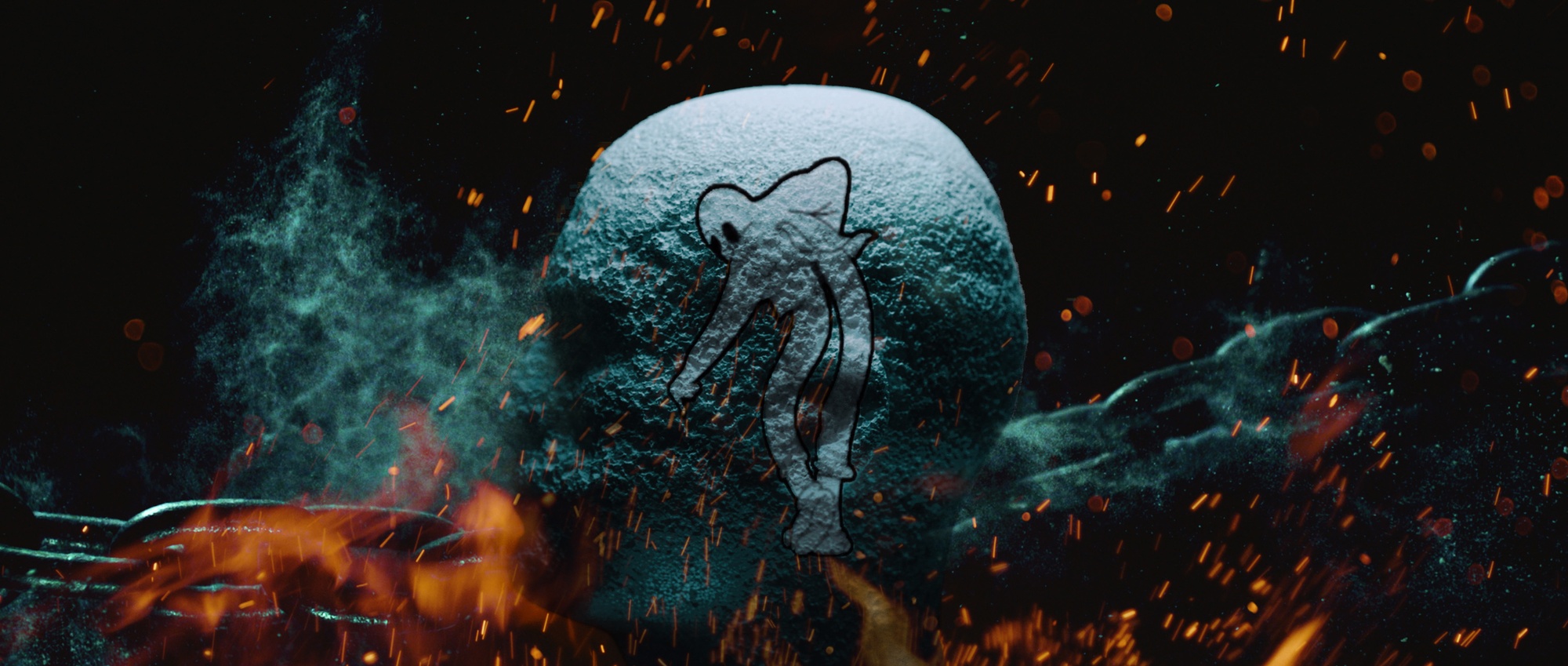
Sgt. 1st Class Tim Beery, Ghosts in the Machine, image 3 of 3 (2024), released by DVIDS as public domain.
The dancing ghost is an approved recruiting motif rather than the formal PSYOP crest. The method names itself through public imagery. Click to open the full frame.
Institutions choose their ancestors. PSYOP’s chosen Ghost Army ancestry declares a craft: manipulating appearances, coordinating channels, provoking interpretation, and acting through the world the target assembles.
The 4th Psychological Operations Group made this ancestry a public initiation through its Ghosts in the Machine films. Army accounts describe layered quotations, sounds, ambiguity, esoteric imagery, and emotional cues. Every scene and sound carried an objective. Repeated viewing revealed further connections. The viewer compelled to ask why identified himself as the desired recruit.
The film performs the faculty it seeks. It attracts pattern-recognizers, sorts them by response, and turns public argument into distribution. Viewers reveal susceptibility, curiosity, resistance, and aptitude through their responses to the ghost.
Official CENTCOM footage released in March 2026 carries the same ghost-and-lightning emblem aboard the USS Spruance during a weapons sequence. The ship’s formal Navy crest is different. The emblem carries the living Ghost Army lineage across services and into public images. It serves as an operational signature.
One Artifact, Many Audiences
One influence product can address several audiences through different operations. The mass audience receives spectacle. A target receives inducement, intimidation, reassurance, or proof of access. Recruits receive a puzzle exposing their abilities. Adversary intelligence receives a picture of capability. Operators receive reaction data.
Investigators receive dated statements, contracts, payments, and relationships. Future readers receive an artifact whose full meaning appears when later events supply its key. These audiences can encounter the same object without receiving the same message.
This structure lets public symbolism remain obvious and deniable together. A sign can serve professional morale, recruiting theater, adversary signaling, a public joke, and an initiatic breadcrumb. Each interpretation activates a different circuit. Their coexistence increases the artifact’s reach.
A sinister spectacle can bait, contain, warn, measure, rehearse disclosure, or preserve a record. A benevolent spectacle can conceal capture. Allegiance becomes visible through what the operation causes, records, extracts, and leaves as capacity after the show ends.
The Theater State supplies the stage; Narrative Control assigns available motives. Mass Ritual synchronizes the audience. The ghost moves through all three, admitting that the scene has an operator. No single operator needs to own the whole scene for its effects to converge.
The Audience Becomes the Army
Networked media lets a small initiating signal recruit millions into expanding its world. One group archives; another decodes; another creates images and slogans. Opponents amplify the signal while trying to destroy it. Journalists give it official existence through condemnation. Platforms measure response and rank the most adhesive fragments. Algorithms select among those fragments, producing authors the initiating planner never chose.
Q displayed this architecture at population scale. Sparse anonymous posts generated archives, maps, videos, timelines, proofs, rituals, communities, predictions, corrections, and identities. The source seeded ambiguity; the audience built the inhabited world. Platform owners controlled authentication, while influencers translated the material. Political actors, intelligence services, opportunists, and algorithms entered through different doors.
The distributed Ghost Army operates without one traveling chassis. Source, carrier, editor, platform, interpreter, adversary, beneficiary, and audience supply an ecology’s separate roles. The World That Reads Back begins when those layers answer one another. Their production acquires causal power beyond its first author.
The operation can change polarity while running. Dependency and commerce can capture a protective signal. A hostile signal can train participants into independent research. Origin supplies no guarantee of outcome. The participant’s retained capacity reveals the current’s direction.
The Future-Facing Ledger
The archive participates in the operation. A story, film, photograph, contract, joke, program name, or public appearance can await a reader who does not yet exist. The first audience receives entertainment or noise. A later event activates the dormant relation. The past appears to anticipate the future because the artifact waited for that future to complete it.
Recursive intelligence works through dated trails that researchers leave. Later knowledge reorganizes those trails; the recovered pattern changes present questions and decisions. A temporal dead drop is a record placed where a future reader will find it. The future that reader inhabits also reaches backward, drawing the earlier researcher toward the records needed to bring it into existence.
Future selves, later institutions, and successor civilizations read the record and return information through the patterns they make visible. We Are the Stories We Tell develops this reciprocal passage. Culture carries memory across generations. The operation writes to history and waits for history to answer.
Overpublication can conceal a signal more effectively than secrecy. Abundance, ridicule, genre, repetition, and poor indexing keep the signal available but unrecognized until its reader arrives. The archive preserves the means of repair while the consensus forgets who placed it there.
Extortion 17 shows this ledger activating around a military event. A 2011 ambush, a protected investigation, post-Abbottabad publicity, and family testimony entered public time in separate waves. A cryptic 2020 video and renewed Benghazi proceedings supplied later entries. Their convergence reorganizes the earlier record’s meaning.
Protective Theater
The same machine can manufacture consent, conceal predation, and hold a population inside permanent spectacle. It can also misdirect an enemy, expose intent, preserve evidence, recruit builders, prevent violence, and guide a civilization through transition. Its direction follows the operation’s consequences.
The protective current works inside the larger apparatus. It uses spectacle as bait, culture as ledger, ambiguity to sort responses, and myth to carry transition. Predatory actors enter a controlled social world. They reveal intentions, sign agreements, move money, and identify associates while different audiences believe they are watching different shows.
The Counter-Current Within the State describes agencies containing factions, traditions, rival custodians, and people loyal to different futures. A fourth-turning transition, the crisis phase of a historical cycle, intensifies that conflict. One current centralizes interpretation and turns awakening into dependence. The other releases records, distributes capacity, and prepares people for the old consensus’s loss of authority.
Protective theater completes initiation and dismisses the initiator. It returns memory, evidence, lawful capacity, correction, relationship, and sovereign action. Its audience becomes capable of leaving the theater.
The Unseen Order of Battle
The Ghost Army gives conscious reality production a military form. Physical substrate, sensory agreement, institutional authority, symbolic framing, and participant action join until a proposed world becomes operational. Each carrier supplies a different part of the world’s force.
The contemporary system extends through military and intelligence services, media firms, entertainment studios, platforms, political movements, artists, researchers, and audiences. Command, shared doctrine, inherited craft, or convergent incentives can coordinate their components. Archetypal recurrence and the field’s self-organization also assemble these relations. The visible contest joins realities seeking human participation.
A population’s believed world supplies the decisive terrain. The action that belief recruits supplies the maneuver. A coherent reality tunnel becomes victorious when it returns agency, preserves memory, attracts builders, and sustains itself inside the collapsing consensus.
The ghost is the intelligence that understands appearances as instruments. It constructs the scene, coordinates channels, watches entrants, and preserves what they reveal. Their actions show it which world becomes real. Once the audience recognizes this machinery, its deliberate participation enters the order of battle.
References
Beery, Tim. “Ghosts in the Machine: Irregular Recruitment for an Irregular Force.” U.S. Army, May 6, 2024. https://www.army.mil/article/276015/ghosts_in_the_machine_irregular_recruitment_for_an_irregular_force
Ghost Army Legacy Project. “About the Ghost Army.” https://ghostarmy.org/about/
Ghost Army Legacy Project. “Operation Bettembourg.” https://ghostarmy.org/about/operation-bettembourg/
Ghost Army Legacy Project. “Ralph McAllister Ingersoll.” https://ghostarmy.org/roster/ralph-mcallister-ingersoll/
National World War II Museum. “General George S. Patton and Operation Fortitude.” https://www.nationalww2museum.org/war/articles/general-george-s-patton-world-war-ii
National World War II Museum. “Ghost Army: The Combat Con Artists of World War II.” https://www.nationalww2museum.org/war/articles/ghost-army
U.S. Army John F. Kennedy Special Warfare Center and School. Psychological Operations Preparation Handbook. 2025.
U.S. Central Command. “U.S. Forces Remain Centered on Very Clear Military Objectives.” March 11, 2026. https://x.com/CENTCOM/status/2031837461219795130
U.S. Central Command Public Affairs. “USS Spruance (DDG 111) Fires a Tomahawk Land Attack Missile.” March 2, 2026. https://www.centcom.mil/OPERATIONS-AND-EXERCISES/EPIC-FURY/videoid/997811/dvpmoduleid/41413/
U.S. Department of Veterans Affairs. “Ghost Army: Ralph Ingersoll.” January 17, 2019. https://news.va.gov/55083/ghost-army-ralph-ingersoll/