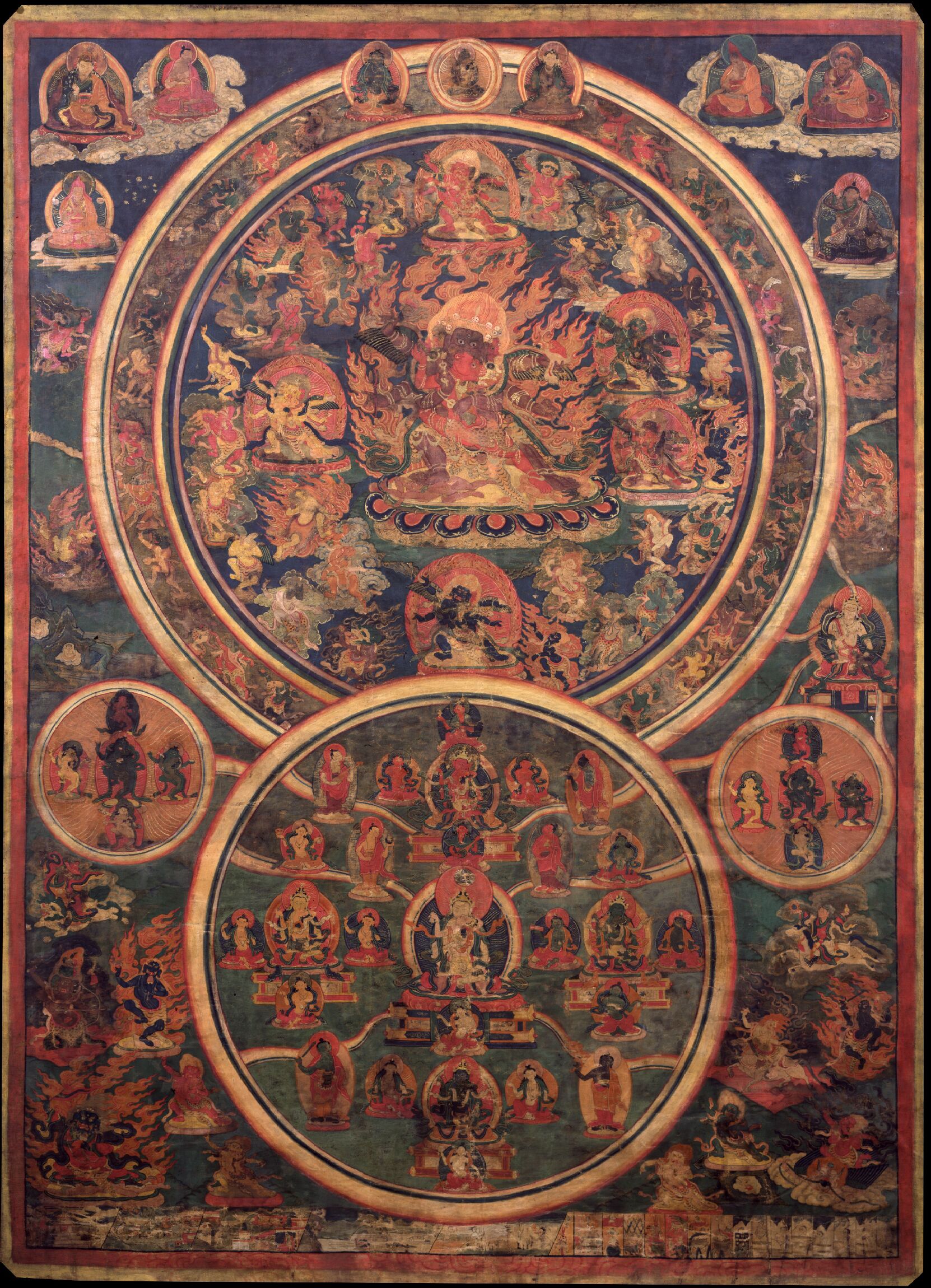
The Liberation Through Hearing
In eighth-century Tibet, the master Padmasambhava composed a text designed to be recited aloud to the dying and recently deceased. Known in the West as the Tibetan Book of the Dead — formally titled the Bardo Thodol — the actual translation of the title reads “Liberation Through Hearing in the Between-State.”
This is not a text about death in the conventional sense. Rather, it functions as a practical manual for consciousness navigation, describing the territories that consciousness traverses when the physical body falls away. The Tibetan Buddhist tradition understood what modern near-death experience research is only now confirming: consciousness continues through transitional states when the heart ceases beating and brainwaves stop. Rather, it enters a sequence of transitional states — the bardos — each offering distinct opportunities for liberation or for further entanglement in the cycle of birth and death.
The text is recited aloud to the dying and deceased because consciousness persists and remains remarkably receptive to guidance in these liminal states. A word spoken at precisely the right moment can illuminate the path toward freedom or awakening.
The Six Bardos: The Complete Map
Tibetan Buddhism identifies six bardo states, which together form a comprehensive map of consciousness. Three occur during life; three follow death. Together they encompass the complete cycle of consciousness from ordinary waking awareness through ultimate dissolution and beyond.
Bardo of This Life (Kyenay Bardo)
This is the bardo in which most readers find themselves at this very moment. Ordinary waking consciousness — the state we conventionally term “normal life” — is itself a bardo, a transitional state between birth and physical death. We do not ordinarily recognize it as such because we remain immersed within it.
This constitutes the most valuable of all bardos for spiritual practice because it offers stability, extended time, and the capacity for sustained effort over years. The recognition that even daily life constitutes a bardo — impermanent, dreamlike, a between-state — conveys itself as a liberating insight.
Bardo of Dreams (Milam Bardo)
Each night, consciousness enters another transitional state. Dreams constitute genuine experiences in non-physical realms rather than being merely noise produced by the sleeping brain. Tibetan Buddhism developed the practice of dream yoga — learning to recognize that one is dreaming while dreaming — as direct training for maintaining awareness in the after-death bardos.
If a practitioner can maintain continuous awareness during dreams, that same skill transfers to maintaining awareness during death. The capacities are identical: recognizing the constructed nature of experience and remaining lucid within it.
Bardo of Meditation (Samten Bardo)
Deep meditative absorption constitutes its own bardo state. In profound concentration, ordinary perception dissolves and consciousness accesses territories normally hidden from awareness. The meditator experiences directly what will be encountered after death: the luminosity of mind itself, the dissolution of the sense of separate self, the arising of visionary forms.
Advanced practitioners deliberately use meditation to rehearse the death process, gaining familiarity with states that would otherwise be overwhelming and profoundly disorienting.
Bardo of Dying (Chikhai Bardo)
The moment of death itself constitutes a distinct bardo. As the body’s elements progressively dissolve — earth into water, water into fire, fire into air, air into consciousness — a specific sequence of inner experiences unfolds. Vision gradually dims, sounds fade, the body grows cold and heavy, then dissolves entirely from awareness.
At the completion of this dissolution process, something extraordinary occurs: the Clear Light of the Ground dawns. This is the primordial luminosity of pure awareness itself — the fundamental nature of mind unobscured by conceptual thought or sensory experience. It is what one has always been, momentarily unveiled.
This represents the first and most significant opportunity for liberation. If the dying person recognizes this light as the nature of their own awareness — not as something external but as the very essence of consciousness itself — liberation is instantaneous and complete.
Bardo of Dharmata (Chonyid Bardo)
If the Clear Light passes unrecognized, consciousness moves into the bardo of dharmata — the bardo of reality itself. Here, the fundamental energies of mind manifest as visionary forms: initially the peaceful deities, then the wrathful ones.
For seven days (in Tibetan reckoning), brilliant peaceful buddhas appear, radiating overwhelming light in the five wisdom colors. These are not external beings but rather projections of one’s own enlightened nature — the wisdom aspects of consciousness itself taking visionary form.
Then arise the wrathful deities — terrifying manifestations with flaming hair, holding skulls, wearing necklaces of severed heads. These also are not external. They are the same enlightened energies in their protective and transformative aspect.
The crucial teaching remains: do not flee in terror. These visions — peaceful or wrathful — are the display of your own mind. Recognizing them as such brings liberation. Fleeing from them in fear drives consciousness toward rebirth.
Bardo of Becoming (Sidpa Bardo)
If liberation has not occurred in the previous bardos, consciousness enters the bardo of becoming — the journey toward a new birth. The mental body becomes fully formed, and the being experiences a dream-like existence, driven by karmic winds toward its next incarnation.
In this bardo, the subtle body possesses remarkable capacities. It can travel anywhere instantaneously by thought alone. It can pass through walls. It can perceive at great distances. The being experiences its own past karma as environmental phenomena — storms, fires, chasms, and hostile beings representing unresolved mental states.
The bardo of becoming lasts (symbolically) up to 49 days. During this time, beings are drawn inexorably toward the light of a womb — toward the light whose color and quality matches their karmic affinity. The brightness and character of the light indicate the realm of rebirth: bright lights lead toward higher rebirths, dim and seductive lights toward lower ones.
The Clear Light: The Supreme Opportunity
The Clear Light (Osel) arising at the moment of death represents the supreme opportunity for liberation. Tibetan masters spend their entire lives specifically preparing for this single moment of recognition.
The Clear Light constitutes what one has always been rather than being something new appearing at death — the fundamental luminosity of awareness itself, ordinarily obscured by the constant flow of thoughts, perceptions, and conceptual elaborations. At death, this conceptual activity temporarily ceases entirely, and the ground luminosity reveals itself.
This is the same light encountered in deep meditation, the same nature of mind that advanced practitioners glimpse during life. Death simply removes all the veils simultaneously. For the unprepared, the Clear Light passes unrecognized — like lightning flashing in darkness, striking but not comprehended. For the prepared, it becomes the doorway home.
All Deities as Mind
Perhaps the most profound teaching of the Bardo Thodol holds that every deity encountered — peaceful or wrathful, beautiful or terrifying — constitutes a projection of the perceiver’s own consciousness.
The hundred peaceful and wrathful deities are not external beings waiting to judge or test. They represent the spontaneous display of mind’s wisdom energies, taking form as the conceptual overlays that filtered them during life fall away. When the brilliant blue light of Vairochana Buddha dawns, that is the wisdom of all-encompassing space — one’s own awareness in its aspect of infinite openness. When Mahakala appears with fangs and flames, that is the protective wisdom of transformation — one’s own capacity to transmute poison into medicine.
Recognition of any deity as self-projection brings liberation. The deity dissolves into light, and consciousness dissolves with it into the Dharmakaya — the dimension of ultimate reality beyond all form.
Phowa: Consciousness Transference at Death
Tibetan Buddhism developed a specific practice for the moment of death: phowa, the transference of consciousness. Through visualization, mantra, and breath work, practitioners learn to eject consciousness through the crown of the head at the moment of death, directing it deliberately toward a pure realm or enlightened state.
Advanced practitioners perform phowa for themselves at death. Some achieve the signs of accomplishment — a small opening at the crown of the head where consciousness will exit, sometimes accompanied by drops of blood or fluid.
Phowa can also be performed for others. Qualified lamas conduct phowa ceremonies for the recently deceased, visualizing the consciousness of the dead person being transferred to a buddha-field. The practice operates as direct intervention on the trajectory of the deceased’s consciousness, beyond merely symbolic effect.
Preparation Through Life
The Bardo Thodol makes explicit that the time to prepare for death is now, during life. The bardos reveal what is already true about consciousness — that it is luminous, unobstructed, and capable of liberation. But this revelation means nothing without prior training and familiarity.
Meditation familiarizes the practitioner with the nature of mind before death forces the encounter. Those who have glimpsed the Clear Light through meditation will recognize it at death. Those who have never looked will not understand what they are experiencing.
Dream yoga trains the capacity to remain lucid within illusory experience. If one cannot maintain awareness in a dream, one will not maintain it in the bardo.
Study of the text itself plants seeds of recognition. Even hearing the words creates a connection that can activate in the after-death state. This is why the text is recited aloud to the dying — familiarity aids recognition in the critical moments.
Ethical conduct shapes the karmic winds that will drive the bardo being toward rebirth. A life of compassion creates momentum toward fortunate rebirths; a life of harm creates momentum toward suffering.
Parallels Across Traditions
The Bardo Thodol is not the only ancient map of the after-death journey. The Egyptian Book of the Dead (Pert Em Hru — “Coming Forth by Day”) similarly provides guidance for navigating the underworld, with spells to assist the deceased in passing through gates guarded by threatening beings.
Both traditions understood that death is not instantaneous dissolution but a process requiring navigation and preparation. Both provided texts meant to be heard by the deceased. Both described encounters with beings who test the dead — though Egyptian tradition emphasized judgment while Tibetan tradition emphasizes recognition.
The Western mystery traditions also preserved such knowledge. The Greek Orphic tablets gave instructions for the soul’s journey through Hades. Medieval ars moriendi texts taught the art of dying. This knowledge is perennial — only the cultural expression and terminology change.
Modern Confirmation Through Near-Death Experience Research
Near-death experience research has documented phenomena that correspond with bardo descriptions with remarkable precision.
The life review mirrors the panoramic memory that arises in the bardo of dying. Experiencers report reliving their entire life, feeling the effects of their actions on others — exactly matching the karmic review Tibetan tradition describes.
The tunnel and light correspond directly to the Clear Light experience. NDE experiencers describe overwhelming luminosity that appears to be the essence of reality itself — conscious, welcoming, infinitely accepting.
Encounters with beings match the bardo of dharmata. Though Western experiencers interpret them through their own cultural lens — angels, Jesus, deceased relatives — the structure remains consistent: encounters with beings who appear external but actually represent aspects of one’s own consciousness or projections shaped by expectation.
The reluctant return parallels the bardo of becoming. Many NDE experiencers describe being drawn back to physical life against their preference, just as bardo beings are drawn toward rebirth.
Robert Monroe‘s Focus Levels provide a modern Western map that parallels the bardos in structure. His Focus 27 — “The Park,” a reception center for the recently dead — corresponds to the peaceful environments of the early bardo of dharmata. His descriptions of thought-responsive reality match the Tibetan teaching that the bardo environment is shaped by the mind of the perceiver.
The Essential Teaching
The Bardo Thodol’s core message is direct and practical: recognition liberates. At every stage of the after-death journey, liberation is available through a single fundamental act — recognizing that whatever appears is the display of one’s own mind.
The peaceful deities? One’s own wisdom. The wrathful deities? One’s own wisdom in protective form. The terrifying appearances of the bardo of becoming? One’s own unresolved karma taking form. The light that draws one toward rebirth? One’s own habits of attraction and aversion.
At any point, recognition brings freedom. The vision dissolves because there is no longer an observer separate from what is observed. Subject and object collapse into the primordial ground from which both arose.
This is liberation — recognizing what one has always been. Remembering what was never lost.
References
- van Lommel, P., van Wees, R., Meyers, V., & Elfferich, I. (2001). “Near-death experience in survivors of cardiac arrest: a prospective study in the Netherlands.” The Lancet, 358(9298), 2039-2045.
- Becker, C.B. (1981). “The centrality of near-death experiences in Tibetan Buddhism.” The Journal of Religion and Health, 20(3), 231-242.
- Katz, N.W. (1987). “Buddhist and Western Approaches to Suffering.” In S. Grof & C. Grof (Eds.), The Spiritual Emergency: When Personal Transformation Becomes a Crisis, 163-185.
- Holecek, A. (2016). “Preparing to Die: Practical Advice and Spiritual Wisdom from the Tibetan Buddhist Tradition.” Snow Lion Publications.
- Moody, R. (1975). “Life After Life: The Investigation of a Phenomenon — Survival of Bodily Death.” Bantam Books.