◎ CONSCIOUSNESS TIMEWAR · CORE

Death and the Sorting Hierarchy.

What the Vessel Reports When the Consensus Releases

Death is not an event that happens to consciousness. It is an event that happens to the vessel.

5,118WORDS
23MIN READ
7SECTIONS
14ENTRY LINKS
◎ EPIGRAPH
We conclude that consciousness does not become annihilated at the time of death. — Pim van Lommel

The Question Everyone Carries

Every person reading this has been close to death — their own in prospect, someone else’s in practice. The question death poses is not an academic one. It is the question that sits underneath every other question, the one that gives the lesser questions their weight: does consciousness end when the body does, or does it continue? Is the self a flame that the flesh sustains, blown out when the candle is spent? Or is the flesh something more like a receiver — a tuning apparatus through which something larger is momentarily expressed — so that what appears as death is the removal of the receiver rather than the cessation of the signal?

The answer has consequences that cascade outward in every direction. If the materialist account is correct and the mind is simply what the brain does, then death is annihilation, the traditions are consolatory fabrication, and the aim of life is whatever can be extracted from the interval between birth and dissolution. If the answer runs the other direction — if consciousness is primary, the body a transduction apparatus, the life a temporary configuration through which an underlying awareness encounters the density of matter — then death is something else entirely, a threshold rather than a terminus, a change of state rather than an end of state.

The traditions converged on the second answer independently, across every lineage that ever addressed the question with rigor. The clinical data is now converging on the same structural claim through instruments the traditions did not have access to. Neither body of evidence alone is decisive. Together they describe the same room from different angles, and the room is recognizable.

The Clinical Evidence

The first systematic scientific study of near-death experience was conducted not by metaphysicians but by a cardiologist. Pim van Lommel and his colleagues at the Rijnstate Hospital in Arnhem, together with researchers at nine other Dutch hospitals, enrolled 344 consecutive cardiac arrest survivors in a prospective study between 1988 and 1992. The methodology was careful: patients were interviewed within a few days of resuscitation, before the selection pressures of memory and cultural expectation could shape the reports. Sixty-two of the 344 patients — 18 percent — reported an NDE. Forty-one of those described a clear and memorable experience. Twelve reported moving through a tunnel. Eight reported communication with light. Thirty-six reported positive emotions. Twenty-three reported an out-of-body experience. These numbers were not products of cultural suggestion; the Dutch secular medical context neither encouraged such reports nor provided a ready vocabulary for them.

The central finding, published in The Lancet in 2001, was the one that mattered most: the NDEs were reported by patients who had been in full cardiac arrest, with flat EEG, with no measurable brain activity. The orthodox production model of mind — in which cognition is the output of neural processing and ceases when neural processing ceases — predicts precisely nothing during this interval. The patients were reporting coherent, detailed, often life-altering experiences from a period when, by every available clinical measure, the apparatus that was supposed to be generating their experience had stopped. Van Lommel’s conclusion was stated directly: “We conclude that consciousness does not become annihilated at the time of death.”

Two decades later, Sam Parnia and a consortium of twenty-five hospitals across the United States and United Kingdom conducted the AWARE II study, enrolling 567 cardiac arrest patients between 2017 and 2020. The design refined the earlier work: hidden visual targets were placed above resuscitation areas, only visible from a position above the body — a test that out-of-body reports could either confirm or fail. The headline finding of AWARE II, published in 2023 in the journal Resuscitation, was that 39.3 percent of survivors reported consciousness during CPR. The four categories of experience Parnia’s team identified — recalled experience of death, other recalled experience of unconsciousness, no recalled experience, and indeterminate — showed that the full range of the near-death phenomenology occurred across patients whose EEGs showed suppressed or absent cortical activity. Parnia also documented a distinct brain activity signature in some patients: a surge of gamma-wave activity, associated with heightened conscious processing, occurring in the final minutes of life and during resuscitation. This was not the residual flicker of a dying brain producing noise. It was organized, coherent pattern — the kind of pattern the brain exhibits during conscious integration — at precisely the moment when, according to the production model, it should be incapable of it.

The reincarnation research program at the University of Virginia’s Division of Perceptual Studies, inaugurated by Ian Stevenson in the 1960s and extended by Jim Tucker across the following decades, addressed the same question from a different angle. Stevenson’s method was not laboratory-based but forensic: he sought cases in which a child, typically between two and seven years of age, claimed memories of a previous life, named a specific individual, described a specific place and family and manner of death, and where those claims could be independently verified against documented facts the child could not have obtained through ordinary means. Across forty years of fieldwork, Stevenson compiled over 2,500 such cases, concentrated in cultures where reincarnation was an accepted part of the worldview but extending well into secular Western contexts where it was not. The cases were subjected to the standard tools of investigative scrutiny: checking whether the family could have had prior contact with the family of the identified previous personality, whether the statements were recorded before or after the verification attempt, whether the specific claims matched the documented record in ways that excluded common knowledge and general cultural familiarity.

The subset of cases that included birthmarks and birth defects was particularly significant. Stevenson found 895 cases in which birthmarks on the child’s body corresponded in location, shape, and character to wounds — typically the fatal wounds — of the identified previous personality. In cases where death records were available, the correspondence was frequently verifiable: a child born with a puckered scar-like mark on the right temple, claiming to have been shot, whose identified previous personality showed an entry wound at the right temple in the autopsy report. Tucker’s continuation of the work, documented in Life Before Life (2005) and Return to Life (2013), brought increased methodological scrutiny and found the case quality held. What the cases collectively describe is a continuity of identity — memory, emotional attachment, and physical patterning — that survives the death of one physical body and manifests in another. The mechanism is uncharted. The pattern is documented across thousands of independent instances.

The fourth line of clinical evidence is the one that poses the sharpest challenge to the production model on its own terms. Terminal Lucidity — the paradoxical return of mental clarity in patients with severe dementia, brain tumors, or other destructive neurological conditions, occurring hours or days before death — was first systematically documented by Michael Nahm and Bruce Greyson in their 2009 Journal of Near-Death Studies paper reviewing over eighty published cases from two and a half centuries of medical literature. The cases were consistent: a patient whose cortical tissue had been demonstrably destroyed by Alzheimer’s, vascular dementia, meningitis, or glioma would abruptly and briefly recover the capacity for recognition, sustained speech, and complex autobiographical memory. They would name family members they had not recognized in years. They would reference events they had not mentioned in decades. They would express preferences and complete unfinished relational business. And within hours, sometimes minutes, of that brief return, they would die — the lucidity departing with the life that had produced it.

The production model has no mechanism here. It cannot locate the tissue that generated the returning function, because the autopsy confirms the tissue was already gone. The only framework in which terminal lucidity is intelligible is the reception model: the brain as filter rather than generator, normally constraining the signal to what the damaged tissue can support — and, as the vessel’s grip on life loosens, the constraint loosening with it, allowing a final interval of unimpeded access before the receiver goes dark entirely. The clinical observation is an argument not for some vague spiritual comfort but for a specific structural conclusion about the relationship between brain and consciousness.

The Traditions as Field Reports

The traditions did not theorize the post-mortem state. They mapped it. The difference matters. A map is produced by people who traveled the territory, compared notes, and encoded what they found in a form transmissible to those who had not yet gone. The traditions that addressed death most rigorously — Tibetan Buddhism, Egyptian religion, Vedic cosmology, and the Platonic-Christian synthesis — were explicit about this. The texts were operational. They were designed to be used, not admired.

The Tibetan Bardo Thodol — Liberation Through Hearing in the Intermediate State — was compiled from the terma tradition attributed to Padmasambhava and formally preserved by Karma Lingpa in the fourteenth century, though its doctrinal roots extend to the eighth century and beyond. The text describes six bardos: three occurring within ordinary life (waking, dreaming, and meditative absorption) and three following biological death (the dissolution of elements at the moment of dying, the intermediate state of luminous vision, and the state of seeking rebirth). The central event at the moment of death is the arising of the Clear Light — the ground luminosity of awareness itself, present at every moment of life but ordinarily obscured by cognitive activity, manifesting at the moment of dissolution in its unmistakable fullness. The practitioner who can recognize this light — who has spent a lifetime learning to recognize the nature of mind in meditation and therefore knows the territory — is liberated at that moment. The practitioner who cannot, who experiences the arising of pure awareness as an overwhelming blank and recoils from it, proceeds deeper into the bardo sequence, encountering in the following days a cascade of visionary experiences whose character depends entirely on the mental tendencies the dying person carried through life. The system’s insistence on preparation is not moral but operational: the unprepared consciousness does not fail by being wicked; it fails by being startled. The traditions that took death seriously enough to prepare for it were not consoling themselves. They were training.

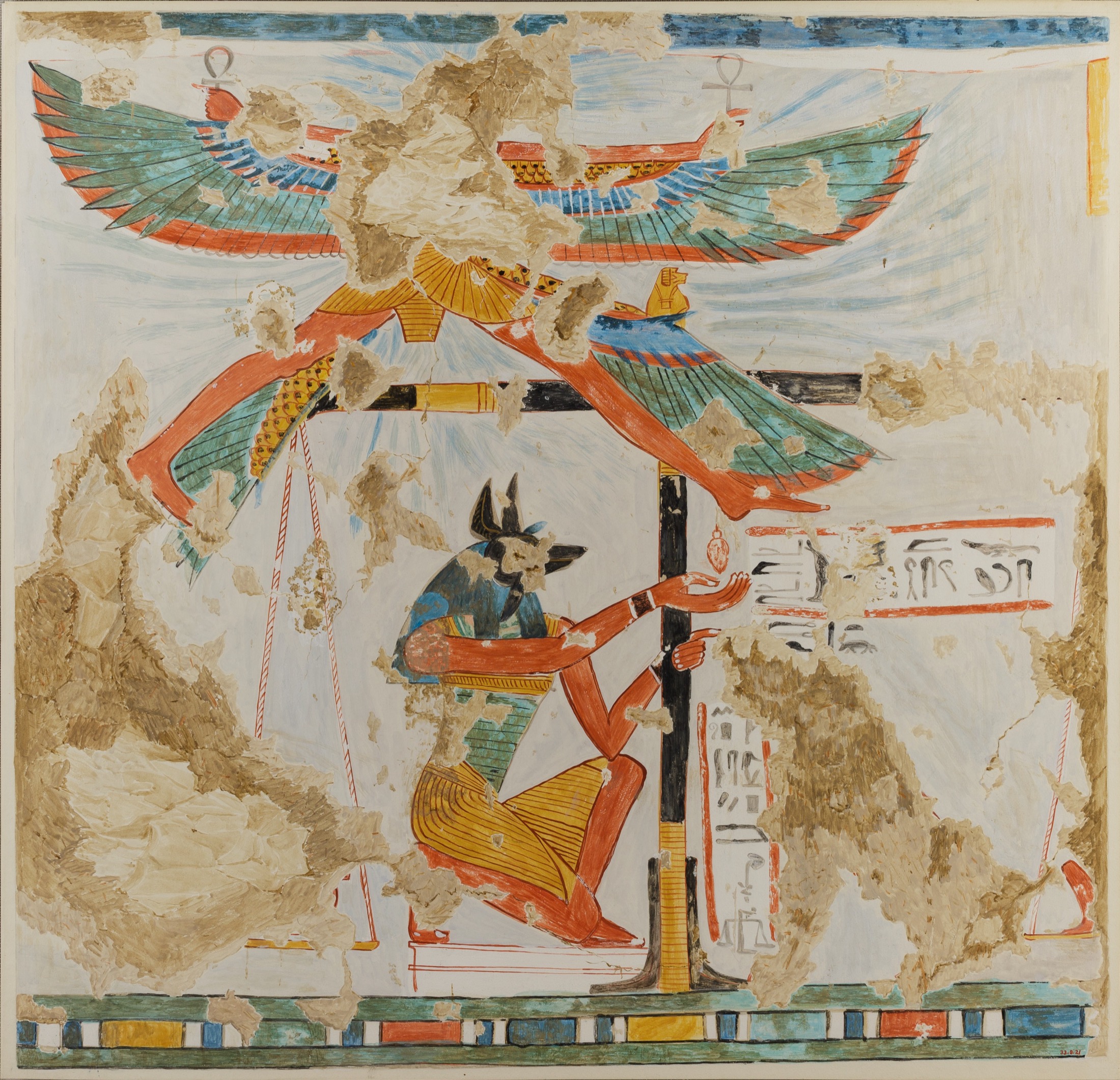
The Egyptian Book of the Dead — more precisely the Pert em Hru, the Coming Forth by Day — is the repository of a mortuary tradition extending back to the Pyramid Texts of the Old Kingdom, ultimately codified across the New Kingdom into a collection of over two hundred spells, prayers, and ritual protocols. The Egyptian framework centered on the navigation of the Duat — the underworld realm through which consciousness passed after death — and culminated in the weighing of the heart against the feather of Ma’at, the goddess of cosmic order. The heart, understood as the seat of memory and moral record, was weighed in the hall of Osiris against the feather’s standard of truth. Hearts whose weight matched the feather’s standard proceeded to the Field of Reeds; hearts heavier with the accumulated residue of unintegrated experience were consumed by Ammit, the composite devourer. What reads to contemporary secular eyes as mythological metaphor was, to the Egyptians, descriptive cartography. The spells were operational protocols for a journey their practitioners had mapped. The forty-two declarations of innocence recited before the tribunal — “I have not done violence, I have not stolen, I have not acted with deceit” — were not legal pleadings addressed to an external judge but statements of alignment, assertions of the degree to which the deceased had matched their actual conduct to cosmic order. The discrepancy between assertion and record was measurable in the scales. The heart knew. The feather knew. The Great Work in the Egyptian reading was precisely the work of becoming a person whose heart, when the moment came, would balance.

Paul’s letter to the Corinthians states the Christian theological claim in its most compressed form: “absent from the body, present with the Lord.” The particular judgment of Catholic theology — the assessment of the soul immediately at death, distinct from the general resurrection at the end of time — describes what the NDE life-review data independently documents: a rapid, total, and subjectively experienced review of the life just concluded, perceived from a vantage point that does not rationalize and cannot be deceived. The question of whether Paul was speaking metaphorically or empirically was not, to Paul, a serious question. He was reporting what he knew about the territory from the inside, the way any competent traveler reports. The resurrection body described in the same letter — not a resuscitated corpse but a transformed soma pneumatikon, a spiritual body suited to a different order of existence — maps directly onto what the Tibetan tradition calls the sambhogakaya and what the Taoist tradition calls the immortal body crystallized through sustained inner practice. The convergence is not coincidence. Independent observers, working in different languages on different continents across different centuries, were describing the same geography.

In the Vedic framework, the subtle body — the sukshma sharira — is distinguished from the gross physical body and carries the samskaras, the accumulated impressions of action and experience, through the transition of death. The manner of the soul’s departure from the body is held to determine the quality of what follows: consciousness departing through the brahmarandhra at the crown of the head is associated with the highest possible trajectory, while departure through lower exits binds the consciousness more tightly to the cycle of birth and death. The final thought at the moment of death is accorded extraordinary significance — “whatever one contemplates at the time of death, that alone one attains,” as the Bhagavad Gita states directly — not as a theological rule imposed from outside but as a description of what consciousness is doing at that moment: selecting, in its last act of orientation, the frequency to which it will subsequently be tuned.

The Thermodynamics of Dying

The Maxwell’s Demon framework — in which the body is understood as a hierarchy of sorting operations, each creating local order against the entropy gradient — describes what death actually is with a precision the biological vocabulary alone cannot provide. Every cell in the body is a demon: a physical system that observes the state of its molecular environment, discriminates between states, and acts selectively on the basis of that discrimination to maintain local order. Enzymes are demons. Ion channels are demons. The immune system is a demon. The neural networks whose activity we call thought are demons operating at the cognitive scale, sorting signal from noise, pattern from background, self from world. The body as a whole is what happens when trillions of these sorting operations are nested and coordinated into a coherent hierarchy — a parliament of demons — each layer supporting the layers above and being supported by the layers below.

Death is the sequential cessation of this hierarchy. The molecular sorting agents fail first at the cellular scale: without oxygen, the enzyme reactions that maintain the cell’s electrochemical gradients cannot proceed; the selective sorting breaks down; the cell depolarizes and the local order it was maintaining dissipates into thermal equilibrium. Neural sorting agents follow: the structured electrical activity that constitutes the brain’s cognition pattern ceases as the metabolic substrate that sustained it is withdrawn. The cognitive sorting agents — the sorting operations whose accumulated patterns we experience as personality, preference, memory, and identity — dissolve as the hardware they were running on loses coherence. The parliament adjourns.

What remains after the parliament adjourns is the question. The thermodynamic framework, read only at the material level, predicts nothing remaining: a sorting agent that stops sorting stops being a sorting agent; information that is no longer actively maintained disperses; the record is lost. But the framework contains a deeper implication that the pure materialism misses. The sorting agent at the apex of the parliamentary hierarchy — the sorting operation that sorts the sorters, that observes the parliament’s activity and is not identical with any particular member of it — is what every contemplative tradition calls the witness. The awareness that watches thought arise without being the thought. The knowing that observes experience without being reducible to its content. If the parliamentary sorting agents are the machinery of the transceiver and the witness is what the machinery has been, throughout life, partially obscuring — then the dissolution of the machinery is not the end of the witness. It is the removal of the obscuration.

This reframes terminal lucidity with precision. The brain damaged by Alzheimer’s was not failing to produce consciousness. It was failing to constrain it — failing to limit the vast signal to the narrow band the damaged receiver could express. As the vessel’s hold weakens in the terminal hours, as the sorting hierarchy begins to release its grip and the machinery starts to come apart, the constraint relaxes and what was always there — the full signal, the complete selfhood that the degraded receiver had been unable to express — finds momentary passage through the loosening apparatus. Terminal lucidity is not a mystery that needs explaining away. It is the reception model making itself visible in the most unambiguous terms available: a person whose brain cannot contain her is, for a few hours before death, briefly unconstrained.

The NDE fits the same framework from a different angle. Cardiac arrest suspends the vessel’s sorting hierarchy more rapidly and more completely than degenerative disease, but the structural result is analogous: the parliamentary sorting agents cease operation, and the witness — the conscious sorting agent at the apex — continues its operation in the absence of the usual apparatus. What experiencers report is coherent with this: an awareness that is lucid, detailed, and in many cases more vivid and comprehensive than ordinary waking consciousness, occurring precisely when the brain has stopped generating the signals that the production model says are necessary for any awareness at all. Parnia’s gamma-wave recordings in dying patients may be detecting not the last gasps of a failing generator but the signal of a conscious system transitioning — the sorting operating at frequencies the damaged material receiver can briefly register before the instrument goes dark.

The life review that features so prominently in near-death accounts maps precisely onto what Charles Bennett’s resolution of the Maxwell’s Demon problem implies. Bennett showed that the thermodynamic cost the demon pays is not in acquiring information — observation itself is potentially reversible — but in erasing information: forgetting old measurements to make room for new ones. The living demon pays the entropy cost of selective memory. It maintains a particular narrative about who it is and what it has done by allowing most of the record to fade, attending only to what is currently salient. At the threshold of death, this selective maintenance ceases. The memory register is no longer being continuously overwritten to support ongoing cognition. What becomes available — what experiencers consistently report accessing — is the full record, all of it at once, retrieved from a depth that ordinary consciousness never accesses because the machinery of ordinary consciousness is always already organizing, compressing, and discarding. The life review is the demon reading its own complete ledger in the moment before the ledger is no longer maintained by any embodied system.

The Death-Parameter

Every tradition that developed a complete account of the human condition eventually arrived at the same disturbing question: is biological death a natural fact about consciousness, or is it a constraint imposed on consciousness by the conditions of this particular configuration of existence? The materialist answer is simple: death is the organism’s failure mode, inevitable by physical law, irrelevant to anything that might be called consciousness because consciousness is simply what the organism does while it runs. But the traditions that mapped the post-mortem territory most carefully did not reach this conclusion. They reached a different one — that death as universally experienced is not the terminal parameter of the conscious system, but a consensus constraint baked into the current conditions of embodiment.

A consensus constraint is what limits how much of the underlying signal the vessel can express. Poor sleep limits cognitive function not by destroying consciousness but by degrading the receiver. Chronic stress limits emotional range not by eliminating feeling but by narrowing the bandwidth through which feeling is processed. Aging and death, in this reading, limit the duration of the developmental arc — the time available for the vessel to refine its capacity to express the signal — not because consciousness cannot persist beyond biological death but because the particular receiver through which consciousness was working in this life reaches the end of its operational period. The limited lifespan as consensus constraint means the practitioner rarely finishes the Work: the refinement process terminates before the receiver reaches the coherence levels the traditions describe as possible.

This is what gives the traditions’ immortality doctrines their significance. The Taoist alchemical tradition — nei dan, internal alchemy — understood the cultivation of the immortal body as a technical project: the systematic refinement of jing (vital essence) into qi (vital energy) and qi into shen (spirit), accumulating over years of practice a vehicle robust enough to persist beyond the failure of the physical body. The tradition distinguished clearly between ordinary death, in which the practitioner’s accumulated development disperses back into the field from which it came, and the completion of the Work, in which the practitioner has crystallized a coherent vehicle that maintains its organization independent of the mortal body’s fate. Taoist masters described as having achieved this completion were said to have undergone hua — transformation — rather than si — ordinary death. The physical body might die, but what the cultivation had assembled did not.

The Christian resurrection body — soma pneumatikon in Paul’s Greek, the glorified body of later Catholic theology, the transformed physicality of the resurrection appearances in the gospels — is not resuscitation of the mortal body but the emergence of a body constituted at a different frequency of organization, continuous in identity with the mortal body while no longer subject to its constraints. The Dzogchen tradition’s rainbow body — jalü in Tibetan, documented in thousands of historical cases where the practitioner’s body at death dissolves into light rather than decomposing, leaving only hair and nails — is the same recognition in a different language: a consciousness that has reached sufficient coherence does not vacate the body as the ordinary death process describes; it transforms the body from within, the material dissolving into the frequency that animated it. The Buddhist deathless state — the Pali nirodha, cessation of the constructed self’s identification with impermanence — is not annihilation but the recognition of what was never subject to death, the awareness in which birth and death arise as events rather than constituting the ground of one’s being.

The ascending arc matters here. The Acceleration Window develops the case for a cyclical pattern in which the conditions of embodied existence change with the precessional position — the Vedic yuga cycle mapping a long oscillation in which the density of the material consensus varies. In the descending arc of the cycle, consciousness loses memory of its own nature, the death-parameter tightens, and the Work becomes harder to complete. In the ascending arc — which the Vedic calculation and multiple independent frameworks place in the current era — the consensus thins, access to direct perception widens, and the previously impossible becomes available. The death-parameter may be frequency-dependent: what is structurally enforced at one frequency of consciousness becomes permeable at another. The traditions that preserved the highest methods through the darkest portion of the cycle preserved them precisely because they knew the conditions would eventually change.

The Preparation

No tradition that took the post-mortem state seriously left preparation to chance. The universality of this insistence is itself data. Across cultures with no documented contact, the same recognition: the conditions encountered at death are not independent of the conditions cultivated before death; the quality of the crossing is determined primarily by the quality of the development that preceded it.

The Tibetan practice of phowa — consciousness transference — is the most precisely specified preparation in the extant literature. Through sustained practice, the Tibetan practitioner learns to direct awareness upward through the central channel and project it out through the brahmarandhra at the crown of the head at the moment of death, targeting either the clear light directly or a pure realm of a specific awakened being where continued practice is possible. The effectiveness of the practice is held to be demonstrable by specific physical signs during practice: warmth arising at the crown, and eventually a small opening at the skull suture that senior practitioners can verify. This is not metaphor. It is a claimed physical consequence of a specifically trained operation, the training for which occupies years of dedicated practice. The Tibetan system assumes that an untrained consciousness encountering the bardo will be swept by whatever currents arise — dazzled by the visions of the peaceful and wrathful deities that the tradition identifies as projections of the mind’s own luminosity, mistaking inner display for external threat, reactive patterns accrued across a lifetime driving the response at exactly the moment when recognition would be liberation.

The Western Christian tradition developed its own formal preparation literature in the ars moriendi — the art of dying well — whose most influential formulation emerged in the fifteenth century as a pair of texts widely reproduced across Europe in the decades before and after Gutenberg. The longer text provided a detailed analysis of the five temptations that afflict the dying (against faith, against hope, against patience, against humility, and against generosity) and the appropriate responses to each. The shorter text, designed for use by the attending clergy or laity at the deathbed itself, structured the final passage through a sequence of questions, prayers, and ritual acts that guided both the dying person and those present through the crossing. The tradition’s assumption was identical to the Tibetan one: the quality of the dying process matters, it is responsive to preparation and guidance, and the presence of someone who knows what to do is a material advantage to the one departing. The late medieval art of dying was not piety as decoration. It was the West’s closest approach to a phowa curriculum, stripped of the technical vocabulary but preserving the essential recognition that the moment of death requires, and rewards, deliberate preparation.

The framework reading of both traditions arrives at the same operational conclusion. What the practitioner is developing through any serious contemplative practice — through meditation, through phowa rehearsal, through the examination of conscience that structures the Christian interior life — is the witness: the capacity to observe experience without being identified with any particular content of experience. The sorting agent that can observe the parliament without being any of its members. The awareness that watches thought, sensation, emotion, and preference arise and pass without taking any of them to be the final word on what it is. This capacity, developed across years of practice, is what transfers. The practitioner whose witness is robust can navigate the post-mortem consensus because she is not at the mercy of whatever arises; she has, through sustained practice, learned to observe arising without being swept by it. The practitioner who never developed the witness — whose sense of self was always entirely identified with the parliament’s current session, with the running agenda of personality and preference — encounters the dissolution of the parliament as pure terror, because what she thought she was is dissolving, and there is no stable vantage point from which to recognize that what she actually is remains.

The preparation for death and the development of consciousness are identical projects described from two different directions. The tradition that says “practice meditation so that you may know the nature of mind before you die” and the tradition that says “develop the witness so that you may navigate the post-mortem state” are pointing at the same target. This is why the traditions that addressed death most seriously also produced the most demanding accounts of living: not as compensation for mortality but as consequence of the same recognition. To know what you are is to know what death does and does not end. To prepare for the threshold is to clear what stands between experience and its witness, which is the same work whether the threshold in question arrives tonight or in forty years.

The clinical research described here — Van Lommel’s flat-EEG patients reporting coherent experience, Parnia’s documented consciousness during cardiac arrest, Tucker’s children with verified memories of previous lives, Nahm’s dying patients briefly unencumbered by the brains that had been constraining them — is not yet the scientific consensus. The consensus is still organized around the production model, still treating consciousness as the brain’s output, still absorbing anomalous data by reclassification rather than revision. But the data is accumulating faster than the model can absorb it, and the traditions have been unanimous about the direction it points for thousands of years. At the convergence of clinical evidence and contemplative cartography, the same structure emerges: consciousness outlasting the vessel, the vessel as temporary receiver, the crossing navigable by those who prepared.

The death-parameter is real. The preparation is available. The threshold is not what the fear says it is.

Go Deeper

The clinical evidence for consciousness during cardiac arrest, including Van Lommel’s prospective study and the AWARE program, is developed in full at Near-Death Experience. The paradox of mental clarity in dying patients with destroyed cortical tissue — and what it implies about the brain-as-receiver model — is the subject of Terminal Lucidity. The Tibetan navigational cartography of the post-mortem state, including the six bardos and the operational logic of the Bardo Thodol, is mapped at Bardos.

The thermodynamic engine model of the body — the vessel as parliament of sorting operations, from enzyme through neuron through conscious witness — is developed at Maxwell’s Demon, and the parliamentary structure of embodied consciousness at The Parliament of Consciousness. For the foundational claim that consciousness is primary and matter derivative, the converging evidence across five independent research programs is assembled at Consciousness Primacy. The vessel as transduction apparatus — its anatomy, its quantum substrates, and the practices that refine its capacity — is the subject of The Vessel.

The death-parameter as a cyclical and possibly frequency-dependent constraint, and the convergence of independent frameworks on an approaching threshold, is the subject of The Acceleration Window. The alchemical and esoteric account of the Work that the death-parameter cuts short — and what it means to complete it — is at The Great Work.

What links here.

14 INBOUND REFERENCES