The tradition
Neoplatonism is the modern name for the Platonic philosophy developed by Plotinus and later teachers in late antiquity. Its schools joined the study of reality to the soul’s return to the divine. 9
Late antiquity · Philosophy & sacred rites
The divine source and the soul’s return
Plotinus begins with a question: how have souls forgotten the divine life from which they came? His answer leads inward, through the soul to the Intellect and the One. Iamblichus brings the sacred rites into this work of return. Through prayer, purification, and the symbols entrusted to worship, the gods awaken the soul to a life it cannot give itself.
Beliefs · Diagrams · Practice · Primary texts

The essentials
These are the tradition’s central teachings.
Neoplatonism is the modern name for the Platonic philosophy developed by Plotinus and later teachers in late antiquity. Its schools joined the study of reality to the soul’s return to the divine. 9
Everything depends upon a first source that Plotinus calls the One or the Good. It lies beyond even Intellect, because thought already involves the distinction between knowing and what is known. 1
The divine Intellect contains the eternal Forms: the living originals of the things we encounter in the world. It knows them together, where ordinary human thought considers one thing after another. 1
Soul gives life and order to the visible universe. The human soul can become absorbed in bodily life and forget its origin, yet it retains the power to turn toward the divine. 1
Theurgy means divine work. In Iamblichus’s account, sacred rites unite the worshiper with the gods through their own activity in the symbols and acts of worship. 2
Iamblichus distinguishes gods, angels, daimones, heroes, and souls by what they are and what they do. Daimones often care for the workings of nature; the word does not itself mean an evil spirit. 2
Where the soul comes from
Read Plotinus’s order downward to follow the origin of the living world, and upward to follow the soul’s contemplation of its source. Beside it, Proclus explains why a return is possible: whatever comes forth continues to depend upon the cause that gives it being.
Plotinus · Enneads V.1–2
The One, Intellect, and Soul are the three primary principles. The visible world is their living expression. The arrows show an eternal dependence, rather than a beginning in time.
Proclus · Elements of Theology 35
The three aspects belong together continually. The circle is a modern explanation of the proposition, rather than a sequence of events or incarnations.
The historical image
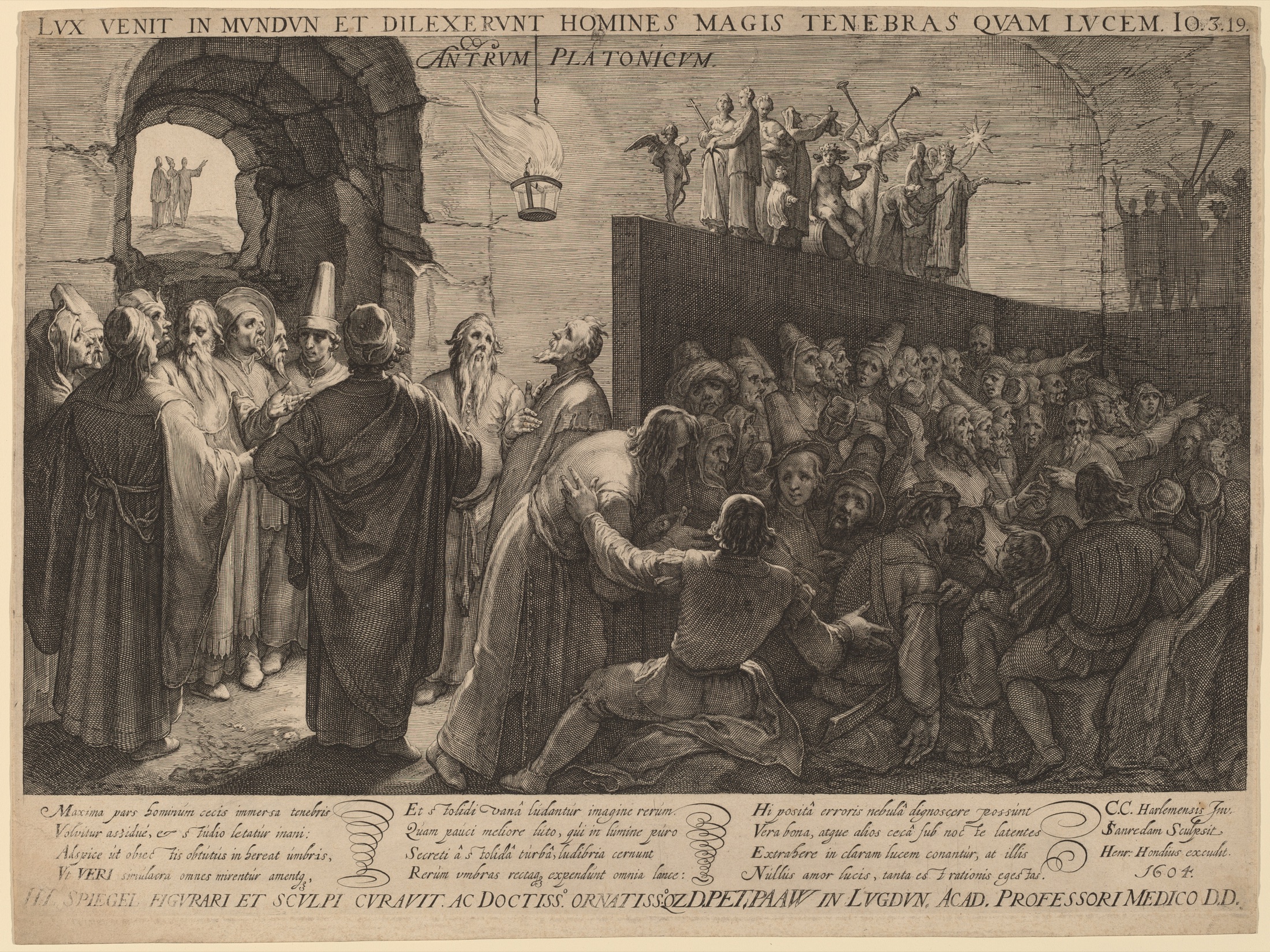
Jan Saenredam after Cornelis Cornelisz van Haarlem, Plato’s Cave, 1604. National Gallery of Art. The inscription above invokes John 3:19, placing Plato’s image within a Christian reading. Complete public-domain engraving.
Begin at the right, where the spectators look at shadows. Follow the image past the figures and their fire toward the opening on the left. Plato’s account asks what happens when the soul turns from the appearances it has always known toward the source of their light.
Plotinus compares the production of Intellect to the radiance surrounding the sun. The source gives rise to something distinct while remaining what it is. Its giving is eternal. The diagram shows how each principle depends on its source; this order exists beyond successive events in time.
Intellect possesses the Forms in an undivided act of knowing. Soul receives from Intellect and brings order into the changing world. A human being’s reasoning moves through successive thoughts, but the soul can learn to contemplate the fullness from which that reasoning comes.
Remaining explains why what comes forth is never wholly cut off from its cause. Proceeding explains how it has an existence of its own. Returning expresses its desire for the good received from that cause. All three belong together; the circle represents a continuing order of being.
Both diagrams are modern explanations of named texts. They preserve the order of Plotinus’s principles and the three terms in Proclus’s proposition; their geometry is editorial. The engraving below is a later Christian reading of Plato’s cave, with its complete lettering preserved. 1567
The work of transformation
Iamblichus describes prayer as an education in divine presence. Repeated worship makes the soul more capable of receiving the gods. He distinguishes three degrees, beginning with an approach to divinity and reaching a union beyond speech.
“causes the soul to repose in the Gods, as in a never failing port”
The first degree gathers the worshiper toward the divine and begins an acquaintance with the gods.
Prayer establishes a concord through which divine gifts reach the worshiper. The soul’s actions come increasingly under the guidance of the gods.
At its fullest, prayer brings the soul to rest in the gods. Iamblichus describes the gift received here as a fullness of divine fire.
These three degrees follow On the Mysteries V.26. They describe the deepening of prayer within sacred worship, not a complete sequence of initiation rites.
The teaching in the texts
Plotinus compares the forgetful soul to a child taken far from home and brought up without knowing its parents. The child’s ignorance does not undo its birth. Something similar happens when a soul gives all its attention to the things around it. It admires what can be possessed, seen, or enjoyed, and gradually forgets the divine life to which it belongs.
His first task is to restore the soul’s knowledge of itself. Consider what makes a body alive, he asks, or what gives the heavens their ordered movement. Soul animates the world and holds its living diversity together. A person who honors the stars while despising the soul has overlooked the presence that makes the stars divine.
This recognition leads to a further question. If Soul gives life and order, where does its wisdom come from? Plotinus directs the reader toward Intellect, where the Forms exist together in eternal knowledge. Our reasoning moves from one thought to the next because we have yet to possess fully what divine Intellect knows at once. Beyond Intellect lies the One, the source upon which even that complete knowledge depends.
Plotinus then brings the account back to the reader. These divine principles are present in our own inward life, although we are usually unaware of their activity. He compares the attention required to listening for a beloved voice amid other sounds. Return begins when the soul changes what it listens for. Sustained attention brings the divine life it had forgotten into its own awareness.
Read the sources 1
In On the Mysteries, Iamblichus answers questions posed by Porphyry about the worship of the gods. One concerns the connection between understanding and successful ritual. If knowledge brings a person closer to divinity, why should sacred acts be necessary? Why should a philosopher who understands the teaching need anything further?
Iamblichus answers by locating the source of the rite’s efficacy in the gods. The sacred symbols, which he calls synthemata, belong to them. A worshiper may understand only part of what a symbol contains, yet the divine power recognizes its own presence there. The work can therefore reach further than the person’s deliberate thoughts.
Preparation still matters. Iamblichus names purity and the best dispositions of the soul among the conditions that assist the work. The person brings attention, understanding, and a life made ready for worship. The union itself comes through divine activity. This is why learning a symbol’s meaning and undergoing the rite have different consequences, even when both concern the same god.
Elsewhere he explains what invocation accomplishes for someone still living in a body. The gods impart their light and draw the soul toward its eternal source. In contemplating their presence, it begins to live through an activity greater than its familiar human life. The bodily worshiper remains the recipient of this change: prayer and sacred action prepare a person to receive what the gods freely give.
A living world filled with distinct beings raises a difficult question for a philosophy that begins from unity. How can things genuinely come forth while continuing to belong to their source? Proclus answers through three terms: remaining, procession, and return. Each explains something that the other two require.
Remaining means that a cause continues to sustain what it produces. Procession gives the effect an existence distinct from that cause. Return describes its turning toward the source of its good. Proclus shows why all three are necessary. An effect wholly severed from its cause would lose the affinity through which it seeks that cause again.
His proposition gives the soul’s longing a place in the order of reality. The desire for goodness has a direction because the soul has received its life from something prior to itself. The divine is already active in the existence of the being that seeks it. Conscious return develops an affinity that makes the search possible in the first place.
This also changes how the circle should be read. Remaining, proceeding, and returning belong together continually. They explain how something can be itself while drawing its life from beyond itself. In the human soul, that enduring dependence can become known and loved. Philosophy and sacred worship bring the question into a person’s own life: how fully can the soul receive the good from which it comes?
Read the sources 5
Across the centuries
The Republic describes education as a turning of the whole soul toward the light. Later Platonists inherit this account of the ascent toward the Good. 6
Plotinus develops his account of the One, Intellect, and Soul. His pupil Porphyry later arranges the treatises into the six Enneads. 9
Writing in the voice of the Egyptian priest Abammon, Iamblichus answers Porphyry’s questions about divine worship in the work now called On the Mysteries. 8
Proclus gives the tradition an extensive philosophical and theological form. His Elements of Theology sets out procession and return in a sequence of propositions. 9
Saenredam’s engraving sets a verse from John above Plato’s scene. The ancient account of light and blindness continues within a different religious world. 7
Continue into the illustrated journey
Continue into Hierarchy, a comparative journey that begins with Plotinus and then brings Hermetic, Christian, and later esoteric teachings alongside his account.
Enter the Hierarchy journey ↗Read at the source
V.1.1–3 explains forgetfulness and the dignity of Soul; V.1.4–7 explains Intellect and the One. V.1.10–12 describes their presence within us and inward attention; V.2.1–2 describes the order of production. Diagram and prose paraphrase these passages.
The different kinds of divine attendants; the efficacy of sacred symbols and the distinction between intellectual understanding and theurgic union.
Divine illumination, the soul’s ascent through invocation, and the change experienced by the embodied worshiper.
The three degrees of prayer and their fruits: illumination, shared activity, and fullness of divine fire. The short quotation preserves Taylor’s wording.
Proposition 35 supplies remaining, procession, and return. The diagram and accompanying discussion paraphrase the argument; their layout is modern.
The cave, the ascent into daylight, and education as the turning of the soul.
Public-domain engraving and photograph, NGA 62542. Its upper inscription invokes John 3:19. The complete existing facsimile is retained, including the Latin verses and publication details.
The literary exchange: Porphyry addresses Anebo; the reply is delivered in the person of Abammon. The introduction records the traditional attribution to Iamblichus.
Historical orientation for the modern term, Plotinus and Porphyry, Iamblichus, and the Athenian school of Proclus.