The otherworld
Fairy traditions describe neighbors who inhabit a world ordinarily hidden from human sight. Encounters occur where the two worlds meet, and the visitor’s appearance gives only a partial knowledge of its nature. 1
Otherworldly encounters · Folklore & UFOs
Otherworldly visitors, revelation, and the changed human life
The encounter often begins in an ordinary place: a road, a bedroom, a field beyond the house. Something appears, and the witness discovers that the familiar world can no longer explain what is happening within it. The visitor may offer a message, impose an ordeal, or disappear without explanation. What follows can occupy the rest of a life. The person must find words for the experience, decide whom to trust, and learn what authority to grant whatever has approached them.
Beliefs · Diagrams · Practice · Primary texts
The essentials
These are the tradition’s central teachings.
Fairy traditions describe neighbors who inhabit a world ordinarily hidden from human sight. Encounters occur where the two worlds meet, and the visitor’s appearance gives only a partial knowledge of its nature. 1
Vallée compares the aerial visitors of folklore with modern UFO occupants. Their appearances change with the age; encounters repeatedly bring wonders and revelations into human lives. 2
Keel’s term places the stranger close to Earth, beyond ordinary perception. His visitors know human concerns and draw witnesses into stories whose explanations often become part of the mystery. 3
Meade Layne proposes that an intelligence can assume a visible body in the form of a disc or globe. The craft and its operator are then one being. 4
Mack follows people who report encounters with alien beings. Their accounts include bodily helplessness, spiritual opening, and lasting changes in how they understand themselves and the Earth. 6
Channeling gives a visitor a speaking voice through a human participant. In the Ra sessions, that voice teaches the unity of creation and describes itself as a collective intelligence. 8
Images, witnesses, and what follows
Glaser’s broadsheet places a celestial disturbance above a familiar city. Arnold’s report gives an unfamiliar object a measured outline. Each image carries its author’s attempt to make an extraordinary sight intelligible. Below them, Vallée and Davis’s six categories widen the inquiry to everything an encounter leaves behind.
The historical image
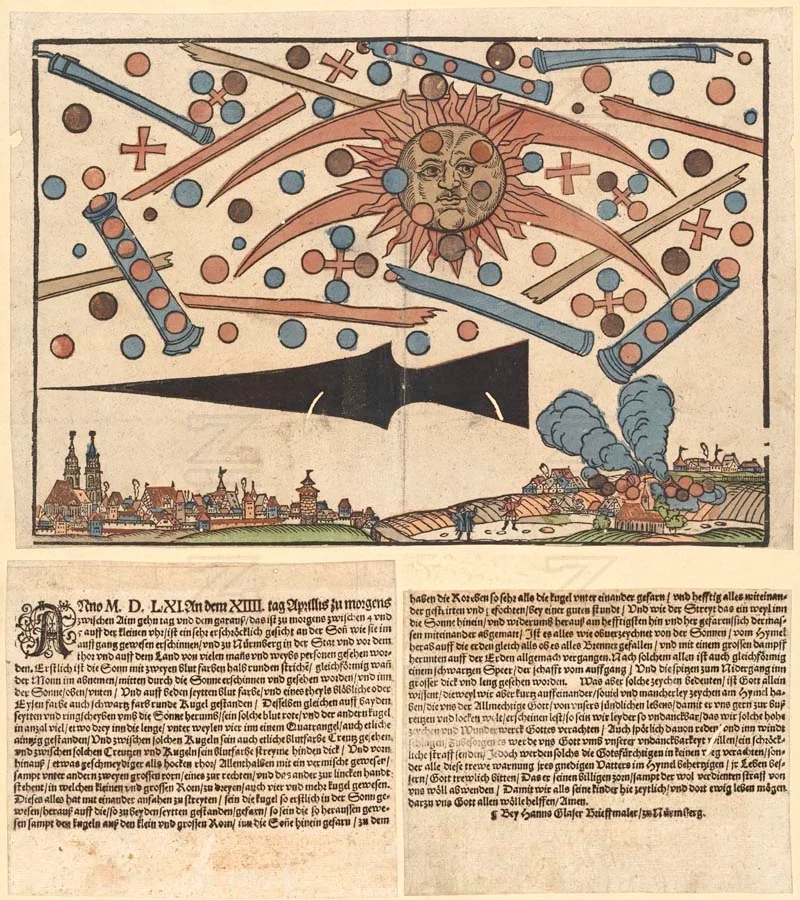
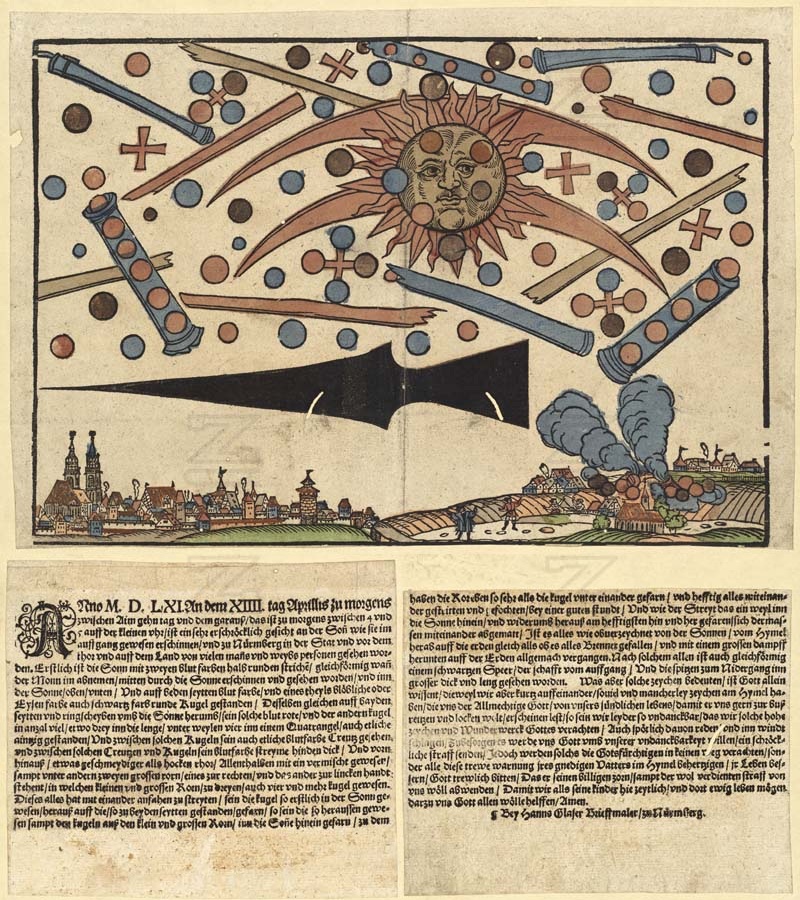
Hanns Glaser, 1561. The printed account interprets the celestial disturbance as a warning to repent. The woodcut and its accompanying text remain together.
The historical image
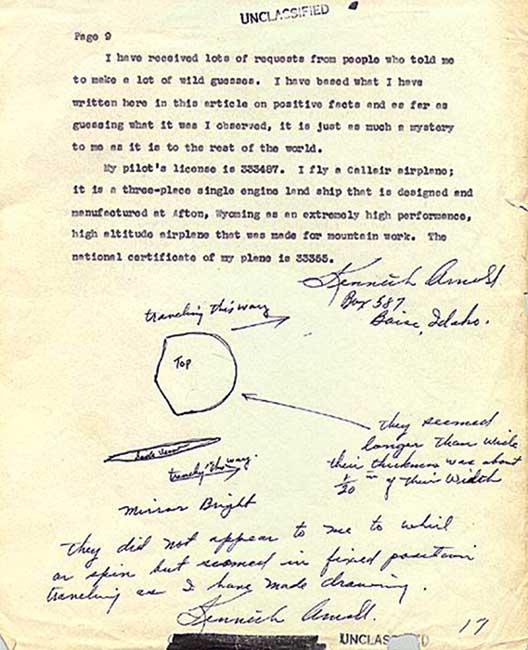
Kenneth Arnold, July 1947. The top and side views preserve his drawing; the arrows record direction. This is a report of objects seen in flight.
Vallée & Davis · 2003
One encounter can touch
several parts of a life
Witnesses report light, movement, heat, and traces in their surroundings.
Witnesses report changes of shape, disappearance, or altered time.
The witness brings expectations to the encounter and responds to the unknown.
Witnesses report bodily sensations, paralysis, or injury during contact.
Witnesses report apparent telepathy, premonitions, and other unusual experiences.
Reports give rise to stories, beliefs, and public reactions.
A way of reading the accounts
An encounter interrupts the person’s familiar world.
The person struggles to understand what happened.
A story or teaching gives the experience meaning.
The person carries this meaning into choices, work, and friendship.
The woodcut shows globes, crosses, and long forms around the rising sun. Beneath it, the printed account describes conflict in the sky and urges its readers to amend their lives. The religious interpretation belongs to the original broadsheet.
Arnold draws a top view and a thin side view. He notes a mirror-like brightness and describes a weaving movement. His accompanying text leaves the identity of the objects unresolved. The drawing records a sighting; it contains no encounter with occupants.
Drawings, recorded voices, and published memoirs bring the witness’s story to strangers. These readers bring their own expectations; some organize their lives around the account’s meaning. Their response gives an individual encounter a shared history and begins a tradition.
Both historical images retain their complete supplied reproductions. Vallée and Davis’s six categories follow their 2003 paper’s order; the layout and icons are modern. The categories describe aspects of reports, not six worlds or initiation stages. The separate encounter sequence is an editorial reading aid. 1112510
The work of transformation
An extraordinary meeting can leave a person with more questions than answers. Afterward, the person must remember carefully, find trustworthy company, and decide what to do with whatever was given. A promised message of wisdom still requires understanding from someone whose ordinary life continues the following morning.
“it is just as much a mystery to me as it is to the rest of the world.”
Write down what happened while its details remain fresh. Preserve the witness’s own words, including the places where memory is uncertain. Later explanations can be kept alongside that first record.
Consider what the visitor actually asks. An invitation to greater understanding and a demand for unquestioning obedience lead to different lives, even when both arrive with an impressive display.
A voice’s apparent knowledge of private things can quickly increase its authority. Give its further claims the same attention as its first disclosure. A failed prediction remains part of the record.
People need company that listens without dictating what an encounter means. Ordinary friendship helps the experience find a place in a life that still includes others.
Notice whether the teaching makes room for patience, clearer judgment, and care for others. A beautiful experience does not establish a guide’s trustworthiness. Over time, what each asks the person to become reveals their difference.
These editorial principles guide reading and reflection on encounter accounts, with the sources below supplying their context. They describe neither a contact ritual nor a sequence attributed to one author.
The teaching in the texts
On Anglesey, Gwilyn Jones told Evans-Wentz that his mother had seen one of the Tylwyth Teg, usually called the fair folk. Evans-Wentz asked whether she was alive and went to interview her. Catherine Jones recalled walking home from Cemaes at about half past ten at night. A young woman of ordinary human size appeared before her.
Jones felt no fear and tried repeatedly to touch the stranger, but her hand passed through the woman’s form each time. The woman stayed beside her until they reached the house. Jones wished her good night, then asked why she would not speak. The figure disappeared at that moment. Jones reported that nothing followed the meeting. She and her neighbors understood the visitor as one of the Tylwyth Teg.
Jones meets the otherworld on a familiar road. A recognizable human form appears, but touch fails to confirm what sight presents. The stranger remains silent, leaving her intention unknown. Jones’s community names the visitor while her account of the event remains spare.
Louis Foster Edwards describes a more dangerous crossing in the Welsh testimony: a mortal joins the fairies’ dance and enters their company. The visit feels like one night, while a year passes at home. Edwards recounts a traditional belief; Jones recalls her own experience. Both accounts preserve enduring concerns of contact lore. A presence becomes visible without an ordinary body, while entering its world changes the conditions of human life.
Read the sources 1
In Passport to Magonia, Vallée compares aerial visitors across times and cultures. Their homelands include Magonia and Elfland. They approach humanity in recognizable or monstrous forms, perform wonders, and influence belief through revelation. Modern accounts describe craft and occupants where older narratives describe otherworldly travelers.
Vallée directs attention toward the meeting: what does the visitor do, and what does the witness believe afterward? Stories about the stranger carry the encounter’s consequences to people who never witnessed it.
The spacecraft appears within a world already inhabited by stories of visitation. Its technological form makes the mystery recognizable to the age. Tracing that form backward leads into folklore. Following the account forward reveals how it shapes its readers’ beliefs and expectations.
Read the sources 2
Layne calls objects that change shape and become transparent aeroforms. In his occult explanation, some aeroforms are bodies assumed by living intelligences.
An entity concentrates its awareness into etheric matter and gives its intention visible form. The disc’s changing appearance expresses the activity of the being that has assumed it.
Layne’s explanation concerns how an intelligence acquires a body, beyond the question of a vehicle’s destination. Contact lore thus meets an older occult concern: how the invisible becomes present to the senses.
Read the sources 4
Keel asks the reader to imagine visitors as neighbors listening to the household. Their knowledge of private lives gives them authority that the witness struggles to assess.
Keel describes contactees whose trust leads to exploitation and disaster. He also allows for other kinds of contact. The investigator must examine the stranger’s explanation as part of the encounter.
Older spirit lore examines persuasion as well as appearance. Keel follows a visitor’s promises into the person’s affairs, where believing them produces visible consequences.
Read the sources 3
Mack describes lights, sounds, or presences interrupting ordinary life. People report paralysis, transport into an enclosure, and encounters with beings apparently carrying out a procedure. The person must understand what happened while facing fear of its return.
Mack follows the experience beyond its first terror. Some people report expanded consciousness and renewed connection with a divine source. Their feelings toward the beings can change. They also describe reverence for earthly life and distress at ecological destruction.
Mack considers transformation central to understanding these reports. He also records the possibility that a person’s response to suffering produces the growth. Courage in living through an ordeal deserves recognition independently of the visitor’s intentions. Spiritual change adds a further history to the encounter.
The initiatic passage continues in the life the encounter leaves behind. Familiar explanations have broken down, and the person must learn to live with new possibilities. Lasting change takes time among work, friendships, and people whose presence preceded the encounter.
In the first Ra session, dated January 15, 1981, the speaking intelligence identifies itself as a collective. It places its communication within the Confederation of Planets in the Service of the Infinite Creator. Ra describes all beings as expressions of one creation. Sunlight divided through a prism explains how multiplicity arises within unity.
The teaching connects cosmic development to how a person treats others. Session 17 distinguishes service to others from service to self and describes further densities of existence. In this cosmology, a density means a degree of development. Human choices teach the seeker and prepare further development.
Asked how best to serve, Ra directs the seeker toward self-knowledge and individual discernment. Each person must discover how their circumstances allow them to express love. This demand joins daily conduct to the vast account of cosmic history.
The Ra material is a particular received teaching, with named participants and dated sessions. Its Confederation belongs to this account. Vallée and Keel’s investigations bring a further question to the teaching: how can someone receive spiritual instruction while retaining judgment about its speaker?
Across the centuries
Hanns Glaser publishes a celestial spectacle together with an appeal to repentance. Image and interpretation share the same sheet. 11
Evans-Wentz publishes interviews, local traditions, and his own interpretation of the fairy-faith across Celtic countries. 1
Kenneth Arnold submits a report and drawing to the Army Air Forces. His outline and motion notes preserve his attempt to describe an unfamiliar sight. 12
Layne explains aeroforms through intelligence, attention, and etheric embodiment. 4
Vallée publishes Passport to Magonia; Keel’s Operation Trojan Horse follows in 1970. 3
The recorded teaching opens with creation’s unity and a speaking collective that calls itself Ra. 8
His interviews and essays examine the spiritual changes reported alongside the fear and disruption of encounters. 7
Diana Pasulka’s American Cosmic and Encounters bring the study of religion into conversation with modern experiences, technological culture, and emerging communities of belief. 10
Continue into the illustrated journey
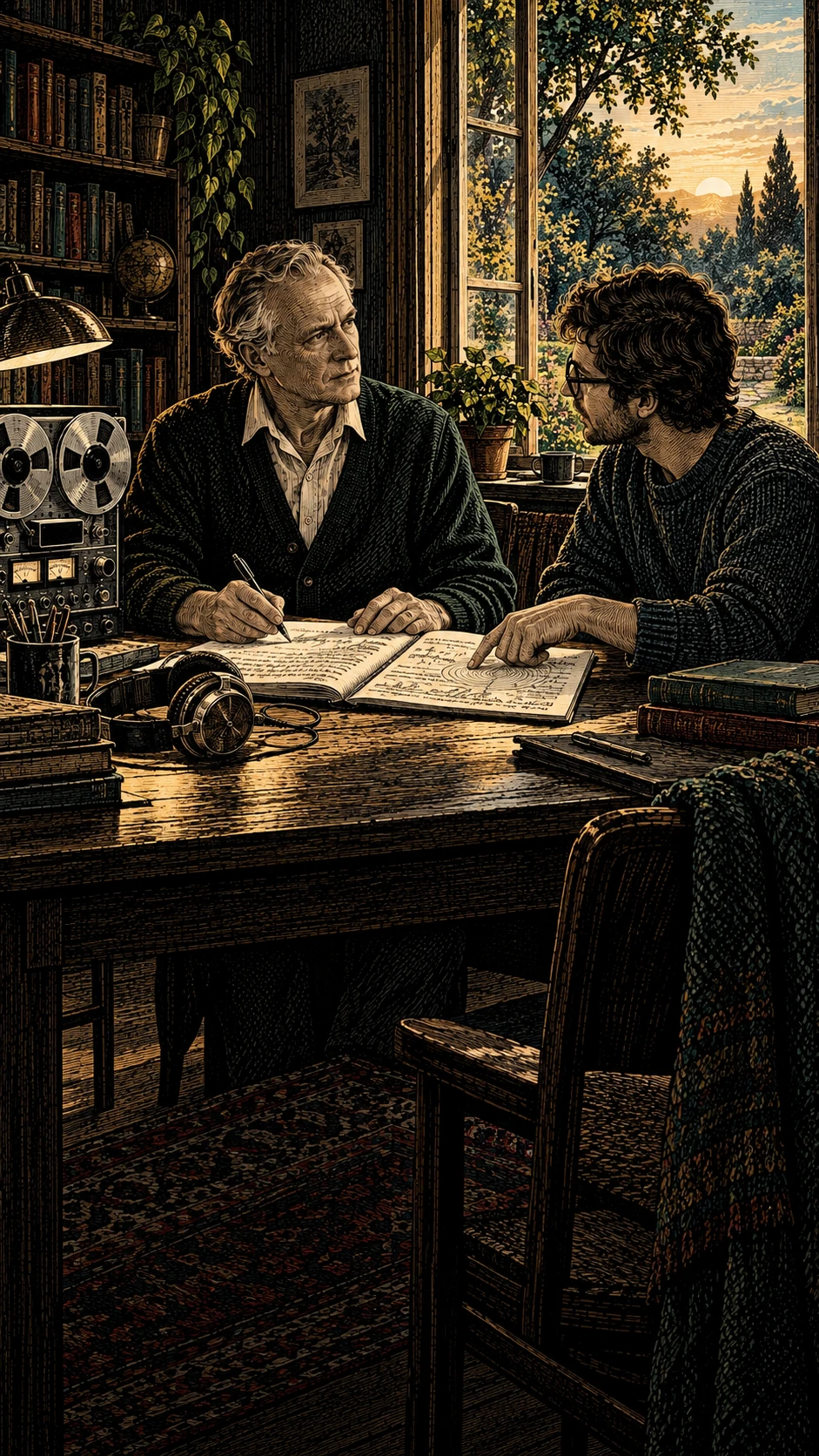
Monroe’s accounts of leaving the body open a neighboring inquiry into unfamiliar worlds and the people met within them. The illustrated journey follows his exploration and the work of returning to ordinary life.
Explore Monroe’s journey ↗Read at the source
Welsh testimony, pp. 141–145, includes Catherine Jones’s personal recollection and Louis Foster Edwards’s account of traditional beliefs. This public-domain text preserves their distinct kinds of testimony.
The author’s bibliography reproduces the book’s opening comparison of aerial visitors and their changing cultural forms.
Printed pp. 60–61, 187, and 269–270: the nearby stranger, contactee exploitation, and the variety of contacts. Keel’s explanations remain attributed to him.
Paragraphs 10–14 and 27–30 develop craft as embodiment. The concluding footnote distinguishes entities and motives. Etheric matter belongs to Layne’s occult cosmology.
Pages 7–9 supply the six-layer model. Category order is preserved; descriptions are abbreviated. “Anti-physical” names reported behavior at odds with ordinary physical expectations.
Mack describes encounter reports and his approach to the experiencers. This is the original 1996 interview, distinct from the expanded 2005 book version.
Fear, spiritual opening, ecological concern, and the distinction between a visitor’s intention and growth through adversity.
Opening transmission and answers 1.1, 1.5, and 1.7: Confederation, collective identity, unity, and prism. The linked archive transcribes L/L Research’s sessions.
Answers 17.23–24 and 17.30–33: densities, polarity, and individual discernment in service. These are teachings of this transmission, not a taxonomy shared by every contact tradition.
Author profile for American Cosmic and Encounters, and her work on religion, technology, and new religious movements.
Public-domain broadsheet and reproduction. The complete supplied 800 × 900 image retains the printed appeal to repentance; the hero shows a labeled detail. Glaser presents a celestial prodigy, without identifying extraterrestrial craft.
Complete supplied report page, 528 × 650. Top and side views, direction arrows, handwritten observations, signature, and classification stamps remain intact. Commons identifies the reproduction as public domain in the United States.