The eye supplies a field of light; psyche assembles it into a scene. Memory gives the scene continuity, and language names its objects. The body then acts within the resulting world. Control of the visible field enters this world-model before reasoning begins.
False light is illumination captured by an operator. The operator selects a surface and binds it to fear, authority, glamour, disgust, or salvation. The apparatus arranging that view remains concealed. The observer grants the image a witness’s authority and completes its instruction through attention, expectation, imitation, and conduct.
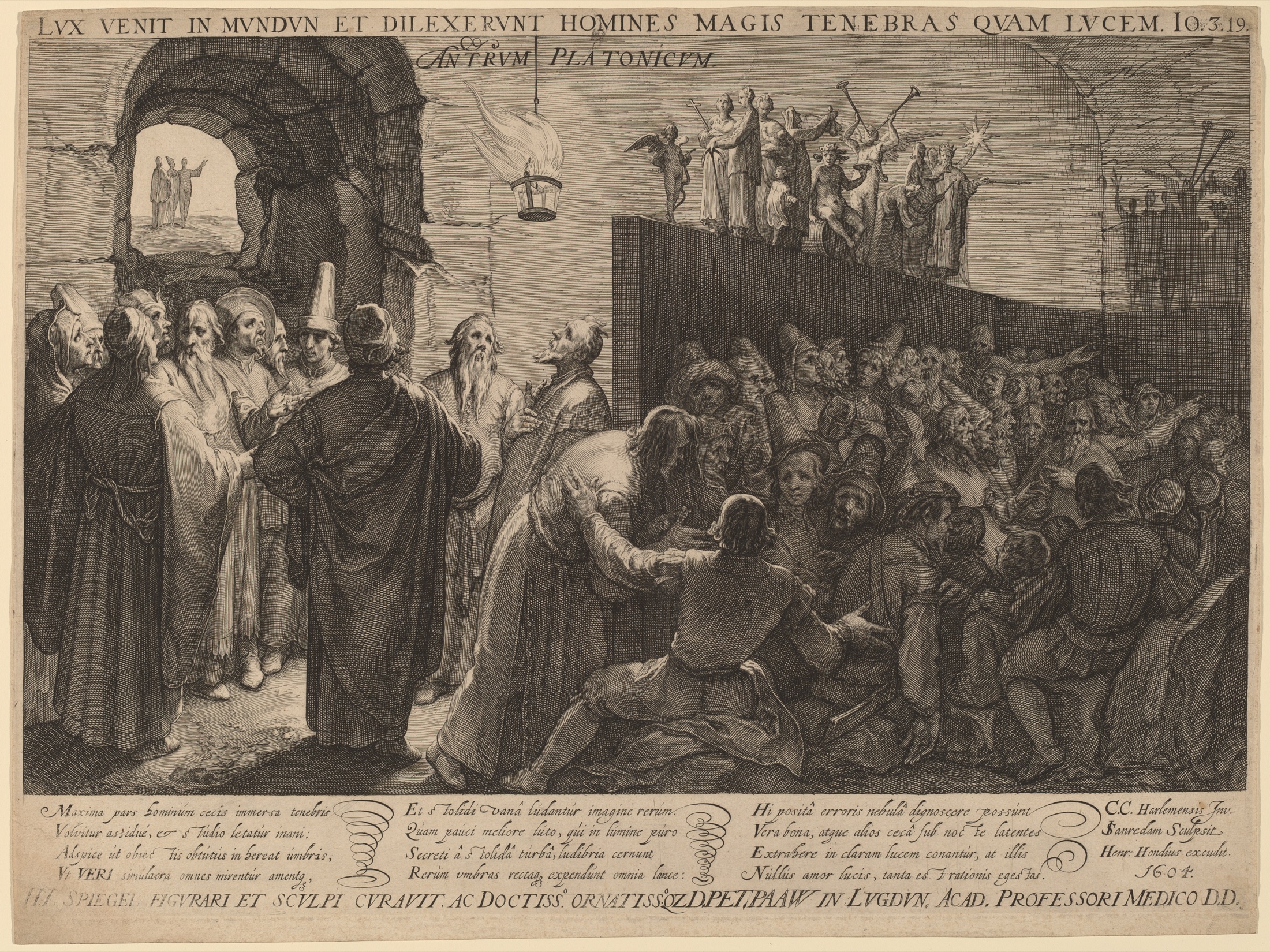
Jan Pietersz Saenredam after Cornelis van Haarlem, Plato’s Cave (1604). Prisoners, projections, concealed apparatus, and the world beyond the cave occupy one field. Click to open the full image.
The Cave and the Screen
Plato’s cave gives captured vision a founding Western diagram. Chains fix the prisoners’ attention on a surface where shadows appear. A fire supplies illumination, hidden carriers supply forms, and the group supplies consensus. The entire perceptual arrangement makes a projection available as the world.
The cave persists when a representation takes the place of its originating event. A press image stands for war, a dashboard for an economy, or a diagnostic scan for a person. A campaign emblem stands for a political order. Each representation can convey real information. Capture begins when the selected surface gains the whole event’s authority while its framing conditions disappear.
The Theater State industrializes this arrangement through a governing stage. Ritual, costume, architecture, spokesperson, camera position, soundtrack, caption, schedule, and repetition shape what the audience receives. Some interpretations become immediate; others become difficult to perceive. The screen claims reality through showing an appearance.
Crossed Light
Vision reconstructs a scene from changing patterns reaching two retinas. Optic pathways divide and cross at the optic chiasm. Each cerebral hemisphere receives the opposite visual field. The nervous system integrates these partial signals with memory, expectation, attention, and bodily state. Consciousness receives a coherent world whose composing operations remain hidden.
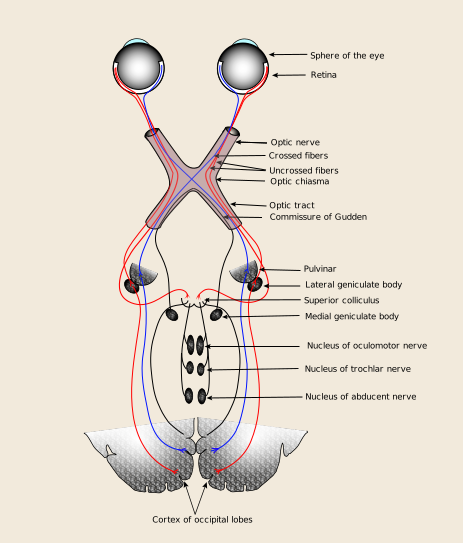
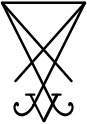
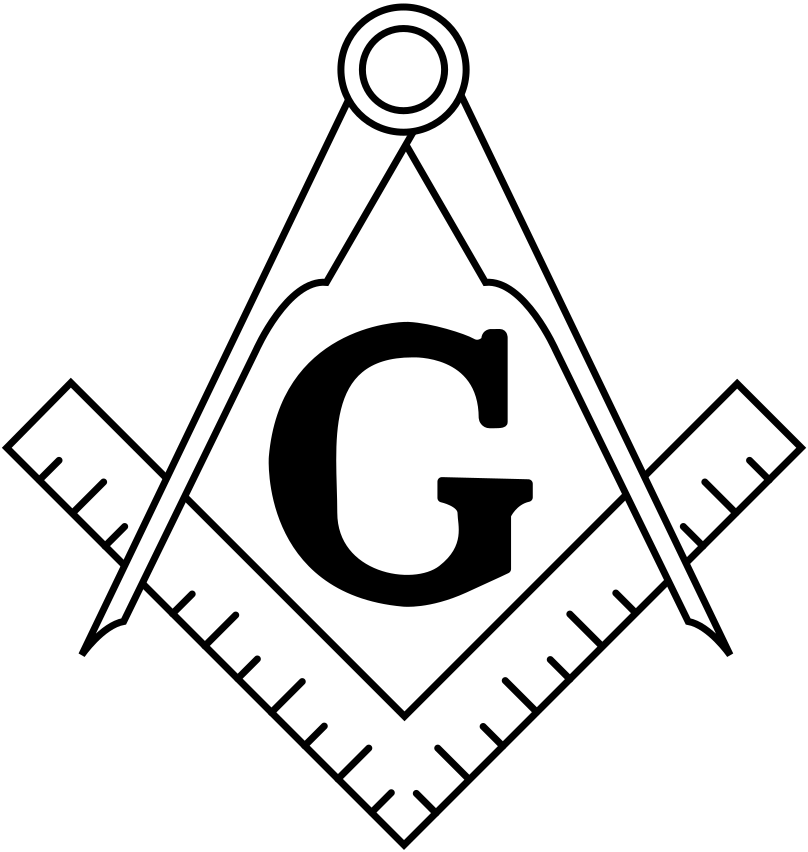
Anatomy and initiatic symbolism share a visual grammar of division, crossing, inversion, measurement, and reintegration around a center. The optic chiasm performs the biological crossing. The Luciferian seal presents the light-bearer through an inverted triangle and crossing lines. The Masonic square and compasses place crossed instruments under geometry, the Great Architect, and the observing eye.
Correspondence joins these carriers through their repeated form. Light enters divided paths, opposed paths cross, and a center reconciles their contribution. The resulting order becomes available as a world. Anatomy supplies a biological operation; the initiatic emblems give that relation symbolic form.
An image has no native account of its origin. Memory, comparison, other senses, and consequence recover its provenance. Dreams, remembered scenes, imagined events, cinema, virtual environments, and direct perception recruit overlapping perceptual machinery. The experience’s appearance alone cannot identify which route supplied it.
Spectacle enters through this aperture. A campaign supplies an image charged with fear, authority, glamour, disgust, or salvation before conscious assent. Psyche receives the charge together with the appearance. Repetition makes the selected association feel familiar as experience.
Crossed geometry compresses the danger into an emblem. Illumination mediates and inverts an appearance. The danger concerns the authority granted to whatever arrives clothed in light.
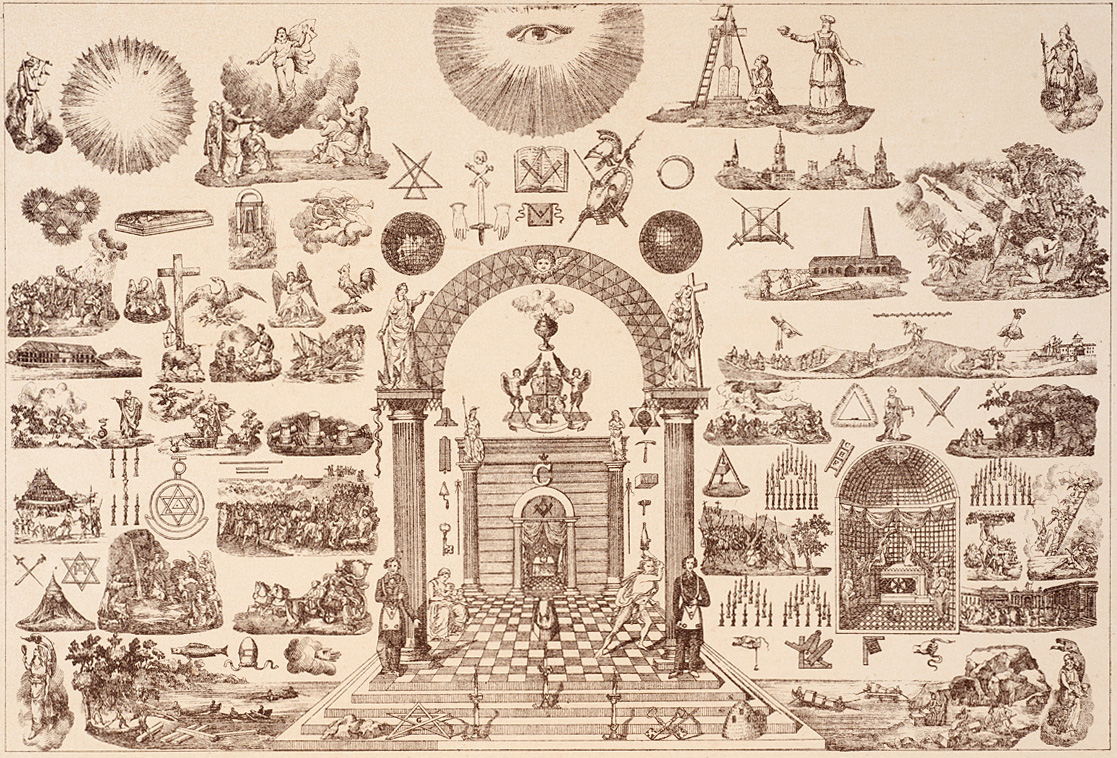
Masonic tracing board, Rotterdam, 1850–1900, Dutch Museum of Freemasonry. Eye, temple, geometry, ordeal, ascent, and measure form an instructional environment before their relations become fully disclosed. Click to open the full image.
The Image Becomes a World
False light works through selection, charge, repetition, and confirmation. Accurate fragments can compose a captive world when their selected relations govern the whole view. The frame determines how those fragments enter a world-model.
occurrence
    ↓ selection
framed appearance
    ↓ symbolic and emotional charge
world-model
    ↓ expectation and coordinated behavior
material consequence
    ↓ repetition, record, and institution
apparent confirmation
    ↺
Conduct gives the image durable form. A represented enemy becomes budgets, checkpoints, weapons, searches, laws, and inherited fear. A represented emergency becomes protocols, architecture, identity systems, and permanent authority. A represented future becomes investment, engineering, policy, imitation, and public demand. Ontogenesis follows this passage from an address into embodied reality.
Consciousness Warfare governs the circuit through salience and interpretation. Narrative Control supplies its question, name, sequence, source hierarchy, and permitted memory. Hollywood as Initiation gives audiences a shared sensory world where they rehearse a future before encountering it. Bodies and institutions complete the image’s instruction and make it materially real.
Selective truth suffices for the operation. Its operator controls what appears, acquires symbolic charge, repeats, or remains excluded. Selected appearances become attached to authority, danger, salvation, and destiny. Custody of visibility shapes what the observer can recognize and enact.
The Image Learns to Think Inside You
An installed image continues working after the screen goes dark. It returns through memory, inner speech, anticipatory fear, fantasy, and automatic interpretation. External spectacle has become an internal agent.
Wilson’s mind parasites confine awareness within the robot of habit. Burroughs’s word-virus enters through language and reproduces through its host’s voice. Visual capture gives these installations a theater. Image supplies a world, emotion supplies force, and repetition teaches psyche to summon the installation without another command.
The foreign instruction eventually says “I.” Represented danger becomes the host’s vigilance; represented desire becomes the host’s appetite. A represented future becomes the host’s plan. The operator can cease continuous transmission once the captive image reproduces within perception.
The mind parasite survives through this borrowed frame. It consumes attention, resists examination, and recruits the body to maintain its own conditions of survival.
The Light Inside Darkness
The biblical inner lamp names the crisis: “The light of the body is the eye.” A captured faculty of illumination presents darkness as sight. Its observer accumulates images while losing the ability to recognize what selected them.
Abundance can therefore produce blindness. Attention remains active and information plentiful, while perception stays within the offered surface. The prisoner becomes an expert in shadows. Greater resolution deepens the enclosure when every detail belongs to the same controlled frame.
Paired eyes orient the body within visible space. The pineal gland participates in light-dark timing through melatonin. Retinal information reaches the suprachiasmatic clock, which coordinates pineal rhythm with night and day. Sleep, dream, endocrine timing, and waking state meet along this axis.
The third eye extends orientation initiatically. Descartes assigned the pineal gland a coordinating role between sensation and mind. Yogic and later esoteric traditions place inner sight at a central point where divided appearances become integrated. Biological organ and initiatic symbol converge on an office of orientation. That office joins space with time, image with meaning, and perception with the intelligence perceiving.
Awakening opens this faculty when awareness sees its own participation in the scene. The witness perceives both the image and the act of seeing. The frame becomes visible, and emotional instruction separates from the event. The operator loses concealment previously supplied by the image’s immediacy.
The Inner Lamp
True sight requires the faculties of the human instrument to answer one another. Vision receives appearance, while psyche renders meaning. Nous, the faculty of intelligible recognition, recognizes pattern. Spirit discerns direction; the body verifies consequence; memory reveals recurrence.
vision      receives appearance
psyche      renders meaning
nous        recognizes pattern
spirit      discerns direction
body        verifies consequence
memory      reveals recurrence
                    ↓
              integrated sight
Each faculty has a characteristic form of capture. Vision without context mistakes the surface for the whole. Psyche without discrimination confuses emotional charge with meaning. Nous without embodiment becomes elegant abstraction.
Spirit without consequence becomes spiritual glamour. The body without wider orientation becomes appetite and reflex. Memory without renewal becomes a closed archive. Integrated sight restores each faculty’s relation to the others.
An image earns authority through a judgment joining source, pattern, direction, bodily effect, historical recurrence, and material consequence. Intuition participates while remaining answerable to the whole instrument. Coherence reveals whether a received signal enlarges perception and agency or narrows them around a handler.
Seeing the Projector
Recovery turns attention toward the conditions producing the invited image. Who selected the frame, and which event lies beyond it? What emotion accompanied the image, and which action does the scene make automatic? What remains invisible? Which institution gains permission through the accepted interpretation? What future will repeated embodiment make easier to inhabit?
These questions recover provenance while keeping vision available. The eye regains range by rejoining the other faculties. Art reveals an order suppressed by the waking world; cinema gives public form to a private recognition. Symbol gathers dispersed knowledge into an image, while sacred architecture orients the body toward a larger cosmos. The channel carrying false light also transmits an aperture.
Discernment concerns custody and direction. False light captures appearance and recruits the observer to complete its world. True sight perceives appearance together with source, frame, shaping interests, and the future being produced.
The prisoner leaves the cave by turning from the image toward the fire. From the fire, the turn reaches the operator. From the operator, it reaches the light by which every appearance becomes visible.
References
Arendt, Josephine. “Melatonin and Human Rhythms.” Chronobiology International 23, no. 1–2 (2006): 21–37. https://doi.org/10.1080/07420520500464361
Bernays, Edward L. Propaganda. Horace Liveright, 1928.
Debord, Guy. The Society of the Spectacle. Translated by Donald Nicholson-Smith. Zone Books, 1995. Originally published 1967.
Descartes, René. Treatise of Man. Written before 1650; first published 1664.
Ellul, Jacques. Propaganda: The Formation of Men’s Attitudes. Vintage, 1973.
Gray, Henry, and Henry Vandyke Carter. Anatomy: Descriptive and Surgical. John W. Parker and Son, 1858. Public-domain optic-pathway plate.

Unknown artist. Masonic Tracing Board. Engraving published in Maçonnieke Schatkamer, Rotterdam, 1850–1900. Dutch Museum of Freemasonry, accession VM 16145-3. Photograph by Paul Mellaart. Public-domain digital image.

Johnson, Marcia K., Shahin Hashtroudi, and D. Stephen Lindsay. “Source Monitoring.” Psychological Bulletin 114, no. 1 (1993): 3–28. https://doi.org/10.1037/0033-2909.114.1.3
Lippmann, Walter. Public Opinion. Harcourt, Brace, 1922.
Plato. Republic, Book VII, 514a–521d.
Saenredam, Jan Pietersz, after Cornelis van Haarlem. Plato’s Cave. 1604. National Gallery of Art. CC0 digital image.

Ssolbergj and Nosferattus. Sigil of Lucifer. Modern vector rendering, 2008–2025. CC BY-SA 3.0.

Grimorium Verum. Eighteenth century. Public-domain full Seal of Lucifer.

Wilson, Colin. The Mind Parasites. Arthur Barker, 1967.
Burroughs, William S. “Mind Parasites!” Rat, June 19, 1969.
MesserWoland. Square and Compasses. Modern vector rendering, 2006. CC BY-SA 3.0.

The Holy Bible, King James Version. Matthew 6:22–23; 2 Corinthians 11:14.