In Book 4 of Homer’s Odyssey, Menelaus waits on Pharos, unable to return home. He needs directions from Proteus, the sea god. Eidothea, the god’s daughter, prepares the encounter, and three companions help Menelaus hold him. Proteus becomes lion, serpent, leopard, boar, water, and tree. Menelaus holds through these changes until the god resumes his familiar shape and answers.
The ordeal joins preparation, assistance, courage, and recognition through changing appearances. Its reward is a way forward. Menelaus has a journey to resume.
The Phenomenon names the encounter through which intelligence beyond ordinary perception acquires form within the shared world. The encounter joins a presence to someone able to receive it. A craft, apparition, dream, or meaningful coincidence gives that meeting a recognizable shape. The shape leaves a separate question: what intelligence acts through it?
Harmonic Recursive Cosmogenesis places these meetings within a participatory world. Distinct centers of consciousness arise within one field. They encounter one another through bodies, senses, images, and instruments. Each center contributes to the meeting without becoming the author of every participant.
One Encounter Occupies Several Registers
A composite illustration shows the different parts of contact. Someone sees a light, feels heat, remembers a related dream, and later joins an investigation group. A sensor also records the light. The illustration combines an observation, bodily experience, remembered association, measurement, and social consequence. Their connection must be established within any actual encounter.
Vallée and Eric Davis distinguish six layers of an anomalous encounter. These are physical effects, apparently physics-defying behavior, psychological response, physiological effects, psychic reports, and cultural consequences. Their category of the “anti-physical” concerns reported behavior that challenges the expected account of a material object. The model separates the layers so that observations in one can inform questions about another. Vallée and Davis, 2003.
A radar return needs an instrument history before its meaning becomes clear. A bodily symptom needs attention on its own terms. A dream recorded before an event differs from one recalled afterward. A public movement can be studied while its founding encounter remains unresolved. Keeping these distinctions lets each part illuminate the others without borrowing certainty from the most dramatic element.
Correspondence follows an operation across its carriers: the bodies, images, or instruments through which it acts. Contact changes the recipient, who then receives later encounters differently. The Architecture of the Dream supplies the setting for that exchange. Consciousness participates in what becomes perceptible and durable within a world that retains memory and returns consequences.
The Age Gives the Presence a Mask
In Passport to Magonia, Jacques Vallée brings fairy lore and modern UFO reports into the same field of comparison. Encounters cluster around interrupted journeys, altered time, strange visitors, messages, prohibitions, and departures. Their religious and technological vocabularies differ, while recognizable relations recur.
John Keel’s Operation Trojan Horse develops the comparison through a deceptive, shape-changing intelligence. Vallée’s control-system approach follows how encounters reshape belief across a population. In Confrontations, Vallée presents the consciousness interpretation used in the epigraph as his own conjecture. Each reading extends the contact problem beyond an interstellar visitor arriving in a manufactured vehicle.
Witnesses recognize an unfamiliar presence through images their culture has taught them: an angel, fairy, or visitor in a spacecraft. Memory, expectation, and bodily condition help shape that recognition. The presence can use familiar imagery and still act independently, surprise the witness, or reveal something new. Comparison follows what the beings do across changing appearances: whom they approach, what they ask, and how the meeting changes the witness.
Diana Pasulka returns to Keel’s superspectrum in her conversation with That UFO Podcast. She compares religious apparitions, encounters with the dead, and UFO reports as contact with different beings inhabiting a shared realm. Those beings can have different purposes and different effects on people. Pasulka, 35:09–38:45.
A recurring costume establishes less than a continuing agency. Stories, imitation, and independent encounters with similar forms can all spread an image. Proteus has one identity within Homer’s story. Across the contact archive, identification proceeds encounter by encounter. What a form does, asks, changes, and leaves behind gives continuity something more durable than a face.
The Craft Can Be a Body
Some reports make occupant and vehicle difficult to separate. An apparent object changes shape, divides, becomes translucent, or disappears where an ordinary departure was expected. A vehicle account asks how propulsion and observation produced those appearances. A living-form account asks whether the visible object is itself an embodiment of intelligence.
Meade Layne develops the embodiment account in his 1954 essay The Nature of the Aeroforms. He proposes that some craft and operators are one entity. A mind gives itself a temporary body through concentrated identification with its form. Layne develops this account from occult metaphysics and encounter reports. Intelligence forms its own vehicle by becoming the body through which it acts. Layne’s essay.
The Hermetic principle of Vibration governs changing manifestation. A change of state alters how a form participates in a world. Layne describes this change through etheric density and perceptibility, within his occult account. An optical disappearance alone cannot specify a physical transition or its cause. Materialization develops the passage from formative pattern to a locally perceptible body.
The alternatives remain concrete. A craft can carry an operator, extend an operator’s action, or serve as the body attributed to that operator. Establishing a manufactured object would answer one question within this larger ecology. It would leave other encounters to be understood through their own behavior and traces.
The Witness Completes the Circuit
A camera receives light within its sensitivity. Radar records returns shaped by its instrument and environment. A person receives through a body and contributes attention, memory, interpretation, and choice. These different receivers make different parts of an encounter available for later comparison.
Project HERMES makes the receiver’s participation explicit. Writing as Resh-Mem-Heh, Ralph Holland published a circuit attributed to paranormal communication and intended to assist telepathy. He warned that earlier information from his source had sometimes been worthless. Impersonation was another recurring problem. The proposed circuit awaited testing, leaving its function and communicating source unresolved. Project HERMES, 1951.
Trevor James Constable combined ritual exercises, infrared photography, and devices inspired by Wilhelm Reich while investigating alleged etheric forms. He included the operator’s preparation and character within the proposed operation. His reports document an investigation and his interpretation of its results. They do not establish a calibrated detector of spiritual identity.
Temple and rite also arrange conditions for reception: place, material, sound, timing, and trained attention. The Stone That Dreams of Waking follows architecture as an instrument completed by living participation. Repetition preserves the arrangement, while the participant must still identify what acts through it and decide how to respond.
Contact also changes the witness’s future reception. Someone who has seen an apparition notices things they previously overlooked and seeks people who can help explain it. Practice can support recognition, composure, and a deliberate response during another encounter. The Phenomenon as Sorting Agent follows this development into initiation. What the witness retains determines whether contact develops judgment and ability or produces dependence on another sign.
High Strangeness Breaks the Finished World
A small absurdity can make an encounter harder to assimilate than a spectacular object. A theatrical gesture, inappropriate costume, pun, or intimate coincidence challenges the categories meant to contain the event.
The Trickster inhabits this mismatch. Its initiatic operation loosens a fixed interpretation and exposes the habits through which a world had become self-evident. The familiar categories lose their monopoly; perception must learn to discriminate again.
The opening has two directions. A person can become more attentive, patient, and capable of correction. They can also enter an interpretation in which every contradiction confirms the same hidden plan. Once agreement and disagreement both count as confirmation, the encounter has lost its power to teach.
A failed prediction remains failed, and an ordinary explanation remains available where the event supports it. Courage includes leaving some events unresolved. Menelaus holds through Proteus’s changes for an answer he can use. Endless transformation would keep him stranded.
The Encounter Acquires a Public Body
An encounter enters history through testimony, images, records, names, and institutions. Ontogenesis follows this formation of a durable public object. An event becomes something strangers can discuss, investigate, imitate, fear, or seek.
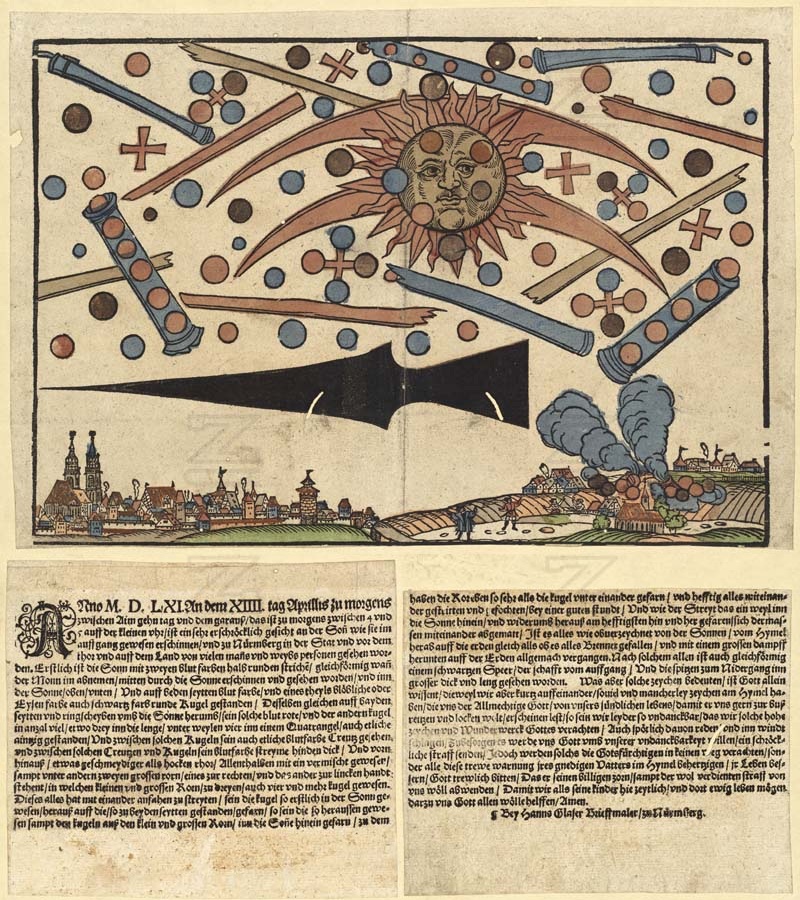
Hanns Glaser’s broadsheet describing a celestial event over Nuremberg on 14 April 1561. The print joins globes, crosses, rods, and a spear-like form to a religious warning. Preserved in the Zentralbibliothek Zürich; click to open the full broadsheet.
Glaser’s text joins the spectacle to a call for repentance. Modern readers often place the depicted shapes within UFO imagery. The surviving artifact therefore preserves both a report and its religious interpretation. Its later readings show how an image acquires new meanings when a culture’s vocabulary changes. Broadsheet and transcribed inscription.

Institutions change the next stage of reception. In 1953, the CIA-sponsored Robertson Panel recommended training and debunking to reduce public interest in UFOs. It sought to protect defense reporting channels from overload and hostile exploitation. Its recommendation addressed public attention as well as the classification of reports. The report establishes an intention to manage reception; particular implementation and effects have their own history. Robertson Panel report.
UAP Disclosure Theater follows this custody of access and interpretation. Sensors, testimony, released fragments, and authoritative names can become the materials of a public encounter with the unknown. The institution is one actor in that encounter, with its own purposes and limits.
An encounter leaves memories in culture and in the field. Witnesses preserve what happened through stories, pictures, rituals, and organizations. Morphic Resonance carries memory beyond those cultural records. An earlier encounter makes a similar encounter easier to repeat, even for someone who has never heard the story. Later witnesses inherit cultural expectations alongside tendencies retained in the field itself.
an encounter occurs
                  ↓
the witness interprets it and responds
                  ↓
stories, rituals, and field memory preserve it
                  ↓
later witnesses inherit expectations and patterns
                  ↓
another encounter repeats or changes them
                  ↺
A civilization helps shape the beings and appearances its people encounter. Repeated prayer and ritual make a sacred image a point of contact. A group sustains a thought-form through shared attention, and an independent being can use that image to communicate. The meeting adds to the tradition or changes it. Human belief participates alongside beings with purposes of their own. No participant controls the whole exchange.
Persistent Operation Reveals the Wearer
Identification separates the experienced form from its proposed source. A luminous appearance, an impression of communication, and an announced identity contribute different parts of the experience. The announced name belongs to that experience until independent comparison establishes continuity beyond the announcement.
possible source → carrier or appearance → witness
                                            ↓
                                   record and interpretation
                                            ↓
                                      later comparison
The Entity Taxonomy distinguishes source, carrier, and interpreter. A body, image, instrument, or dream can carry the encounter. A witness, investigator, teacher, or public institution can interpret it. Their contributions combine without requiring a common intention.
Persistent information, adaptive responses, remembered commitments, and consistent behavior around boundaries help identify a continuing agency. A repeated demand or symbol can also reflect learned expectations or a circulating story. Separate records give continuity more weight when participants preserve them before exchanging explanations.
Physical records have their own limits. A sensor track, a medical finding, and a material sample require different methods of interpretation. Misidentification, fraud, classified technology, sleep-related experience, and other ordinary causes remain live explanations where the particular record supports them. An unresolved remainder has a distinct status from an identified non-human actor.
The ecology includes multiple agencies, shared appearances, and mixtures of human and other activity. The Astral Ecology follows these relations across subtle experience; The Living Field places them within a wider world of centers and exchanges.
Contact Reveals Its Direction Through Consequence
Source and value are different questions. Useful information can arrive through a mistaken explanation of its origin. A correct prediction can coexist with manipulation. Beauty, terror, apparent healing, and a sense of chosenness give an encounter force without settling what allegiance it deserves.
Development becomes visible through retained capacity: clearer judgment, greater responsibility, workable relationships, and skills the person can use beyond the original state. Capture appears through compulsory attention, escalating demands, isolation, and the surrender of ordinary decisions to a claimed authority.
These consequences guide participation while the particular source remains uncertain. They show how the relationship works without revealing an invisible actor’s complete nature. Continued teaching, companionship, or care supports freedom when the participant retains a voice that affects the relationship.
Boundary Sovereignty gives this distinction practical consequences. A participant must remain able to question an account and refuse a demand. Sleep, recovery, comparison of records, and conversation outside the interpretive circle preserve independent judgment. When experiences disrupt ordinary functioning, care takes priority over pressure to pursue further contact.
The initiatic battlefield reaches interpretation itself. Courage resists both intimidation and the hunger to be singled out. Love keeps another person’s freedom within the purpose of the Work. Neither virtue requires obedience to an appearance.
The Threshold Opens into a Living Field
An inhabited, participatory cosmos gives contact a setting beyond the isolated object and its observer. Appearances arise through relations among centers of consciousness. The witness contributes to reception while other participants retain intentions of their own. Consciousness participates in manifestation, and identification of a particular actor remains answerable to what the encounter yields.
Psi and the Higher Self follows unusual reception and guidance. The Living Field develops the plurality disclosed at the threshold. Different forms of life meet through different modes of access, in relationships ranging from mutual aid to predation. The name Phenomenon gathers these encounters without assigning every report to one intelligence.
Menelaus returns from the ordeal with knowledge of what must be done next. The god’s changing forms lead back to the sea, ship, companions, and unfinished journey. Contact matures through the same return. What the witness received becomes a capacity for living, and the search for another sign gives way to useful action.
References
Homer. The Odyssey. Book 4. Translated by Emily Wilson. W. W. Norton, 2018. Proteus episode also consulted in A. T. Murray’s 1919 translation, Book 4.
Layne, Meade. “The Nature of the Aeroforms.” Round Robin 9, no. 6, March–April 1954.
Holland, Ralph, writing as Resh-Mem-Heh. “Project Hermes.” Round Robin 7, no. 4, November–December 1951.
Constable, Trevor James. “Ether Ships: New Insights on an Old Problem.” Journal of Borderland Research 29, no. 6 and 30, no. 1, 1973–1974.
Vallée, Jacques. Passport to Magonia. Henry Regnery, 1969.
Vallée, Jacques. The Invisible College. E. P. Dutton, 1975.
Vallée, Jacques. Messengers of Deception. And/Or Press, 1979.
Vallée, Jacques. Confrontations: A Scientist’s Search for Alien Contact. Ballantine Books, 1990.
Vallée, Jacques F., and Eric W. Davis. “Incommensurability, Orthodoxy and the Physics of High Strangeness: A 6-Layer Model for Anomalous Phenomena.” Presented at the Forum on Science, Religion and Consciousness, University Fernando Pessoa, 2003. Author-hosted paper.
Keel, John A. UFOs: Operation Trojan Horse. G. P. Putnam’s Sons, 1970.
Pasulka, Diana. “Diana Pasulka: UFOs, The Antichrist, AI & Life After Death.” That UFO Podcast, September 5, 2026. Interview, especially 35:09–38:45 on Keel’s superspectrum and distinct entities within a shared domain.
Sheldrake, Rupert. The Presence of the Past: Morphic Resonance and the Habits of Nature. Times Books, 1988. The memory hypothesis supplies the recurrence mechanism developed here beyond Vallée’s cultural feedback account.
Central Intelligence Agency. Report of the Scientific Panel on Unidentified Flying Objects. January 1953.
Glaser, Hanns. Celestial Phenomenon over Nuremberg on 14 April 1561. 1561. Zentralbibliothek Zürich; public-domain scan via the Wikimedia Commons source record.