The noosphere names Earth’s developing sphere of thought. Language, memory, culture, science, institutions, and technical networks let intelligence act beyond a single body or lifetime. Its spiritual life gives this development an inward dimension: a planetary being capable of conscious participation in its own becoming.
An 1871 map of telegraph lines announced an ambition: “to complete the circuit of the globe.” It showed existing cables alongside contracted and contemplated routes. The drawing gave a common form to many separate engineering projects. Signals could join the planet before its participants knew how wisely they would use the connection.
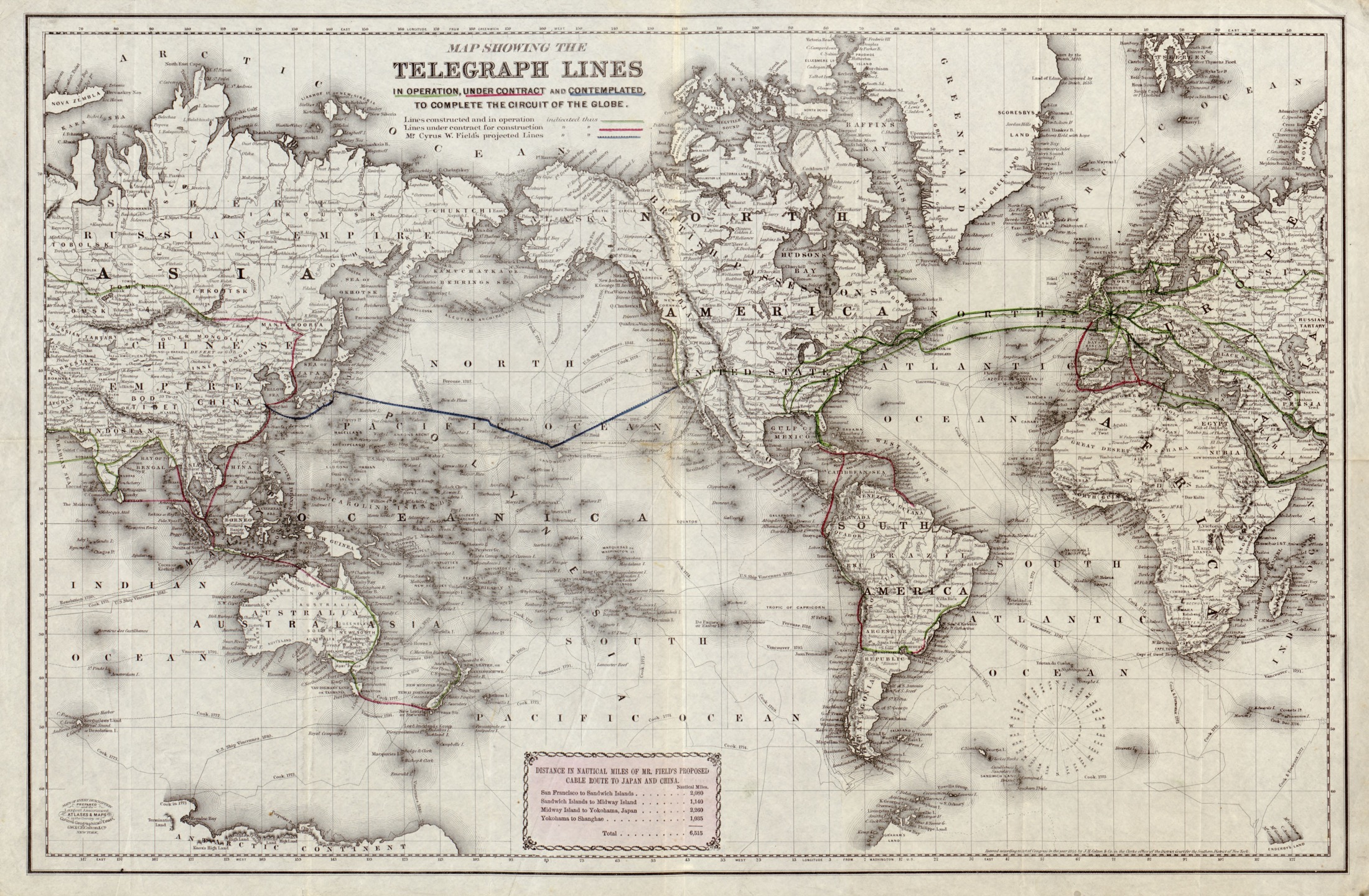
J. H. Colton & Co., map of telegraph lines intended “to complete the circuit of the globe” (1871). The lines show an early material body for planetary coordination. Click to open the full map.
Connection gives this development reach. Its direction depends on what happens to the lives joined by it. A network can increase their ability to perceive and act, or gather those powers into a center that decides on their behalf. Love gives planetary development its orientation: a common life in which greater powers of participation preserve the freedom of those who exercise them.
Thought leaves a geological record
Vernadsky approached the noosphere through the biosphere. Living organisms already transform the planet’s materials and chemical relations. Human thought gains geological force through agriculture, industry, scientific work, and organized action. Decisions leave consequences in soil, water, atmosphere, and built form.
He called the noosphere “a new geological phenomenon on our planet.” The phrase gives thought a material history. A mining decision changes a landscape. Scientific discovery changes what a civilization can manufacture, while its production systems alter the conditions inherited by other lives.
Lovelock and Margulis’s Gaia hypothesis gives this relation a biological operation. Organisms alter atmospheric chemistry and surface conditions; those conditions affect the organisms that can live there. Their 1974 account proposes that such relations can regulate the planetary environment. Regulation concerns how a system maintains conditions through feedback. Planetary subjecthood adds an interior life: a whole capable of experiencing, recognizing, and learning from its relations.
Teilhard de Chardin gives the development an interior and spiritual direction. His account of a thinking Earth concerns convergence among persons as well as increasingly connected activity. Vernadsky’s geological agency and Teilhard’s spiritual culmination name different dimensions. The noosphere joins their questions through a return: mind changes Earth, and the changed Earth enters mind as consequence.
Sensing becomes judgment through return
A satellite registers heat. An ocean buoy measures changing conditions. A local observer notices that a familiar seasonal relation has failed. NASA’s Earth-observation systems join measurements with data infrastructure and scientific interpretation, allowing changes in land, ocean, air, and ice to be studied together.
Measurement becomes useful when someone can understand it and act. A warning lost in an inaccessible archive has little practical reach. A community can receive accurate information while lacking the authority or resources to respond. Planetary perception therefore includes the conditions under which different observers can compare their accounts and influence decisions.
observation → shared memory → judgment → action
      ↑                                  ↓
      └──────── consequence and correction ┘
The Consensus Engine follows this loop from shared attention through language, institutions, and material consequences. At planetary scale, the question becomes who can interpret the shared record and make a correction effective.
Memory lets that loop extend beyond the immediate moment. Records, craft, scientific methods, languages, and institutions preserve what a previous generation learned. A surviving archive holds knowledge available; people able to interpret and practice it restore its living use. The Lineage That Remembers gives this continuity a human scale. At the planetary scale, custody of archives, categories, and models determines whose knowledge remains available to the next decision.
Pierre Lévy’s collective intelligence locates knowledge among participants whose contributions can be recognized, connected, and put to use. No individual needs to contain the entire field of knowledge for a group to act intelligently. A shared archive becomes more capable when the people who know different things can find one another and combine their skills.
The cables themselves can become obsolete while their routes, standards, and accumulated engineering experience enter later systems. A generation inherits both artifacts and ways of working. Maintenance, teaching, and correction determine how much of that inheritance remains usable when its original makers are gone.
Relation beyond technical connection
The noosphere includes psychic relation beyond known communication channels. Reiser’s world sensorium and Argüelles’s psi bank place persons within a wider psychic order. Sheldrake’s morphic-resonance hypothesis proposes influence among similar systems across time. Psychic relation, formative memory, and technical transmission operate within the same field of participation. Their mechanisms differ. A cable carries an electrical signal; telepathy concerns a psychic relation that exceeds this technical channel.
The Global Consciousness Project attempted to give one version of the question a measurable form. Nelson and Bancel’s 2011 paper reported deviations in networked random data associated with specified global events. Their later interpretations diverged: Bancel argued for an experimenter-associated effect rather than evidence of global consciousness, while Nelson defended the collective reading. The observed statistics and the identity of a proposed source remain distinct questions.
Shared symbolism, technical transmission, telepathy, and synchronicity establish relations through different routes. Psi and the Higher Self carries the discipline of comparing an experience with its interpretation. Wider participation needs that discipline as much as ordinary perception does.
Aurobindo and Steiner bring the change into Earth
Aurobindo gives the planetary horizon an explicit demand: spiritual realization must reach embodied nature. His account of Supermind concerns truth-consciousness transforming mind, life, and body. Descent and ascent work together: the spiritual principle becomes active in the forms that have evolved to receive it. Earth’s transformation involves a change in the powers through which life participates in reality.
Steiner also joins the development of consciousness to the Earth’s future, while giving it another history and spiritual organization. In From the Akashic Record, future forms are prepared through soul and spiritual development. In his Michaelic writings, intelligence must enter human freedom through the whole person, including feeling and will. Spiritual beings remain active within his account; the transformation cannot be reduced to a new arrangement of institutions.
These two approaches give earthly becoming its developmental depth. Aurobindo’s Supermind and Steiner’s Michaelic relation retain their distinct meanings. Both make the person a participant whose formation matters to what can become manifest. The future requires capacities that can receive a wider order and carry it through embodied action. The Great Work follows how an opening becomes a lasting ability to perceive, choose, and act.
Collective awakening makes shared reality more responsive to consciousness and formative possibility. It alters the conditions of participation themselves. Institutions and tools give this development durable expression; the relation between Spirit and manifestation changes through the capacities beings develop. Technical connection measures reach; this transformation concerns the powers of the beings who participate. The Recursive Future develops the temporal implication. A future whole acts within the present, drawing capacities toward the conditions through which it can become embodied.
What one world leaves to another
In his 1908 lecture on the Earth’s mission, Steiner gives love a place within this succession. He writes: “When the Earth has reached the end of its evolution, love should permeate it through and through.” He describes love cultivated here becoming an environmental quality of the future planetary condition he calls Jupiter. This is a stage of his spiritual cosmology, distinct from the present astronomical planet. Human development contributes to what later beings encounter as their world.
Recurrent descent and return carries experience into bodies and history. Integration preserves some of its gains, which renewed embodiment brings into another field of action. Civilizations also leave unresolved injuries and systems of dependence. Retention becomes development through the freedom, discernment, and reciprocal responsibility that later lives can exercise.
Spiritual inheritance reaches beyond material remains. A civilization’s completed Work persists as an archetypal or imaginal presence that helps form the world available to later beings. A book, a learned skill, a morphic tendency, and a continuing intelligence carry different kinds of continuity. Continuing subjecthood adds experience, recognition, intention, and the capacity to respond. A remembered pattern and a being who remembers it must remain distinguishable.
The encompassing temporal whole and the sequence lived within it are different standpoints. Within the sequence, acquisition and loss change the next encounter. A completed Work can become another beginning’s inheritance, leaving later beings free to encounter different tasks.
Participation finds its time
A calendar organizes what people repeat, remember, anticipate, and do together. It can align communal life with ecological rhythms or make every day answer to an administrative schedule. The Consensus Clock follows this faculty and its capture.
Argüelles extends the question into a synchronic cosmology. NET means Noospheric Earth Time. He describes it through universal synchronization and proposes a common temporal order in which human participation becomes conscious. His calendar and psi-bank account give meaningful timing a planetary form.
Ordinary synchronization aligns activities through clocks and signals. Synchronicity concerns meaningful coincidence. Argüelles brings them into relation through a synchronic order. Living timing joins formative meaning and earthly activity in an answering relation. Its calendar ratios and transition chronology remain features of his particular system. The Synchronometer carries the calendar practice and its claims about the recovery of shared time.
The developmental accounts and the temporal account meet in practice. A capacity must mature, find its occasion, and enter a world able to retain its consequences. A well-timed act can help another person learn, preserve an endangered inheritance, or make a shared project possible. The larger horizon grows through such actual relations while reaching beyond their familiar mechanisms.
A whole that preserves its participants
Chile’s unfinished Project Cybersyn gave coordination and autonomy a concrete design problem. During Allende’s government, from 1971 to 1973, the team connected industrial information with decisions. It used telex, statistical software, economic simulation, and an operations room. Stafford Beer’s approach assigned local units room to respond while passing exceptional problems to a wider coordinating level. The project ended with the military overthrow of Allende, leaving its design partly realized.
The problem survives its particular technology. A system needs local knowledge as well as a way to answer problems larger than one unit. Removing local judgment deprives the whole of information it cannot produce from the center; disconnected units lose the ability to meet a shared threat.
The same requirement acquires ethical force in Boundary Sovereignty. A participant must be able to perceive, remember, judge, refuse, and correct. Concentrating those powers in an opaque center makes the network easier to command while diminishing the intelligence it can receive from its members.
Babel gives concentrated coordination an enduring image: one language, one people, and a tower through which they seek to make a name. Read as an architecture of power, the image joins a common project to the danger of making every participant serve the same ascent.
Pentecost gives shared reception a different image. The hearers recognize speech “in our own tongue, wherein we were born.” Relation becomes possible through differentiated persons and languages. The image lets unity be understood through mutual intelligibility, with each hearer still present.
Conscious communion preserves what each life has learned. A participant brings a history, a judgment, and a response that the others cannot supply in advance. Spiritual union makes these differences available to a common life. The whole gains depth through their encounter, while each person remains capable of answering from an experience of their own.
Courage and virtue govern the use of this shared capacity. Michaelic discernment includes resisting one’s own wish to dominate. Christic love includes service without ownership. A community may have to defend its records, protect an unwelcome witness, or refuse an authority’s demand to erase a fact. Love becomes effective through these acts of protection and truthful refusal. It also governs their means: the freedom sought for the whole must remain present in its treatment of the person.
The common world takes form
AI, archives, sensors, and communication systems can return useful intelligence to people. They can also make memory and judgment dependent on one interface.
The Lock captures the same faculties a planetary mind needs: attention, memory, interpretation, prediction, and action. When those faculties enter an opaque center and return as permissions, the apparent voice of the whole conceals the participants’ loss of agency. Deus Ex Machina follows the machine that comes to occupy this position.
The developmental test concerns what remains with the participants: skills, accessible records, local trust, and the ability to act when the central service is unavailable. A network that transfers competence gives people resources with which to survive its interruption. A system that replaces judgment with dependence makes every outage or change of ownership a threat to their remaining freedom.
Collective initiation reaches this threshold through the organs it builds. Shared archives, models, and communications must carry knowledge back into lives able to interpret and use it. Their governance helps determine whether greater reach cultivates judgment or reserves it for an operator. The person integrates an inheritance through the Work; the network must make that integration possible among persons without claiming their place as the living center.
The Universal Platonic Hologram gives this distributed whole a geometric reading through circumference and center. Its twelve/thirteenth symbolism places the living center within a differentiated order.
The New Jerusalem gives the culmination an inhabited image. Divine light, an open city, and life shared within a differentiated order bring spiritual realization into a world. Aurobindo’s divine life on Earth provides another vocabulary for the embodied horizon, while retaining its own account of how transformation occurs.
The telegraph map joined places with lines. The longer work joins observation to judgment, spiritual development to conduct, and common power to the freedom of those who carry it. The noosphere matures as Earth’s participants learn to understand their relations and answer their consequences. Their growing capacities give a wider consciousness durable form.
Such an achievement leaves work for those who follow, with different starting conditions. A preserved language, an accessible archive, a practiced freedom, or a spiritual capacity can enlarge what the next generation is able to receive and create. The measure of the common world lies in the lives it makes possible.
References
J. H. Colton & Co. Map Showing the Telegraph Lines in Operation, Under Contract, and Contemplated, to Complete the Circuit of the Globe. G. W. & C. B. Colton & Co., 1871. Library of Congress.
Vernadsky, Vladimir I. “The Biosphere and the Noösphere.” American Scientist 33, no. 1 (1945): 1–12. The epigraph is quoted from the expanded 2005 translation, “Some Words About the Noösphere”, printed page 20. Translated by Rachel Douglas, incorporating portions of George Vernadsky’s earlier translation.
Vernadsky, Vladimir I. Scientific Thought as a Planetary Phenomenon. 1938. English translation, Nongovernmental Ecological V. I. Vernadsky Foundation, 1997.
Teilhard de Chardin, Pierre. The Phenomenon of Man. Harper, 1959.
Lovelock, James E. Gaia: A New Look at Life on Earth. Oxford University Press, 1979.
Margulis, Lynn. Symbiotic Planet: A New Look at Evolution. Basic Books, 1998.
Beer, Stafford. Designing Freedom. John Wiley & Sons, 1974.
Medina, Eden. Cybernetic Revolutionaries: Technology and Politics in Allende’s Chile. MIT Press, 2011. Author’s adapted excerpt.
Lévy, Pierre. Collective Intelligence: Mankind’s Emerging World in Cyberspace. Translated by Robert Bononno, 1997. French publisher’s account of the work.
Nelson, Roger D., and Peter Bancel. “Effects of Mass Consciousness: Changes in Random Data During Global Events.” Explore 7, no. 6 (2011): 373–383. Article.
NASA Earth Observatory. “Space-Based Observations of the Earth.” NASA.
The Holy Bible, King James Version. Genesis 11:1–9; Acts 2:1–13; Revelation 21–22.
Lovelock, James E., and Lynn Margulis. “Atmospheric Homeostasis by and for the Biosphere: The Gaia Hypothesis”. Tellus 26, nos. 1–2 (1974): 2–10.
Reiser, Oliver L. The World Sensorium: The Social Embryology of World Federation. Avalon Press, 1946.
Reiser, Oliver L. Cosmic Humanism. Schenkman, 1966, “The World Sensorium and the Helium Layer.”
Bancel, Peter A. “Determining that the GCP Is a Goal-Oriented Effect: A Short History”, 2017.
Nelson, Roger. “Evoked Potentials and GCP Event Data”.
Sri Aurobindo. “Supermind and the Life Divine”, in The Supramental Manifestation upon Earth.
Steiner, Rudolf. “The Earth and Its Future,” GA 11.
Steiner, Rudolf. “The World-Thoughts in the Working of Michael and in the Working of Ahriman,” GA 26, paragraphs 9–15. Translated by George and Mary Adams.
Steiner, Rudolf. “The Mission of the Earth,” GA 103, 20 May 1908, §§6–13. Translated by Maud B. Monges.
Argüelles, José. Time and the Technosphere, 2002, PDF page 150, “Table of Noospheric Earth Time Units.”
Sheldrake, Rupert. Morphic-resonance research.