The body is an event maintained across many scales. Cells hold voltage, organs exchange signals, and the nervous system feels the interior. Attention changes the state being felt, while relationships reorganize the whole instrument. The subtle body is the living architecture that joins these layers in one embodied life.
Practice can perceive and alter this order of embodied relation. Ordinary anatomy does not exhaust it. Subtle names neither an imaginary body nor a weak physical signal. Bioelectricity supplies one physical layer of the interface; it does not name the entire subtle body.
Older maps use sheaths, winds, channels, centers, breath, light, soul, and spirit. Modern maps add neural networks, interoception, endogenous voltage, biomagnetism, and ultraweak photon emission. Each addresses structured embodiment. Practice changes the range of states that this structure can sustain.
The traditions built maps for different transformations. They supplied no universal hidden diagram. Five layers remain distinct within their synthesis: bioelectric organization, embodied signaling, traditional subtle anatomy, clairvoyant and healing cartography, and nonlocal field participation. Each performs different work. Their interaction forms the interface through which consciousness becomes a human life.
Five Pages, Five Scales
The Breath supplies the cosmogonic architecture. The subtle-body interface takes lived and traditional form. The Distributed Receiver follows the whole organism’s participation in mind. The Vagal Gate develops autonomic range and return. The Heart as a Living Center develops cardiac intelligence, interoception, and the field question.
Biofield names a modern research and clinical umbrella. It gathers field-like properties, emissions, interactions, and healing claims around living systems. Subtle body names several lineage-specific initiatic ontologies, or accounts of spiritual being. Modern synthesis brings them into conversation while preserving their different histories.
The Physical Interface
Living tissue has electrical organization. Membrane voltage and gap-junction networks participate in growth, repair, and anatomical patterning. In planarian experiments, changing this distributed physiology changes the regenerated body while its genome remains in place. Bioelectric Fields carries the experimental account. Living form retains memory through relations spread across the organism.
Heart, brain, and metabolism also produce measurable magnetic and photonic emissions. These establish a physical interface alive with signals. They neither exhaust the subtle body nor automatically explain telepathy. What another organism receives remains a question. The same question applies to another layer of the being that produces the signal.
The Felt Interior
The organism continually senses itself. Interoception gathers cardiac, respiratory, visceral, endocrine, immune, thermal, pain, and metabolic signals into an experienced interior. These signals contribute to affect, motivation, memory, self-experience, and action. The distributed receiver extends throughout the organism. The brain remains the principal measured integrator of neural information.
Subtle-body practice works through this physical interface. Breath changes respiratory chemistry, cardiac timing, and autonomic state. Posture changes muscular recruitment, circulation, visceral pressure, and available action. Voice joins breath, vibration, hearing, language, and social signal. Attention changes which bodily information matters and how it is interpreted. Ritual joins movement, image, intention, expectation, and relation in a repeatable transition between states.
The felt body exceeds an inventory of organs. An open chest, closed throat, violated abdomen, charged spine, or expanded boundary can arrive before discursive explanation. Such perceptions can track physiological change while carrying symbolic, relational, and initiatic meaning. One sensation can be biologically caused, psychologically organized, spiritually consequential, and incompletely interpreted.
The human chord names the coordination problem. Cellular, neural, cardiac, respiratory, endocrine, behavioral, and attentional rhythms operate at different rates. Coherence lets more of the instrument participate in one action. Subtle-body practice often reorganizes relations among these rhythms. It need not add a new substance to the body.
The Traditional Maps
Four questions distinguish the maps: what carries the process, what moves through it, what practice changes it, and what life results? Similar locations cannot establish identity when the operation and end differ.
Hindu Tantra and Haṭha Yoga
The Taittirīya Upaniṣad describes nested selves made of food, breath, mind, understanding, and bliss. Later Vedānta organizes these as five sheaths. Tantric and haṭha sources build ritual-yogic bodies through prāṇa, channels, winds, centers, knots, syllables, deities, elements, and cosmological powers. Initiation and practice activate and configure these bodies. Different texts build different bodies because their operations differ.
Chakras and kundalini belong primarily to this family. Kundalini does not name every spontaneous energetic opening. The Ṣaṭ-cakra-nirūpaṇa presents six centers beneath the thousand-petaled lotus. Other systems have different counts, placements, powers, and ends.
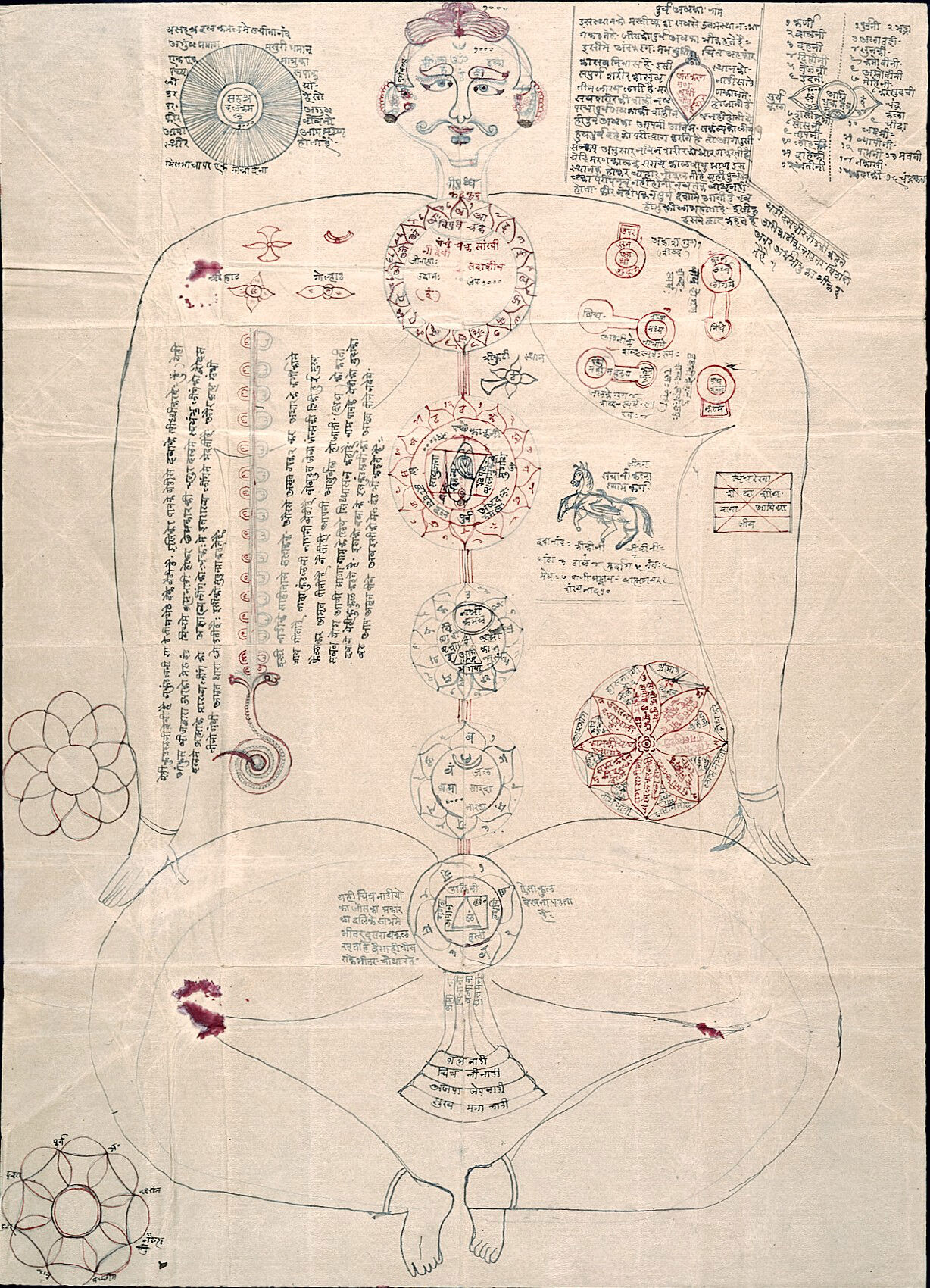
Indic Manuscript 347, side a, artist and date unidentified. Seven centers, channels, symbols, and bodily correspondences form an operative anatomy. They organize transformation rather than supply a second visible skeleton. Click to open the full image.
Tibetan Vajrayāna
Tibetan completion-stage practices organize channels, winds, drops, centers, image, breath, and attention. Winds gather into the central channel. Ordinary conceptual construction releases, allowing recognition of clear-light awareness. The Buddhist end is awakening without a permanent self. It differs from perfecting an immortal personal energy body or arranging a modern chakra ladder.
Daoist Inner Alchemy
Daoist inner alchemy refines jing, qi, and shen: essence, energy, and spirit. It organizes dantians and channels, reverses ordinary dispersal, and cultivates an embryo or transformed body able to return to the Dao. Body and cosmos change together. Gestation and refinement identify this operation more closely than opening seven psychological centers. Chinese medical channels and organs belong to an adjacent tradition. Their use alone does not establish inner alchemy.
Sufi Laṭāʾif
Sufi orders cultivate laṭāʾif, subtle faculties or organs of perception and character. Remembrance, discipline, transmission, and grace awaken them. Their number, color, placement, and sequence vary among orders. Their test is purified personhood and deeper receptivity to God. Energetic intensity supplies no equivalent test, and Islamic chakras would erase their distinct operation.
Kabbalistic Bodies
Kabbalistic anthropology describes grades of soul, garments, and worlds. Later material especially develops the tzelem as a mediating spiritual configuration. The sefirot can structure the human microcosm. The Tree of Life did not begin as a chakra diagram. Soul grades, garments, and mediating form supply the closest subtle-body bridge; a direct sefirah-to-gland mapping cannot establish their historical identity.
Neoplatonic, Hermetic, and Christian Bodies
Late Platonism describes the ochēma-pneuma, a vehicle of soul. Thinkers differ about its constitution and persistence after death. The classical Hermetica describe an ensouled cosmos, spiritual rebirth, and a body of powers. Later occult and Theosophical synthesis substantially supplies the familiar etheric, astral, mental, and causal stack.
Paul’s psychikos and pneumatikos bodies belong first to resurrection. They do not identify two simultaneous aura layers. Christian tradition also develops glorification, the nous and heart, ascetic transfiguration, and perception of divine light. These make salvation an embodied path. They do not document an ancient seven-layer aura.
The traditions agree that embodiment has depths beyond ordinary anatomy. They differ about those depths, what moves through them, how transformation occurs, and what survives it. The differences belong to the evidence as fully as the shared depth.
Aura, Hara, and Core
Barbara Brennan produced a systematic modern healing cartography. Hands of Light organizes seven auric levels. Light Emerging distinguishes physical body, aura, hara, and core star. Aura describes patterned state and relation; hara describes intention becoming organized action. Core star describes being before defense and role.
This map performs useful work without becoming universal anatomy. Brennan identifies fear, denial, defensive contraction, and relational agreements that preserve familiar wounds. Aura layers, hara alignment, core-star perception, disease forms, and treatment claims carry different evidentiary weights. Her dedicated page preserves the complete source and clinical boundary.
Healing and the Problem of the Carrier
Healing moves through touch, attention, prayer, breath, attachment, expectation, symbolic authority, meaning, and the healer’s regulated presence. Biofield traditions describe influence crossing beyond ordinary contact. The mixed clinical and blinded record belongs in Evidence. Its limits cannot empty the encounter; confidence cannot substitute for perception.
Kirlian images record corona discharge shaped by moisture, pressure, voltage, grounding, and processing. An aura instrument must recover something beyond these effects. The subtle body is first encountered through living interior and relation. A photograph cannot establish its own ontology.
The Nonlocal Layer
The nonlocal layer carries information or influence beyond ordinary routes. Morphic resonance, telepathy, remote viewing, and distant healing name different crossings of that boundary. Voice, gaze, shared environment, expectation, imitation, biology, institution, ritual, and archive already provide powerful coupling. Their contribution must be distinguished before attributing a result to another carrier.
Information surviving those controls remains consequential. A blinded transfer can reveal a real capability while leaving its carrier unresolved. Consciousness Primacy requires no weak magnetic, photonic, or quantum decoration. Consciousness is the field within which measurement and subtle perception appear. The route between addresses remains a question within that field.
Correspondence Without Collapse
Five layers interact within one instrument while retaining different identities. Bioelectric patterns organize living form; interoception makes physiological state available to experience. Traditional maps train attention and transformation. Clairvoyant maps report structured perception beyond ordinary sensory consensus. Nonlocal research tests whether specific information crosses the remaining boundary. Evidence passes between layers through a demonstrated bridge.
Reduction forces every chakra into a nerve plexus and every vision into autonomic noise. Inflation makes a measured picotesla field prove telepathy, aura colors, or distant healing. Both erase the architecture they claim to explain. Consciousness becomes embodied through nested relations. Those relations can be perceived, trained, damaged, healed, and extended.
The torus gives these relations a dynamic form. Sensation becomes attention, attention becomes intention, and intention becomes action. Action returns through memory, relationship, and changed physiology. Holography supplies an informational image: each local center participates in patterns larger than itself. This correspondence guides practice and interpretation without making every map a second anatomy or every field image proof of a hidden carrier.
The published record supplies a floor. Instruments detect the signals they were built to detect. Their methods bracket ontology, meaning, initiation, and many kinds of first-person discrimination. Spiritual traditions map those neglected domains. Specific claims allow comparison, repetition, and testing, increasing the maps’ authority.
Practice and Sovereignty
Direct observation begins subtle-body work. What is sensed, and where? What changes with breath, posture, attention, image, relationship, or environment? Which effects persist after practice? Which interpretation came from experience, and which came from the teacher?
Practice aims to increase range. A useful practice strengthens feeling without flooding, action without compulsion, reception without submission, and discrimination between signal and interpretation. Boundary Sovereignty applies throughout the instrument. A healer, device, entity, or doctrine that produces dependency has captured the interface it claims to repair.
The subtle body joins body, feeling, image, intention, relation, and spirit in one operative field. It includes physical organization and exceeds a metaphor for emotion. It also exceeds a second object imagined behind the skin. The physical record reveals part of the interface; practice reveals its interior. Discernment governs what crosses between them.
References
The Holy Bible, King James Version. 1 Corinthians 15:44.
Olivelle, Patrick, trans. The Early Upanishads. Oxford University Press, 1998. Taittirīya Upaniṣad 2.
Mallinson, James, and Mark Singleton, eds. Roots of Yoga. Penguin Classics, 2017.
Woodroffe, John, trans. The Serpent Power. Ganesh & Co., 1919.
Samuel, Geoffrey. The Origins of Yoga and Tantra. Cambridge University Press, 2008.
Despeux, Catherine. “The Body Revealed.” In Taoist Meditation and Longevity Techniques, edited by Livia Kohn. University of Michigan, 1989.
Corbin, Henry. Spiritual Body and Celestial Earth. Princeton University Press, 1977.
Brennan, Barbara Ann. Hands of Light. Bantam, 1987.
Brennan, Barbara Ann. Light Emerging. Bantam, 1993. Official description.
Durant, Fallon, et al. “Long-Term, Stochastic Editing of Regenerative Anatomy via Targeting Endogenous Bioelectric Gradients.” Biophysical Journal 112, no. 10 (2017): 2231–2243. doi:10.1016/j.bpj.2017.04.011.
Levin, Michael, Giovanni Pezzulo, and Joshua M. Finkelstein. “Endogenous Bioelectric Signaling Networks: Exploiting Voltage Gradients for Control of Growth and Form.” Annual Review of Biomedical Engineering 19 (2017): 353–387. doi:10.1146/annurev-bioeng-071114-040647.
Allen, Micah, et al. “Functions of Interoception: From Energy Regulation to Experience of the Self.” Trends in Neurosciences 44, no. 1 (2021): 29–38. doi:10.1016/j.tins.2020.09.002.
Giannino, Giuseppe, et al. “The Intrinsic Cardiac Nervous System: From Pathophysiology to Therapeutic Implications.” Biology 13, no. 2 (2024): 105. doi:10.3390/biology13020105.
Roth, Bradley J. “The Magnetocardiogram.” Biophysics Reviews 5, no. 2 (2024): 021305. doi:10.1063/5.0201950.
Pospíšil, Pavel, Ankush Prasad, and Marek Rác. “Role of Reactive Oxygen Species in Ultra-Weak Photon Emission in Biological Systems.” Journal of Photochemistry and Photobiology B 139 (2014): 11–23. doi:10.1016/j.jphotobiol.2014.02.008.
Rosa, Linda, Emily Rosa, Larry Sarner, and Stephen Barrett. “A Close Look at Therapeutic Touch.” JAMA 279, no. 13 (1998): 1005–1010. doi:10.1001/jama.279.13.1005.
Sprengel, Meredith L., et al. “Biofield Therapies Clinical Research Landscape: A Scoping Review and Interactive Evidence Map.” Journal of Integrative and Complementary Medicine 31, no. 5 (2025): 406–430. doi:10.1089/jicm.2024.0773.
National Center for Complementary and Integrative Health. “Reiki.” National Institutes of Health.
Sheldrake, Rupert. A New Science of Life. J. P. Tarcher, 1981.
Indic Manuscript 347, side a. Artist and date unidentified. Wellcome Collection, CC BY 4.0. Object record.